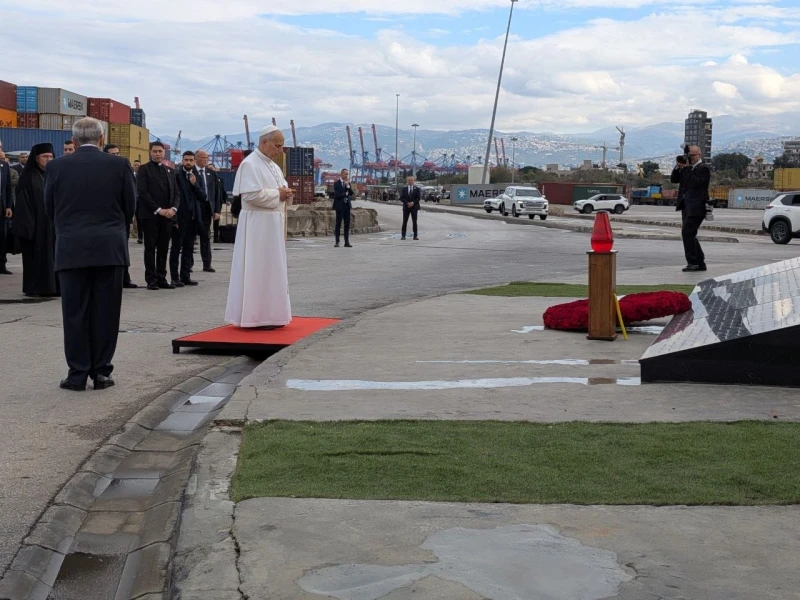
Pope Leo XIV prays in silence at the site of the 2020 port explosion in Beirut, Lebanon, on December 2, 2025. / AIGAV Pool
Beirut, Lebanon, Dec 2, 2025 / 03:15 am (CNA).
Pope Leo XIV paused on the final morning of his trip to Lebanon before the ruins of the Beirut port explosion, praying in silence and placing a wreath in memory of the victims. He also met families of those killed and survivors still carrying the wounds of the 2020 blast.
The pope lit a candle and laid down a wreath of red flowers at the site, and seemed at one point to hold back tears. Afterwards, he spoke with family members of victims, some of whom who were holding photographs of their relatives killed in the blast.
The pope’s silent prayer at the port unfolded against an unresolved search for justice, a grief still felt across Lebanon.
Five years after the August 4, 2020 explosion, one of the largest non-nuclear blasts in history, families of the 236 people killed and more than 7,000 wounded say they are still waiting for truth and accountability. Vast neighborhoods of Beirut were shattered, yet justice remains elusive. Lebanese Prime Minister Nawaf Salam greeted the pope at the site.
Lebanon’s investigation has been marked by political interference and long periods of inactivity. Although the probe formally resumed in 2025 after a two-year halt, it remains stalled. Successive governments have failed to ensure an independent and impartial process, leaving families of victims facing what they describe as a prolonged denial of justice.
Several senior officials summoned by lead investigative judge Tarek Bitar have resisted cooperation, invoking immunity or filing legal challenges that repeatedly froze the inquiry.
Some movement returned in early 2025. Judge Bitar resumed work in February after new public commitments by President Joseph Aoun and Prime Minister Salam to uphold the rule of law. The following month, interim top prosecutor Jamal Hajjar reversed earlier measures that had paralyzed the investigation. A number of figures, including former Prime Minister Hassan Diab and Major General Abbas Ibrahim, responded to summonses, while others, including members of parliament, continued to refuse cooperation.
If you value the news and views Catholic World Report provides, please consider donating to support our efforts. Your contribution will help us continue to make CWR available to all readers worldwide for free, without a subscription. Thank you for your generosity!
Click here for more information on donating to CWR. Click here to sign up for our newsletter.
Vatican City, Oct 28, 2017 / 10:36 am (CNA/EWTN News).- In a lengthy speech to civil and ecclesiastical leaders of Europe on Saturday, Pope Francis defended the family as being made up of a man and woman open to life – saying that this fundamenta… […]
Pope Francis greets thousands of children and their families as he makes his way through St. Peter’s Square during the first World Children’s Day, Saturday, May 26, 2024. / Credit: Daniel Ibañez/CNA
Vatican City, May 26, 2024 / 13:15 pm (CNA).
After an exuberant kick-off event on Saturday for the first World Children’s Day, Pope Francis gathered together with tens of thousands of children in St. Peter’s Square for Mass on this feast of the Holy Trinity. A piercing early summer sun moved everyone — from nuns to the boys’ choir — to shade their heads with colorful hats.
Thousands gather in St. Peter’s Square in Rome on Saturday, May 26, 2024, for the first World Children’s Day with Pope Francis. Credit: Daniel Ibañez/CNA
The creation of a World Children’s Day was announced by the pope on December 8, 2023, at the midday Angelus. The idea for it was suggested to the pope by a 9-year-old boy in an exchange shortly before World Youth Day in Lisbon.
Among the special guests at the Mass was Italian Prime Minister Giorgia Meloni, who together with her daughter Ginevra, met the Pope briefly before the Mass.
With this first event complete, Francis announced at the end of the festivities today that the next World Children’s Day will be held in September 2026.
Among the special guests at the Mass for the first World Children’s Day was Italian Prime Minister Giorgia Meloni, who together with her daughter Ginevra, met the pope briefly before the Mass on Saturday, May 26, 2024. Credit: Daniel Ibañez/CNA
The One who accompanies us
The Holy Father, smiling and clearly happy to be surrounded by children, completely improvised his homily, making it a brief and memorable lesson on the Holy Trinity.
“Dear boys and girls, we are here to pray together to God,” he began. But then counting on his fingers and enumerating, Father, Son, and Holy Spirit, he asked, “But how many gods are there?”As the crowd answered “one,” the pope praised them and started talking of each of the Persons of the Holy Trinity.
He began with God the Father — “who created us all, who loves us so much” — asking the children how we pray to him. They quickly answered with the “Our Father.”
Pope Francis went on to speak of the second person of the Trinity, after the children called out his name — Jesus — as the one who forgives all of our sins.
When he got to the Holy Spirit, the pope admitted that envisioning this person of the Trinity is more difficult.
“Who is the Holy Spirit? Eh, it is not easy …,” he said.
“Because the Holy Spirit is God, He is within us. We receive the Holy Spirit in Baptism, we receive Him in the Sacraments. The Holy Spirit is the one who accompanies us in life.”
Using this last phrase, the Pope invited the children to repeat the idea a number of times: “He is the one accompanies us in life.”
“He is the one who tells us in our hearts the good things we need to do,” the Pope said, having the kids repeat the phrase again: “He is the one who when we do something wrong rebukes us inside.”
The pope speaks to thousands of children and many others who gathered in St. Peter’s Square on Saturday for the first World Children’s Day on the feast of the Holy Trinity. May 26, 2024. Credit: Daniel Ibañez/CNA
The pope ended the homily thanking the children and also reminding them that “we also have a mother,” asking them how we pray to her. They answered “with the Hail Mary.” The pope encouraged them to pray for parents, for grandparents, and for sick children.
“There are so many sick children beside me” he said, as he indicated the children in wheelchairs near the altar. “Always pray, and especially pray for peace, for there to be no wars.”
Applauding the grandparents
The pope frequently urges young people to seek out their grandparents, and the give-and-take of his homily gave the impression of a beloved grandpa surrounded by his grandkids. He insisted that the kids quiet down for the time of prayer.
When the Mass concluded, and after praying the midday Angelus, the pope summarized the lessons of the homily: “Dear children, Mass is over. And today, we’ve talked about God: God the Father who created the world, God the Son, who redeemed us, and God the Holy Spirit … what did we say about the Holy Spirit? I don’t remember!”
The children needed no further invitation to answer loudly that “the Holy Spirit accompanies us in life.” Joking that he couldn’t hear well, the Pope had them say it again even louder, and then prayed the Glory Be with them.
Pope Francis speaks with a group of children in St. Peter’s Square in Rome during the first World Day of Children on Saturday, May 26, 2024. Credit: Daniel Ibañez/CNA
The pope also asked for a round of applause for all the grandparents, noting that at the Presentation of the Gifts, a grandfather had accompanied a group of children who brought forward the bread and wine.
Dreaming and dragons
After the closing procession, Italian actor Roberto Benigni took the stage for a lively and inspirational monologue that combined good humor and life lessons.
While Benigni is known especially to the English-speaking world for his role in Oscar-winning Life is Beautiful, in Italy he’s also known for his commentaries on important issues, combined with his exuberant humor.
“When I was a boy, I wanted to be pope,” he told the audience.
Urging the children to read — “Kids need to read everything!” — he paraphrased G.K. Chesterton who insisted that fairy tales are important: “Fairy tales do not tell children the dragons exist. Children already know that dragons exist. Fairy tales tell children the dragons can be killed,” Chesterton said.
Italian actor Roberto Benigni speaks at the World Children’s Day in St. Peter’s Square at the Vatican. He took the stage for a lively and inspirational monologue that combined good humor with a call for children to read and to dream. Credit: Daniel Ibañez/CNA
“Dream!” Benigni urged the children. “It’s the most beautiful thing in the world. But I want to tell you a secret. You’ll tell me you know how to dream; you’ll say you just have to close your eyes, sleep, and dream. … No, no. I’ll tell you a secret — to dream, you don’t have to close your eyes. You have to open them! You have to open your eyes, read, write, invent.”
The actor emphasized the need to be peacemakers, saying that the Sermon on the Mount contains “the only good idea” that’s ever been expressed. War is the “most stupid sin,” he lamented.
“War must end,” Benigni insisted, going on to quote a famous author of children’s literature. “You will tell me: That is a dream, it is a fairy tale. Yes, it is, but as Gianni Rodari said, ‘Fairy tales can become reality, they can become true!’”
Vatican City, May 10, 2017 / 03:04 am (CNA/EWTN News).- The Jesuit director of the Vatican Observatory, who has worked as an astronomer and planetary scientist at the Vatican for more than 20 years, told journalists Monday that faith and reason are hardly at odds.
“If you have no faith in your faith, that is when you will fear science,” Brother Guy Consolmagno, S.J., said May 8.
Presser w/ Br. Guy Consolmagno (@specolations) & col. on Vatican conference on Black Holes, Gravitational Waves & Space-Time Singularities pic.twitter.com/Q8FYJMD2y5
“The Vatican Observatory was founded in 1891 by Pope Leo XIII to show that the Church supports good science, and to do that we have to have good science,” Br. Consolmagno said, explaining the reasoning behind the conference.
The hope is that the encounter will foster good science, good discussion, and even friendship. Among the speakers will be a Nobel Prize winner in physics and a Wolf Prize winner.
Among the topics of papers being presented at the conference are Strong evidence for an accelerating universe; Black hole perturbations: a review of recent analytical results; and Observing the Signature of Dynamical Space-Time through Gravitational Waves.
“Those of us that are religious, will recognize the presence of God, but you don’t have to make a theological leap to search for the truth,” Br. Consolmagno said. “There are many things we know we do not understand. We cannot be good religious people or scientists if we think that our work is done.”
The summit is also taking place in recognition of Fr. Georges Lemaître, the Belgian physicist and mathematician who is widely credited with developing the “Big Bang” theory to explain the origin of the physical universe.
Addressing common misconceptions surrounding the Big Bang, such as the idea that it did away with the need for a creator, Br. Consolmagno said the solution isn’t just to put God at the beginning of things and call that good, either.
“The creative act of God is not something that happened 13.8 billion years ago,” he said. “God is already there before space and time exist. You can’t even say ‘before’ because he is outside of time and space.”
The creative act is happening continuously: “If you look at God as merely the thing that started the Big Bang, then you get a nature god, like Jupiter throwing around lightning bolts.”
“That’s not the God that we as Christians believe in,” he went on. “We must believe in a God that is supernatural. We then recognize God as the one responsible for the existence of the universe, and our science tells us how he did it.”
The organizer of the conference, Fr. Gabriele Gionti, S.J., said Fr. Lemaître always distinguished between the beginnings of the universe and its origins.
“The beginning of the universe is a scientific question, to be able to date with precision when things started. The origins of the universe, however, is a theologically charged question.”
Answering that question “has nothing at all to do with a scientific epistemology,” he added.
Br. Consolmagno commented that “God is not something we arrive at the end of our science, it’s what we assume at the beginning. I am afraid of a God who can be proved by science, because I know my science well enough to not trust it!”
“An atheist could assume something very different, and have a very different view of the universe, but we can talk and learn from each other. The search for truth unites us.”
He suggested that to demonstrate that the Church and science are not at odds, those who are both church-goers and scientists should make that fact more known to their fellow parishioners.
He threw out some practical ideas, such as setting up a telescope in the church parking lot or leading the parish’s youth group on a nature hike.
The Church, in a sense, developed science through the medieval universities she founded, he explained. For example, Bishop Robert Grosseteste, a 13th century Bishop of Lincoln and chancellor of Oxford University, helped develop the scientific method and was often cited by Roger Bacon.
“If there is a rivalry” between the Church and science, Br. Consolmagno said, “it’s a sibling rivalry.”
“And it’s a crime against science to say that only atheists can do it, because if that were true, it would eliminate so many wonderful scientists.”






Justice and peace are two sides of the same coin. Where there is justice, there is peace – declare prophets in all Scriptures.
Look to Israel for the resources, ability, and sheer ruthlessness to bring about this explosion.
“Never ascribe to malice that which is adequately explained by incompetence.”