

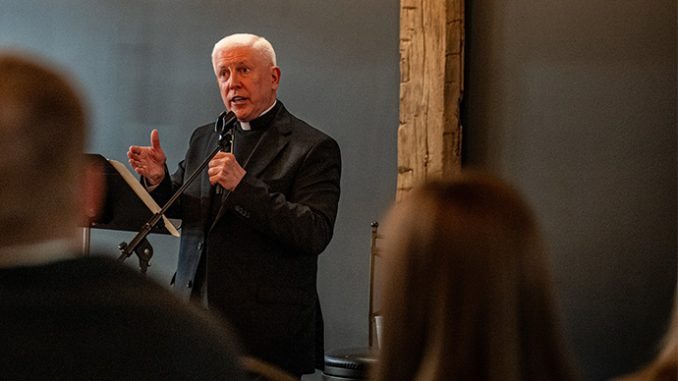
Bishop Daniel E. Thomas, 66, is the eighth bishop of the Diocese of Toledo, Ohio. He is originally from Philadelphia and was ordained a priest for the Archdiocese of Philadelphia in 1985. He lived in Rome for 15 years, working for the Congregation for Bishops (today the Dicastery for Bishops) and serving as spiritual director for seminarians of the North American College.
He returned to the Philadelphia archdiocese to serve as pastor of Our Lady of the Assumption Parish in Strafford in 2005, and the following year was appointed an auxiliary bishop for the archdiocese. He became bishop of Toledo in 2014. Toledo has 70 active priests and 60 retired priests who serve a Catholic population of 320,000.
CWR: What was it like growing up in Philadelphia in the 1960s and 70s?
Bishop Daniel Thomas: Philadelphia is the city of neighborhoods. Mine was Manayunk. I was blessed with an enjoyable childhood and youth. I had two loving parents, married in the Church, who were faithful, practicing Catholics. I had one older brother, Fran. All are deceased now.
It was my great gift to enjoy a Catholic formation in the home. I was taught how to love, I was taught how to forgive, and I was taught the Catholic faith.
I attended Holy Family Parish in Manayunk, and went to the parish school from first through eighth grade. We were taught by the Sisters, Servants of the Immaculate Heart of Mary. We had two classes per grade, and they were large classes. It was a wonderful experience. We were involved in all aspects of the parish and parish life.
My father was a self-made man. He drove oil trucks, then went to engineering school and became a design supervisor. My mom was a homemaker until my later years in grade school, when she did odd jobs, including working as a medical receptionist.
CWR: Why did you want to become a priest?
Bishop Thomas: I’d first point to my parents. They were wonderful witnesses of the Catholic faith, and theirs was a faithful Catholic marriage. They were committed to prayer and their Catholic faith. They took us to Sunday Mass as well as parish devotions, such as the Stations of the Cross. My earliest childhood memories include seeing my mom kneeling at her bedside saying her prayers, and teaching me to do the same.
I also had a wonderful witness from our parish priests. The principal of the local Catholic high school, Msgr. Charles Gallen, who was in residence at our parish, inspired me with his very fine homilies. He was also reverent in his celebration of the Holy Eucharist. I looked up to him. When I was ordained a priest myself, my parents held a reception in their home afterward, which he attended. I remember he asked me for his blessing in front of their home, kneeling in the street. It was very inspiring.
I also recall the witness of our pastor, Fr. Joseph Marley. When I was a boy, you’d see him out in the neighborhood bringing bags of groceries to needy families.
Priests I knew encouraged me. I attended Roman Catholic High School in Philadelphia, and the priest who taught European history told me that I’d look good in basic black: his way of telling me I should be a priest. I also had the encouragement of lay people who said the same; that’s why I always tell lay people, don’t be afraid to identify young men who would make good priests.
CWR: You’ve been a priest for 40 years. How has the life of a priest changed since you were first ordained?
Bishop Thomas: The priest himself has a share in the priesthood of Jesus Christ, so that aspect does not change. But the expression of the priesthood can change according to history and culture. I grew up in a time when there were many priests living in the parish, and few lay people were involved in the work of the parish. That is different today.
CWR: What surprises have you had as a priest?
Bishop Thomas: One of the most striking things that comes to mind is when I became Bishop of Toledo, hearing my name spoken in the Eucharistic prayer at every Mass throughout the diocese.
Bishop Thomas: There are also many unexpected moments of grace. They may occur while preaching, responding to parishioners’ needs, or ministering to the dying. It is not my own power or strength but the Lord using me for his intentions.
CWR: What advice might you offer a newly ordained man?
Bishop Thomas: Be yourself. Compare yourself to yourself, not to others. Maintain a faithful discipline of prayer so that you can love the people.
CWR: You spent 15 years working in Rome. What did you do there, and what did you learn?
Bishop Thomas: It was an extraordinary experience, working at the heart of the Church. At the Congregation for Bishops, we assisted with everything dealing with the office of bishop and the pastoral care of bishops. We received information from bishops and presented candidates for the episcopacy. We also assisted with the quinquennial [ad limina, every five years] visits by bishops to the Holy See.
I enjoyed the profound witness of Pope St. John Paul II, who died the last year I was there. Although I had infrequent contact with him, I was able to concelebrate Mass with him in his private chapel. He used my chalice and patens, which makes them third-class relics. He had the extraordinary capacity to offer Mass in a pastoral, spiritually attentive way, whether he was with 20 people in his chapel or at an outdoor Mass with millions. He also had the ability, when meeting with you personally, to give his full attention to you as if you were the only person in the room.
I was present at John Paul’s funeral, as well as his canonization.
CWR: When you returned to Philadelphia, you were the first non-Italian pastor in the history of Our Lady of the Assumption Parish in Strafford.
Bishop Thomas: The joke was that I was the first pastor whose name did not end in a vowel. I was also one of the few pastors who actually spoke Italian. At my first Mass, I offered a greeting in Italian, and people were so excited that they began waving at me. I remember two older Italian widows talking, with one telling the other, “He’s the son of immigrants from Ireland and Germany, and he speaks better Italian than you do.”
CWR: What was your reaction to being named a bishop?
Bishop Thomas: I was shocked, surprised, overwhelmed, and spiritually challenged. I was sitting at my desk at Our Lady of the Assumption when Cardinal Justin Rigali [Archbishop of Philadelphia 2003-11] called. He asked me if I could come for dinner. I said that I had a parish finance council meeting and asked if I could come the following day. He replied, “Can you come over now?” I wondered if I was in trouble!
CWR: What is the Diocese of Toledo like?
Bishop Thomas: The Diocese of Toledo is made up of every iteration you could have in terms of population and economics. We have inner city parishes, suburban parishes, rural parishes and very rural parishes. We have lots of farming; 65% of the diocese is rural. The Diocese of Toledo is much larger than the City of Toledo alone; Toledo is just a small portion of it.
CWR: How is the Diocese of Toledo doing for vocations to the priesthood?
Bishop Thomas: We’re doing well, but we don’t have half the priests we need. We have 14 seminarians, but things are headed in the right direction. Two years ago, we accepted one man for formation. Last year, we accepted four. This year we have five, an unheard of number before Christmas, and could get as many men as ten. So, the number is increasing.
We have a full-time vocations director, who has revitalized our Andrew dinner program, in which we have supper with young men considering the priesthood. We also have Quo Vadis [“Where are you going?”] retreats for our high school boys. They last three days; I came, and 30 young men were participating. We have two traveling chalices in the diocese, which encourage vocations. We also have a Walk for Vocations, a new initiative. Three of our younger priests walked miles on pilgrimage to raise awareness of vocations.
CWR: How do you think the Church can do a better job of evangelization? Is there a particular approach you use in Toledo?
Bishop Thomas: Evangelization is the work of all of us. It is part and parcel of everything we do. A young person once asked me: What is the New Evangelization? I responded, “What’s new is you. Evangelization starts with each one of us.”
Evangelization is part of our diocesan prayer. We pray for holy disciples, families, and vocations. That triad is key to evangelization in our diocese. If we’re working as individuals to be holy disciples, and if we’re forming holy families, we’ll generate holy vocations.
CWR: Are there any specific Catholic evangelism organizations or programs you like?
Bishop Thomas: I like the work of the FOCUS missionaries and the Culture Project. These are made up of young people who share the Gospel. We also founded a young Catholic professionals group and make use of the Franciscan at Home program. Some prominent people who I think are effective include Fr. Mike Schmitz and Bishop Robert Barron.
CWR: You released a pastoral letter in 2025: “The Body Reveals the Person: A Catholic Response to the Challenges of Gender Ideology”. Why did you think there was a need for this document?
Bishop Thomas: Faithful Catholics expressed to me their anxiety about the uncertainties of our time. They had concerns about members of their own families or communities who were caught up in gender ideology. The letter was an effort to help those in my diocese to navigate the reality of gender ideology, and to do so in a way that was accessible, readable and digestible.
I worked with others in regard to writing, editing, and artwork; it was published at the time of the Minneapolis Catholic school shooting and just before Charlie Kirk was shot. It was not my timing, but God’s. There was a bit of tension to it; some friends in the media commented on this.
Although I had intended it for my flock, other bishops have been using it in their dioceses, and it has been translated into different languages. I’m grateful it can serve the broader Church.
CWR: Transgenderism was exceedingly rare a generation or two ago, but seems to be widespread today. Is this a media-generated phenomenon?
Bishop Thomas: I wouldn’t blame it on the media but on the culture. I never heard of gender confusion when I was growing up. I think it has been a series of things—when two people of the same sex can enter into a relationship that the law recognizes as marriage, the breakdown of the family, the absence of fathers in the home—all have played a role in leading us to the place we are at this moment.
CWR: What should a person do who has a loved one who has been adversely affected by gender ideology?
Bishop Thomas: Read my document! One has to be informed about what Christ teaches about the human body, about respect for human dignity, and that God created us male and female. God did not intend transgenderism. We should not try to change our God-given identity. We must receive and embrace who we are, even if this means we must embrace the Cross.
CWR: If a biological male who identifies as a woman wants to use “she/her” pronouns, should we oblige?
Bishop Thomas: As I say in my document, we respect the human person too much not to share the truth. We have to lead people to the truth. Using these pronouns does not respect the person’s humanity. We want to love them as they are loved by God. While it may be a great struggle, we should respect them too much to lead them down the path of confusion.
CWR: You’re the USCCB chairman of the Committee on Pro-Life Activities. What do you think would be a good route to go forward in the upcoming years?
Bishop Thomas: Science has certainly assisted us. Ultrasound images, for example, give us a glimpse into the womb so that we can see that yes, this is human life. I’m impressed with the pro-life commitment of many of our young people who declare, “I am the pro-life generation.” We’re certainly grateful for the Dobbs decision, which allows for the regulation of abortion, but we’ve had an uphill battle in some states.
We have the compelling testimonies of those who have been touched by the reality of abortion. And in our dioceses, we have programs such as Project Rachel, which helps women heal from abortion, and Walking with Moms in Need, a parish-based effort to assist women in crisis pregnancy situations.
CWR: Who are some Catholics you admire?
Bishop Thomas: I have a broad circle of friends whom I believe are saints in heaven. This may be 15 or 20 people. But there are two canonized saints that I have met in life several times, Pope John Paul II and Mother Teresa. I was present at both their canonizations. They were two extraordinary people.
If you value the news and views Catholic World Report provides, please consider donating to support our efforts. Your contribution will help us continue to make CWR available to all readers worldwide for free, without a subscription. Thank you for your generosity!
Click here for more information on donating to CWR. Click here to sign up for our newsletter.

Thank you,Jim, for introducing us to another good Bishop.
I don’t like the term: saying the Mass, offering the Mass would be more appropriate.
Yup, absolutely correct. It’s little details like that are so telling about larger things.
Doesn’t everyone present “offer the Mass”? Or is it just the priest? If everyone offers then Mass, and the Bishop is referring to himself as the one saying the prayers, then I can understand that he would use a verb like “saying”.
If on the other hand, you believe that only the priest offers the Mass and every one else just witnesses it, then your comment makes sense.
OK fine, sounds like a good man. Looks like he values bringing souls to Christ by calling sin a sin and grace, grace.
With any luck, he keeps altar rails in place and might even give a slight nod to the Tridentine Mass of the ages.
All the best to him.
I continue to pray for more holy priests.
Some excerpts and my comments…
CWR: How is the Diocese of Toledo doing for vocations to the priesthood?
Bishop Thomas: We’re doing well, but we don’t have HALF OF THE PRIESTS we need. We have 14 seminarians, but things are headed in the right direction. Two years ago, we accepted one man for formation. Last year, we accepted four. This year we have five, an unheard of number before Christmas, and could get as many men as ten. So, the number is increasing.
CWR: How do you think the Church can do a better job of evangelization? Is there a particular approach you use in Toledo?
I must disagree, given the entire world picture of a significant decrease in vocations.
Catholicexchange.com: The US Catholic Church is facing an urgent challenge: the number of priests is declining at an alarming rate. The number of active priests in the US has plummeted from 58,000 in 1970 to fewer than 35,000 today, even as the Catholic population grew by 20 million. At the current rate, by 2030 some areas may only have one priest for every 6,000 Catholics, forcing parishes to close or merge.
Have we seen a true evangelist recently? Are they also in decline? I see an answer… Holy Women Priests will fill that critical gap!
https://catholicexchange.com/taking-on-the-vocation-crisis-restoring-public-perception-of-the-priesthood/
Holy women priests?
Mr. Morgan, have you considered the fate of denominations that ordain women? It’s basically a plan for religious extinction.
It’s refreshing and inspiring to read the words of a bishop who answers questions with clarity and directness. I admire individuals who aren’t afraid to speak the truth.
Thank you for a great article!
Mrs… I refrain from using compartmentalizations. Interesting that you say our “Church will be on a path to religious extinction.” That very expression shows a lack of hope. Other faiths show a decline in leaders and parishioners for various reasons.
Pew research: Catholics – Changing societal attitudes towards religion and authority affect the perception of the priesthood.
Some priests cite personal dissatisfaction, burnout, or a desire for family life as reasons for leaving.
Ongoing scandals, particularly related to sexual abuse, have eroded trust in the clergy. This has led some priests to reconsider their roles within the Church. Economic challenges faced by parishes can lead to job insecurity for priests. Some priests leave due to frustrations with administrative structures or a lack of support.
I would add… the lack of spiritual guidance from Catholic parents. Jesus, not Santa, Lack of teaching Nuns, Deacons and Brothers.
My family were parishioners in St. John’s in Kingston, New York. My sons were to attend St. Coleman’s High School. Both are now closed.
On ordained women. My continuing search for a solid reason why women are excluded from the priesthood remains truly vague. The following URL reveals the stupid mythological reasons. I still hold that women are the heavy lifters of society. They are truly seen as second-class by the Church. To “seal” the search for ordained women was made when Pope Francis concluded that on women deacons: ‘Holy orders is reserved for men’. The discussion is now “off the table”.
CNA-
https://search.yahoo.com/search?fr2=p%3ads%2cv%3aomn%2cm%3asa%2cbrws%3achrome%2cpos%3a1&fr=mcafee&type=E210US0G0&p=why+does+the+catholic+hierarchy+refuse+to+ordained+women
“My continuing search for a solid reason why women are excluded from the priesthood remains truly vague.”
That’s too bad. Maybe you should read clear teaching and sound doctrine. Here’s a short list:
• (October 15, 1976)
• St. Pope John Paul II’s “Ordinatio Sacerdotalis” (May 22, 1994)
• The Authority of Women in the Catholic Church by Monica Migliorino Miller
• The Catholic Priesthood and Women: A Guide to the Teaching of the Church by Sister Sara Butler
• Women in the Priesthood? A Systematic Analysis in the Light of the Order of Creation and Redemption by Fr. Manfred Hauke
Carl. Thank you for directing me. I read much of the following extensive declaration with some hard to fathom liturgical text. If one can fully define the real conclusion, I cannot. The history of the Reformation seems to be used as a “starting” point for Holy Orders for women. I will continue to find a crisp conclusion. Carl, you might help me by excerpting wording for this novice. I see no mention of the old references of Jesus selecting only men for his Last Supper. Or the “fact” that the priesthood is not allowed since the Church is a woman (Mother Church).
SACRED CONGREGATION FOR THE DOCTRINE OF THE FAITH
DECLARATION
INTER INSIGNIORES
ON THE QUESTION OF ADMISSION OF WOMEN
TO THE MINISTERIAL PRIESTHOOD. For some years now various Christian communities stemming from the sixteenth-century Reformation or of later origin have been admitting women to the pastoral office on a par with men. This initiative has led to petitions and writings by members of these communities and similar groups, directed towards making this admission a general thing; it has also led to contrary reactions. This therefore, constitutes an ecumenical problem, and the Catholic Church must make her thinking known on it, all the more because in various sectors of opinion the question has been asked whether she too could not modify her discipline and admit women to priestly ordination. A number of Catholic theologians have even posed this question publicly, evoking studies not only in the sphere of exegesis, patrology and Church history but also in the field of the history of institutions and customs, of sociology and of psychology. The various arguments capable of clarifying this important problem have been submitted to a critical examination. As we are dealing with a debate which classical theology scarcely touched upon, the current argumentation runs the risk of neglecting essential elements.
——————————————————————————
“Therefore, as we read elsewhere in Holy Scripture, God saw “ALL” that he had made, and it was very good” (Gen. 1:31).
“God’s plan gives first place to discrimination based upon sex.”
Mr Morgan, my comments were that every denomination that ordains women is on a path to extinction. Not our Church , thankfully. Women priests are not a path of hope but a death wish for any church.
The only parts of Calvinist and Anglican churches that are stable or growing are the traditional ones who have rejected ordained women, same sex unions, etc. and who hold on to biblical teachings on marriage and family. That model works.
morganD: Maybe you should try something other than vagueness in your “search.” Perhaps try a more honorable attempt at learning what Catholicism teaches.
Perhaps you might also consider that there might be meaning to the fact of shared delusional dishonesty among women promoting their own ordination when very close to a hundred percent of them also believe in such things as slaughtering the inconvenient unborn. Evil thoughts and values and conclusions drawn from evil thoughts and values are not accidental.
“Evangelization is part of our diocesan prayer. We pray for holy disciples, families, and vocations. That triad is key to evangelization in our diocese. If we’re working as individuals to be holy disciples, and if we’re forming holy families, we’ll generate holy vocations.”
Also, evangelization must be alert to scandal.
The Catholic schools seem to be so expensive that they are serving primarily the upper classes, while the poor are left in the public schools. We run the risk of another scandal if we do not provide “a preferential option for the poor”.