

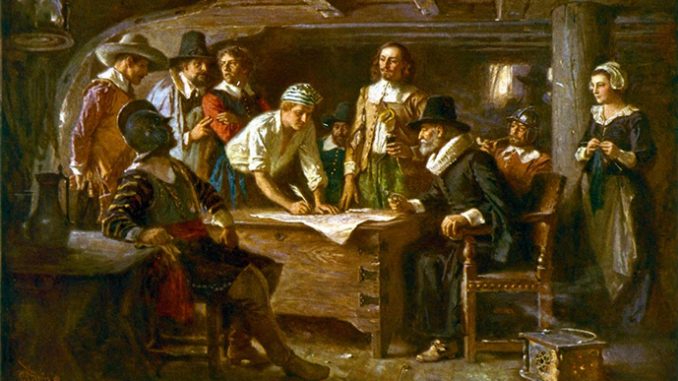
When the Mayflower anchored off Cape Cod in November 1620, its passengers had already accomplished something remarkable. They had survived a perilous Atlantic crossing on a leaky vessel in freezing winds. Yet before they even set foot on the unfamiliar soil of the New World, they performed a second and greater act. They drafted and signed a covenant. In so doing, they established what might be called the moral embryo of American self-government.
The Mayflower Compact was only two hundred words long, but it was weightier than many modern constitutions padded with legal jargon. Its signatories described themselves as “loyal subjects of our dread Sovereign Lord King James,” yet they also declared that they were forming “a civil Body Politick” to enact “just and equal Laws.” In those few lines lay the seeds of a distinctly biblical and covenantal idea: that men could freely bind themselves before God to form a community ordered to justice.
The Compact’s tone was scriptural, though its signers were English separatists rather than theologians. To the Puritan mind, law arose from the moral order established by the Creator and revealed in Scripture. The same God who delivered Israel from Egypt and entered into a covenant at Sinai was believed to have guided them to this new land. They were His people in a new exodus, promising to govern “for the glory of God, and advancement of the Christian faith.”
This was theology applied to political rhetoric. Natural law and divine revelation were woven together in a worldview that assumed man is accountable to a transcendent moral order.
Natural law, classically understood, refers to the rational participation of man in the eternal law of God. As Thomas Aquinas wrote, “the light of natural reason, whereby we discern what is good and what is evil, is nothing else than an imprint on us of the Divine light.”¹ To the Pilgrims, this meant that the laws of their civil body politic must conform to the moral law inscribed in the human heart and revealed through Scripture. Authority, therefore, was covenantal and granted by God and exercised in the service of the common good.
Ironically, many of the same modern critics who accuse early colonists of tyranny ignore that the Mayflower Compact explicitly framed government as an act of mutual consent and moral accountability, understanding that it was divine obligation that authorized their rule.
In historical terms, the Compact carried no legal weight in English law. Yet it carried immense symbolic authority. It was the first self-governing agreement of its kind in the English-speaking world, preceding John Locke’s Two Treatises of Government by nearly seventy years. It demonstrated that political legitimacy could flow from covenantal consent among free men under God. In essence, it was a theological contract that became the philosophical ancestor of the social contract. When the Founders later wrote that governments derive “their just powers from the consent of the governed,” they were merely polishing an idea first expressed aboard the Mayflower.
The Compact’s invocation of religious purpose has led many to misunderstand it. Freedom of religion in the seventeenth century was not relativistic. The Pilgrims sought freedom for truth, not freedom from it. They wished to worship God rightly according to conscience, yet within a Christian moral order. Modern commentators who scoff at this as intolerance forget that freedom of conscience only has meaning if there is a conscience to follow. The Pilgrims’ conception of freedom presupposed an objective moral law to which the conscience is bound. In this, they were closer to the Catholic view of liberty than to the later Enlightenment notion of license.
The Catholic Church, in her own reflection, has spoken of religious freedom in similar terms. The Second Vatican Council’s Dignitatis Humanae affirmed that “the human person has a right to religious freedom,” yet clarified that this freedom means immunity from coercion, not freedom from truth. The Council added that “the exercise of this right cannot be impeded, provided that just public order be observed.”
The Church does not teach that all religions are equally true, only that the human person must be free to pursue the truth without external compulsion. The Mayflower Compact, in its own primitive way, anticipated this principle. Its signers sought the liberty to order their society according to divine law, while acknowledging the limits of human authority.
This covenantal foundation also fostered a spirit of enterprise. The same men who covenanted under God to form a political body soon built farms, schools, and markets. They integrated faith with economic life. Their belief that man was created in the image of a rational Creator encouraged creativity, industry, and stewardship. In this way, covenantal theology quietly gave rise to the American ethic of ingenuity and enterprise. Human flourishing was seen as a duty. The Protestant work ethic may have been their banner, but the principle was older, and it came from the Genesis mandate to “till and keep” the earth.
In contrast, modern critical theories rewrite the genesis of the nation through the lens of oppression and exploitation. They treat every act of founding as an act of violence. To such minds, the Mayflower Compact is not to be viewed as a covenant but a kind of colonial contract of privilege. Yet this interpretation collapses under historical scrutiny because the Pilgrims were refugees from tyranny. Their agreement was voluntary, written in a cramped cabin by weary travelers seeking order and mutual cooperation in a strange land. They came with women and children, with an aspiration to build a godly community while escaping an empire. To interpret their covenant as proto-imperialism is to mistake moral earnestness for malice.
Moreover, the moral framework they established laid the groundwork for later freedoms enjoyed by Catholics, Jews, and dissenters alike. The Mayflower Compact inaugurated a pattern of self-rule that gradually expanded the scope of liberty. The same moral vocabulary that grounded their covenant in justice, equality, consent, and accountability before God, would later be invoked to abolish slavery, defend human rights, and enshrine freedom of worship. Even when the United States eventually separated Church and State, it never divorced morality from law. The logic of natural law and covenantal obligation still lingers in the American conscience, though much of modernity tries hard to forget it.
The debt owed to the Pilgrims is therefore cultural as well as political. They modeled a form of self-government rooted in virtue rather than coercion. They believed that a free people must first be a moral people. As John Adams later remarked, “Our Constitution was made only for a moral and religious People. It is wholly inadequate to the government of any other.”² That conviction was born, in part, in the cramped quarters of the Mayflower. It was there that men bound themselves to obey laws they had yet to write, in a land they had yet to see, under a God they had never ceased to fear.
To read the Compact through contemporary sensibilities is to misunderstand its context. The Pilgrims were righteous for their time, though imperfect. They were men shaped by the feudal remnants of Europe, the fires of the Reformation, and the yearning for conscience unshackled from monarch and bishop alike. They risked everything for an unseen hope. Far from a cynical narrative, they deserve a charitable reading. The civilization that emerged from their moral vision, however evolved today, still bears their imprint.
The modern West owes a debt to these early settlers for proving that self-government is possible when men govern themselves under God. The United States, in turn, owes its moral vocabulary to the covenant that those settlers signed in 1620. It was a small document with lasting consequences. It taught that freedom, law, and faith are inseparable threads of the same moral fabric. When woven together, they form the sturdy garment of civilization. When torn apart, they leave a people naked before the chaos of self-will.
In the end, the Mayflower Compact stands as a reminder that political freedom without moral covenant degenerates into anarchy, and moral covenant without political freedom decays into tyranny. The balance lies in the ancient truth that man is both free and bound—free to choose, bound to the good.
The Pilgrims understood this intuitively. They lived it in faith. Their compact, humble, and brief, became the first American sermon in political form: that men may covenant together under God for justice, liberty, and the flourishing of all.
Endnotes:
¹ Thomas Aquinas, Summa Theologiae, I-II, Q.91, a.2.
² John Adams, Letter to the Massachusetts Militia, October 11, 1798.
If you value the news and views Catholic World Report provides, please consider donating to support our efforts. Your contribution will help us continue to make CWR available to all readers worldwide for free, without a subscription. Thank you for your generosity!
Click here for more information on donating to CWR. Click here to sign up for our newsletter.

On the other hand, part of the “tyranny” in Europe from which the Pilgrims escaped was their grievance against the Anglican high church which, to them, looked too much like the Catholic Mass…
And, the first Thanksgiving in North America was the 1565 Mass at St. Augustine, Florida, half century before the Pilgrims memorialized Plymouth Rock. And, the same Pilgrims were saved from starvation and disappearance (as at the tragic Jamestown) by the English-speaking (!) Native American Squanto—who earlier had been carried off to Europe and after several years had escaped (with the help of two Catholic Franciscan monks) back to his homeland, after first having converted to the Catholic Faith in Spain.
About the U.S. Constitution, with its inseparable preface in the Declaration of Independence, the complex backstory might likely include a Catholic cardinal who died almost the same year that Plymouth was founded. Sylvester J. McNamara proposes and documents that the philosophy of Declaration of Independence derives possibly more likely from the writings of the Jesuit Robert Cardinal Bellarmine (1542-1621) than from, say, even the British John Locke, etc. (“American Democracy and Catholic Doctrine” [Brooklyn: International Catholic Truth Society, n.d., c. 1920], 106-122, esp. 155).
Bellarmine’s writings included tracts against James I and his claim to the “divine right of kings.” The greatest similarity between Jefferson and the original Bellarmine is in the content and exact wording of Jefferson’s five principles in the preamble. These are sovereignty, equality, divine and Natural Law, the right to select magistrates, and the right to change the form of government. McNamara draws from Filmer’s “Patriarcha” (a compendium of Bellarmine’s philosophy). Jefferson’s copy of “Patriarcha” remains in the Library of Congress.
In any event, the complex problem for the future in our now secular-ist (not legitimately secular) and post-Christian setting, is how to witness to Christ and the transcendent dignity of the human person, in public affairs to be made more fully human, while surely adhering to the included and universal natural law as championed by the quoted John Adams (a Unitarian…) who remarked: “Our Constitution was made only for a moral and religious People. It is wholly inadequate to the government of any other.”
Thank you both Marcus Peter and Peter Beaulieu for your insights into our history. We have much to be thankful for in our religious heritage- both Protestant and Catholic. Many good things come out of the Reformation, and the Church benefited from it greatly. Before the Reformation the Church (both clergy and lay) was plagued with rampant corruption and immorality. The Renaissance movement had infiltrated the church and threatened its very foundation. Traditional Christian morality was being broken down. A strong reaction was needed to bring correction and perhaps the biggest reaction was that of the Protestant Reformers. This sparked the counter reformation in the Church and the great Council of Trent. We can thank the Reformers for helping us clean up the Church. Just as we owe much to the Puritans for present form, however imperfect, form of government.
Dr Peter elicits a wonderful sentence from Aquinas, that “the light of natural reason, whereby we discern what is good and what is evil, is nothing else than an imprint on us of the Divine light”.
This natural reason is inherent, prescient knowledge within the soul. It’s Aquinas’ reconciliation of Plato’s Ideas [Plato wasn’t simply an idealist, rather he understood that Man must have this prescient knowledge in order to make identifications in the external world].
Aquinas adds that the natural law within is a reflexion of the eternal law. That ordinance of God that is reflected throughout his creation and available to the human intellect. As such the undergirding of our consciousness of good and evil. The basis of all just law, as Marcus Peter underscores the intent [intent in that Pilgrim justice became oppressive in practice in the New England Colonies] of the Mayflower Compact, a prototype of the US Constitution.
Needed corrections later made by Protestants, Roger Williams, and William Penn, and the Catholic, Lord Baltimore.
I love my country (it’s the only one I’ve ever had). That said, if truth be known America and, then later, the United States of America was founded on a deep-seated loathing for the Catholic Church, its hierarchy, its Sacraments and its tenets. Catholics in the USA have been trying desperately to assimilate into this country and, in the process, have voluntarily surrendered our core beliefs with the hope of being accepted. Guess what? Not only has that project failed but we are hated more than ever as Catholics and have lost our faith as well. Look at Ireland. Look at France. Look at Spain. All very secular and so much hatred for the Catholic Church. We need to stop trying to be loved and instead simply live and speak the Truth. Wasn’t it Christ who told us that they hated Him before they even began hating us?
A debt to a pack of heretics???
Unfortunately the Mayflower colonists endorsed what would become a characteristic of early Enlightenment society; they abolished the distinction between civil society and the Church. For them, their civil society was the Church. This society was the final arbiter of moral law and of Christian belief itself. They viewed their society as countering human nature per se. This social theory is radically opposed to the Catholic one. There is nothing in this worldview to limit the absolute independence of society itself from all universal principles from beyond itself, other than its own contingent “conscience” of what is right and wrong. As Pope Leo XIII wrote, conscience is the light of our intelligence, which can know natural law with certitude. But individuals and civil societies make mistakes. The ultimate arbiter of natural and divine law is the Church. The Puritans were not the Church, but a civil society of believers and their contingent interpretation of the Bible. With nothing to appeal to but themselves, there was no tyranny to which they were not prey. They’ve had a huge impact on today’s society, there’s no doubt about that.