


Washington, D.C. Newsroom, Nov 10, 2025 / 13:25 pm
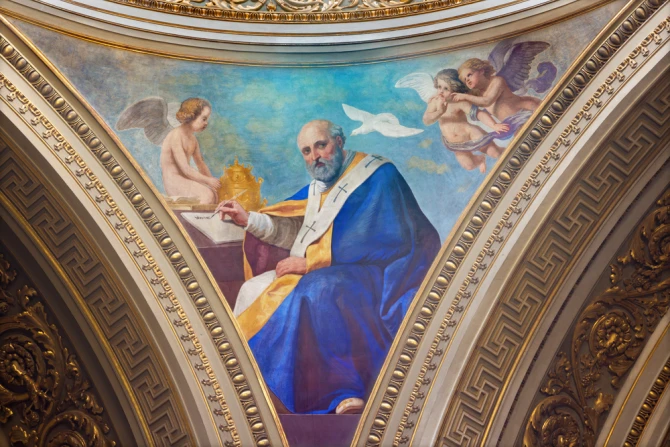
Throughout the last two millennia, the Catholic Church has only granted the title “doctor of the Church” to 38 saints, one of whom we celebrate today on Nov. 10: St. Leo the Great, the 45th bishop of Rome.
Pope Leo I, who was the first pope to be remembered posthumously as “the great,” began his papacy in 440 and served until his death in 461. During his pontificate, he worked to clarify doctrines related to Christ’s human and divine natures.
The pontiff was a “pope-theologian, but he’s also known as a remarkable bishop,” Thomas Clemmons, a professor of Church history at The Catholic University of America, told CNA, adding that “theologian popes are rare.”
St. Leo’s papacy began nine years after the Council of Ephesus, which condemned Nestorius and the heresy of Nestorianism, leading many of Nestorius’ followers to schism. The heresy rejected the close union of Christ’s human and divine natures and rejected the Marian title of “Theotokos,” or God-bearer, claiming that Mary only gave birth to Christ’s human nature.
Rising out of the Nestorian schism were more Christological conflicts over the relationship between Christ’s humanity and divinity. Eutyches, an opponent of Nestorius, went too far in the opposite direction, claiming that Christ’s human and divine natures were fused into one single nature. His human nature, Eutyches claimed, was “dissolved like a drop of honey in the sea.”
This heretical understanding, according to Clemmons, turned Christ into a “third thing” or a “kind of monster” rather than the Catholic understanding of Christ as “one Person” with “complete and true humanity and complete and true divinity.”
To combat Eutyches’ error, Pope Leo wrote a letter to Flavian I, the archbishop of Constantinople, which clarified the hypostatic union of Christ’s distinct human nature and distinct divine nature. The letter, which became known as “Leo’s Tome,” is the pontiff’s most famous work and set the stage for defining Christological doctrines at the Council of Chalcedon in 451.
“Both natures retain their own proper character without loss: and as the form of God did not do away with the form of a slave, so the form of a slave did not impair the form of God,” Pope Leo wrote in the letter.
“From the mother of the Lord was received nature, not faultiness: nor in the Lord Jesus Christ, born of the Virgin’s womb, does the wonderfulness of his birth make his nature unlike ours,” the letter continued. “For he who is true God is also true man: and in this union there is no lie, since the humility of manhood and the loftiness of the Godhead both meet there.”
In emphasizing the fullness of Christ’s human nature in the letter, Leo cites the genealogy of Christ listed in the Scripture, along with his human experiences, particularly suffering and death on the cross: “Let [Eutyches] not disbelieve [Christ is a] man with a body like ours, since he acknowledges [Christ] to have been able to suffer: seeing that the denial of his true flesh is also the denial of his bodily suffering.”
Leo emphasized the words of the Creed when emphasizing the fullness of Christ’s divine nature, stating: “Not only is God believed to be both Almighty and the Father, but the Son is shown to be co-eternal with him, differing in nothing from the Father because he is God from God, Almighty from Almighty, and being born from the Eternal One is co-eternal with him.”
The pontiff bolstered his argument with citations from Scripture that point to the fullness of Christ’s divine nature and the fullness of his human nature.
“To be hungry and thirsty, to be weary, and to sleep, is clearly human,” Leo said. “But to satisfy 5,000 men with five loaves, and to bestow on the woman of Samaria living water, droughts of which can secure the drinker from thirsting any more, to walk upon the surface of the sea with feet that do not sink, and to quell the risings of the waves by rebuking the winds, is, without any doubt, divine.”
Clemmons praised “Leo’s Tome” as a “simple and clear text” that is “very readable and very instructional now,” even more than 1,500 years later.
At the time, however, the letter was met with hostility from supporters of Eutyches’ position in Constantinople: “[It was] sent there, read aloud, and they rejected it,” Clemmons said. Emperor Theodosius II convened the faux Second Council of Ephesus in 449, which rejected St. Leo’s letter and defended Eutyches. The supporters of Eutyches brutally assaulted Archbishop Flavian I for defending St. Leo’s position, deposed him, and sent him into exile. He died from his injuries.
St. Leo referred to the council as the “Latrocinium,” the “robber council,” and in 451 the Church convoked the Council of Chalcedon, which defined clearly the hypostatic union of Christ’s human and divine natures and rejected the Second Council of Ephesus.
Chalcedon Council documents cite Leo’s letter and affirm his teachings on the two natures of Christ, stating that Christ “must be confessed to be in two natures, unconfusedly, immutably, indivisibly, inseparably [united] … without the distinction of natures being taken away by such union.”
When speaking to a general audience in 2008, Pope Benedict XVI referred to St. Leo the Great as one of the greatest popes in the history of the Church.
“As the nickname soon attributed to him by tradition suggests, he was truly one of the greatest pontiffs to have honored the Roman See and made a very important contribution to strengthening its authority and prestige,” Benedict said.
This story was first published on Nov. 10, 2023, and has been updated.
If you value the news and views Catholic World Report provides, please consider donating to support our efforts. Your contribution will help us continue to make CWR available to all readers worldwide for free, without a subscription. Thank you for your generosity!
Click here for more information on donating to CWR. Click here to sign up for our newsletter.

We read “This heretical understanding [Nestorianism]…turned Christ into a ‘third thing’ or a ‘kind of monster’ rather than the Catholic understanding of Christ as ‘one Person’ with “complete and true humanity and complete and true divinity.”
About any “third thing,” this from Walter Farrell OP, STM and Martin Healy, STD, in “My Way of Life,” Confraternity of the Precious Blood, 1952):
“The union between the two natures in Christ is a personal union. It takes place in the Person of the Son of God….They are not mixed or fused with one another to form a third thing [!] distinct from both [forming a quaternary with the Father, Son and Holy Spirit]. Rather they are united to one another indirectly in the Second Person of the Trinity…But in the Incarnation, the person pre-exists the union of the two natures, because it is the Person of the Eternal Son of God.
“In the Incarnation the Son of God, Who is eternal, assumes to Himself a complete human nature, a body and soul. By this union the human nature becomes the human nature of the Son of God. He is the Person existing in this human nature, the Person responsible for all its actions, the responsible Agent acting in and through the human nature in the world of men [….] If we were to look at the human nature of Christ and ask [….] ‘Who is he?’ then we could not give in reply the name of any human or created person, because there is no created personality present in Christ. We should have to say, ‘He is Christ, the Son of God’” [Matt 16:16].
Might we also say with complete veracity that he is also Jesus of Nazareth, the son of Man?
In the beginning was the Word, and the Word was with God. And the Word is God. Prior to the incarnation was the Word. The Trinity, Father, Son, and Holy Spirit. The Word was with God identifies an eternal Person. As Fr Farrell says there is no created person in Christ.
Why then does Christ frequently refer to himself as the son of man? We nevertheless must acknowledge that Jesus of Nazareth, the son of man, was also the son of God. It speaks to the mystery of God’s expression, the Word of God, and his revelation to us through his human nature.
While always a divine Person he mysteriously is a man. A man who can suffer as a man, experience anguish, request the cup be withdrawn, question his abandonment by his father. Benedict XVI likely titled his major opus Jesus of Nazareth with this mystery in mind. That mystery we will never fully comprehend except to accept in awe.
Saint Leo the Great – Pray for us.