


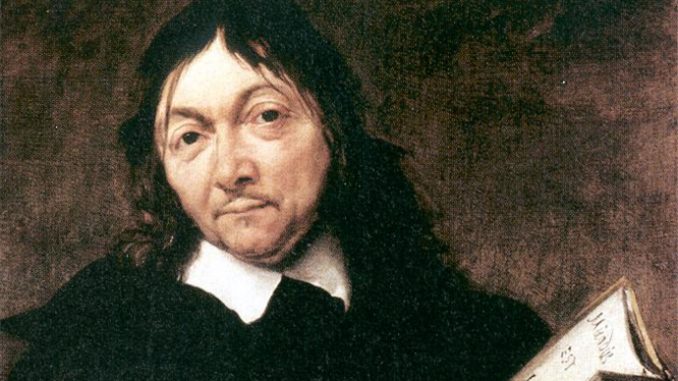
On November 10, 1619, during a Saint Martin’s Eve celebration in Germany, a twenty-three-year-old French soldier slipped into a small room with a stove to do some thinking—and it changed the course of history.
Philosophy, it has been said, is one long footnote to Plato, but modern philosophy—indeed, much of the modern world—is arguably one long footnote to René Descartes. On that night near Ulm, the Catholic philosopher conceived of the unification of all the sciences into one great rational system, a mystical vision accompanied by three vivid dreams—and followed by a vow to make a pilgrimage to Our Lady of Loreto.
The fruit of Descartes’s search, as intro to philosophy students the world over have learned since, was his famous cogito (“I think, therefore I am”) and a sharp dualism of mind and body. On these two pillars rose the whole tradition of modern rationalism—and the tidal wave of scientism, skepticism, and subjectivism associated with it.
Descartes’s influence has made him the prime philosophical target among fellow Catholics. (A runner-up is John Duns Scotus, who at least has the advantage of being a Scholastic and a Blessed.) Thomists such as Jacques Maritain and (to a lesser degree) Etienne Gilson saw in Descartes an intellectual defector who threw the holistic spirit of medieval philosophy into the ash heap of history—the inflection from Aristotle and Thomas to Kant and Hegel.
And at the heart of the critique of Cartesianism was the French philosopher’s stark mind-body dualism.
As a young Catholic revert interested in philosophy and disoriented by the Meditations, I fell fairly quickly into this thinking, largely through reading Walker Percy. “The Self since the time of Descartes,” he wrote in Lost in the Cosmos, “has been stranded, split off from everything else in the Cosmos, a mind which professes to understand bodies and galaxies but is by the very act of understanding marooned in the Cosmos, with which it has no connection.”
A “dread chasm,” he added in Love in the Ruins, “has rent the soul of Western man ever since the famous philosopher Descartes ripped body loose from mind and turned the very soul into a ghost that haunts its own house.”
Percy’s critique of Cartesian “angelism,” I later learned, was picked up from Maritain, so a careful reading of the latter’s Dream of Descartes soon followed. Descartes, it seemed, was the great villain who loosed substance dualism upon the world—especially, if Alexis de Tocqueville was right, upon America, “where philosophy is least studied, and where the precepts of Descartes are best applied.”
Percy and Maritain were, I think, basically right in their critique of Descartes. But over the years, I’ve also realized that heaping all our mind-body problems on his head—as I was once all too eager to do—is misguided. The fact is that substance dualism is a much deeper and broader current than Descartes’s philosophical project.
In the first place, Descartes himself wasn’t exactly a Cartesian dualist. He did argue that mind and body were distinct substances, but as a good Catholic, he was at least eager to show that they were, in the end, deeply connected. For Descartes, our five senses form a kind of bridge between the two, demonstrating that we’re not present in the body “as a pilot is present in a ship.” Instead, the mind is “very closely conjoined” to the body to “form a single entity with it.” Man—and here he joins his voice to the whole chorus of Catholic thinkers running from Augustine to John Paul II—is “a composite of mind and body.” The idea that Descartes was happy to sever man from his body is simply a caricature.
But secondly—and more importantly—Cartesian dualism emerged out of a wider river of human thought with several tributaries, as spotlighted by Bishop Barron in his recent homily for All Souls Day. One major tributary was Plato himself, whom Descartes drew comparisons to after publishing the Meditations. Another was Gnosticism, which merged Platonic dualism with grand mythological frameworks and resurfaced again and again in the first millennium. Arguably, Martin Luther’s own retreat into solitude exactly a century before Descartes—his “tower experience” in 1519—opened to a third, which Charles Taylor has called “excarnation”: a dualistic pull away from bodily expressions of Christian faith (“works”), and thus from the body itself.
In short, the impulse to seal the self off from the body is a much longer, older story. In fact, as I’ve argued in The Way of Heaven and Earth, the whole philosophical and religious trajectory of radical mind-body (or soul-body, or spirit-flesh) dualism is itself just one volume in an even bigger saga—a division of heaven and earth haunting the history of ideas. Descartes isn’t the root cause of our dysfunction—only a symptom.
Substance dualism continues to resurface in our culture in strange ways, from “body swap” stories to New Age spirituality to transgender ideology. We remain enamored with the idea that the “real me” is something utterly distinct and separable from my body. And while Descartes didn’t exactly get us off that train, and may have even pressed the gas, he didn’t put the wheels in motion. Neither, for that matter, did Plato, since substance dualism stretches beyond even him. The fault lies not in our sages but in ourselves—in the perennial human temptation to split the world in two and persuade others to do the same. And whoever started it, the weightier question is: Who can stop it? Who can integrate the mind and body once more—or show us how integrated they already are?
That cold November night in the heart of Germany may have changed history, but history also repeats itself. An ancient, sundering spirit is always crouching at the stove-room door, and “its desire is for you” (Gen. 4:7). It’s time to stop blaming that would-be “master of nature,” and to start mastering our age-old desire for division.
If you value the news and views Catholic World Report provides, please consider donating to support our efforts. Your contribution will help us continue to make CWR available to all readers worldwide for free, without a subscription. Thank you for your generosity!
Click here for more information on donating to CWR. Click here to sign up for our newsletter.

Oops. “Platonic dualism” was a wildly mistaken interpretation of Plato, not Plato’s own position, which should be made clear. In fact, it is a kind of “Black Legend” about Plato, of which there were several (including that he was a proto-fascist, as supposedly suggested by his “perfect city” which was more of a thought experiment than anything else). It’s the kind of thing taught in secular colleges, a cheap and easy way to cover Plato in overview courses and even sometimes in grad school (I experienced this myself on my way to a doctorate in philosophy).The single best book on Plato is that of the brilliant Catholic philosopher D.C. Schindler: “Plato’s Critique of Impure Reason: On Goodness and Truth in the Republic” (the title is a double entendre referencing Kant). Highly recommended – in fact, an absolute necessity for anyone who truly wants to understand Olato.
As a “composite of body and soul,” actually an ensouled body…
About the Christian understanding of human deification finally in heaven, the 7th-century dualist Muslim mind (still echoing the Zoroastrianism influence) still insists today: “Let God be God.” And, yet, with its Qur’anic approach to unity, offers a composite—heterogeneous and blended (!)—version of what is mostly a natural religion…
“Islam has not wanted to choose between Heaven and Earth. It proposed instead a blending of heaven and earth, sex and mysticism, war and proselytism, conquest and apostolate. In more general terms, Islam proposed a blending of the spiritual and the temporal worlds which neither in Islam nor among the pagans have ever been divided” (Jean Guitton, Great Heresies and Church Councils, 1965).
Speaking of himself, the 5th-century St. Augustine had this to say about such false unity and the divided will:
“It is no monstrous thing partly to will a thing and partly not to will it, but it is a sickness in the mind. Although it is supported by truth, it does not wholly rise up, since it is heavily encumbered by habit. Therefore there are two wills, since one of them is not complete, and what is lacking in one of them is present in the other” (Confessions, Bk 8, Ch. 9:22).
ABOUT Today’s DUALISM: the symmetrical comparison between Islam and Christianity is not some theologians’ comparison between the two scriptures, but maybe the cultural anthropologist’s replacement (!) of the eternal and incarnate Jesus Christ (the “Word made flesh”) with only the composite and “uncreated” Qur’an (“the word made book”).
“It’s time to stop blaming that would-be “master of nature,” and to start mastering our age-old desire for division.”
I agree! I respond with my Dominican teacher: thank God, sound philosophical and theological knowledge has continued to this day, despite the Cartesian enterprise having enjoyed great success thus far, passing itself off as “modern philosophy,” when in reality, as Heidegger aptly stated, Descartes is nothing more than a revival of ancient Protagorean subjectivism.
In any case, we all know how the Cartesian cogito in the following centuries has expressed its idealistic, pantheistic, and atheistic potentialities, leading to the modernism of our time.
Meanwhile, in the 19th century, In the 19th century, it would happen that for Fichte, a keen interpreter of Descartes, I do not find my being as an objective fact independent of myself, but I posit it myself, so there is no need for a God to create it, as is instead necessary in Augustine’s “I am,” which is not posited by his will but discovered by his intellect.
Hence the inevitable question in the Augustinian process, a senseless one in the Cartesian-Fichtean sum: who created the self? A question that does not arise in Descartes, as Fichte clarified. And for this reason, Fichte was rightly accused of atheism, already latent in the Cartesian sum. As for Descartes’ God, he is not a God found at the end of a journey that begins with the perception of things and of one’s own self, but is an idea posited by one’s own self. How, then, can this God be the creator of the self, or is it not rather the self that is the creator of God?
Indeed, as is well known, Descartes declared from the outset that he did not know whether things existed outside of me, and therefore maintained that it was necessary to demonstrate it. Such an idea absolutely did not occur to Augustine, since he knew well that things exist outside of the self. And it is precisely the testimony of things that tells him that they did not come into being by themselves, but that God, omnipotent and of infinite goodness, created them. For this reason, Augustine, like Thomas Aquinas, ascends from the effects to the cause, exactly as St. Paul prescribes in Romans 1:19-20, “per ea quae facta sunt invisibilia Dei intellecta conspiciuntur.”
Becklo nails it with a correct assessment of Descartes. That he understood man as an integral composite of body and soul [mind].
Descartes’ methodical doubt begins with the rejection of the very bodily feature he says connects body with mind, the senses. What followed the repudiation of certitude of the external world in sensible perception is after the fact theoretical conjecture.
Catholicism, in the main thanks to the influence of one philosopher/theologian Saint Thomas Aquinas and his defense of the certitude of sense perception as the first principle of all knowledge has remained, in accord with Apostolic tradition, focused on the essential moral link of the physical with the spiritual.
https://crisismagazine.com/opinion/why-are-the-left-and-the-woke-movement-so-closely-aligned-with-islam-and-the-pro-palestinian-cause
Regarding “the dualism runs deep” and the fact that only God, The Most Holy And Undivided Blessed Trinity, In The Unity Of The Holy Ghost, The Spirit Of Perfect Complementary Divine Eternal Love Between The Father And His Only Begotten Son, Jesus The Christ, Who Proceeds From The Father And His Only Begotten Son, Jesus The Christ, In The Ordered Communion Of Perfect Divine Eternal Love, The Most Holy Blessed Trinity, Has The Ability And The Desire To Take us from death, To Eternal Life:
At the heart of Liberty Is Christ, “4For it is impossible for those who were once illuminated, have tasted also the heavenly gift and were made partakers of the Holy Ghost, 5Have moreover tasted the good word of God and the powers of the world to come…”, to not believe that Christ’s Sacrifice On The Cross will lead us to Salvation, but we must desire forgiveness for our sins, and accept Salvational Love, God’s Gift Of Grace And Mercy; believe in The Power And The Glory Of Salvation Love, and rejoice in the fact that No Greater Love Is There Than This, To Desire Salvation For One’s Beloved.“
“Hail The Cross, Our Only Hope.”
I think therefor He is “I am Who am”
The dualism is not a caricature, it essentially describes what Descartes concocted. Descartes isolates the self for making its own discoveries and formattings; by which to find -determine- the connection between mind and matter, for the philosopher. This is his idea or makings of true philosophy in which every man would discover ohimself and philosophy, nce he applied himself thoughtfully or honestly; Descartes supposed he would be its authentic lead.
There is another aspect to the dualism, can be located via logic. “Cogito ergo sum” is meant to shorthand, or, is Descartes wonted shorthand for, “I doubt, I think about doubt, I think, therefore I am.” The “therefore” really means what I come to as making sense will amount to a needed certitude about myself. “You will see what I admit when you also affect from doubt.”
Terrible. One of his “proofs” is that nobody before would say such things if he knew it even.
Notwithstanding his “acknowledgement” of mind-eventually-in-matter, it would appear he died utterly abandoning any claim on his body.
As captured in WIKIPEDIA:
‘ Descartes concludes that he can be certain that he exists because he thinks, but perceiving his body through the use of the senses is an unreliable evidence. So Descartes determines that the only indubitable knowledge is that he is a thinking thing. Thinking is what he does, and his power must come from his essence. Descartes defines “thought” (cogitatio) as “what happens in me such that I am immediately conscious of it, insofar as I am conscious of it”. Thinking is thus every activity of a person of which the person is immediately conscious. He gave reasons for thinking that waking thoughts are distinguishable from dreams, and that one’s mind cannot have been “hijacked” by an evil demon placing an illusory external world before one’s senses.[69]
** And so something that I thought I was seeing with my eyes is grasped solely
** by the faculty of judgment which is in my mind.
In this manner, Descartes proceeds to construct a system of knowledge, discarding perception as unreliable and, instead, admitting only deduction as a method. ‘
https://en.wikipedia.org/wiki/Ren%C3%A9_Descartes
I am unable at this moment to find out more on Fr. Pierre Bourdin S.J. 1595–1653. Earlier I found the mention of him in NEW ADVENT.
‘ AI Overview
Pierre Bourdain (1595–1653), a French church figure, was a vocal critic of René Descartes. Bourdain argued against Descartes’s conception of the human mind as a disembodied substance and suggested the mind was a product of the material brain.
Bourdain’s criticisms, particularly regarding Descartes’s position on radical doubt and the nature of the mind, were presented in the (omitted) seventh set of “Objections” to Descartes’s Meditations on First Philosophy. Descartes, in his “Replies,” did not engage in a substantive debate on these points. Instead, he largely repeated his original arguments and reportedly dismissed Bourdain’s critique as “barking” while also reporting him to his ecclesiastical superiors.
Key areas of Bourdain’s criticism included:
– The Nature of the Mind: Bourdain challenged the idea of the mind as a separate, immaterial substance, suggesting a material basis (the brain) instead.
– Radical Doubt: He also contested Descartes’s original philosophical position of radical doubt regarding the reality of existence.
Descartes’s interactions with Bourdain reveal a defensive posture, where he avoided direct intellectual confrontation and resorted to personal dismissal and appeals to authority. ‘