

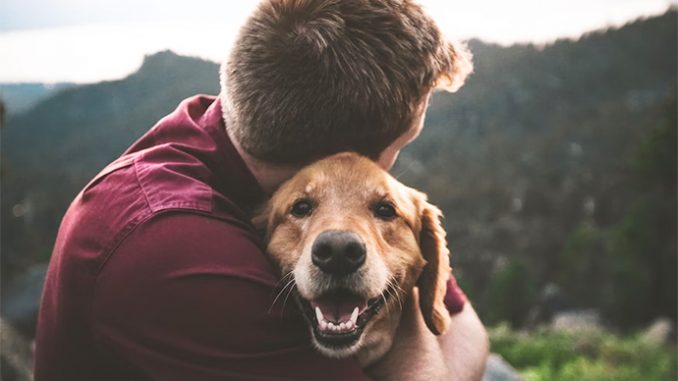
No theologian likes being asked about the mortal fate of beloved pets, as it’s sure to hurt feelings. With the feast of St. Francis of Assisi, the patron saint of animals, approaching October 4th, I was asked to wade into this increasingly sensitive topic.
In short, having lost a sense of our own dignity, we view ourselves more like animals and, in turn, view them more like humans.
In The Descent of Man, for instance, Charles Darwin stated that “the difference in mind between man and the higher animals, great as it is, is certainly one of degree and not of kind.” Animals can perceive, feel, remember, and respond to their surroundings, reacting to pleasure and pain in ways that seem familiar to us.
What Darwin, and many others, miss, however, is the nature of human intelligence, which constitutes a leap from the material to the immaterial. Animals are moved by instinct in how they respond to sensory perception, unable to move beyond it. They can perceive the difference between things but could never explain it rationally. They might figure out how to overcome obstacles to what they want, but could never imagine and pursue something beyond their instincts and experience. They remain confined to the world of sense, incapable of thinking about or freely choosing things that go beyond it.
You might wonder what makes human beings so different, as we, too, are animals. Aristotle deemed us “rational animals,” with a soul, a living principle within us, that does more than animate our bodies. We are transcendent beings, with a mind and soul that can reach beyond the world of sense, contemplating the stars and even what lies beyond them. God has breathed his life into us, making us in his image, so we might be capable of friendship with him, one that would endure into eternal life.
Animals have souls, too, of course, as all living things do; that’s what makes them animate. But these souls are natural, bound to the world of matter and sense, which they cannot transcend. Simply by looking at what animals can and can’t do, we can perceive that their souls are bound up with this world and unable to persist after death.
Is that the end of the story?
When we look at the life of St. Francis and other saints, we see that animals are bound up with the unfolding of salvation. Francis was surrounded by birds, who landed upon him as he approached Mount La Verna, the place of the stigmata, to confirm God’s blessing. Once there, he would be drawn to prayer in the morning by a falcon. He was also known for taming a wolf, which had harassed the town of Gubbio, and which instead became the town’s servant.
His friend Anthony of Padua preached to a school of fish to shame a town that had scorned him. He also led a donkey to bow down before a monstrance to chastise its doubting master.
In Scripture itself, Balaam’s donkey recognized the presence of a sword-bearing angel barring his path and then, through God’s miraculous power, spoke to him to protest an unjust beating.
Elijah was fed by ravens (as was St. Benedict of Nursia), while a whale swallowed Jonah and spewed him forth on the coast.
God entrusted humanity with the mission to exercise dominion over the created world. We tend to think of this as economic or technological, while in reality it is a priestly mission to enable the world to pay homage to its Maker. Sin threw a monkey wrench into this plan, and now, St. Paul tells us, the earth is groaning in travail as it awaits its redemption (Rom 8:22). The Resurrection inaugurated a new creation, raising up and divinizing humanity and also preparing a new heaven and a new earth (Rev 21:1). All things will be brought to perfection in the end, with humanity’s mission coming to fulfillment, as Isaiah prophesied, “The wolf shall dwell with the lamb, and the leopard shall lie down with the kid, and the calf and the lion and the fatling together, and a little child shall lead them” (Isa 11:6). The miracles we see in the Bible and lives of the saints point to this reality beginning even now.
If everything will be brought to perfection in the renewal of creation, does that mean our own animals, our pets, especially, will be there? The philosopher Peter Kreeft speculated, “Why not?” building on insights from C.S. Lewis (Everything You Ever Wanted to Know about Heaven). Lewis himself posits that a “derivative immortality suggested for [animals] is not a mere amende or compensation: it is part and parcel of the new heaven and new earth, organically related to the whole suffering process of the world’s fall and redemption” (The Problem of Pain).
Since life beyond death does not conform with animal natures, however, it will take a supernatural act, an intervention by the Creator to re-create. In theology, we can only speak with confidence about what God has revealed to us. He certainly can create new animals or raise up past ones if he chooses to, and we could even see it as fitting, but it’s not something we can assert with certainty. We cannot hope for it in the theological sense, since the virtue of hope pertains to what God has explicitly promised, even if there’s no harm in a general wish.
If I were to make a case for why God might raise up animals, it would be because he’s a loving Father who delights in pleasing his children. Jesus told the disciples not to have anxiety about losing worldly things. He often encouraged them that God would provide an even greater abundance to those who let go of earthly things in favor of Heaven. In particular, he said, “Fear not, little flock, for it is your Father’s good pleasure to give you the kingdom” (Lk 12:32). This kingdom will realize all the things we have been called to do, and often failed at, including our dominion over creation.
God gave us animals as a blessing, to help provide for our needs and to assist us in fulfilling our earthly mission. They are not our true helpmates, for they are unable to love (a free choice to sacrifice for the good of another) and cannot share spiritual communion with us. They have their place and mission alongside us in this life and find their fulfillment through us in giving glory to God. The good we find in them points already to the perfection of Heaven. Whether we find animals there or not, we must trust that God works all things for the good and that nothing will be lost in the happiness of Heaven.
If you value the news and views Catholic World Report provides, please consider donating to support our efforts. Your contribution will help us continue to make CWR available to all readers worldwide for free, without a subscription. Thank you for your generosity!
Click here for more information on donating to CWR. Click here to sign up for our newsletter.

QUESTION: “DO ANIMALS GO TO HEAVEN?”
ANSWER: Only if they’ve been baptized.
When my oldest son was little I caught him “baptizing” our chickens. I guess he’d seen a baptism at church & thought the hens would benefit from that.
(The chickens weren’t very cooperative.)
mrscracker, Carl Olson posted an article years past that in the Portland Oregon region way out West they have end of life care, retirement farms for old chickens. Wonder what those folks out there believe?
I couldn’t begin to guess what folks in Portlandia might believe but it sounds like a First World thing other cultures don’t have the luxury for.
I always thought retired chickens went to the soup pot.
For the chickens, yhat was a baptism by fire!
Actually for the older hens it usually ended up baptism by crockpot.
🙂
Judging by their behavior, it’s likely that most animals will get to Heaven far ahead of most people.
Reminds me of a Mark Twain quote: “Faith is believing in something you know ain’t true.”
Of course, there’s the story of Old Drum:
per wiki:
..,Vest took the case tried on September 23, 1870, in which he represented a client whose hunting dog, a foxhound named Drum (or Old Drum), had been killed by a sheep farmer, Leonidas Hornsby. The farmer (Burden’s brother-in-law) had previously announced his intentions to kill any dog found on his property; the dog’s owner was suing for damages in the amount of $150 (equivalent to $3,730 in 2024), the maximum allowed by law.
During the trial, Vest stated that he would “win the case or apologize to every dog in Missouri”. Vest’s closing argument to the jury made no reference to any of the testimony offered during the trial, and instead offered a eulogy of sorts. Vest’s “Eulogy of the Dog”[1] is one of the most enduring passages of purple prose in American courtroom history (only a partial transcript has survived):
Gentlemen of the jury: The best friend a man has in this world may turn against him and become his enemy. His son or daughter that he has reared with loving care may prove ungrateful. Those who are nearest and dearest to us, those whom we trust with our happiness and our good name, may become traitors to their faith. The money that a man has, he may lose. It flies away from him, perhaps when he needs it the most. A man’s reputation may be sacrificed in a moment of ill-considered action. The people who are prone to fall on their knees to do us honor when success is with us may be the first to throw the stone of malice when failure settles its cloud upon our heads. The one absolutely unselfish friend that a man can have in this selfish world, the one that never deserts him and the one that never proves ungrateful or treacherous is his dog.
Gentlemen of the jury: A man’s dog stands by him in prosperity and in poverty, in health and in sickness. He will sleep on the cold ground, where the wintry winds blow and the snow drives fiercely, if only he may be near his master’s side. He will kiss the hand that has no food to offer, he will lick the wounds and sores that come in encounters with the roughness of the world. He guards the sleep of his pauper master as if he were a prince. When all other friends desert, he remains. When riches take wings and reputation falls to pieces, he is as constant in his love as the sun in its journey through the heavens.
If fortune drives the master forth an outcast in the world, friendless and homeless, the faithful dog asks no higher privilege than that of accompanying him to guard against danger, to fight against his enemies, and when the last scene of all comes, and death takes the master in its embrace and his body is laid away in the cold ground, no matter if all other friends pursue their way, there by his graveside will the noble dog be found, his head between his paws, his eyes sad but open in alert watchfulness, faithful and true even to death.
Vest won the case (the jury awarded $50 to the dog’s owner) and also won its appeal to the Missouri Supreme Court. A bust of the dog resides in the Missouri Supreme Court building in Jefferson City, Missouri. In 1958, a statue of the dog was erected on the Johnson County Courthouse lawn containing a summation of Vest’s closing speech, “A man’s best friend is his dog”….
Diogenes: How so?
BBQ
Okay two points…Revelation and the New Heavens and New Earth have rivers mountains and trees — but no dogs ??? seems from a literary standpoint implausible
Two, as C S Lewis points out, pets acquire a higher being by being around a higher being. Not a big deal if a whale no one’s ever encountered is not in Heaven but that is not the case with my 5 dogs and 3 cats.
Finally, God cares about my loves because He cares about me. I miss those pets daily.
Why is the topic of the afterlife for pets considered sensitive for theologians?
What about chickens given names yet eaten all the same? And all the beefburgers would be a tremendous embarrassment if one has to spend eternity with the same cows?
Maybe people should not be attached to their pets to the point where they ask if their animals will go to heaven.
You mean, Maybe I should not be attached to my pets because YOU are not attached to my pets.
I’m sorry you’ve never felt that bond.
👏👏👏👏👏👏👏
Exactly. Same with possessions, money, titles, and relationships. If you focus on things of this world, you are missing the mark.
A German Shepherd, a Doberman Pinscher and a Cat die and go to heaven. There they are met by God.
He turns to the Shepherd – “What do you believe?”
“I believe in discipline, and loyalty to my master.”
“Excellent – take your place at my right.”
He turns to the Doberman – “What do you believe?”
“I believe in discipline and loyalty to my master.”
“Excellent – take your place at my left.”
He turns to the Cat – “what do you believe?”
“I believe you’re sitting in my seat.”
There will undoubtedly be some learned tomes submitted on this subject, and I thought it would be a good idea to start it out with some levity before I put Rachel the wonder-dog out.
Those answers sound about right.
🙂
I sure miss my feisty little dog who went to his reward a few years ago. He was like Donald Trump on four legs. Completely fearless & he never backed down from anything (except a vacuum cleaner).
Rachel (the wonder dog) also fears the vacuum cleaner – greatly.
A similar article appeared on this subject, February 11 2021, which I only discovered last week. In the comments, our beloved Fr. Morello spoke fondly of his time with his dog years ago. Father was upset last week, like many of us, over the doctrinal relativism implicit in Leo’s interview, so I thought I would lift his spirits by referring him back to my anecdotal reflection on the passing of my dog, which I posted at the older article, and I thought I’d recreate it here given the subject:
Twenty years ago, our family chihuahua needed to put down six months after my wife passed to her reward after two years of illness and my being her full-time caregiver. Before taking my dog to the vet, I sat her on my lap and verbalized a long talk. I told her we both went through a couple of very hard years, that I do not know much about a lot of important things, and that I know you do not know what I am saying, but if you do pass to a place to be greeted by wonderful beings called angels, they might explain what I am trying to say to you now. What I want, if there is some way possible, is that you ask that a sign be sent to me that you’re all right.
My friend drove us to the veterinarian, and took me for a beer afterwards. An odd thing happened at the moment the vet gave the injection. I felt a thought was planted in my mind that did not originate with me. I had this silent thought, saying to Mimi, I’m sorry I never got to take you swimming, a pastime I always enjoyed with my boyhood dogs. Without knowing of my embarrassing private talk, my friend did say to me, don’t be surprised if you get a sign from her.
I did. I woke up the next morning after a final intense dream of figures and voices, half male and half female, singing Edelweiss, which I always sang to her when I made her breakfast bowl. I never had music in a dream previously. The figures lacked clarity, but they conveyed a unique beauty. Then I woke to a somewhat silly but very intense and charming physical reality. It was the familiar acrid odor of a wet dog. It was powerful, filling my bedroom, and I knew what it was. I was sensible enough to test it. I tried to get rid of it as a passing sinus event. I couldn’t, and it did not come from any neighbor washing a dog nearby as my window was open in late June. My neighbors had no dogs. I walked around and could not get rid of the scent even though I didn’t really want to. I finally had a thought where I said to my departed canine friend, You did it! You actually did it! You actually charmed our Creator and obtained this favor where you are saying to me, You were right! This place is wonderful, and when it’s time for you to come home, we can go swimming together!!! Once I had that thought completed, the scent disappeared completely.
One further note on this subject. Animals know suffering. And we know that suffering is never meaningless.
Thank you for this moving story, Mr. Baker. My first dog as a child I also called Mimi. On the question of what theologians etc. have to say about the matter under discussion (and other subjects as well…): I would rather pay attention to what Saints say and do, rather than what theologians say. Such as Saint Francis, Saint Modestos, Saint Anthony of Padua… and even what poets like Homer (and C.S. Lewis and Tolkien, for they poets who wrote in prose rather than verse) have said.
mrscracker: we need a big vacuum cleaner! 🫣
Dogs probably imagine Hell as place filled with vacuum cleaners & endless fireworks.
🙂
Thank you for this. Perhaps links aren’t allowed in posts (that’s fine, the editors will just disallow it_ but this is a similar take (at least in that it ends the same way – we can trust a loving Father whether we find animals in heaven, which is btw a new heaven and a new earth): https://humanumreview.com/articles/on-david-bentley-hard-and-the-peaceable-kingdom
Thank you. If I recall, CS Lewis also said that mosquitoes are in Hell because it is Heaven to them.
Anyway, I adore my dog and wouldn’t mind him laying on the eternal couch, but I am disturbed by the yard signs welcoming a newborn baby from a “fur brother” in the shape of a dog bone. Even more pathetic are the strollers seen in my city carrying a pet. My suspicion is that animals being paraded around as people does not play well in farming communities. I fear for my first sighting of a trans pets in a pram, some poor male boxer identifying as a pink poodle…
“…but I am disturbed by the yard signs welcoming a newborn baby from a “fur brother” in the shape of a dog bone.”
********
Oh my goodness.
🙁
That’s a new one for me.
There is a reason that God spelled backwards is D-O-G. If heaven means a place of great happiness with God, and your happiness is enhanced by your pets, there is good reason to believe that they will be with you in heaven.
I was on the East side of Central Park one Saturday morning on a glorious Spring morning waiting for the Metropolitan Museum to open. I sat on a park bench doing my favorite past time- people watching. There were about 30 or so young people gathered who seemed part of the trendy Upper East Side smart, rich and ivy league-educated set. They all were gathered, each with their requisite dog. They were obviously engaged in lively conversation (my guess about Fido’s latest antics). And then it struck me: there was not a single child in sight. What a pity.
It’s a shame. There should be room in young people’s lives for children & dogs both.
MAYA
Make America Young Again
🙂
That’s a great slogan knowall. It’s going to take a while to catch up on that but now is the time to begin.
Great point, while I like dogs, in todays society we replaced kids with dogs.
St Augustine answers that , the more love the better. What is wrong is when the hierarchy is disturbed. I love my Border Collie Misty but I do not value her over a human life. Why is this a problem. I love my spouse but that does not imply a degrading of any other human being that I didn’t or wouldn’t marry.
Thank you for that Mr. Robert.
I’ve witnessed this group think attitude among the “well-educated” for decades, ever since the overpopulation myth gained traction in the seventies.
Associating with others with real babies represents a duel threat to the esteem of liberal feminists. It might spark a dim awareness that their repressed nagging heart might be right to remind them that their life choices have been wrong in assuming that the self-sacrifice of motherhood is “selfish,” and that it represents an inferior life to career. It’s hard work that takes many years to sustain delusions.
Or maybe it’s selfish to paint entire groups of people you do not personally know with the same broad brush brush of ASSumption. You don’t know any of those people. You don’t know what their plans for the future are. You do not know what is in rheir hearts unless you speak to each ine of them personally and engage with them thoughtfully. But you won’t you’d rather be rude, petty, and insulting to people whom you have never met for no reason other than to score some kind of brownie points in an internet comm box.
If you don’t like when it’s done to Catholics why is it ok for you, a Catholic, to do that to other people you do not know or understand?
This comment probably won’t even be posted.
“Furbaby on Board”.
I remember the former head of the Episcopal Church in the America, a female Katherine something with a hypenated surname saying without the slightest bit of irony there was a low birthrate among her flock with some indifference.
The columnist Michael Medved noted the comment, observing that he thought it strange for him as a practicing Jew to comment, but noted her glib indifference was the prelude to denominational death.
About dogs and hope, in one of his better moments the mentioned Charles Darwin also said this:
“I feel most deeply that this whole question of Creation is too profound for human intellect. A dog might as well speculate on the mind of Newton! Let each man hope and believe what he can.”
And He said to them, “Go into all the world and preach the gospel to every creature.”
Jared offers a wise analgesic should we not find pooch in heaven.
Whatever may not be there that was dearly loved here, “we must trust that God works all things for the good and that nothing will be lost in the happiness of Heaven”.
I would translate that reality not differently but further, that knowledge of God will infinitely surpass all that we know on this earth, in the sense that we will find their completion in Him.
Good article. St. Francis of Assisi thought and behaved in communion with all creatures of God without establishing the rankings in This world and in the Other world that we humans seek for:
“Francis’s simple, childlike nature fastened on the thought, that IF ALL ARE FROM THE FATHER THEN ALL ARE REAL KIN. Hence his custom of claiming brotherhood with all manner of animate and inanimate objects. The personification, therefore, of the elements in the “Canticle of the Sun” [Cantico delle Creature”] is something more than a mere literary figure. Francis’s love of creatures was not simply the offspring of a soft or sentimental disposition; it arose rather from that deep and abiding sense of the presence of God, which underlay all he said and did.”
“The very animals found in Francis a tender friend and protector; thus we find him pleading with the people of Gubbio to feed the fierce wolf that had ravished their flocks, because through hunger “Brother Wolf” had done this wrong. And the early legends have left us many an idyllic picture of how beasts and birds alike susceptible to the charm of Francis’s gentle ways, entered into loving companionship with him; how the hunted leveret sought to attract his notice; how the half-frozen bees crawled towards him in the winter to be fed; how the wild falcon fluttered around him; how the nightingale sang with him in sweetest content in the ilex grove at the Carceri, and how his “little brethren the birds” listened so devoutly to his sermon by the roadside near Bevagna that Francis chided himself for not having thought of preaching to them before. Francis’s love of nature also stands out in bold relief in the world he moved in. He delighted to commune with the wild flowers, the crystal spring, and the friendly fire, and to greet the sun as it rose upon the fair Umbrian vale. In this respect, indeed, St. Francis’s “gift of sympathy” seems to have been wider even
Please see the moving, superb bio of SF in Catholic Encyclopedia New Advent
https://www.newadvent.org/cathen/06221a.htm
Thank God for St. Francis of Assisi. Thank God for St. Modestos. And for the dogs who licked the sores of St. Lazarus. And thank God for St. Anthony of Padua (“in Rimini, Italy, where he encountered a group of heretics who refused to listen to his preaching on the faith of Christ and the Holy Scriptures. Frustrated by their hardened hearts, St. Anthony, inspired by God, went to the seashore where the river met the sea and began to preach to the fish, saying, “Listen to the word of God, O ye fishes of the sea and of the river, seeing that the faithless heretics refuse to do so.
Miraculously, a vast multitude of fish, both small and large, approached the bank, arranging themselves in perfect order with their heads out of the water, seemingly listening attentively to his sermon. St. Anthony preached solemnly, thanking the fish for their Creator, highlighting their preservation during the universal deluge, their ability to navigate the waters, their role in providing tribute-money to Jesus Christ, and their nourishment of the eternal King. The fish responded by opening their mouths and bowing their heads, showing reverence.
Witnessing this miracle, the people of Rimini, including the previously obstinate heretics, were deeply moved, rushed to the shore, and many were converted to the true faith. St. Anthony then continued to preach to them, reaping much spiritual fruit. The event is often cited as a demonstration of the sanctity of St. Anthony and the power of divine intervention when human hearts are closed to the Gospel.”)
The ancient Greeks also knew about these things. When Odysseus returned home in disguise, the first one who recognized him, while all humans did not, not eve his wife Penelope, was his by now very old big guard and hunting dog, Argos. Argos had been waiting for Odysseus all these years, like his wife Penelope. And now that he saw his master again, he could die in peace, and he did.
I have had several dogs in the course of my life. Big, powerful guard dogs. All of them helped me learn how to be a better father to my son. All of them helped my son, who grew up with them around, learn to be a better son to me. All of them would have died for me without hesitation. How many humans would have? None of them ever failed me. Humans have.
St. Francis poetic masterpiece, Il Cantico delle Creature can be heard here:
https://www.youtube.com/watch?v=2vIzGZg7iss&list=RD2vIzGZg7iss&start_radio=1
Thanks!
Thank you for your kind response, steveb. I always pay far more attention to what SAINTS have to say and do, than to what theologians write and speculate about.
Thanks Oscar, made my day! 🤗
You are welcome Br. I should have added that I pay more attention to what Saints (and poets like Homer, and C.S. Lewis and Tolkien–who wrote in prose rather than verse) say and do than to what theologians write.
Is the Beatific Vision not enough for us?
How many things that really matter to us now will really
be important then?
But that argument defeats itself. As C S Lewis said ALL OF CREATION SHOULD BE OF INTEREST BECAUSE IT IS WHAT IS ON GOD”S MIND.
I have heard your argument from students about why God doesn’t care about Physics and Philosophy
I see a lot of “Dog Mom” bumperstickers these days. I even saw one that proclaimed the driver loved their “great grand dogs”. In some places it seems easier to put down an elderly person than it does to euthanize an animal. At least vets will try to talk pet owners out of that if it doesn’t seem appropriate.
I do believe God can use His creatures in supernatural ways. I don’t know if pets will be in Heaven or not. I hope I don’t meet up there with the varmints I’ve shot or livestock & game that’s filled our freezer. I’m sure they’d have some choice words for me.
I’ve had an animal-related experience following a loved one’s death that I have no explanation for. So, I try to keep an open mind. God’s in charge of His Creation & His critters.
Mrs. C – Your 9/25 7:58 a.m.
Thanks, I needed that.
Thank you Mr. Terence. I appreciated your 4:44 post, too.
🙂
I need to find me another dog. It’s not the same at home without one. But I will be looking for one that doesn’t growl at babies or take on other dogs several times its size.
Allow me to recommend – ‘Old Dogs New Digs’
Help one out that has no hope currently.
Recommended reading – ‘The Story of Webster’ by the late great P.G. Wodehouse, followed by the sequel ‘Cats Will Be Cats’.
The translation of the language between Webster and the cat Percy prior to their battle is pricelessly funny, and will in all probability cause the lucky reader to find him (or her) self chuckling at odd times for days afterward.
This is indeed a sensitive question for some people. I always say that God will give them everything they need to be happy which is certainly true.
Dr. Staudt ought to explain what he means by, “it will take a supernatural act”. Does he mean “grace”? Now, grace is given to “rational” beings for their salvation. Are the “recreated” animals he speaks of to be given a rational nature so that they can now converse like Huan in The Silmarillion or like the great eagles, who seem at times to be more akin to embodied preternatural spirits (and in which case the new beings would no longer be animals). Or can instinct (the appetitive nature) ever be remade sufficiently in the image of God; even remade to be able to praise God with some sort of “recreated” instinctual-free-will (there are many philosophical difficulties here)? The main difficulty though that Dr. Staudt seems to grapple with (right from his first sentence) is the emotional one that many of today’s instructors struggle with: speaking the truth boldly when they think it might “hurt feelings”. So instead of addressing the actual question which those who work in parishes need to field from time to time – “Will I see my pet in heaven?”, the good Doctor skirts around this issue. A fuller explanation of this question would also include the vegetative nature: Are there trees and plants in heaven? In this context, it might be easier to devise an answer about animals being in heaven (the context of the full natural order). In any case: “No. Your pet is not waiting for you in heaven”
I don’t like the New Age type, “Rainbow Bridge” stuff but I think it’s not as clear cut as you state. God’s in charge. He has all the answers, we don’t. And we can trust Him with the details of Eternity.
By supernatural, I mean an act that goes beyond the nature of animals. They are mortal souls. The Book of Revelation does speak of plants in the new Jerusalem but does not mention animals. I skirt around the issue because while divine revelation does not teach us that animals will be in heaven, it also does not rule it out. We can speak of reasons it could be fitting but cannot give a definitive answer one way or the other. We are left with the default position of creatures with moral souls not enduring past their death, even though God, of course, could recreate them.
Thank you Dr. Staudt. When I hear “supernatural”, I think “divine”, the Holy Trinity, and grace. The angelic order (preternatural) also goes “beyond” the nature of animals (and beyond the human being as pure spirit). I am not a proponent of the Occam Razor, but I am leery of speculating about what divine revelation leaves out. St. Thomas Aquinas does not see animals in heaven either through the use of reason or through the application of divine revelation (I don’t see St. Thomas as a “default”). There is a tendency in today’s pastoral care to say that if you need a pet to be happy in heaven, God will grant you this; others say (rightly) that you are not ready for heaven, if you need a pet there (yet God can heal this deficit of course). The heaven-pet community is also one that often needs immediate agreement that their human loved ones are in heaven after death and this belief often keeps them from praying for the souls in purgatory or even from a belief in purgatory or hell. If animals-in-heaven is a possibility, I still await a reasonable explanation of how this “re-creation” occurs based in Catholic philosophy and theology; otherwise encouraging this notion (in practice it is has gone beyond a belief in possibility) detracts from other vital areas of the Catholic faith.
St. John PAUL II writes of heaven as involving total “intersubjectivity” [!] among the members of the Communion of Saints, all fully “face to face” with God and with each other. Such is real love within the eternal moment of delight: “eye has not seen, ear has not heard, nor has it entered the imagination of man what God has prepared for those who love him” (1 Cor 2:9). A moment, not a duration.
Augustine also writes that in heaven there is no memory of bad times…
Wondering, here, about memory of good times as part of the whole person, as an embodied and transfigured soul now “in” heaven—totally resurrected and transformed—might such memory (surely not amnesia!) include past companionship with dogs, but “now” in an inter-interior way that is even more real than whether only partially real dogs in our partially real world go to heaven, or not. No dog hair…
Mortal not “moral” I suppose it what that should be.
If God recreates animals in the Eternal Kingdom, either they would still have mortal souls and be subject to death or passing away, or they would persist according to some new modality assigned to them. But I should add two things: 1. not to make the Eternal Kingdom in the likeness of earth which has its purpose and 2. avoid spoiling surprises. Could be the the jasper, gold, sapphires etc., the river and the fruit-bearing tree in the Book, are figures of perfections.
In my own way I have resolved this by noting that the soul consists of memory, intellect and will. The many cats and dogs I have cared for will always be with me in my memory regardless of whether or not they are actually present in eternity.
Once upon a time there was a dog in my life called Spike. One of the guys in the house where I was living at the time got him out of the shelter in South Bend, where I was living at the time, but he soon became mine. He had a personality unlike any I’ve ever seen – I always thought of him as part Saluki, because he was built like a hound, could run like the wind, and was a one man dog. The other half was yellow lab by coat color.
I was a tad macho at the time, so he fit me well, rather – we fit each other well. He was a one man dog and I was that ONE man.
He could intimidate people and he knew it, and when he was in one of his moods he would do so – when it amused him to do so.
There are many stories I could tell of him but I have chosen this one – I had taken him to the local vets for his annual checkup and he had been in a cage for 24 hours when I came to pick him up. I had him on the leash and we exited the building when he stopped- he would NOT move. He then proceeded to defecate profusely at the front door of the establishment. I must admit that I did NOT do the responsible thing which would have been to clean it up accompanied by profuse apologies – when he was through I got him in the car as fast as I could and drove off laughing uproariously.
I am fully aware that this story will probably not pass muster and will never appear, but it is one of the favorites of my many stories of the dogs I have known and loved over my 81+ years.
It sounds like our dogs had something in common as far as attitude.
🙂
Our cat did the same outside the door of the room where the in-laws stayed during their visit.
We had both a cat and a dog. No family member was particularly attached to either though the dog was more engaging, both in terms of trouble and more humor. He would tilt and turn his head, his long floppy ears adding a mournful look. He did this when he didn’t understand our tone of voice or the words we spoke. Everyone thought that was quite a smart move for a dog low on the dog-intelligence-totem pole. He could smell and hear better than any human….barking and running to the door as soon as anyone entered the property, 600 feet away.
On the day we set to euthanize him, he went out the front door as jauntily as usual but then stopped mid sidewalk and wouldn’t go farther. I had to carry him to the car and into the vet’s for that last journey. So Sad.
That’s so sad meiron. I know you all were trying to keep him from suffering but it’s a very hard thing to do. I hate even thinking about it.
In my non-theologian opinion, I think animals or perhaps species that have been loved by humans acquire a different status through that relationship and therefore might be part of our heaven. As someone suggested above, what good would a New Heaven and a ?New Earth be without living things? Otherwise, how can the lamb lie down with the lion?
Unfortunately, the question of whether “Fido will join me in Heaven” strikes me as an example of the sin of presumption. Where does anyone get off thinking that THEY’RE assured the Beatific Vision? Maybe Fido will be there but you or I will not!
About the most well-developed way of saying “we don’t know” that I’ve seen so far. I certainly have enjoyed the pets I’ve shared time with, and have been quite sad to let more than one of them go when their time came, but I also am convinced that my attention in Heaven (God willing) will be on adoring God and not so concerned about anyone or anything else.
But God created those pets, so it should be of interest.YOu put your childs artwork on the fridge for only one reason and it isn’t the art
You’all forgot about Jonah and the whale that saved him. Might not that kind and thoughtful whale be there?
I am quite confident that Pope Francis, upon being asked the question of pets in heaven, responded in the affirmative. I simply add this item to the discussion and as a FYI for those interested.
Aquinas teaches that only people have immortal souls and immortality. Other living beings have souls but not immortality.
We simply do not know fully what eternity holds for those who attain it. As Jesus said, “Only the Father knows ….” this and that.
Elias. You can bank on it that there will be no mosquitoes in Heaven. They’re all condemned to Hell.
Is there hope of eternal life in Heaven for my Pet…Rock?
I’ve often wondered about Buddhists. A good question.
I think Dr R. Jared Staudt had never an animal as a companion. Has never heard or seen the life long love of animals to each other or to humans. St Francis of Assisi called the wolf that entered the church during a Mass: Brother wolf !!! The dogs that take care of cows, sheep or other animals like that, have a sacrificial love for them, protecting them with their lives!!!!! What about the horses??? It seems at the end of the world God will appear with great glory and majesty on a horse! Sure, animals with love and good character will go to Heaven. They are not just flesh and bone but have a SPIRIT !!! The dogs that I had and the dog I still have CAN READ MY MIND !!!
“What about the horses??? It seems at the end of the world God will appear with great glory and majesty on a horse!”
*********
Randy Travis has a great song about that:
“There are horses in Heaven
It says it in the Bible
Right there in Revelation
Red and pale, and black and white
Elijah left this world
On a chariot of fire
When Jesus comes back, he might just borrow
The silver for the night
There are horses in Heaven
So I bet that God’s a cowboy
Heading off into the sunset
In a big white Stetson hat
Every time you hear the thunder
It’s just a posse full of angels
Riding those horses up in Heaven
Golden saddles on their backs”
A theologian I read has made the interesting point that, “Many people would be happy to go to heaven and not find Jesus there.” If I am more concerned about whether or not my pets will be in heaven than I am looking forward to “beholding the glory of God in the face of Jesus Christ,” then it is fair to assume that something is off in terms of my spiritual life.
About as much as angels do, IMHO.
My favorite answer to this question was given by a father to his daughter: “If you want (pet’s name) in heaven, you will have him!”
The Bible tells us many times that animals worship their Creator, have souls, and will be with Him in the afterlife, and that God’s covenant is with all of creation. Read Isaiah 11:6-9, Revelation 5:13 and 19:11, Ecclesiastes 3:18–21, Luke 3:6, Romans 8:19–21, Psalm 36:6 and 50:10–11, Genesis 9:12–17, Hosea 2:18, Job 12:7–10, and many others. John Wesley, Martin Luther, and Pope John Paul II all spoke about kindness to animals and their restoration to their intended glory in Heaven.
If animals can go to heaven or hell, then the practice of euthanizing them is a sin.
Those who believe animals go to heaven are appalled when someone suggests that hell must, therefore, also be a possibility. If a sweet, affectionate, and loyal golden retriever goes to heaven, why would it not be rational to suppose that a ruthless, baby-eating pit bull goes to hell? But most people base their religious beliefs, not on divine revelation or reason, but on feeling and uninformed opinion. That’s the real problem.
My son always assumed our terrible little dog was headed to dog Hell due to his behavior. I’d like to think rather, dog Purgatory. Street dogs have an excuse for their orneriness.
🙂
When I was about 6 or 7 our mother cat attacked me, just as I walked out the door onto the front lawn. Scratched my arms and legs pretty nicely but my siblings stopped her quickly. We weren’t sure what her problem was but our vet said to isolate her for a week, so we put her in an empty rabbit cage and she seemed to calm down and nothing ever came of it. I’ve also seen a Holstein bull attack my neighbor but he lived but couldn’t milk for a few days. I recently read more people are killed by cattle in a year than by lightning, which is about 20. Radar on MASH got bit by a stray dog and almost started getting the shots but they found him and he wasn’t rabid. Of course, the Waltons had Chance the cow who died in that one episode and it was like one of the family died, no to mention the lack of fresh milk.
Cows can have long memories. One of my mama cow’s tried to take out my son in law when he helped me load her calf on a trailer headed to the slaughterhouse. I can’t really blame her but that’s dangerous.
When my daughter came over weeks later to help me move hay she had borrowed my son in law’s jacket and the mama cow recognized it and came at her. She’d never been aggressive with my daughter before but she remembered the jacket.
A dog-facilitated conversion true story: years ago, I asked a girlfriend if she had be brought up as a Catholic. She said that when she was little (7 or 8 years old), her dog was ill and under treatment by a veterinarian. Her mother took her to the minister at the Protestant church they attended where she asked him to pray for her dog. He blew her off rather curtly by saying that dogs don’t have souls so he would not pray for her. Bawling and crying, she was dragged by her mother out of the church and down the street to the Catholic Church. The Priest there patted her head and said that, of course, he would pray for their dog’s recovery. From then on, they attended Mass at the Catholic Church.
Of course animals feel emotions—and no less deeply than we do. Anyone who’s lived with a dog, cat, or other animal knows this truth. Love, grief, joy, empathy—science confirms what our hearts already understood.
They don’t have empathy though, my dog does not let the cats “go first”believe me. I have to feed them up high so the pig can t reach it.
Also, I’ve noticed the younger cattle will steal the succulent feed from the granny cow who can’t eat very fast.
Anyone who has spent time around animals can see that God endowed them with the ability to love, just as humans do–if not better. Animals love unconditionally. Jesus himself chose to use the analogy of a mother hen gathering her chicks to illustrate his love and desire to care for Jerusalem in Matthew 23:37. And of course, he’s coming back on a white horse, so that would strongly suggest that animals are in Heaven. Personally, I don’t have a shred of doubt about whether I’ll see my beloved animal companions again. Our loving creator cares for all he has made–now and eternally. 🙂
This entire argument is built on an outdated and frankly flawed understanding of animal “instinct” and intelligence. The evidence for animal learning– not instinct– as the foundation of intellect (at least for mammals and birds) is pretty sound and accepted at this point. It is increasingly supported that the biological, mechanical, and even social underpinnings of their learning is indeed closer to our own than ever suspected. I’d politely say leave the biology to the biologists and refrain from incorporating shallow or even incorrect analysis in your theology, sir.
“Aquinas teaches that only people have immortal souls and immortality. Other living beings have souls but not immortality.”
God did not create existence and all that it contains from nothing. The void itself cannot exist if not already created by God.
All of Creation is an extension of God Himself. Which is why God cannot annihilate that which He created.
The trials through which humanity is currently suffering is but a phase of God perfecting all that he created.
Animals, whatever their purpose, along with everything else that God has created, have a permanent place in God’s creation.
Else, He would not have created them.
After all, there is enough room in infinity to contain, for all time and eternity, all of that which He created.
I think that Thomas Aquinas said that there are no plants in heaven because heaven is unchangeable and plants change. Maybe it wasn’t Thomas, but I remember hearing some theologian say that there are no plants in heaven, only rocks because rocks don’t change. If there are no plants then there clearly won’t be any animals because animals move, which is a form of changing. Also, I doubt if any animals would WANT to be in a place where there are no plants, only rocks. I am not sure that I would want to be in a place where there are no plants either.
If there are no plants in heaven, why bother having rocks? Besides, rocks are the very proof of change. Study a bit of geology & you’ll be surprised.
In Heaven is found both completion and perfection.
Our lives on earth are but a preparation for Heaven.
Nowhere, either in Sacred Scripture or in Catholic Tradition (check the Catechism of the Catholic Church), is found any mention of heaven being a place of absolute and perpetual lack of motion.
Jesus Himself speaks of the future “Wedding feast of the Lamb.” I would expect that such a wedding feast would be full of guests along with an incomprehensibly elaborate banquet with Jesus as the Groom. Certainly there would be Heavenly music performed for such a Divine occasion. And don’t forget the wine. Jesus, at the Last Supper told His Apostles that “He would not again taste of the fruit of the vine until He drinks it anew with them in the Kingdom of Heaven.”
Saint Paul writes that ” Eye has not seen and ear has not heard of what God has in store for those who Love Him.”
Now, with such an unimaginable magnitude of Heavenly celebration, I would expect Heaven to be more along the lines of what Elvis Presley described as “A whole lot of shaking goin’ on!”
I quite agree! I forget what theologian said it, but it was somebody important and the whole point was based on the unchangeableness of God. As I wrote at the end of my comment, I wouldn’t be interested in spending eternity among a lot of rocks!
T-shirt –
“In dog years I’m dead”
We now return you to our regularly scheduled programming
Yes, animals do go to heaven.
It’s just that bishops don’t.
Of course, animals go to Heaven. God loves all His sentient beings. They are “wonderfully made” by God. For many of us, Heaven wouldn’t be heavenly without our beloved animal companions. We look forward to being reunited with them just as we’re eager to see our human loved ones again.
Alright I’ll take the heat and say, because it’s true. An interesting sideline on dogs is that Meriwether Lewis and William Clark, who led the Corps of Discovery from 1804 to 1806 when crossing the Great Plains became short on food. They discovered that dogs were on the menu for several Native tribes who kept them partly for the purpose of dinner.
A tribe named Tsistsistas, meaning ‘The People’ kept many dogs for that multi purpose. It was the French before the Louisiana Purchase who gave them the name Cheyenne. Chienne is the French word for dog. AI, fed politically correct input incorrectly gave another history regarding their language for the name Cheyenne. The written account by the two explorers Lewis and Clark record that tribe, the Tsistsistas of Wyoming were dog farmers from whom they purchased ‘several fat and juicy dogs’.
The author states that “(animals) are unable to love”, a statement which I find utterly abhorrent. Millions of pet owners the world over would strongly argue the opposite! I find his remarks arrogant and presumptuous in the extreme.
A scholarly stone cold Benedictine professor once told me that dogs are proof that there are angels. I found myself yesterday between two grand bucks with incredible antlers. Nothing that lives is abandoned by God. All creatures manifest their Creator. How that works out I don’t know nor will I speculate, but I know if the hairs on my head are counted He isn’t ignoring the fate of animals…and insects as well.
Do bacteria and viruses have souls? I still haven’t gotten the answer to that question I asked Sister Harty back in 2006
yeah, not all opinion pieces have good opinions. Pope Francis spoke the word of God and I know that I would rather see a dog in heaven than to see Pope Benedict XVI or any clergy he protected of crimes against the Lord’s children