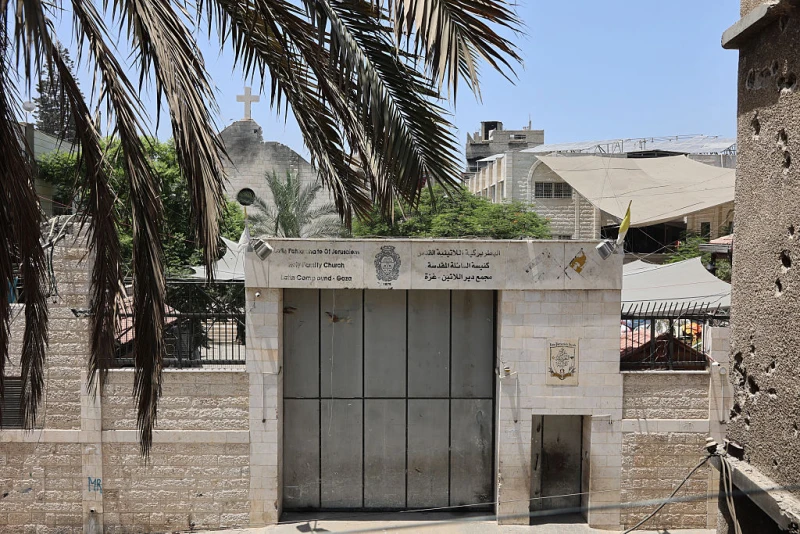
A view of the damage to Holy Family Church in Gaza City following an Israeli strike on the church in the Zeitoun neighborhood of Gaza City on July 17, 2025. The Latin Patriarchate of Jerusalem said an Israeli strike on Gaza’s only Catholic church killed three and injured several people on July 17, including the parish priest, as well as causing damage to the building. / Credit: OMAR AL-QATTAA/AFP via Getty Images
Rome Newsroom, Jul 18, 2025 / 13:00 pm (CNA).
Israel said Holy Family Church in Gaza was “mistakenly” hit during a Thursday military operation and “regrets” damage done to the city’s only Catholic parish.
Israel Defense Forces (IDF) shared a post on X on the evening of July 17 saying “fragments from a shell” hit the parish church, which has become a shelter for more than 500 people since the Israel-Hamas war broke out in October 2023.
“The cause of the incident is under review,” the X statement read. “The IDF directs its strikes solely at military targets and makes every feasible effort to mitigate harm to civilians and religious structures, and regrets any unintentional damage caused to them.”
Saad Issa Kostandi Salameh, 60; Foumia Issa Latif Ayyad, 84; and Najwa Abu Daoud, 70, were fatally wounded by shrapnel that scattered across the compound after the explosion.
Holy Family Church pastor Father Gabriel Romanelli, a native of Argentina and friend of the late Pope Francis, was also among those injured by the Israeli attack.
The Latin Patriarchate in a July 17 statement strongly condemned “this targeting of innocent civilians and of a sacred place,” adding that it “will continue to stand by the side of the community of Gaza” and other Christian communities in the Holy Land.
“The time has come for leaders to raise their voices and to do all [that] is necessary in order to stop this tragedy, which is humanly and morally unjustified,” the statement read.
The attack occurred days after Latin Patriarch of Jerusalem Cardinal Pierbattista Pizzaballa and Greek Orthodox Patriarch Theophilos III spoke out on July 14 against “systemic and targeted” attacks against Christians by illegal Israeli settlers in the West Bank.
“The Church has had a faithful presence in this region for nearly 2,000 years,” the Monday statement read. “We firmly reject this message of exclusion and reaffirm our commitment to a Holy Land that is a mosaic of different faiths, living peacefully together in dignity and safety.”
If you value the news and views Catholic World Report provides, please consider donating to support our efforts. Your contribution will help us continue to make CWR available to all readers worldwide for free, without a subscription. Thank you for your generosity!
Click here for more information on donating to CWR. Click here to sign up for our newsletter.
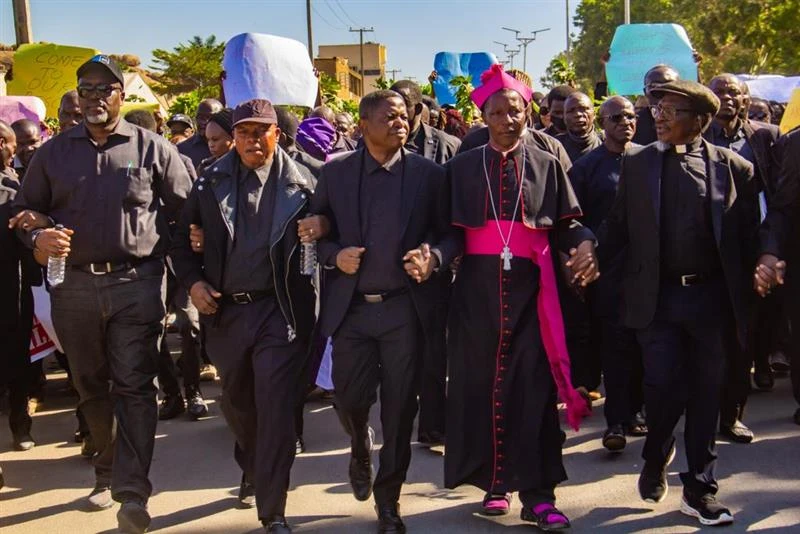
Catholic Archbishop Matthew Ishaya Audu of Jos marches alongside evangelical leader Rev. Dr. Gideon Para-Mallam in front of the Plateau state governor’s office building in Jos, Nigeria, Jan. 8, 2024. / Credit: Photo courtesy of Rev. Dr. Gideon Para-Mallam, photo by Plateau State Government Media Team.
Washington, D.C. Newsroom, Jan 9, 2024 / 15:30 pm (CNA).
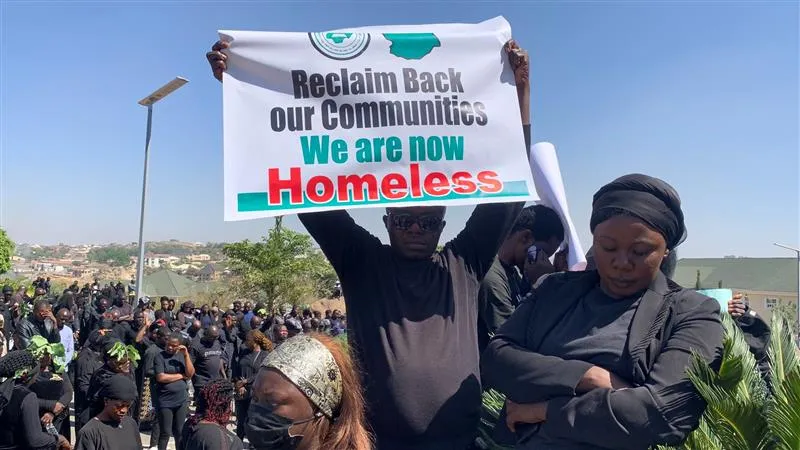
Thousands of Christians rallied yesterday in front of the governor’s office in Nigeria’s Plateau state to demand action after more than 200 were killed in a series of Christmas massacres.
The attacks, which targeted Christian villages beginning Dec. 23 and continuing through Christmas day, left Christian communities in Nigeria’s Plateau state reeling. Photos obtained by CNA after the attack showed villagers burying their slain relatives and loved ones in mass graves.
According to Rev. Dr. Gideon Para-Mallam, an evangelical leader who helped to organize the rally, the attacks also left 15,000 people displaced without homes.
Among the demands being made by the protestors, Para-Mallam said that they asked for an “urgent humanitarian relief material response by the state and federal government” and for the arrest of the perpetrators of the Christmas massacre, which he called a “genocidal,” “terrorist” attack.
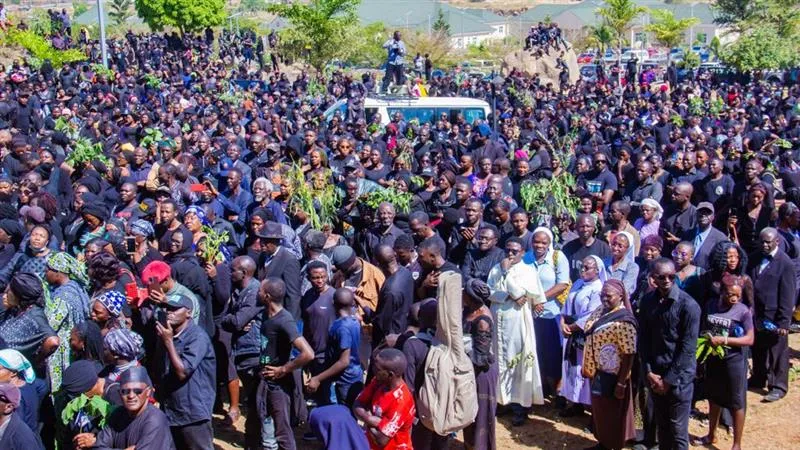
Thousands of Christians peacefully and prayerfully march to a rally in front of the Nigerian Plateau state governor’s office building in protest of the 2023 Christmas massacre that left over 200 Christian Nigerians dead, Jan. 8, 2024. Credit: Photo courtesy of Rev. Dr. Gideon Para-Mallam, photo by Plateau State Government Media Team.
The attack marks the latest instance of terrorists targeting Christian Nigerians on significant Christian feast days. In 2022, on Pentecost Sunday, 39 Catholic worshippers were killed at the St. Francis Xavier Owo Catholic Parish in Ondo Diocese.
Religious freedom advocates believe that militant Muslim Fulani herdsmen were responsible for the Christmas attacks. In Nigeria as a whole, at least 60,000 Christians have been killed in the past two decades. An estimated 3,462 Christians were killed in Nigeria in the first 200 days of 2021, or 17 per day, according to a new study.
Due to continued attacks, Nigeria is one of the most dangerous countries in the world to be a Christian, according to a 2023 report by the advocacy group International Christian Concern.
Para-Mallam told CNA that Nigeria’s middle belt region, of which Plateau state is a part, has “suffered sustained attacks for over a decade now with destruction of lives and properties.”
The thousands of protestors at the rally, he said, were “mournful, angry, but surprisingly joyful.”
Their “central objective,” he explained, was “to ask for an end to the killings not just in Plateau but Nigeria and seek justice for the people.”
Just-In: CAN Plateau State Chapter is having a Peaceful Walk to Government House pic.twitter.com/YbFRqtFI9J
“Above all, it was very peaceful and prayerful,” he added. “The old, the young all together felt that we had to do what we had to do to get our message across.”
According to Para-Mallam, the crowd numbered about 5,000 and included both Catholics and Protestants. Together, he said, they peacefully and prayerfully marched, ending in front of the governor’s office building in the city of Jos. Archbishop Matthew Ishaya Audu of Jos and several Catholic priests also took part in the march and rally, according to Para-Mallam.
The demonstration was “mournful, angry, and surprisingly joyful,” according to Rev. Dr. Gideon Para-Mallam. Credit: Photos by Nigerian multimedia journalist Jœy Shèkwônúzhïbó, used with permission.
The rally was organized with the help of the Christian Association of Nigeria (CAN), a coalition of Nigerian Christian Churches and groups that includes the Catholic Church in Nigeria.
Para-Mallam said the purpose of the demonstration was to “mourn in solidarity” with the devastated communities as well as to show them that the Church “cares” and “identify with them in the moment of suffering and mourning.”
A secondary purpose for the rally, Para-Mallam said, was to “get the Church on the Plateau to unite and to speak with one voice around the issues of social justice” and to “create awareness nationally and globally about the Christmas season attack.”
Para-Mallam said that Plateau’s governor, Caleb Mutfwang, addressed the crowds at the rally and was “sympathetic and understanding and spoke well on the pains of his people.”
Mutfwang condemned the attacks shortly after they occurred in a Dec. 26 statement in which he said: “This has indeed been a gory Christmas for us.”
“He promised to relay our concerns to the president and committed to work with the president to end the killings in the Plateau state,” Para-Mallam said.
Despite the governor and president voicing their support for the impacted communities, several religious freedom advocates have been critical of the lack of government response to the growing terrorist attacks.
Maria Lozano, a representative for the papal relief group Aid to the Church in Need, told CNA after the attacks that tangible government support was largely absent after the Christmas massacre and that a “lack of response from the government” over the years has worsened the situation in the region. The absence of government support, Lozano said, has forced Christian churches to take on the “primary responsibility of providing assistance.”
Para-Mallam asked for Christians outside of Nigeria to help by offering prayer, advocacy, and humanitarian intervention.
“We also want fellow believers to encourage policymakers to encourage the Nigerian government to do more to end the killings in general and particularly those targeted at Christians,” he said.
For several years now, religious freedom advocates have criticized the U.S. government for failing to include Nigeria in the State Department’s “Countries of Particular Concern” list, which some consider to be America’s most effective tool to encourage foreign governments to address the persecutions in their countries.
“There is no justification as to why the State Department did not designate Nigeria or India as a Country of Particular Concern,” said U.S. Commission on International Religious Freedom chair Abraham Cooper and vice chair Frederick Davie in a Jan. 4 statement.
Cooper and Davie mentioned the Christmas massacre as “just the latest example of deadly violence against religious communities in Nigeria.”
Speaking on “EWTN News Nightly” on Monday, Davie said that the decision to leave Nigeria off the list was “particularly” concerning and a “huge mistake.”
Davie told EWTN that “there are some who are saying that the government [of Nigeria] if it is not actively participating in some of this religious persecution is actually standing by and not doing what it can to prevent it.”
“We just believe,” Davie explained, “that by designating Nigeria a Country of Particular Concern, the United States puts itself in a position to work more closely with the government of Nigeria to address some of those fundamental security issues that are going unattended to.”
Despite this, the State Department has left Nigeria off the Countries of Particular Concern list since 2021.
A section of the priests’ house at St. John Paul II Rwamishenye Church in the Diocese of Bukoba in Tanzania was destroyed by the storm Oct. 18, 2023. / Credit: Radio Mbiu
ACI Africa, Oct 21, 2023 / 08:00 am (CNA).
St. John Paul II Rwamishenye C… […]
Kinshasa, Democratic Republic of the Congo, Jan 24, 2018 / 11:58 am (CNA/EWTN News).- After security forces killed at least six people participating in Church-organized protests this weekend, the Archbishop of Kinshasa has likened his country to an “open prison”.
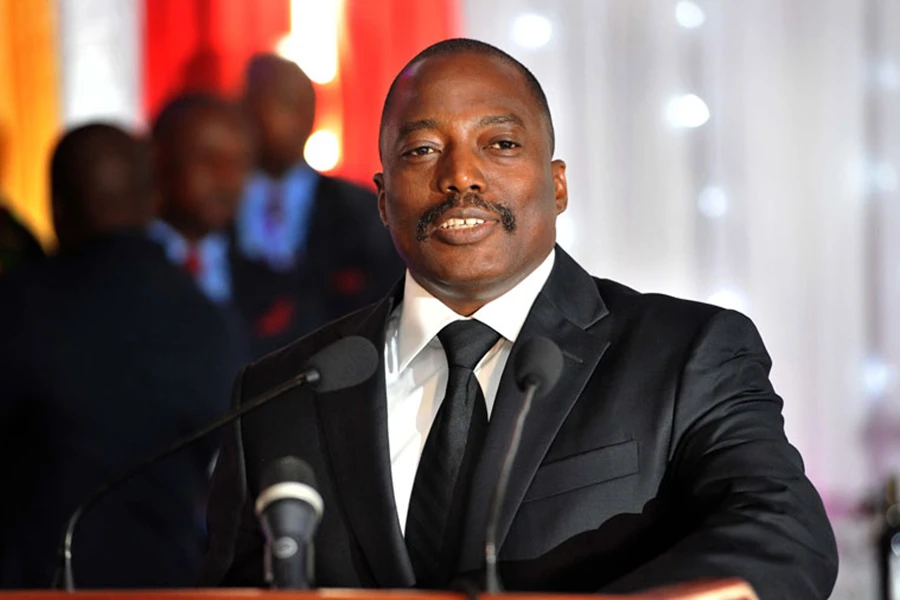
The protesters were calling for Joseph Kabila, president of the Democratic Republic of the Congo, to step down. His two-term limit expired in December 2016, but he has refused to resign and has not allowed elections to be held.
“We were dispersed by tear gas, stun grenades and live bullets. We have again seen deaths, injuries, priests being arrested, and the theft of citizens’ property,” Cardinal Laurent Monsengwo Pasinya said Jan. 23 at a church in the capital, Kinshasa.
“Christians were prevented from praying. Others were prevented from leaving by … police and military who were armed as if they had been on a battlefield,” he said.
“How can you kill men, women, children, youths and old people all chanting religious songs, carrying bibles, rosaries and crucifixes?” Cardinal Monsengwo asked. “Are we now living in an open prison?”
During Jan. 21 demonstrations against Kabila, six people were shot dead by security forces, and dozens more were wounded. Hundreds have been detained, including at least a dozen priests and nuns, The Guardian reports.
The protests were organized by the Lay Coordination Committee of the DRC, which has the backing of many clerics in the country.
Arrests were also reported in Mbuji-Mayi, Goma, and Lubumbashi.
The US Department of State said Jan. 23 that “We are appalled that the DRC government, including President Kabila, would employ repressive tactics and disproportionate use of lethal force against civilians – including religious leaders and children – exercising their democratic rights to call for credible and inclusive elections.”
“The use of lethal force against Congolese citizens, and the cutting of internet and SMS service, undermine the democratic process, obstruct implementation of the St. Sylvestre Accord and contravene international human rights norms,” added State Department spokesperson Heather Nauert.
The latest demonstrations and arrests follow a similar incident on Dec. 31, 2017. Then, several protestors were killed and more than 120 arrested, most of them in Kinshasa.
The bishops in the DRC have asked that Kabila not seek a third term as president. He has been in power since 2001. With about half the population identifying as Catholic, the Church in the DRC is one of the country’s most important institutions.
The Church played a crucial role as mediator in negotiations that led to an agreement reached at the end of 2016 that Kabila would step down following elections to be held in 2017. Those elections were not held, and have now been delayed until December.
The delay in elections has been attributed by the government to difficulties with voter registration.




Leave a Reply