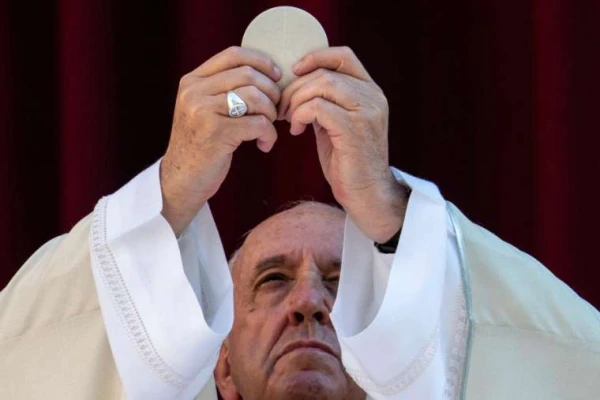
Denver Newsroom, May 29, 2020 / 08:00 am (CNA).- As dioceses across the United States start to reopen public Masses, the scientist leading the government’s response to the coronavirus pandemic recommended that Catholic Churches ought not resume distribution of Holy Communion. But other medical experts told CNA there are ways that Communion can be distributed safely amid the coronavirus pandemic.
Dr. Anthony Fauci, director of the National Institute of Allergy and Infectious Diseases, told America magazine May 26 that he does not consider the distribution of Holy Communion to yet be safe— even if distributed in the hand.
“I think for the time being, you just gotta forestall that,” Fauci said regarding Communion, calling for “common sense” measures to protect worshippers and the wider community such as masks, social distancing, and prohibiting singing.
“As many times as a priest can wash his hands, he gets to Communion, he puts it in somebody’s hand, they put it in their mouth…it’s that kind of close interaction that you don’t want when you’re in the middle of a deadly outbreak,” he told America.
Fauci’s recommendation on the Eucharist came a month after he said it could be possible for Americans to connect with people through dating apps like Tinder, Bumble, or Grindr.
“If you’re willing to take a risk…you could figure out if you want to meet somebody,” Fauci told Snapchat’s “Good Luck America.”
“If you want to go a little bit more intimate, well, then that’s your choice regarding a risk,” he added.
Deacon Robert Lanciotti is a microbiologist and the former chief of the Center for Disease Control and Prevention’s diagnostic and reference laboratory in Fort Collins, Colorado. Lanciotti told CNA that Fauci’s call for “common sense” measures to mitigate the risk of infection does not exclude the possibility of distributing Communion.
“The primary way that this virus is spread is by direct person to person contact; droplets produced when an infected person coughs or sneezes that land on another person and then enter the respiratory tract,” Lanciotti told CNA in an email.
“Maintaining a 6-foot distance or wearing a cloth mask are both methods that disrupt this process. Utilizing one of these measures in a group setting where infected symptomatic people are not present should be a sufficient level of risk reduction.”
Lanciotti, a graduate of Loyola College, was ordained a deacon in 2017.
He took issue with Fauci’s concerns regarding Communion in the hand.
“With the use of hand sanitizer immediately prior to the distribution of Holy Communion, and being careful not to directly touch the communicant, there is virtually no risk in the distribution of Communion,” Lanciotti told CNA.
Deacon Lanciotti pointed to an April 28 document from the Thomistic Institute in Washington D.C., written by medical professionals, researchers, and theologians.
That group recommended that out of respect for the Mass, the priest ought not wear a mask or gloves during the Mass, and neither should anyone distributing Communion.
Under the group’s recommended guidelines, those who wish to receive could approach the altar, spaced six feet apart; if the priest believed he touched the hands or mouth of a recipient, he could use hand sanitizer sitting on a table next to him.
According to the Thomistic Institute’s recommendations, the Precious Blood ought not be distributed at Mass.
To date, dioceses that have developed Church reopening plans have called for suspension of distribution of the Precious Blood. The Catholic Church teaches that reception of either the host or the chalice is a complete act of Eucharistic reception.
The Thomistic Institute’s document, distributed to bishops by the U.S. bishops’ conference, also recommends— as did Dr. Fauci— that singing ought to be discouraged.
It also states that it could be possible to receive Holy Communion on the tongue “without unreasonable risk.”
The document recommends that the elderly and those with underlying medical conditions ought not attend Mass anyway, as they are at especially high risk.
“I completely agree with this statement…In the setting of a church service, the single most important safety measure is for symptomatic individuals to stay home,” Lanciotti told CNA.
“I would argue that having sick individuals stay home, followed by adopting one more measure— masks or social distancing— is a reasonable approach. Utilizing both masks and social distancing represents a safety redundancy that is excessive and counter to ‘common sense,’” he said.
At St. Peter’s Basilica in the Vatican, Masses resumed May 18, after more than two months of closure amid Italy’s coronavirus lockdown.
Visitors are advised to keep two meters apart, hand sanitizer is available at kiosks in the basilica, and, at the church’s entrance, the body temperatures of visitors are checked with scanning thermometers, by two attendants wearing hazmat suits.
The Eucharist is distributed during Masses at the basilica.
Fauci, a Catholic, attended a Jesuit secondary school and Jesuit university.
In 2015, he told C-Span that he is no longer “a regular church-attender. I have evolved into less a Roman Catholic religion person to someone who tries to keep a degree of spirituality about them. I look upon myself as a humanist. I have faith in the goodness of mankind.”
He similarly told America that he appreciates his Catholic education, and especially the values he was taught at the Jesuit institutions he attended.
“I identify more, much more, with that than the concept of organized churches, religions,” he told America.
Other Catholic medical professionals have weighed in on the question of whether Holy Communion can be distributed safely.
An ad-hoc committee of seven Catholic doctors and medical school professors released on May 12 a document entitled “Road Map to Re-Opening our Catholic Churches Safely.” That group of doctors concluded that the safest recommendation is to receive Communion in the hand rather than on the tongue.
The document calls for Mass to be held with social distancing, and for the use of masks and hand sanitizer. Singing should be avoided, and those who are ill or believe they may have been exposed to the virus should stay home, it says.
One member of that committee is Dr. Andrea Baccarelli, chair of Environmental Health Sciences at Columbia University’s School of Public Health.
Baccarelli told CNA that he agrees with and appreciates Fauci’s suggestions, and that there is a risk to the distribution of Holy Communion.
“Our committee wrote a plan to minimize the risk to distribute communion. That doesn’t mean that there will be no risk nor that we advised on whether it was safe to do it now or in the future,” Baccarelli added. “We just provided a document to guide masses and distribute Communion whenever it will be safe enough to do so.”
“If Dr. Fauci suggests it is not time yet to distribute communion, I think we should listen to him and wait before doing that again,” Baccarelli said.
Another member of the committee told CNA last week that he believes Catholics can attend Mass safely, and sacraments can be administered with appropriate precautions.
“I think that if we just use common sense to compare apples to apples for metrics that we know matter – like density, for example – then there’s no real kind of objective scientific reason why Mass is any more dangerous than going to the grocery store. I think the difference here is a perceived risk,” Dr. Andrew Wang, an immunobiologist at the Yale University School of Medicine and one of the plan’s co-authors, told CNA.
The plan calls for confessions to be held in outdoor or well-ventilated indoor areas, with the use of masks, an impermeable barrier between the priest and penitent, and frequent sanitization of surfaces.
Wang said that distributing Holy Communion on the hand, rather than on the tongue, represents an appropriate precaution for churches, especially while some things about the coronavirus spread are not yet completely understood.
Acknowledging that some people may object to that recommendation, Wang said that in his perspective, “it boils down to, is it better to not have communion at all – and by extension not have Mass at all?”
Ultimately, Wang said, going to church at this time is not risk-free, just as any other public activity is not without risk during a pandemic. He noted that dioceses throughout the country have granted dispensations from the Sunday obligation for those who are unable to attend or are not comfortable with the risk involved.
Deacon Tim Flanigan is a member of the Thomistic Institute’s working group, an infectious disease specialist who has battled Ebola outbreaks, and a professor of medicine at Brown University. Flanigan also told CNA that Catholics can return to Mass and the sacraments safely – if they observe CDC protocols.
“The question is: can I follow the CDC guidance just as carefully, in each setting, in order to decrease transmission of coronavirus? Can I maintain safe distancing? Can I maintain good hand hygiene? Can I ensure that I am not ill?” Flanigan told CNA last week.
If CDC guidelines are followed, “There is no reason to prohibit church services when you don’t prohibit other gatherings,” Flanigan said.
“The CDC gives us that guidance to decrease the rate of transmission. It’s just as important that guidance be followed at a house of worship, as at a conference, as at any other gathering.”
“If somebody makes an arbitrary judgment that a church is not going to follow that guidance, without any evidence, that is biased and there is no evidence for that,” he said.
Flanigan questioned the categories of some governors who classified religious gatherings as “non-essential,” compared to more “essential” activities like grocery stores.
“Being able to come together and pray together, being able to receive the sacraments, to encounter the Lord, right there in the sacraments, is so important,” Flanigan said.
Mental health is just as important as physical health, just as important as spiritual health,” he said. “We are a whole self, which has a mind, a body, a heart a soul. To be able to pray together, to be able to support each other, to be able to worship together, to be able to receive the Lord in Communion, is so important for us to be healthy and to thrive.”
“That is why our churches are essential,” Flanigan told CNA.
 […]
[…]






German Archbishop authorizes blasphemous dance at ancient cathedral:
https://www.breitbart.com/europe/2025/05/30/fowl-behavior-chickens-in-diapers-dance-performance-at-westphalia-cathedral-blasted-as-blasphemous/
Chickens in Diapers and half-naked men Dance Performance at Westphalia Cathedral Blasted as ‘Blasphemous’
The question for Martin is this: Have the sheep abandoned the shepherd? Jesus told us that he knows the sheep and the sheep know him. It seems to me that the crisis in that diocese is less about the Tridentine manner of offering the Holy Sacrifice of the Mass but the full frontal assault on the liturgical sensibilities of the worshipping community in the diocese of Charlotte. Standing v. kneeling, mantillas v. barehead, and on and on. It’s all so arbitary. What’s important is that we do God’s will, proclaim the Gospel to the world and seek the kingdom.
A delay of five months is delaying the inevitable. Trads simply need to accept and live with the reality that Traditionis Custodes requires bishops to phase out the use of the 1962 Missal.
The bishop’s reversal will probably convince trads that if they make a big enough stink, then they can get their way. That’s not true. The Roman Rite is now in the form of the Third Edition of the 1970 Roman Missal: i.e., the reformed Mass. The TLM is going away, as it should, because that’s what Vatican II decreed when it called for the liturgical books to be revised.
Miss Dorothy, should we refer to other Catholic Christians as “Trads “?
I see a lack of charity on all sides of the issue. Catholic means universal and there’s room for diversity in rites and liturgies.
Let’s model charity and respect towards each other please.
They call themselves trads with pride; it’s not derogatory. Besides, Dorothy is right that the TLM should have the plug pulled. There is no place for a pre-Vatican II liturgy in a post-Vatican II Church. The TLM is not liurgical diversity; it’s liturgical backwardism. The Roman Rite has evolved.
Sebastien, do you think similarly about the Byzantine Rites?
I think we should all consider charity more seriously in commenting. Myself included.
mrscracker, yours are universally, always the most charitable of comments.
My thinking seconds Mr. Meynier’s.
Did we ever think we’d live to see the day? Liturgical ressourcement is now portrayed as backward!?!
Seabass and Dot would pull the plug on Jesus’ liturgical practices! After all, he lived a very long time ago. Even paper had not been invented then. Design and development have EVOLVED. We know more today than the mork trads of yesteryear. Down with tradition, no matter its stem, root, source or foundation.
Sebastian, your comment reveals that you are unaware (perhaps due to living in a news bubble rather than lack of Christian princple) that Pope Francis practiced clericalis, presumption, and hypocrisy when it comes to accompaniment and dialog for those he did not understand and was inclined to be judgmental toward. He was a man of deep empathy and compassion, but not with the consistency of a saintly pope. George Wiegel, who is exlusively Novus Ordo and does not care for the TLM, points out that Traditiones Custodes is “cruel and unnecessary”. When you get into the details you will realize that TC is based on lies as well as being a way of promoting Vatican II by betraying Vatican II. I pray that Pope Francis was manipulated, and was a victim of the lies rather than an architect.
Excellent comments, Mrscracker! You are right on!
“Bishop Martin is Out of Touch”
https://firstthings.com/bishop-martin-is-out-of-touch/
Perhaps the TLM saves more souls, brings the sinner closer to Jesus; has that been considered?
Are we to just look like the Protestant brands?
SWhatDorothy said was nonsensical. The Church still allows the Ambrosian, Mozarabic, Dominican, Carthusian, Carmelite, Anglican Use, Byzantine, Alexandrian, Maronite (Antiochene) Rites, and more. Pope Benedict XVI was clear that the Ordinary and Extraordinary forms were two forms of the SAME Roman Rite. He also said they could help each – there were some minor changes to the Tridentine, for example – it is NOT pure Tridentine.
Yes, but — for example — the Mozarabic rite does not have the legal fiction of an ordinary form and an extraordinary form: there is one Mozarabic rite. Same with the other rites. Similarly, there is one Roman Rite: the post-Vatican II evolution of the Roman Rite, which is the Missal of Paul VI.
There are approved “uses” of the Roman Rite, but they all follow the post-Vatican II form of the rite. The TLM cannot be considered a “use” of the Roman Rite nor a “form” of the *current* Roman Rite (Pope Benedict was wrong). The TLM is properly understood as a prior liturgical form of the Roman Rite, a form that has been superseded by the new form: the Missal of Paul VI.
That’s exactly what trads like about it: that it is preconciliar, because at heart the trads reject the reforms of Vatican II.
The permissions to celebrate the TLM have their origin in pastoral concessions to avoid schism, not in the intent to preserve the celebration of the TLM in perpetuity. Trads have wrongfully turned a temporary pastoral concession into a hope for perpetual indulgence of their preconciliar proclivities.
Pope Benedict was a careful scholar who studied and wrote on the Divine Liturgy. Pope Francis was often rash and rarely a nuanced thinker (though he had some good ghostwriters). As Father Stravinskas has pointed out the Novus Ordo is the Roman Rite Mass with parts removed and some parts added. Basically, it is to the TLM what a movie adaptation is to a classic novel. When staying close to Sacrosanctum Concilium it can be a quite adequate and satisfying abridegment. But as you know, some movie adaptations are both unfaithful and horrid messes. Pope Francis was much less zealous about fixing actual abuses; one hopes that only his mind and not his heart was in the wrong place.
Rads have wrongfully turned episcopal power into a hope for perpetual eradication of their postconciliar proclivities.
FIFY, you’re welcome.
Yes. Many rites, one Faith.
No, Dorothy, we “Trads” do not have to accept and live with the reality that TC requires bishops to phase out the TLM. The bishops (and you) need to accept and live with the reality of Pope Pius V’s Quo Primam Tempore. Read it and you will see that Traditiones Custodus is invalid and anathema.
Quo Primum was a liturgical directive that bound the Church at that point in time, and was understood to be in force in perpetuity until a subsequent change occurred by a future pope. It was an ecclesiastical law, not a Divine law. It set policy for worship, but was not a definition of faith in and of itself. “Trads” have used this document (especially the SSPX) to further their argument as proof that the Tridentine Mass can never disappear or be limited because it is necessary for salvation to the exclusion of the so-called Novus Ordo Mass. But Tradition is not more important than the living authority of Christ via His Church. Like it or not, the OF form of the Mass is an acceptable and valid form of worship. To claim otherwise is private judgment and Protestant in spirit.
Everything you wrote can be applied to Traditiones Custodus.
Given that “Trads” (I note this is used as invective, especially if you are part of the FBI-are you part of the FBI?) are the ones doing the marrying and having children, perhaps they should be accommodated.
If it was up to me, I’d allow both forms. If it fifty or a hundred years, we see a growing, pious and faithful Church because of Novus Ordo, even if the music is guitars and flutes-so be it.
But if the TLM is what fills pews, so be it.
I agree Pitchfork. But I also have qualms about both forms being in competition with each other. I like the premise of the EF being preserved, and people having a choice, but I dislike the outcome of one eventually winning and the other losing. Which in effect means we all lose. The EF was never intended to remain in force, it was to be phased out. And many adherents weaponize it to discredit Vatican II. On the other hand, we are all too familiar with the lousy implementation of the OF and all the satellite nonsense surrounding it, crummy music being at the top of my personal list. Traditionis Custodes is the last current document in effect and until Leo or a future pope changes it, it should be accepted.
Did you see Pope Leo XIV talk to the Eastern Catholic Patriarch after the Conclave? He said their ancient orthodox rite was beautiful and should continue on. If the Eastern Catholics can have their ancient rite, then why can’t we have our also ancient Latin rite? What’s the difference?
Looking back on the last 69 years, 60+ of which I can remember, including starting as an altar boy, and choir boy, in the ancient Mass, and having lived through the ugly, brute force NO implementation, and over the last 30 years reading deeply and widely about the “reform of the Mass,” and the “reform of the reform,” it seems that the plan of the Church establishment is to commit cultural suicide.
Chris, we might paraphrase Orwell’s famous 1984 quote:
If you want a vision of the future, imagine a Novos Ordo boot stamping on the Latin Mass forever ?
Neither form of the Mass are the enemy though. This is about fallen human nature, not liturgical preferences.
Too true, alas. I have no idea why the Tridentine Mass went from the visible symbol of Catholicism’s universality–the thing that made a Catholic feel at home no matter where he was–to the epitome of liturgical evil. And, of course, made thd Catholics who still cherish it outcasts in their own Church…
The answer is simple: the liturgical reforms of Vatican II changed the form of the Mass for the whole Roman Church. The new form of the Mass is the current liturgical form to which all Roman Catholics are expected to adhere. The TLM is the former, preconciliar form of the Mass, which has been superseded by the conciliar mandate to revise the liturgical books and the subsequent promulgation of those books.
I don’t understand why trads can’t understand that simple logic. Nor why they won’t accept Vatican II.
Sebastian, in an effort to help you to understand why trads can’t understand “that simple logic” I suggest that you read Quo Primum Tempore. You will understand quite clearly that the TLM cannot be abrogated or suppressed. It is there for all to read.
It’s time for all Roman Rite Catholics who care deeply about reverent liturgies to switch affiliation from the Roman Rite to the Anglican Rite or any of the multitude of Byzantine Rites.
The Roman Rite extant in 1960 worked for the vast majority of Catholics and churches were filled to the brim. That “good-enough” Roman Rite was tossed aside and now only about 19% of Catholics attend the new rite Masses on a regular basis. Draw your own conclusions.
The New Mass, written by a committee which included Protestants, did not follow the guidelines of Vatican II in many ways. The Council Fathers wanted minor changes, such as perhaps the scripture readings in the vernacular and perhaps the congregation joining the priest in the Our Father, but not the wholesale tearing up and starting over (in large part) of the resulting mass. They definitely wanted the Roman Canon to remain as it was, and always to be in Latin. Now there are at least 8 Eucharistic prayers, one of which is mostly the Roman Canon. Depending on the whim of the priest, there is almost infinite variety in the new mass, and complete uniformity in the old rite.
“I don’t understand why trads can’t understand that simple logic. Nor why they won’t accept Vatican II.”
Have you read the documents which outline Novus Ordo, I mean HOW it must be celebrated? It clearly states such rules as priests facing the same direction as parishioners is a major choice; Gregorian chant is a major choice; silences and solemnity and so on. I do not go to TLM but two things are clear to me:
1 – Novus Ordo can and must be celebrated according to the actual prescribed rules (see above)
2 – the reforms of the Vatican II were overtaken and “interpreted” by the people who want to worship themselves instead of God. And so, when you speak about NO which “superseded” TLM and thus must be accepted, you in fact speak of its narcissistic “interpretation”. Alas, the possibility of such an interpretation, up to sacrilege, seems to be inherent in some aspect of the NO. It probably shows that the Church must not allow a choice when it is a liturgical matter; too many priests take it as a license to perform and improvise, making the worship impossible. The very predictability, word after word and solemnity makes Mass universal i.e. belonging to everyone. When you are free from a fear of “improvisations” bordering on sacrilege you actually can pray. This is why, I think, people appreciate the Latin Mass.
The God-orientation of TLM, so often being compromised by NO, is, I believe, the major reason why it is being suppressed. NB: Novus Ordo also has the God-orientation and can be done splendidly, but it is far easier to “bring it down” to the level of “us, beloved”.
I was a young adult around the time of Vatican II. While the vernacular Mass was instituted worldwide, the Tridentine Mass was not abolished, and in fact was to continue to have a place in the Church. There is no particular reason why Mass in both forms cannot continue to be accepted. But it is the intensity of its rejection that I find especially troubling.
Jo-Anne, the TLM was never hated as much since 1789. Today’s freemasons can idly watch on, as the post-conciliar-catholic bishops finish the work of the 18th century Luciferian sects for them. The devil hates latin…
IMO this is the first real test for our new Pope.
Let’s hope and PRAY that he passes.
Terence; Sadly, whatever he decides will never please all. He doesn’t have a chance of passing “the test”, for there is no correct answer.
Br. Jaques. I think there IS an answer. As with all other PROTESTANTS , they can leave, cross the Tiber and join their Vatican II deniers on the other side.
Please define what a “Vatican II denier” means. It was a legitimate council of the Church, and a legitimate disaster for the Faith. Does that make me a denier? According to every study I have seen, 67% of Catholics attending Mass today deny the Real Presence of the Eucharist. How does that fit into your “denial” litmus test?
Agree
Pope Benedict XVI on the Traditional Latin Mass:
‘What earlier generations held as sacred, remains sacred and great for us too, and it cannot be all of a sudden entirely forbidden or even considered harmful. It behooves all of us to preserve the riches which have developed in the Church’s faith and prayer, and to give them their proper place.”
Pope Benedict XVI used his 2007 motu proprio Summorum Pontificum to affirm the use of the Traditional Latin Mass (Extraordinary Form) alongside the Ordinary Form (Novus Ordo). He stated that the TLM was not “forbidden” but should be honored and preserved as part of the Church’s rich liturgical tradition. He also emphasized that the Tridentine Mass was not a “faulty” Mass and was valid and could be celebrated freely by priests.
YES! Also, Cardinal Ratzinger wrote:
“What happened AFTER THE COUNCIL was something else entirely: in the place of liturgy as the fruit of development came FABRICATED LITURGY. We abandoned the organic, living process of growth and development over centuries, and replaced it–as in a MANUFACTURING PROCESS–with a FABRICATION, A BANAL ON-THE-SPOT PRODUCT.” [Emphases added.]
~From the Preface to the French Edition of “The Reform of the Roman Liturgy: Its Problems and Background.”
He’s not the pope anymore. He was overturned by Pope Francis. He was also wrong. You’re quoting a document that is obsolete. You have to do better than that.
Francis too is no longer the pope, so by your logic, are his documents not also obsolete?
Also, what relevance does Scripture hold under your understanding of obsolescence?
Finally, what authority gives you the right to claim that Benedict was wrong?
Finally, no one ‘overturned’ Benedict. A successor pope simply chose to dishonor the beauty, truth, wisdom, and goodness of some of Benedict’s work. QED.
It’s not a court decision.
What is accomplished by the delay if the end result is to cancel Latin Mass there anyway? I am not a Latin Mass attendee, have not been to one in 50 years, but I dont see what harm is done by allowing people to worship at what had been a legitimate form of Catholic Mass for thousands of years. Who are they bothering?? Except of course, the control freaks, of which this Bishop appears to be one. Its my opinion that this Bishop has already squandered what little good will he had among the members of his diocese, and he will be ineffective going forward. He appears to have been primarily an administrative type before this assignment and it shows in his “my way or the highway” attitude. Would not be in his diocese for anything, nor would I donate a dime while he was still in power.
This type cant admit the installation of V2 changes heralded large scale damage to the church. The effect of fleeing clergy, non-church going parishioners, drop in donations, and flat out stripped, ugly churches resulted in damage to the Church which is felt to this day, decades later.
I come from a long line of Protestants. If I wanted to pray in a stripped down church devoid of inspiration , I could select from any number of denominations. Our parish church says the “Lamb of God” response in Latin during lent. So far no one has died from the experience . I would not mind keeping a touch of Latin all year round. It adds a bit of special beauty to the liturgy.
My parish church is primarily done in marble and which was too expensive to remove during the V2 tragedy. Thats why it survives to this day. Beautiful. The interior looks traditional and yet a reverent NO Mass is offered there. For us it works. But I think traditionalists should be free to attend a Latin Mass if they want to.
Where in the documents of Vatican Council II did it call for “Clown Masses”? (we had those in our parish church in Ridgefield, CT).
Where in the documents of Vatican Council II did it call for “Balloon Masses”? (we had those too).
Where in the documents of Vatican Council II did it call for “Religious Sisters doing interpretive dance in the center aisle”? (saw that at a Jubilee celebration at the Motherhouse of the School Sisters of Notre Dame in Wilton CT)
BUT “NO” TO COMMUNION ON THE TONGUE!!!!
(BTW, I’m not one who attends to Extraordinary Form )
It is truly sad that this Mass was ever let go! I grew up with it, as did so many, and they took it away! We always had translations in our St. Joseph Daily Missal! WE HAD TO CHANGE!!! Bishop Martin needs to see the many folks who attend this Mass at Our Lady of Grace, Greensboro! I appreciate his delay, but he really should reconsider his decision! It is truly a beautiful, well attended Mass! In my opinion, it should remain! Many young families attend every Sunday! We are all praying for Bishop Martin and for ourselves that we will grow closer to Christ! Thankyou!
Every argument that traditionalists use for the TLM has its exact counterpart among LGBTs who want gay marriage blessed by the church.
We just want to worship/love the way we want.
The church is persecuting us, a minority.
Why won’t the church just listen to us about our experience?
This is how we connect with God.
There should be room for diverse expressions of faith in the church.
The church does not have the authority to ban our worship/our love.
I’m going to do what I want anyway, regardless of what the church says.
Et cetera.
Wake up call.
I’d be very interested if you could state the source of your belief that traditionalists think such as you’ve listed. How does continuing in a state of make-believe differ from living a lie?
You might try better reading material:
The Heresy of Formlessness: The Roman Liturgy and Its Enemy (Revised and Expanded Edition), by Martin Mosebach.
Close the Workshop: Why the Old Mass Isn’t Broken and the New Mass Can’t Be Fixed, by Peter Kwasniewski, Ph.D.
A Forest of Symbols: The Traditional Mass and Its Meaning, by Abbé Claude Barthe, translated by David J. Critchley, with a Foreword by Robert Cardinal Sarah.
Bolderdash, Amy. Absolute bolders.
There is no link what-so-ever between sacred apostolic tradition being trashed and the promotion of sodomy and alphabet derivitives. No link, other than this: the novos Ordo protestants are also the pro-sodomites.
It would seem to me that what would suffice is a concise letter or homily reminding the Faithful that they should not assume attendance at a Latin Mass confers greater individual holiness or superior spirituality. However, in my experience, attendees do tend to show greater reverence, and it is a beautiful Mass. Personally, I am more drawn to the centrality of the Eucharist.
Martin’s restrictions included: “Neither an upright crucifix nor fixed candles may be placed on the altar, lest they interfere with the sight-lines of the congregation.”
Bishop Martin ‘sees’ a crucifix or a source of light on the dining table interfering with vision! Does he not understand irony?
He obviously prefers the congregants not to be reminded of the light of the world nor of the sacrifice of Jesus on the cross.
Personally, I remember the last meal and the bold details of the deathbed of my dear mother.
This priest/bishop Martin is clueless regarding the riches of vision and memory as they pertain to the Lord.
Jesus: “But blessed are your eyes, for they see: and your ears, for they hear. For verily I say unto you, That many prophets and righteous men have desired to see those things which ye see, and have not seen them; and to hear those things which ye hear, and have not heard them. Hear ye therefore the parable of the sower. When any one heareth the word of the kingdom, and understandeth it not, then cometh the wicked one, and catcheth away that which was sown in his heart. ~Matthew 13:16-19.
Good Jesus, have Mercy on us, and deliver us from evil.
I remember the lighting in the room where my mother died.
Rorate Caeli: News from Charlotte: Bishop Comes for the Catholic Schools’ Masses
Posted by New Catholic at 9/04/2025 06:53:00 PM
Excerpt:
“We have received a report of the new liturgical directives which Bishop Michael Martin of Charlotte wishes to impose on the masses of Paul VI celebrated in the three Catholic high schools under his jurisdiction. The goal is apparently the decatholicization of the new liturgy in the schools under his authority.
Unfortunately, but not surprisingly, they are exactly what we would expect, given what we have previously seen of his ideas about “liturgical norms.”
The use of kneelers and communion rails for the distribution of Holy Communion is forbidden.
There must be students to serve as extraordinary ministers of Holy Communion.
A projector and screen are to be installed in the chapels to facilitate the singing of hymns and longer parts of the Mass such as the Gloria and the Creed. (It is, of course, a major pastoral problem that young people today spend too much time reading from books, and not enough time interacting with screens.)
At large Masses, a student is to give a testimonial about their faith life, lasting 3-5 minutes, between the final prayer and the blessing and dismissal.”
We might be tempted to say that Bishop Martin has learned nothing from the international backlash that resulted when his would-be liturgical norms, full of absurdities and illegalities, were leaked, but this would be unfair. He has learned not to put such things in writing, and to communicate them only by word of mouth.