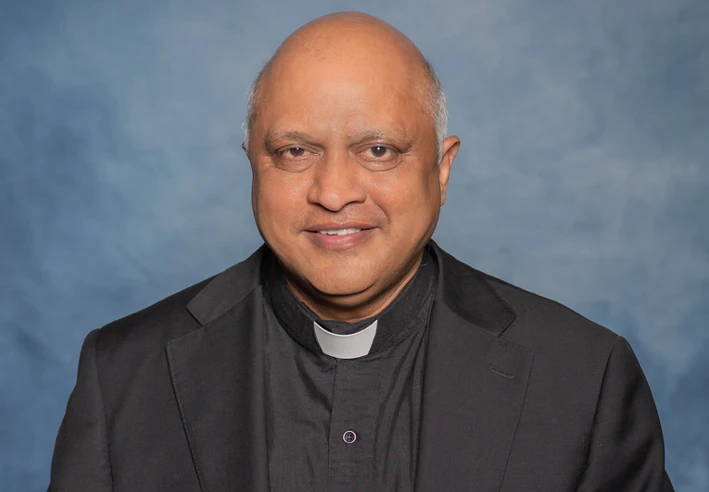
Father Arul Carasala served as a pastor in the Archdiocese of Kansas City, Kansas for over 20 years. / Credit: Courtesy of Archdiocese of Kansas City
CNA Staff, Apr 8, 2025 / 17:12 pm (CNA).
The accused killer of a Kansas Catholic priest shot the clergyman last week “intentionally” and with “premeditation,” a prosecutor has said.
Gary Hermesch was taken into custody last week at the Nemaha County Jail and charged with first-degree murder in the shooting of Father Arul Carasala, the Nemaha County Sheriff’s Office said.
Carasala was shot at Sts. Peter and Paul Catholic Church in Seneca on April 3. The priest later died from his injuries at Nemaha Valley Community Hospital.
Nemaha County Attorney Brad Lippert’s office said in a press release that the murder was planned beforehand. Hermesch is being held on a $1 million bond at the county jail.
The exact motive of the shooting remains unclear, though local news outlet KSNT reported that Hermesch had previously written letters to the local paper that contained both political and religious remarks.
“[M]aybe if we just follow Donald Trump’s example we’ll ‘make the Church great again,’” Hermesch reportedly wrote in one of the letters in which he also alleged that “the faith” is “not being taught.”
In other letters he reportedly referenced a “fake Catholic Church” and spoke negatively of the Second Vatican Council.
The priest had served in the archdiocese for more than 20 years. Kansas City Archbishop Joseph Naumann said after the shooting last week that Carasala “was a devoted and zealous pastor” who “faithfully served” the archdiocese.
“His love for Christ and his Church was evident in how he ministered to his people with great generosity and care,” the archbishop said. “His parishioners, friends, and brother priests will deeply miss him.”
If you value the news and views Catholic World Report provides, please consider donating to support our efforts. Your contribution will help us continue to make CWR available to all readers worldwide for free, without a subscription. Thank you for your generosity!
Click here for more information on donating to CWR. Click here to sign up for our newsletter.
CNA Staff, Dec 14, 2020 / 05:01 pm (CNA).- The life of Fr. Patrick Peyton, an Irish-American priest who traveled the world hosting hundreds of rosary rallies and encouraging families to pray together, is the subject of a new film now available for onli… […]
At the opening reception for the Ricci Center’s “On The Road” exhibit in the School of Theology and Ministry Library was held in June 2023. / Credit: Lee Pellegrini
Boston, Mass., Sep 24, 2023 / 09:00 am (CNA).
An exhibition of powerful images documenting the lives of Catholics in rural China is now on view at Boston College, presented by the college’s Ricci Institute for Chinese-Western Cultural History.
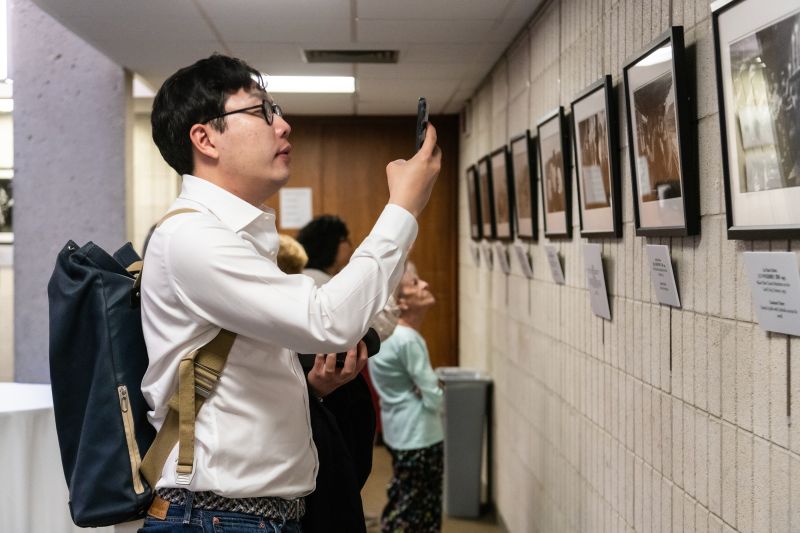
“On the Road: The Catholic Faith in China”— which has been extended through Dec. 22 — comprises 60 images taken between 1992 and 1996, when world-renowned photographer Lü Nan traveled on the road through 10 Chinese provinces to document the lives of Catholic villagers. Fifty images are on view at the School of Theology and Ministry (STM) Library Atrium; 10 are displayed at the O’Neill Library Gallery.
One of the most respected photographers in China today, Lü is considered unrivaled in his capacity to capture and reveal human dignity and the poignancy of the human condition, according to exhibition organizers.
“Lü Nan’s corpus of work is very striking,” said Ricci Institute Director M. Antoni J. Ucerler, SJ, a provost’s fellow and associate professor of history. “His focus, with this project and others, is to explore minorities and communities on the margins of Chinese society. Christians in general and Catholics in particular in remote rural areas, from Yunnan to Tibet, are the focus of this collection of photographs.”
Ricci Institute Director M. Antoni J. Ucerler, SJ. Credit: Photo courtesy of University of San Francisco
Given that the exhibition subject is Christians in China, the Ricci Institute partnered with STM as its primary venue, Ucerler explained, and three STM students co-curated “On the Road.”
Amid the economic and social complexities of the time, “Lü witnessed nothing short of a miracle,” the curators note in an exhibition description: “people of deep faith, despite constant strife in everyday life, on the road to heaven.” This collection — arranged in five categories that depict different aspects of the life and faith of the people he encountered — is his “attempt to convey to the world the miracle he witnessed.”
The Ricci Institute, an internationally recognized research center for the study of Chinese-Western cultural exchange, collaborated on the Boston College display with Michael Agliardo, SJ, director of the U.S.-China Catholic Association in Berkeley, California, and Jamason Chen at Loyola University Chicago. Chen, who often represents and speaks on behalf of his friend Lü, will appear on campus this fall, at a date to be announced, to discuss the exhibition.
“The visual exploration of the profoundly human experiences of these Christian communities in rural China is very specific in terms of time and place. And yet these stark photographs speak eloquently of a common human condition and of the reality of a lived faith across cultures and borders,” Ucerler said.
He described each photograph as “a mini-meditation that invites the viewer to become attentive to and respectful of the message that it is conveying. Each image reveals the complex reality of the Christian faith well beyond the familiar confines of the Western world, while at the same time appealing to universal themes that are part of a shared humanity.”
Following a five-year affiliation with China Pictorial, Lü worked as an independent photographer and produced a trilogy of acclaimed works that made his international reputation. The second comprises the works in this exhibition; many of them have been displayed around the world and have been published in the book “On the Road”(Ignatius Press, 2021). Agliardo assisted Lü in its publication and wrote an afterword to the volume.
“During the period when Lü Nan shot ‘On the Road,’ he visited over 100 church buildings. However, the emphasis of his photographic journey is on how love and faith are practiced in the everyday life of the believers,” according to a description of the book. “His aim is to show that inner divinity is imbued in the everyday life of these believers, and that their time on earth is but a tempering trajectory: Through enduring the trials of life’s fortunes and mishaps, they are able to find true values in divine grace.”
At a campus opening event held last month, Ucerler said a theme that stands out for him is “transcendent hope through a deep faith in the midst of vulnerability.” The co-curators echoed that observation and shared their personal experiences of interacting with the work of the artist. Their reflections and thoughts on the exhibition all underscored the deep faith and hope of those portrayed by the photographer.
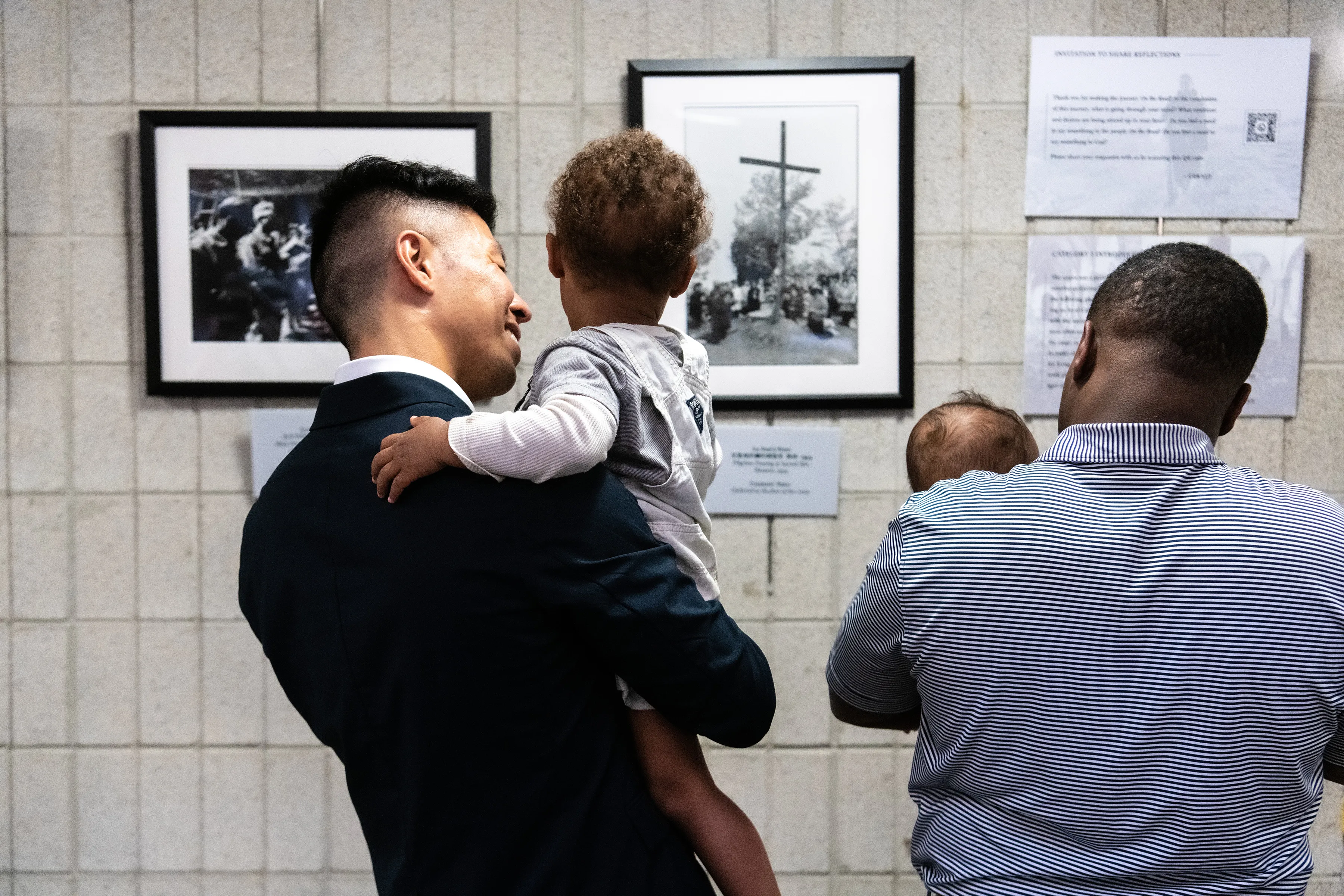
“On the Road: The Catholic Faith in China” exhibit runs through Dec. 22, 2023, at Boston College, presented by the University’s Ricci Institute for Chinese-Western Cultural History. Photo credit: Lee Pellegrini
“The images depicted might be considered austere, showing poverty and suffering,” said co-curator Wen Jie Gerald Lee, MATM/MBA ’23, of Singapore. “But they communicate profound joy, contentment, peace, and purpose in spite of harsh living conditions.”
Ricci Institute intern and co-curator Zhangzhen Liang MTS ‘23 — who was a young girl when Lü visited her Chinese village for this series — hopes “the perseverance and faith expressed in these photos will empower all of us to move forward together, to live a rich and thriving life, and encourage us to become the light of the world.”
Doctoral student and co-curator Shinjae Lee ‘27, whose family moved from China to South Korea, concluded with a quote from Lü: “I hope that by looking into real life I find something fundamentally and enduringly human.”
The curators, who wrote the accompanying wall text, encourage exhibition visitors to record their reactions to these evocative images, by scanning a QR code available as part of the installation. These responses will be shared with other patrons.
“We sincerely hope that those who view this exhibit will experience a common bond with those who are depicted,” Ucerler said, “and allow themselves to be transported to these faraway communities so that they can learn something from their visual witness.”
According to organizers, in addition to Chen’s appearance, other events will be held in conjunction with the exhibition, and the “On the Road” volume is available at a discounted price.
“On the Road: The Catholic Faith in China” is co-sponsored by the Ricci Institute and Boston College Libraries, with funding from the EDS-Stewart Endowment for the Study of Chinese-Western Cultural History at the Ricci Institute.
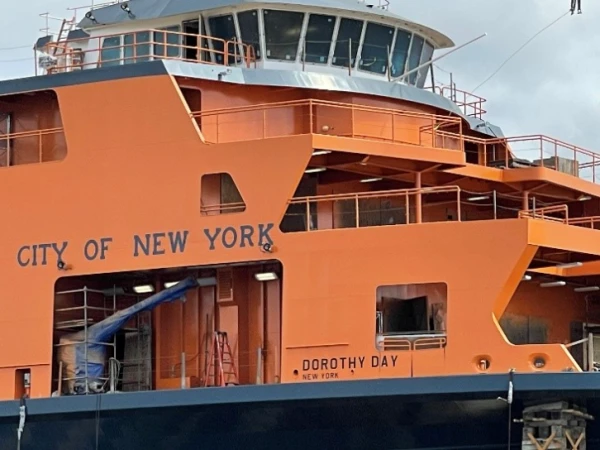
New York City, N.Y., Mar 25, 2021 / 08:01 pm (CNA).- One of the newest Staten Island ferry boats in New York harbor will be named for the Catholic journalist, radical social activist, and possible saint, Dorothy Day.
Kate Hennessy, a granddaughter of Day and author of the book “Dorothy Day: The World Will Be Saved by Beauty,” commented on the honors.
“My grandmother loved Staten Island and treasured her trips on the Staten Island Ferry, the rare time when she could relax and be free of her many responsibilities,” Hennessy said March 25. “While we in her family may find it difficult to line up her selfless work with honors such as this, we nevertheless thank Mayor de Blasio and Staten Islanders for this generous consideration.”
The Dorothy Day is one of three new 4,500-passenger ferry boats under construction by Eastern Shipbuilding in Panama City, Florida. It is expected to arrive in 2022. Its designs will be larger and will have more technologically updated and safer in extreme weather than current ferries. They will continue features like comfortable seating, phone-charging outlets, but the new models also include an upper-deck promenade that serves as an outdoor “walking track.”
Only three Staten Island ferries have now been named for women.
Cardinal Timothy Dolan of New York commented on the honors for Day.
“How providential that the ferry from lower Manhattan to Staten Island should be named after a brave, loving woman who cherished both those areas of our city and the people who live there,” Dolan said. “How appropriate that a ferry transporting people would honor a believing apostle of peace, justice, and charity who devoted her life to moving people from war to peace, from emptiness to fullness, from isolation to belonging.”
New York Mayor Bill de Blasio praised Day’s “life of tremendous selflessness and service.”
“I can think of no greater way to honor her beloved legacy than by having her name on this new ferry boat connecting Manhattan and Staten Island,” he said. “Day loved Staten Island, and this naming will allow others to learn of her inspiring work as a brave activist and journalist. I thank Day’s surviving family for keeping the memory of her work alive, and hope every New Yorker can draw inspiration from her legacy.”
The New York City Mayor’s Office described Day as a “revered social activist and journalist who spent decades on the Island’s South Shore.” The mayor’s office also cited Pope Francis’ praise for her in his 2015 speech before the U.S. Congress.
“Her social activism, her passion for justice and for the cause of the oppressed, were inspired by the Gospel, her faith, and the example of the saints,” the pope said.
Day was born in Brooklyn in 1897 and raised in Chicago. She was baptized Episcopalian at the age of 12. She displayed signs at a young age of possessing a deep religious sense, fasting and mortifying her body by sleeping on hardwood floors.
Her life changed in the 1910s in response to the U.S. social climate. A particular influence was Upton Sinclair’s “The Jungle,” a scathing depiction of the Chicago meat-packing industry.
Day dropped out of college and moved to New York, where she took a job as a reporter for the country’s largest daily socialist paper, The Call. She moved in socialist and bohemian circles, eventually entering a common-law marriage with Forster Batterham, an anarchist lover of nature and a staunch atheist.
Day lived for years on the Lower East Side and Greenwich Village. She moved to Staten Island in the 1920s, where she raised her daughter Tamar. She was increasingly drawn to Catholicism, praying the rosary and having her daughter baptized Catholic. She was received into the Catholic Church in 1927 at Our Lady Help of Christians Church in the Staten Island neighborhood of Tottenville.
After Batterham left Day, she lived in New York City as a single mother. Her deep-rooted and long-standing concern for the poor resurfaced. Along with the eccentric French itinerant philosopher Peter Maurin, she founded the Catholic Worker Movement in 1933. Living the Catholic notion of holy poverty and practicing works of mercy, the two started soup kitchens, self-sustaining farm communities and a daily newspaper. In the course of her 50 years working among the poor and marginalized, Day never took a salary.
In New York City, her work with the Catholic Worker Movement included providing food and shelter during the Great Depression on the Lower East Side. After 1950 she moved back to Staten Island to run a cooperative farm with other members of the movement, including Maurin.
She advocated Catholic devotion and hospitality while also engaged in social action for the poor and for civil rights. Her social criticism often took a radical perspective on poverty, labor, capitalism, and war, while still drawing on Catholic social teaching.
“Day later became best known for her pacifism and work on behalf of the oppressed, including opposition to the Vietnam War and public support of striking farm workers,” the mayor’s office said.
She died in 1990. Her cause for canonization opened in 2000, and she has the title Servant of God. Some 180 Catholic Worker communities continue her work in the U.S. and around the world.
New York City Council Member Joseph Borelli also remarked on her legacy.
“The world knows Dorothy Day as an activist and fighter for justice, but to her South Shore neighbors she met while living on Staten Island, she was the tough-but-kind woman they saw strolling the wooded lanes and shoreline of our community,” he said. “It will be an honor to ride on this boat dedicated to her memory, and even more so when she is declared a Roman Catholic saint.”
The first new ferry scheduled to arrive is named for U.S. Army Staff Sergeant Michael H. Ollis, who was killed in Afghanistan in 2013 at the age of 24 while protecting other soldiers from a suicide bomber attack. He was posthumously awarded the Distinguished Service Cross.
The other boat is named Sandy Ground, in honor of one of the country’s first Black settlements on Staten Island. It served as a stop for escaped slaves on the Underground Railroad.
The boat named for Dorothy Day and its two sister ships are part of a $300 million investment in the ferry service. The three ferries are the first new boats for the ferry fleet since 2006. They were funded by a combination of federal and city funds and other grants, the New York City Mayor’s Office said.




I hope the District Attorney seeks the maximum possible punishment for this murderer.