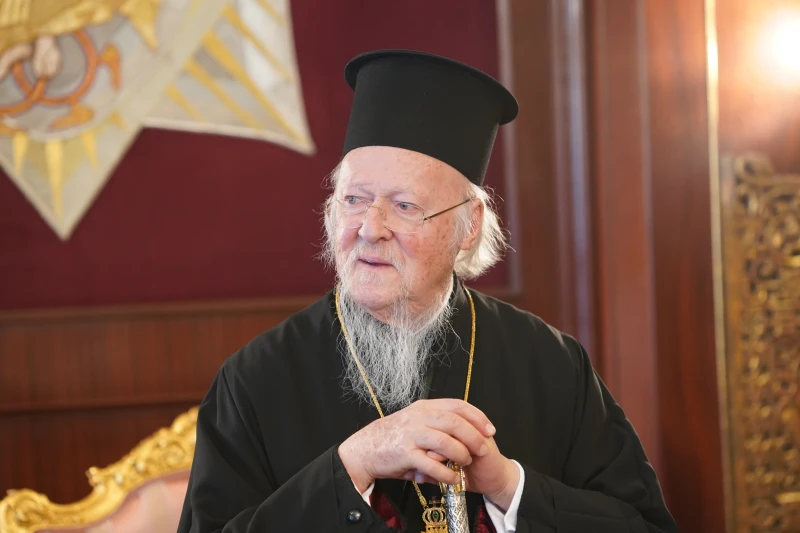
Ecumenical Patriarch Bartholomew I of Constantinople during an audience at the Patriarchal headquarters in Istanbul with the German Association of the Holy Land, Mar. 12, 2025. / Martin Rothweiler / EWTN Germany
CNA Newsroom, Mar 15, 2025 / 08:00 am (CNA).
Ecumenical Patriarch Bartholomew I of Constantinople on Wednesday offered a hopeful historical assessment of the traditional 1054 date for the “Great Schism” between Rome and Constantinople, suggesting that tensions developed gradually over time and “are not insurmountable.”
“Of course, problems have accumulated over a thousand years. But we are full of hope that they will be resolved in a few years,” the patriarch emphasized during an audience in Istanbul on Mar. 12 with a pilgrimage group from the German Association of the Holy Land.
The honorary head of worldwide Orthodoxy made these comments in the presence of Melkite Greek Catholic Patriarch Emeritus Gregory III Laham, reported CNA Deutsch, CNA’s German-language news partner.
Ecumenical Patriarch Bartholomew I (right) speaks with Melkite Greek Catholic Patriarch Emeritus Gregory III Laham during a meeting with the German Association of the Holy Land pilgrimage group in Istanbul, Mar. 12, 2025. Martin Rothweiler / EWTN Germany
The pilgrimage preceded the 1,700th anniversary of the Council of Nicaea held in 325 A.D.
Rather than a sudden break in 1054 — the traditional date of the separation between the Orthodox and Catholic Churches — Patriarch Bartholomew suggested these tensions gradually strengthened over time.
The potential for a historic breakthrough in ecumenical relations has been building for some time. In January 2025, during vespers concluding the Week of Prayer for Christian Unity, Pope Francis highlighted the “providential” timing of Easter falling on the same date in both the Gregorian and Julian calendars this year.
“Let us rediscover the common roots of the faith,” the pontiff urged. “Let us preserve unity!”
Cardinal Kurt Koch, prefect of the Dicastery for Promoting Christian Unity, has long supported efforts toward a common Easter date. In 2021, Koch welcomed a suggestion that the year 2025 would be an ideal time to introduce a calendar reform allowing both Eastern and Western Christians to celebrate Easter together.
“It will not be easy to agree on a common Easter date, but it is worth working for it,” Cardinal Koch stated at the time, adding that the initiative was “very dear to Pope Francis and also to the Coptic Pope Tawadros.”
Calendar considerations
The First Council of Nicaea, held in 325, decided that Easter would be celebrated on the first Sunday after the full moon following the beginning of spring, making the earliest possible date Mar. 22 and the latest possible Apr. 25.
Today, Orthodox Christians use the Julian calendar to calculate the Easter date instead of the Gregorian calendar, which was introduced in 1582 and is used by most of the world. The Julian calendar calculates a slightly longer year and is currently 13 days behind the Gregorian calendar, resulting in different dates for Easter celebrations most years.
One possible obstacle to a universal agreement could be ongoing tensions between different churches. In 2018, the Russian Orthodox Church severed ties to the Ecumenical Patriarchate of Constantinople after Patriarch Bartholomew confirmed his intention to recognize the independence of the Orthodox Church of Ukraine.
During a meeting with the International Theological Commission at the Vatican in November 2024, Pope Francis confirmed his intention to travel to Turkey in May 2025 to mark this significant anniversary.
“I plan to go there,” Pope Francis stated, noting that the Council of Nicaea “constitutes a milestone in the journey of the Church and also of all humanity, because faith in Jesus, the Son of God made flesh for us and for our salvation, was formulated and professed as a light that illuminates the meaning of reality and the destiny of all history.”
However, the pope’s health situation may affect the planned pilgrimage to modern-day Turkey, as his ongoing hospitalization has raised questions about his ability to undertake the journey.
If you value the news and views Catholic World Report provides, please consider donating to support our efforts. Your contribution will help us continue to make CWR available to all readers worldwide for free, without a subscription. Thank you for your generosity!
Click here for more information on donating to CWR. Click here to sign up for our newsletter.
Alfred Magero, Matthew Njogu, and Edward Chaleh Nkamanyi are three Catholic fathers from Africa who recently shared insights about being a present dad, protecting their families amid threats to the African family, and being a model of family values for their children with ACI Africa, CNA’s news partner in Africa. / Credit: Photos courtesy of ACI Africa
ACI Africa, Jun 17, 2024 / 12:37 pm (CNA).
On the occasion of Father’s Day 2024, a day focused on the celebration of fatherhood, four Catholic men from different African countries recently shared their experiences of impacting the lives of their children.
The Catholic fathers — who hail from Cameroon, Kenya, and Nigeria — talk about the importance of “being present,” of protecting their families amid threats to the African family, and of being a model of family values for their children, who they believe someday will become parents as well.
Tony Nnachetta, 68: Fatherhood is a full-time enterprise
Tony Nnachetta shares a moment with Pope Francis. The married father of four is a parishioner in the Catholic Archdiocese of Onitsha. Credit: Photo courtesy of ACI Africa
Tony Nnachetta is a married father of four who attends the Church of the Assumption Parish in Nigeria’s Archdiocese of Lagos. Nnachettahas been a parishioner there for 40 years, and he was wed there 38 years ago. A member of the Grand Knights of St. Mulumba, he originally hails from the Archdiocese of Onitsha.
I got married to my friend after we dated for four years. I was looking forward to fatherhood and I was mentally prepared for it. Here are the lessons I have learned along my fatherhood journey.
First, being a father means you watch your children grow and become independent. You watch them get to a point in their lives where they can engage in a debate with you and even disagree with you.
Fatherhood is a long process. You would be fortunate to go through the entire process and maybe see your children’s children. I have seen mine achieve excellence in school and even leave home and go across the world as they sought to become independent.
Wherever your children go, what is important for them is what they take away from home — what they take from mommy and daddy. I have always told mine to “remember the child of who you are.” This means that they are not allowed to break the Christian values in our family.
I taught them to always stand for the truth and never to flow with the tide. We have encouraged them to always say what they mean. These days, they have jokingly turned around the statement and they tell me, “Remember the dad of who you are,” and we laugh about it.
You can’t always be there to take the bullet for them, but you can support them through prayers. Our family relies a lot on the intercession of the saints. We call ourselves a family of Jesuits because the school my children went to is under the patronage of St. Ignatius of Loyola.
Fatherhood is a full-time engagement. It is not like you can be a father in the morning and take a break in the evening. You worry about your children even when they are grown and have left your home. They preoccupy you everywhere. You wonder whether they are warm and if they have had their meal. But all this brings a father immense joy.
Young fathers in Africa are overburdened by poverty. Because of poverty they don’t have a way to help their families. Others are scared to enter the marriage institution. Poverty has made young men weak and helpless. Some are leaving their young families and going to faraway places outside the continent to make a living.
Poverty is eroding family values because some fathers do what they do, including stealing, for their children to survive. In doing so, they are setting a bad example for their children …
It is important for our leaders to confront this situation. They must accept that they have let us down.
Matthew Njogu, 75: Tips on being a present dad
Matthew Njogu is the moderator of the Catholic Men Association at St. Austin’s Msongari Parish of Kenya’s Archdiocese of Nairobi. His children are now adults. Credit: Photo courtesy of ACI Africa
Fathers need to be present in the lives of their children. For a long time, it was assumed that it was the mother’s responsibility to take care of the young children; fathers kept off. But being absent in the lives of your children hurts your relationship with them. They end up growing up without you having any impact on their lives.
Unfortunately, some fathers assume that fatherhood ends at providing material things… They don’t pay attention to their children’s growth milestones. And when they eventually try to establish a connection, they find that the children are already all grown without knowing anything about their fathers.
Simple things like dropping your children off at school help you connect with them. While stuck in traffic on the way to school, you can talk about things that will help you understand your child and for him to know you.
Always try as much as possible to have dinner with your children and help them with schoolwork. And always try to make up for the time you don’t spend with them.
Edward Chaleh Nkamanyi, 53: Raising a Christ-like family
Edward Chaleh Nkamanyia runs a medical college in Doula, Cameroon. He is a father of two, though he tells ACI Africa that he is “a father of many” as he takes care of several orphans and other vulnerable children. Credit: Photo courtesy of ACI Africa
Nkamanyi runs a medical college in Doula, Cameroon. He is a father of two children ages 16 and 20. He tells ACI Africa that he is “a father of many,” as he takes care of several orphans and other vulnerable children. Here are his insights into nurturing a Christ-like family.
It is the joy of every responsible young man to be called “daddy” or “papa.” Having a Christ-like family is the greatest gift for a father; a family like that of Joseph, Mary, and Jesus.
My appeal for Catholic fathers is to hold their families firmly, to provide for them, and to protect them from all dangers in the contemporary society, where values are being eroded.
I don’t believe that being a father is a challenging task. God already gave us the innate potential to be fathers. I believe that God can’t give you a role that you can’t perform.
It is unfortunate that many young men are choosing to be absentee fathers. From what I have seen, many children raised by a single parent end up adopting wayward behaviors.
Alfred Magero, 48: Being a present dad in a low-income setting
Alfred Magero belongs to the Catholic Men’s Association group of St. Joseph the Worker Kangemi Catholic Parish of in the Nairobi Archdiocese. The father of three has been married for 29 years. Credit: Photo courtesy of ACI Africa
Magero belongs to the Catholic Men’s Association group of St. Joseph the Worker Kangemi Parish of the Archdiocese of Nairobi. The father of three has been married for 29 years and shares his experience and that of other Catholic dads raising their children in a low-income neighborhood.
I am raising my children to become God-fearing adults. This is not an easy task in the community in which we live, where there is a lot of poverty, drunkenness, and other characteristics typical of a low-income [neighborhood].
Many fathers rarely interact with their children since their main focus is to provide for their families. They leave for work before their children wake up and come back at night when the children have already gone to bed.
The young men and boys we are raising are experiencing a different environment from ours when we were growing up. With the whole world brought to them on the palm of their hand by a simple tap on the phone, this generation is dangerously exposed. They need us, their fathers, to constantly give them direction. They need us to be their role models.
They need us to constantly remind them that they are in Africa and that they should not adopt alien cultures, especially those bound to destroy the family.
As fathers, we must remind our young ones to uphold African values that kept the family unit and the society glued together. Africans knew the importance of loving and caring for each other. Unfortunately, this value is being eroded, and in its place, now we have individualism. Older men in families would educate young men to be responsible adults. Unfortunately, we no longer have this kind of education.
Washington D.C., Aug 22, 2018 / 03:00 am (CNA).- Christian and Yazidi communities in northern Iraq need security as they rebuild, said Congressman Jeff Fortenberry after a trip to the region to assess economic aid delivery.
A view of the modern area of the Catholic cemetery located on the southern hillside of Mount Zion in April 2024. In the background are the buildings of the Arabic neighborhood of Abu Tor. / Credit: Marinella Bandini
Leave a Reply
