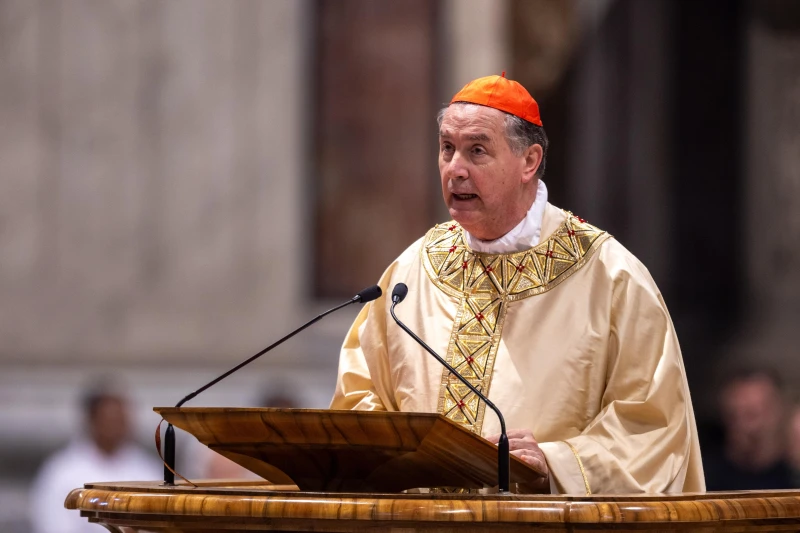
 Cardinal Ángel Fernández Artime speaks at the eighth Novendiales Mass for Pope Francis at St. Peter’s Basilica, Saturday, May 3, 2025 / Credit: Daniel Ibáñez/CNA
Vatican City, May 3, 2025 / 14:30 pm (CNA).
Editor’s Note: On May 3, 2025, Cardinal Ángel Fernández Artime, the former prefect of the Dicastery for Institutes of Consecrated Life and Societies of Apostolic Life, delivered the following homily during the 8th day of Novendiales Masses for Pope Francis. The text below is a CNA working translation of the Italian original published by the Vatican.
Dearest Sisters and Brothers,
St. Alphonsus Maria de Liguori teaches that praying for the dead is the greatest work of charity. When we help our neighbors materially, we share ephemeral goods, but when we pray for them we do so with eternal goods. In a similar way lived the Holy Curé of Ars, universal patron of priests.
To pray for the dead means, therefore, to love those who have died, and that is what we are doing now for Pope Francis, gathered as the People of God, together with the pastors and especially this evening with a very significant presence of consecrated men and women.
The Holy Father Francis felt very well liked by the People of God and knew that those belonging to the different expressions of consecrated life also loved him; they prayed for his ministry, for the person of the Pope, for the Church, for the world.
On this third Sunday of Easter everything invites rejoicing, exultation. The reason is given by the Risen Lord and the presence of the Holy Spirit. St. Athanasius affirms that the risen Jesus Christ makes man’s life a continuous feast. And that is why the Apostles – and Peter first among them – are not afraid of imprisonment, nor of threats, nor of being persecuted again. And in fact they boldly and frankly declare, “Of these things we are witnesses as also is the Holy Spirit whom God has sent to those who obey him.”
“I wonder,” said Pope Francis, in one of his catecheses on this same passage, ”where the first disciples find the strength for this witness of theirs. Not only that, but from where did the joy and courage of proclamation come to them in spite of obstacles and violence?”
It is clear that only the presence, with them, of the Risen Lord and the action of the Holy Spirit can explain this fact. Their faith was based on such a strong and personal experience of Christ, dead and risen, that they were not afraid of anything or anyone. “Today, as yesterday, the men and women of the present generation are in great need of encountering the Lord and his liberating message of salvation,” said St. John Paul II, on the occasion of the Jubilee of Consecrated Life on Feb. 2, 2000, addressing religious men and women around the world, adding: “I have been able to realize the value of your prophetic presence for the entire Christian people, and I gladly acknowledge, even on this occasion, the example of generous evangelical dedication offered by countless of your brothers and sisters who often work in uncomfortable situations. They unreservedly expend themselves in the name of Christ in the service of the poor, the marginalized and the least.”
Brothers and sisters, it is true that all of us, this whole assembly as baptized, are called to be witnesses of the Lord Jesus, who died and rose again. But it is equally true that we, consecrated men and women, have received this vocation, this call to discipleship that asks us to witness to the primacy of God with our whole lives. This mission is especially important when – as in many parts of the world today – we experience God’s absence or forget his centrality too easily. Then we can assume and make our own the program of St. Benedict Abbot, summarized in the maxim: “Put nothing before the love of Christ.”
It was the Holy Father Benedict XVI who challenged us in this way: within the People of God, consecrated persons are like sentinels who discern and announce the new life already present in our history.
We are called, by reason of our baptism and by religious profession, to witness that only God gives fullness to human existence and that, consequently, our lives must be an eloquent sign of the presence of the Kingdom of God for the world today.
We are, therefore, called to be in the world a credible and luminous sign of the Gospel and its paradoxes. Without conforming to the mentality of this century, but transforming ourselves and continuously renewing our commitment.
In the Gospel we heard that the Risen Lord was waiting for his disciples at the seashore. The account says that when everything seemed finished, failed, the Lord made himself present, went to meet his own, who—filled with joy—were able to exclaim through the mouth of the disciple whom Jesus loved, “It is the Lord.”
In this expression we grasp the enthusiasm of Easter faith, full of joy and amazement, which contrasts sharply with the bewilderment, discouragement, and sense of helplessness hitherto present in the disciples’ souls.
It is only the presence of the Risen Jesus that transforms everything: darkness is overcome by light; useless work becomes fruitful and promising again; the sense of weariness and abandonment gives way to a new momentum and the certainty that He is with us.
What happened for the Lord’s first and privileged witnesses can and must become a program of life for all of us.
Pope Francis said in the Year of Consecrated Life: “I expect you to wake up the world, because the note that characterizes consecrated life is prophecy.” And he asked us to be witnesses of the Lord like Peter and the Apostles, even in the face of the misunderstanding of the Sanhedrin of yesteryear or the godless areopagos of today. He asked us to be like the watchman who keeps watch during the night and knows when the dawn comes.
He was asking us to have a heart and a spirit pure and free enough to recognize the women and men of today, our brothers and sisters, especially the poorest, the last, the discarded, because in them is the Lord and so that with our passion for God, for the Kingdom and for humanity, we will be able like Peter, to respond to the Lord, “Lord, you know everything! You know that I love you.”
Mary, Mother of the Church, grant us all the grace to be missionary disciples today, witnesses of Her Son in this Church of His that—under the guidance of the Holy Spirit—lives in hope, because the Risen Lord is with us until the end of time. Amen.
[…]



The facade of naive sentimentalism worn by the USCCB is quite transparent. One might have expected the Catholic episcopate in the United States to have years ago spread the word to their confreres abroad to caution their people not to engage in illegal migration, knowing the same to be not only against the law but an infraction of the rights of the citizens of the United States. Having absented themselves from that responsibility it appears our bishops are maintaining their grossly inadequate engagement with this issue by shifting into shame mode. It is a desperate and impotent move and only serves to further undermine their authority and credence.
Might their concern for “justice” take into account the injustice perpetrated upon the citizens of the United States whose tax dollars, resources of jobs, housing, schooling are being essentially stolen from not merely the prosperous, but even more for destitute and vulnerable American citizens.
Left-wing sentimentality is no substitute for sound theology and economic acumen … but then it is apparent the Church as an NGO is making a pretty penny off this enterprise. Perhaps it’s time for the episcopate to address issues of injustice virulent within the Church, but that would risk life changing consequences from Rom.
They appear out of their depth on illegal migration.
Credence trashed is not easily recovered.
https://nypost.com/2025/01/27/us-news/catholic-charities-draws-fire-over-video-coaching-illegal-migrants-on-how-to-duck-ice/
The Vatican has been cracking down. They don’t want everyone entering illegally to crash their parties:
https://nypost.com/2017/07/05/vatican-cops-bust-drug-fueled-gay-orgy-at-cardinals-apartment/
I can’t wait for the U.S. bishops to be freed from the slavery of government mammon so they can properly shepherd their flocks. Defund the USCCB.