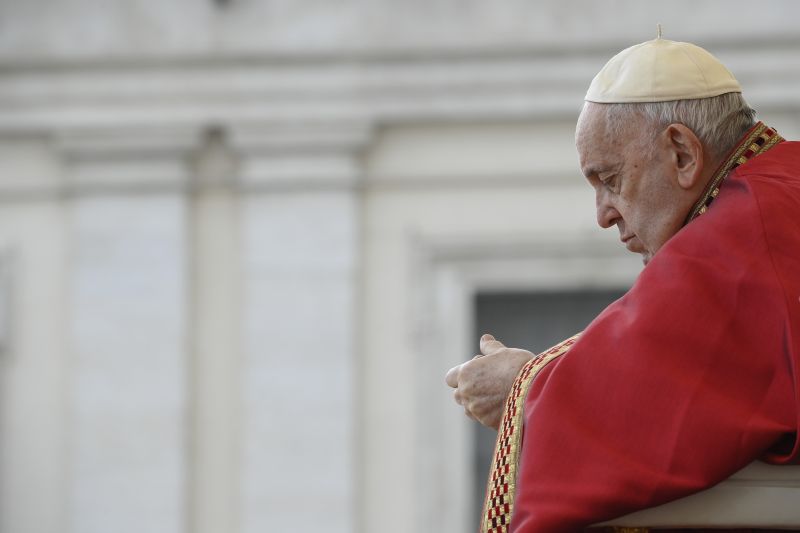
Pope Francis gazes up at the bronze statue of Mary atop the 39.4-foot column at Rome’s Spanish Steps, Dec. 8, 2024. / Credit: Daniel Ibáñez/CNA
CNA Newsroom, Dec 8, 2024 / 15:33 pm (CNA).
Pope Francis marked the Solemnity of the Immaculate Conception with a spiritual journey across Rome on Sunday, beginning at the Basilica of St. Mary Major and continuing to the Spanish Steps — where he reminded the faithful that “the true Jubilee is inside” — before making an unexpected visit to a painting particularly dear to his heart.
Beginning his Marian devotions at Rome’s most important Marian basilica, the pope prayed before the ancient icon “Salus Populi Romani” (Protectress of the Roman People), echoing his cherished tradition of visiting this beloved image before and after his international trips.
Pope Francis prays before the Salus Populi Romani icon at the Basilica of St. Mary Major in Rome, Dec. 8, 2024. Credit: Vatican Media
Despite cold and rainy weather, thousands of faithful gathered in Rome’s historic center as the pope continued the long-standing papal tradition of paying homage to the Immaculate Conception at the foot of the Marian column near the Spanish Steps.
Pope Francis arrives with flowers for the traditional act of veneration of the Immaculate Conception at the Spanish Steps in Rome, Dec. 8, 2024. Credit: Daniel Ibáñez/CNA
The statue of the Immaculate Conception, which sits atop a 12-meter (39.4-foot) high column, was dedicated on Dec. 8, 1857, shortly after the Church proclaimed the doctrine of Mary’s Immaculate Conception. Since the 1950s, beginning with Pope Pius XII in 1953, it has been customary for popes to venerate the statue for the feast day.
Pope Francis reads his prayer of dedication to Mary Immaculate during the ceremony. Credit: Daniel Ibáñez/CNA
At 7 a.m., Rome’s firefighters had continued their own decades-old tradition, ascending to the top of the statue to place a wreath of flowers on the Virgin’s arm. The gesture honors their 220 colleagues who participated in the monument’s inauguration over 166 years ago.
Pope Francis greets the crowd gathered at Rome’s Spanish Steps, Dec. 8, 2024. Credit: Daniel Ibáñez/CNA
In his prayer at the Spanish Steps, Francis highlighted the significance of Rome’s preparation for the upcoming 2025 Jubilee Year, which he will inaugurate this Christmas Eve by opening the Holy Door of St. Peter’s Basilica.
“Rome is alive, renewing itself”
The pope noted that while Rome’s many construction projects preparing for the Jubilee Year cause “not a few inconveniences,” they are also “a sign that Rome is alive, renewing itself, trying to adapt to needs, to be more welcoming and functional.”
“Because, without meaning to,” Francis noted in his prayer, “we risk being totally taken up by organization, by things that need to be done, and then the grace of the Holy Year, which is a time of spiritual rebirth, of forgiveness and social liberation, this jubilee grace may not come well, may be a little suffocated.”
“But your maternal gaze sees beyond,” the pope prayed before the statue. “And I seem to hear your voice that with wisdom tells us: ‘My children, these works are good, but be attentive: do not forget the construction sites of the soul! The true Jubilee is not outside, it is inside: inside of you, inside hearts, inside family and social relationships.’”
The 2025 Jubilee Year, themed around hope, will begin Dec. 24, 2024, with the opening of the Holy Door at St. Peter’s Basilica.
Pope Francis visits Marc Chagall’s painting “White Crucifixion” at Palazzo Cipolla in Rome on the feast of the Immaculate Conception, Dec. 8, 2024. Vatican Media
Following the Marian celebration, Francis made an unexpected stop at the Museo del Corso, where he viewed Marc Chagall’s “White Crucifixion.”
The artwork, which depicts Christ’s crucifixion against a backdrop of Jewish suffering, combines religious imagery with historical context. On loan from the Art Institute of Chicago, it is currently on display as part of a range of cultural events leading up to the jubilee year.
If you value the news and views Catholic World Report provides, please consider donating to support our efforts. Your contribution will help us continue to make CWR available to all readers worldwide for free, without a subscription. Thank you for your generosity!
Click here for more information on donating to CWR. Click here to sign up for our newsletter.
Rome Newsroom, Aug 4, 2024 / 16:40 pm (CNA).
In a new letter released Sunday, Pope Francis touts the benefits of reading literature for priests and all those seeking to enrich their lives as Christian belie… […]
Pope Francis presides over the funeral Mass for Pope Emeritus Benedict XVI in St. Peter’s Square on Jan. 5, 2023. / Vatican Media
Rome Newsroom, Jan 15, 2023 / 11:00 am (CNA).
It was widely anticipated that a major reform of the Diocese of Rome was coming, as Pope Francis has been thinking about it for some time.
But no one expected it to come when it did: On Jan. 6, one day after the funeral of Francis’ predecessor as Bishop of Rome, Pope Emeritus Benedict XVI.
With the reform, Pope Francis firmly took over the reins of the vicariate, or hierarchy, of the diocese. Everything is centralized, and everything must pass, at least formally, under the control of the pontiff.
Cardinal Angelo de Donatis, the pope’s vicar for the diocese, sees his role deeply diminished. The diocese’s auxiliary bishops strengthen their direct link with the pope. In the end, the pope has made it clear that he is the one who also formally presides over the Episcopal Council, a new body established as an “expression of synodality.”
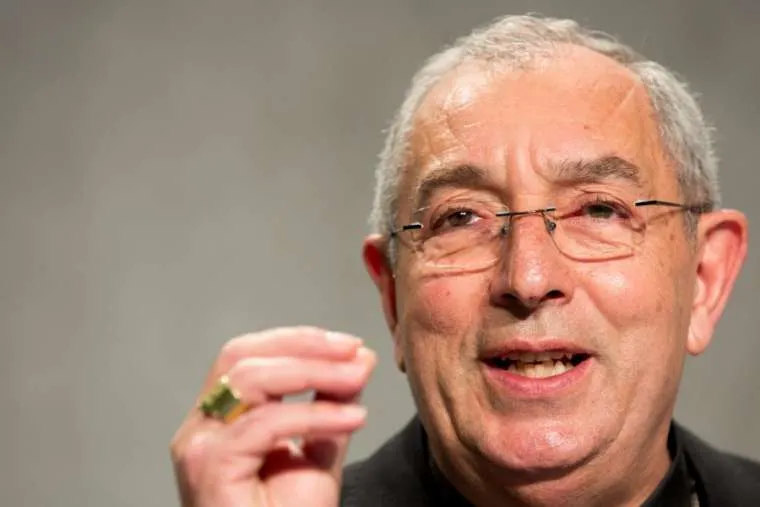
Cardinal Angelo De Donatis. . Daniel Ibanez/CNA
The backstory
Before going into some details of the new decree, however, some background is necessary.
The last reform of the structure of the Vicariate of Rome was outlined by John Paul II in 1908, with the apostolic constitution Ecclesia In Urbe. For the new reform, Pope Francis copied and pasted several passages from that document. In some cases, these have been minimally rewritten to emphasize some details instead of others. In other cases, greater changes were made but these do little to alter the basic substance of things.
The reform presents two general characteristics of Pope Francis’ way of legislating: using councils or commissions and requiring those bodies to report directly to him.
It is clear that the pope is the bishop of Rome and that the pope’s vicar for the diocese is his auxiliary. Pope Francis, however, in this case, goes further, including with the constitution a decree that directly defines the areas of competence of the auxiliary bishops.
Pope Francis shows, in this way, a willingness to exercise greater personal control over everything that happens in the vicariate. At the same time, this choice also testifies to a “break” in the relationship of trust with his vicar, Cardinal de Donatsi.
Although Francis called de Donatis to preach retreats to the Roman Curia in 2014, he was never the pope’s candidate to succeed Cardinal Vallini as vicar. That was Cardinal Paolo Lojudice.
Pope Francis, however, wanted to first consult the parish priests of Rome, 80% of whom preferred de Donatis. It was impossible, therefore, for the pope not to listen to them. He appointed De Donatis vicar (and cardinal) and made Lojudice archbishop of the prestigious Diocese of Siena, and a cardinal, as well.
Last May, at the general assembly of the Italian Episcopal Conference, it seemed clear that Pope Francis preferred the appointment of Cardinal Lojudice as the new president of the CEI.
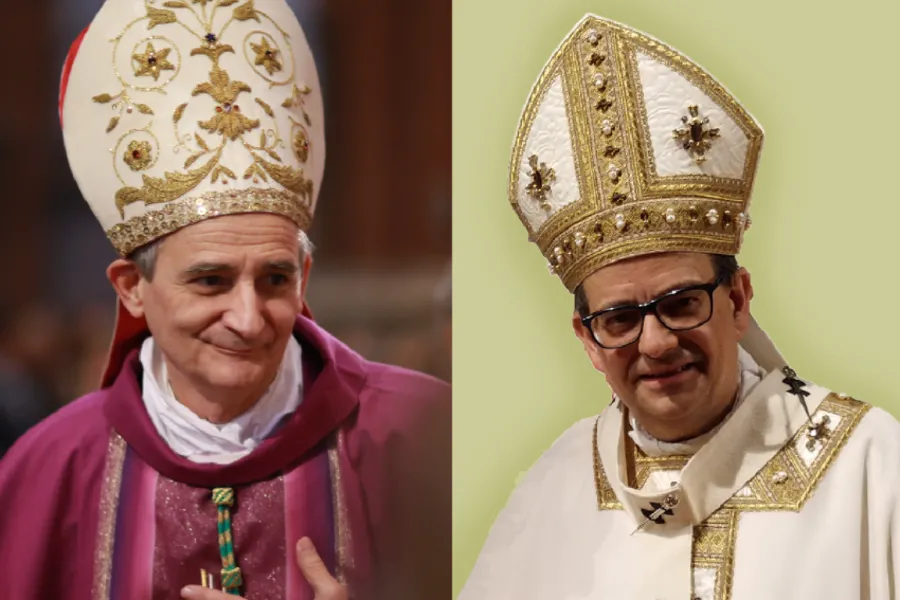
Cardinal Matteo Zuppi and Cardinal Augusto Paolo Lojudice. Francesco Pierantoni via Wikimedia (CC BY 2.0)/Pufui PcPifpef via Wikimedia (CC BY-SA 4.0).
The plan was to appoint Lojudice vicar of the Diocese of Rome to succeed Cardinal de Donatis, who had finished his five-year term, which would then have made Lojudice the primary contact person for the pope both in Rome and among the Italian bishops. De Donatis would have been appointed the new Penitentiary in place of Cardinal Mauro Piacenza, who has now turned 78.
The Italian bishops, however, preferred Cardinal Matteo Zuppi, archbishop of Bologna, who was not unwelcome to Pope Francis.
Lojudice didn’t become vicar for the Rome Diocese, either, as everyone assumed would happen. Meanwhile, the relationship of trust between de Donatis and the pope seemed to have been interrupted in 2020, when, at the beginning of the lockdown for COVID-19, de Donatis decided to close the churches of Rome. When Pope Francis later highlighted the inadvisability of closing churches, de Donatis withdrew the decree but announced that every decision had been made in agreement with the pope. There also have been other moments of friction in recent years.
The pope, however, now seems intent on changing the vicar this year when de Donatis’ mandate expires. An indication of this is the fact that in the decree in which the Pope defines the area and pastoral competencies of the auxiliary bishops, de Donatis is not mentioned as vicar. One might take his presence for granted, of course, but the general interpretation is that the change will be made.
What’s new
What are the novelties introduced by Pope Francis? First, the figure of the prelate general secretary disappears, while the vicegerente (or the deputy of the vicar) manages the offices of the General Secretariat. The prelate secretary also had the function of the moderator of the Curia. In this case, everything is entrusted to the vicegerente, who thus sees his functions and weight increase.
The pope chose the vicegerente from among the auxiliary bishops, and in this case, Baldassare Reina was selected. Bishop Reina does not come from the Diocese of Rome but was called from Agrigento. The pope’s logic is to break possible power chains by bringing in fresh and foreign forces.
The choice of a new parish priest is entrusted to a lengthy procedure which must then, in any case, be submitted to the pope, who acts as the true and proper bishop of Rome without relying on the vicar, who is left with the appointment of assistant parish priests.
Article 20 of the Constitution requests a report for each candidate for the priesthood or diaconate to be submitted before ordination. Also, in this case, the candidates must be presented by the cardinal vicar to the pope, and only after obtaining the Episcopal Council’s consent. Therefore, the vicar seems to be practically a commissariat: He does not choose the candidates but submits them to the pope and can submit them only after the Episcopal Council has endorsed the choice.
The council is defined as the “first organ of Synodality” and must meet “at least three times a month,” presided over by the pope. Only in the absence of the pope can the cardinal vicar preside over the council, which is made up of the vicegerent and the auxiliary bishops. However, the pope wants to receive “the agenda for each meeting as soon as possible.”
Finally, there is also the establishment of an Independent Supervisory Commission. This will have a regulation that must be “approved by the Pope” and six members appointed by the pope who can remain in office for a maximum of two five-year terms.
The service for the protection of minors and vulnerable people is also added, which “reports to the Episcopal Council, through the auxiliary bishop appointed by me,” the pope has decreed.
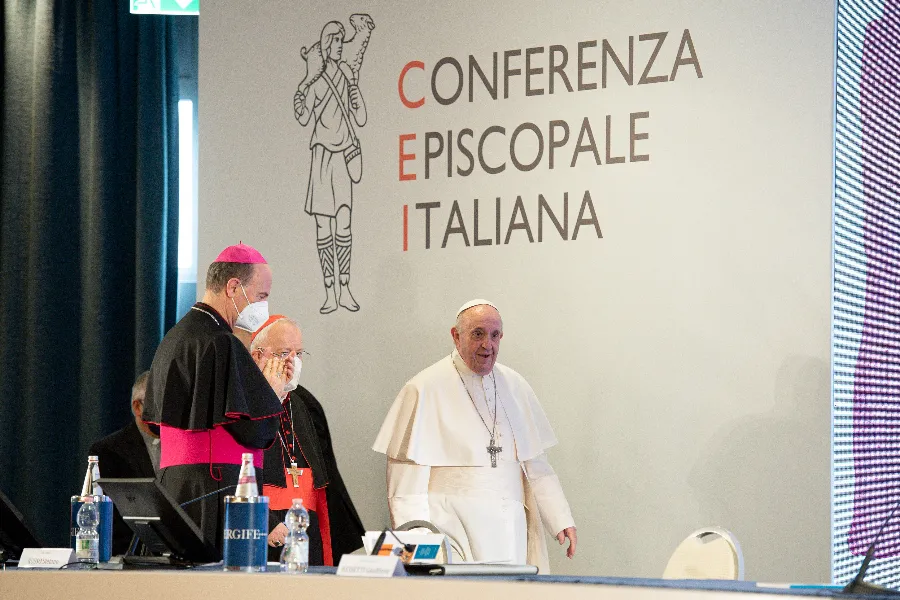
Pope Francis attends the Italian bishops’ plenary assembly in Rome on May 24, 2021. Vatican Media.
The effects of the reform
The constitution also redistributes the areas and offices of the Vicariate’s Curia, and the accompanying decree gives each auxiliary bishop a specific task.
Beyond the reorganization, it should be noted how the pope enters into action as the actual bishop of Rome. Everything must pass through the decisions of the pope, while before, the cardinal vicar enjoyed trust and discretion. For the first time, however, the pope’s vicar is defined as an “auxiliary.” He is, therefore, an auxiliary among the auxiliaries, with a considerable reduction in his weight.
With this centralization, Pope Francis probably wants to overcome the risk of having “abuses” within the Vicariate.
It is worth remembering that in June 2021, Pope Francis ordered an inspection of the Vicariate itself. It was an audit entrusted to the Auditor General of the Holy See, Alessandro Cassinis Righini. It was the first time the Vicariate sifted through the accounting books, registers, and cooperative societies.
However, the Pope, as a matter of practice, has sent an inspection to all the dicasteries of the Curia every time there is a reform or a new mandate. The review, therefore, already predicted the change of pace in the Vicariate, one that has led Pope Francis to be increasingly alone in command.
Rome Newsroom, Sep 27, 2020 / 09:10 am (CNA).- Cardinal George Pell is set to return to Rome on Tuesday, his first time back in the Vatican since 2017, when he took a leave of absence from his role as prefect of the Vatican’s Secretariat for the Economy to travel to Australia.
The cardinal is set to fly on Sept. 29, sources close to Pell confirmed to CNA on Sunday, following an initial report by Australian journalist Andrew Bolt in the Herald Sun newspaper.
Pell has been living in his former Archdiocese of Sydney since his acquittal by Australia’s High Court in April on charges of sexual abuse.
In 2014, the cardinal was appointed by Pope Francis to take charge of the newly created Secretariat for the Economy and to lead efforts at reforming Vatican financial affairs. After charges of sexual abuse were brought by Victoria police, Pell took temporary leave of his role in 2017 in order to return to Australia and prove his innocence.
Pell faced allegations from a single accuser related to his time as Bishop of Melbourne. He spent 13 months in solitary confinement after he was initially convicted and given a six-year prison sentence, before being vindicated on appeal to the High Court.
Pell’s term of office as head of the Vatican’s financial secretariat expired during his time in prison, with Pope Francis naming Fr. Juan Antonio Guerrero Alves, SJ, to succeed him in 2019.
The news of Pell’s return to Rome comes just days after the dramatic resignation of Cardinal Angelo Becciu, whom Pope Francis asked to resign as prefect of the Congregation of the Causes of Saints and from the rights extended to members of the College of Cardinals on Sept. 24 after he was linked to an ongoing investigation of financial misconduct at the Vatican.
Becciu had worked previously as the number two-ranking official in the Vatican’s Secretariat of State, where, CNA has previously reported, he repeatedly clashed with Pell over the reform of Vatican finances.
Pell, who had not spoken publicly about his former Vatican role since his exoneration, responded to the news of Becciu’s resignation with gratitude.
“The Holy Father was elected to clean up Vatican finances. He plays a long game and is to be thanked and congratulated on recent developments,” Pell wrote in a statement sent to CNA Sept. 25.
“I hope the cleaning of the stables continues in both the Vatican and Victoria,” Pell said.
CNA has reported that in 2015 Becciu seemed to have made an attempt to disguise the loans on Vatican balance sheets by canceling them out against the value of the property purchased in the London neighborhood of Chelsea, an accounting maneuver prohibited by new financial policies approved by Pope Francis in 2014.
The alleged attempt to hide the loans off-books was detected by the Prefecture for the Economy, then led by Pell. Senior officials at the Prefecture for the Economy told CNA that when Pell began to demand details of the loans, especially those involving the Swiss bank BSI, then-Archbishop Becciu called the cardinal in to the Secretariat of State for a “reprimand.”
In 2016, Becciu was instrumental in bringing to a halt reforms initiated by Pell. Although Pope Francis had given the newly created Prefecture for the Economy autonomous oversight authority over Vatican finances, Becciu interfered when Pell’s financial secretariat planned an external audit of all Vatican departments, to be conducted by the firm PriceWaterhouseCooper.
Unilaterally, and without permission of Pope Francis, Becciu canceled the audit and announced in a letter to all Vatican departments that it would not take place.
When Pell challenged internally the audit’s cancellation, Becciu persuaded Pope Francis to give his decision ex post facto approval, sources inside the prefecture told CNA. The audit never took place.
Becciu held a press conference in Rome Sept. 25 at which he protested his innocence of financial wrongdoing.





Salus Populi Romani – Ora Pro Nobis.