Before the wooden coffin is closed, Pope Benedict XVI’s personal secretary Archbishop Georg Gänswein and Monsignor Diego Giovanni Ravelli, the Vatican’s lead master of ceremonies for papal liturgies, place a white veil over the late pope’s face. The action on Jan. 4, 2023, is part of the funeral rites for popes. / Credit: Vatican Media
Vatican City, Nov 20, 2024 / 12:55 pm (CNA).
The Vatican has updated the liturgical book regulating the funeral rite of popes, simplifying some of the rituals at Pope Francis’ request.
The second edition of the Ordo Exsequiarum Romani Pontificis (“Order of Funerals for Roman Pontiffs”) is a revision of the version published in 2000 and used for the funerals of Pope John Paul II in 2005 and Pope Benedict XVI in 2023.
Among the changes in the new edition, according to Vatican News, is the elimination of the use of three coffins of cyprus, lead, and oak, and the possibility for a deceased pope to be buried outside of the Vatican basilica.
Another change is that the public viewing before the funeral will take place with the remains already in a simple, wooden coffin, not on a raised bier, as was previously done. The ascertainment of the pope’s death will also happen in the pope’s chapel, not his room.
Pope Francis “has stated on several occasions the need to simplify and adapt certain rites so that the celebration of the funeral of the bishop of Rome may better express the faith of the Church in the risen Christ,” the master of papal ceremonies, Archbishop Diego Ravelli, told Vatican News.
“The renewed rite,” Ravelli said, “also needed to emphasize even more that the funeral of the Roman pontiff is that of a pastor and disciple of Christ and not of a powerful person of this world.”
If you value the news and views Catholic World Report provides, please consider donating to support our efforts. Your contribution will help us continue to make CWR available to all readers worldwide for free, without a subscription. Thank you for your generosity!
Click here for more information on donating to CWR. Click here to sign up for our newsletter.
Athens, Greece, Jul 3, 2017 / 11:21 am (Church Pop).- Pope Francis has donated 50 thousand euros to the island of Lesbos, Greece, which is recovering from a June earthquake.
The donation comes just a few days after the Holy Father received a full report on the extent of the damage.
Archbishop Nikolaos Printezis, Bishop of Naxos, Andros, Tinos and Mykonos, said the Pope’s donation was a sign of the closeness of the Pontiff to the people who have suffered the consequences of the earthquake.
On June 12, a powerful earthquake measuring 6.3 hit the western coast of Turkey and the Greek island of Lesbos , killing one person, displacing approximately 800, and destroying infrastructure from the Turkish Aegean province, Izmir, to the Greek capital, Athens.
The earthquake’s epicenter was located about 50 miles northwest of the Turkish coastal city of Smyrna and nine miles south of Lesbos, according to the European Mediterranean Seismological Center (EMSC).
Pope Francis visited the island of Lesbos in 2016, as it is a main point of entry for thousands of refugees fleeing violence in places such as Iraq and Syria.
During that trip, Pope Francis brought back 12 Syrian refugees with him, selected by lottery, including six children. Their homes had been bombed, and the Vatican oversaw their resettlement.
Currently, there are 3,500 migrants on Lesbos awaiting the outcome of asylum applications or deportation. According to the New York Times, aid workers reported no damage or injuries at the refugee camps due to the earthquake.
In the coming days a Vatican representative will visit Lesbos and deliver the money donated by the Pope.
Michelangelo’s Pietà in St. Peter’s Basilica. / Credit: Daniel Ibañez/CNA
Vatican City, Nov 19, 2025 / 11:15 am (CNA).
Following the reaction to the new Vatican document Mater Populi Fidelis (“Mother of the Faithful People”), Father Maurizio Gr… […]
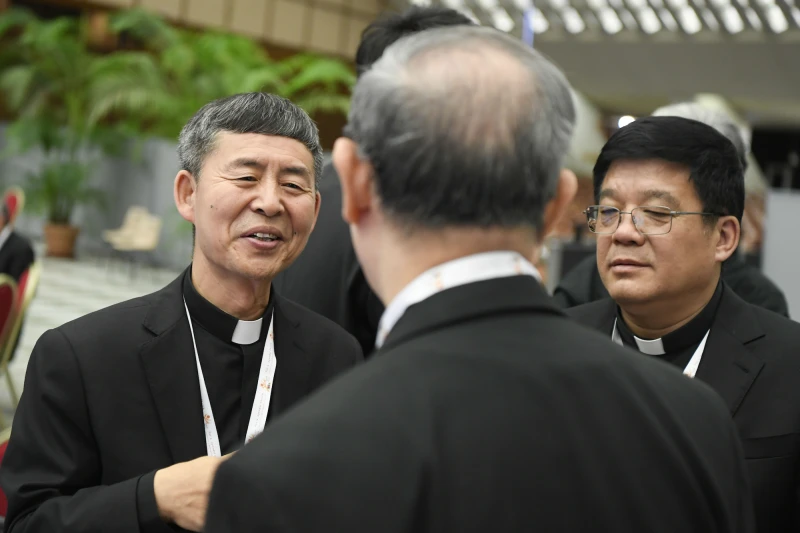
Bishop Yao Shun of Jining and Bishop Yang Yongqiang of Zhouchun (right) of the People’s Republic of China at the Synod on Synodality at the Vatican in October 2023. / Vatican Media
Vatican City, Oct 8, 2024 / 13:30 pm (CNA).
The Synod on Synodality, meant to be a moment of encounter and dialogue for the global Church, has provided a venue for Catholic bishops from mainland China and Taiwan to meet together.
Bishop Norbert Pu is the Catholic Church’s first bishop born in Taiwan. The 66-year-old bishop of Chiayi is a delegate in the nearly monthlong synod assembly as a representative of the Chinese Regional Bishops’ Conference of Taiwan.
In an interview with CNA, Pu said he is most looking forward to getting to know the different bishops, cardinals, and synod delegates from other parts of the world gathered at the Vatican for the second session of the 16th Ordinary General Assembly of Bishops.
Bishop Norbert Pu speaks to CNA at the Vatican, Tuesday, Oct. 8, 2024. Credit: EWTN News
Pu noted that he had already met with the two bishops from mainland China taking part in the synod and plans to meet with them again.
“It’s very important to dialogue with them, to respect each other. I think it’s good … not only for the Chinese, for the whole Church,” the Taiwanese bishop said.
Bishop Antonio Yao Shun of Jining, the first bishop consecrated in China under the terms of the Sino-Vatican agreement, represented the Church in China at the synod assembly in October 2023 along with Chinese Archbishop Joseph Yang Yongqiang before the two suddenly departed early without explanation.
Yao has said that many of the participants in last year’s synod assembly “showed interest in the development of the Church in China, eager to know more and to pray for us.”
The synod also provided an opportunity for the bishops from the People’s Republic of China to spend time with the bishop of Hong Kong, Cardinal Stephen Chow.
During last year’s synod assembly, the cardinal and the two bishops even took a brief trip together to Naples where they offered Mass at the Chiesa della Sacra Famiglia dei Cinesi (Church of the Holy Family of the Chinese), a church built in 1732 as part of an institute founded by Pope Clement XII to train Chinese seminarians and teach missionaries the Chinese language to help with the evangelization of China.
A new synod delegate from China
For this year’s assembly, Yao has been replaced by Chinese Bishop Vincent Zhan Silu of Mindong diocese in China’s southern Fujian province.
Zhan Silu, 63, was formerly excommunicated for having been ordained a bishop without a papal mandate in Beijing in 2000. His excommunication was lifted in 2018 when the Vatican signed a historic provisional agreement with the Chinese government on the appointment of bishops.
When Cardinal Jean-Claude Hollerich was asked why Yao had been replaced by Zhan Silu, the relator general of the synod replied: “The Secretariat of State communicated the names to us, but we have no other information on the matter,” according to Asia News.
Without Yao, Archbishop Yang, 54, is the synod veteran among the two Chinese bishops. Since participating in last year’s synod assembly, Yang has been transferred to the Archdiocese of Hangzhou, a move that took place “within the framework of dialogue” of the provisional agreement with China, according to the Vatican. The change elevated him to the rank of archbishop.
Yang was ordained a bishop with Vatican approval in 2010 and served as the bishop of Zhoucun in mainland China’s Shandong Province from 2013 to June 2024.
He participated in the 2023 National Committee of the Chinese People’s Political Consultative Conference, a political advisory body that is part of the Chinese Communist Party’s united front system, where it was decided that the Catholic Church should integrate its thought with the party and unite more closely to Xi Jinping, according to the official website of the Catholic Patriotic Association.
Zhan Silu and Yang are among the 368 voting delegates taking part in the second synod assembly at the Vatican Oct. 2–27.
The synod is taking place amid the ongoing dialogue between Beijing and Rome on the appointment of bishops. The Vatican has yet to announce if it renewed its provisional agreement with China, which is expected to have been renewed this fall for the third time since it was first signed in 2018.
Vatican-Taiwan relations
During the first week of the assembly, some synod delegates took a break from the day’s meetings to join in the celebration of Taiwan’s 113th National Day at a reception organized by the Embassy of the Republic of China to the Holy See just down the street from St. Peter’s Basilica.
Cardinals and others enjoy a celebration of Taiwan’s 113th National Day at a reception organized by the Embassy of the Republic of China to the Holy See in Vatican City, Wednesday, Oct. 2, 2024. Credit: Embassy of the Republic of China to the Holy See
Vatican City State is the only remaining country in Europe that recognizes Taiwan as a country.
The Holy See has had formal diplomatic relations with Taiwan, formally called the Republic of China (ROC), since 1922, while the Church has not had an official diplomatic presence on the mainland People’s Republic of China (PRC) since it was officially expelled by Beijing in 1951.
The island of Taiwan, fewer than 110 miles off the coast of China and home to a population of more than 23 million people, has maintained a vibrant democracy with robust civil liberties despite increased pressure from Beijing regarding the island’s status.
Unlike mainland China — where images of Christ and the Virgin Mary have been replaced with images of President Xi Jinping, according to a report released last week — Catholics in Taiwan enjoy religious freedom, which is enshrined in its constitution.
More than 10,000 people attended the National Eucharistic Congress in Taiwan last weekend, according to Taiwan’s Ministry of Foreign Affairs.
Pope Francis sent a message to the congress, writing that he hoped it would “arouse in the hearts of the Christian faithful a true worship and love of the Eucharist.” The congress in the Diocese of Kaohsiung was the fifth Eucharistic congress held in Taiwan since 2011.
Bishop Pu told CNA that the congress presented an opportunity to let more people in Taiwan know about the Eucharist and its central importance to the Catholic faith.
“We hope we can always maintain this formal and good relationship with the Vatican. Because for Taiwan, this is very important. We hope that the world will see this because Taiwan is a democratic and free country, respected by other nations,” Pu said.





Leave a Reply