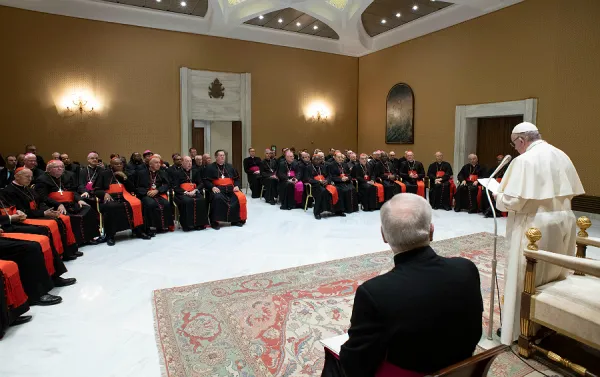
Pope Francis speaks to the academic community at the Pontifical Gregorian University in Rome on Nov. 5, 2024. / Credit: Daniel Ibáñez/CNA
Rome Newsroom, Nov 5, 2024 / 10:50 am (CNA).
Pope Francis warned against “Coca-Cola spirituality” at the Pontifical Gregorian University in Rome on Tuesday, where minutes earlier the rector had highlighted the witness of imprisoned-then-exiled Nicaraguan Bishop Rolando Álvarez as an example of authentic Christian courage.
Speaking at the university’s Dies Academicus celebration, the pope told faculty and students to avoid becoming “disciples of Coca-Cola spirituality,” using the metaphor to warn against superficial approaches to faith formation.
“Have you asked yourselves where you are going and why you are doing the things you are doing?” the pope challenged his audience on Nov. 4.
“It is necessary to know where one is going without losing sight of the horizon that unites each one’s path with the current and ultimate end.”
Jesuit Father Mark A. Lewis, rector of the Gregorian University, opened the event by noting that Álvarez, who studied at the university, “preaches the Gospel with courage and remains in solidarity with his priests, his flock, and all those who are deprived of their human rights.”
Father Mark Lewis, SJ. Credit: Daniel Ibáñez/CNA
Drawing on the example of St. Francis Xavier, the pope emphasized the need to “be missionaries out of love for our brothers and sisters and to be available to the Lord’s call.”
He urged the academic community to avoid “pretensions that turn God’s project into something bureaucratic, rigid, and without warmth, superimposing agendas and ambitions over the plans of providence.”
The pope called for putting “heart” into formation work, warning that without it, education becomes either “arid intellectualism or perverse narcissism.”
“When the heart is missing, you can see it,” Francis emphasized.
The pope called for a university with “the smell of the people” that promotes imagination and reveals God’s love, “who always takes the first step in a world that seems to have lost its heart.”
He lamented that the “world is in flames” due to the “madness of war, which covers every hope with the shadow of death.”
Francis urged the community to “open the gaze of the heart” and seek unity in diversity through exchanging gifts, calling for greater study of Eastern traditions. He urged avoiding abstract ideas born in offices and promoting “contact with the life of peoples, the symbols of cultures, and the cries of suffering of the poor.”
“Touch this flesh, walk in the mud, and get your hands dirty,” he emphasized.
The visit marked a significant development in the university’s history, coinciding with the recent integration of three institutions — the Collegium Maximum, the Pontifical Biblical Institute, and the Pontifical Oriental Institute — under papal directive.
Pope Francis speaks to the academic community at the Pontifical Gregorian University in Rome on Nov. 5, 2024. Credit: Daniel Ibáñez/CNA
Founded in 1551 as the Roman College by St. Ignatius of Loyola, the Gregorian University currently serves 2,952 students from 121 countries studying theology, philosophy, canon law, psychology, and anthropology, among other disciplines.
After leaving the university, the pope privately visited Italian political figure Emma Bonino at her Rome apartment. Bonino, 76, who was recently hospitalized for respiratory and heart issues, is known as a leading voice in Italy’s pro-abortion movement. Pope Francis has repeatedly condemned abortion in the strongest terms. The Vatican press office confirmed the visit took place but offered no additional information.
If you value the news and views Catholic World Report provides, please consider donating to support our efforts. Your contribution will help us continue to make CWR available to all readers worldwide for free, without a subscription. Thank you for your generosity!
Click here for more information on donating to CWR. Click here to sign up for our newsletter.
Jacob Matham’s portrait of Leo XI, who reigned April 1-27, 1605. / public domain
Denver Newsroom, Sep 18, 2022 / 14:00 pm (CNA).
Blessed John Paul I did not serve as Roman Pontiff for long, but 10 other popes had shorter pontificates than he did. Their stories are a microcosm of the history of the papacy. Some were friends of saints and worked for the good of the Church, while the qualifications of others might be a bit questionable. Through all these more or less flawed men who sat in the Chair of Peter, the Catholic Church teaches that the connection to St. Peter and his profession of faith in Christ endures.
Urban VII was pope for 13 days, Sept. 15–27, 1590.
He was born Giambattista Castagna at Rome, the home city of his mother. His father was of Genoan nobility. His uncle was a cardinal, whom he served at points during his long career in the Church. He held doctorates in civil and canon law.
Castagna worked in government and diplomacy on behalf of the papacy, which at the time held civil power over parts of Italy. He led several commissions during the Council of Trent and helped organize the military alliance against the Ottoman Empire, according to the New Catholic Encyclopedia. He was appointed archbishop in 1553 and became a cardinal in 1583.
He had a reputation for genuine piety, intelligence, and ability to govern.
Jacopino del Conte’s portrait (c. 1590) of Urban VII. public domain
After his election as pope, he made sure to address the needs of the poor in Rome. His initial plans included expanded public works to employ the poor.
As God’s providence allowed, he did not have time to do much more than plan. He died of malaria at the age of 69. In his will, he left his personal fortune to support poor girls.
Celestine IV reigned for 15 days, Oct. 25–Nov. 10, 1241.
The future pope was born Goffredo da Castiglione in Milan. He spent time with the Cistercian religious order and was a cardinal bishop of Sabina. He was a nephew of Pope Urban III. He was already in poor health when he was elected, at a time when the papacy was a center of political conflict between backers and opponents of Holy Roman Emperor Frederick II.
Boniface VI reigned for 16 days, April 11–26, 896.
He was born in Rome. Not much is known about this pope, though records indicate that during his life he was canonically deprived of holy orders on two occasions: the first time as a subdeacon, and the second as a priest. His irregular past caused controversy over his election, the New Catholic Encyclopedia says.
Theodore II reigned for 20 days in December 897.
Another little-known pope, it is said that his clergy loved him, that he loved peace, and that he lived a life of chastity and charity to the poor. He came to power soon after a low point of the papacy. Pope Theodore annulled the acts of the “Cadaver Synod,” which had put on trial the corpse of his predecessor, Pope Formosus. He recovered the dead Roman Pontiff’s body from the River Tiber and gave it a proper burial. He also reinstated clergy who had been forced to resign.
Sisinnius was pope for 21 days, Jan. 15–Feb. 4, 708.
This pope was born in Syria. His health troubles included disabling arthritis, and he was unable to feed himself. The papacy was responsible for the military defense of Rome at this time, with Lombards invading from the north of Italy and Muslim armies advancing from the south. Sisinnius ordered the walls of Rome to be reinforced as his first act, the New Catholic Encyclopedia says. Before he died, Pope Sisinnius ordained one priest and consecrated a bishop for Corsica.
Marcellus II was pope for about 22 days in April and May, 1555.
He was born Marcello Cervini, at Montefano in Tuscany. Like the sainted Pope Marcellus of the fourth century, he kept his baptismal name as his papal name.
His father worked under several pontificates as a scribe and secretary.
Before Cervini was elected pope he served various roles as a secretary to popes and cardinals, including work to correct the Julian calendar. He was actively engaged with the “New Learning” of Renaissance humanism. He served as protector of the Vatican Library and helped improve and expand its collection. Cervini served the Vatican at the time of its response to the Protestant Reformation. He was a president at the Council of Trent, which continued through his short pontificate.
He gained a reputation as a Church reformer and had hoped to pursue this path during his papacy. He was not consecrated a bishop until the day after he was elected pope.
Pope Marcellus reputedly became sick from overwork during the celebrations of Holy Week and Easter, and the illness turned fatal.
The Missa Papae Marcelli of Giovanni Pierluigi da Palestrina was composed in his honor.
Damasus II reigned for 24 days in July and August, 1048.
This pontiff was named Poppo. He was born in Bavaria and was of German extraction. He served as Bishop of Brixen in Tyrol, in what is now western Austria.
Popes at the time could be nominated in an unusual manner. Pope Damasus II was named by Holy Roman Emperor Henry III. The pope, however, soon died of malaria.
Pius III was pope for 27 calendar days, Sept. 22–Oct. 18, 1503.
He was born Francesco Todeschini in Siena. He was the nephew of Pope Pius II, a famous Renaissance-era pope. His uncle took him into his household and became his patron, allowing the young man to add the pontiff’s family name Piccolomini to his own last name.
Francesco studied canon law. His uncle named him to become administrator of the Archdiocese of Siena and later made him a cardinal-deacon.
The future Roman Pontiff had a reputation of living an upright life as a cultured, gentle man, the New Catholic Encyclopedia reports. He took part in several conclaves of his time, including that which elected Alexander VI.
His service to the papacy included several diplomatic appointments to Germany, France, and Perugia.
Francesco’s own papal election took place amid ruling Italian families’ disputes over control of Rome and included an unsuccessful power play by the Borgia family.
Pius III was known to be in poor health. At the time of the papal coronation he was already suffering from a diseased leg, which developed into a septic ulcer. He died at the age of 64.
Leo XI was pope for 27 days, from April 1–27, 1605.
The Florentine-born Alessandro de Medici was a member of the famous Medici family. He was grand-nephew to Pope Leo X. He sought to become a priest from an early age, but because his mother objected he was not ordained until after she died, according to the New Catholic Encyclopedia. He served as an ambassador to Rome on behalf of Tuscany, before he began to advance in the Church. He would eventually become a bishop, then archbishop of Florence, before being named a cardinal.
He served as a papal legate to France and was head of the Congregation of Bishops.
Among his great friends was St. Philip Neri, founder of the Oratorians.
He was elected pope at the age of 69 and became sick almost immediately.
Benedict V served as pope for 33 days, May 22–June 23, 964.
He was born in Rome and had a reputation for great learning.
He reigned at a time of great turmoil in the Church. Holy Roman Emperor Otto I had interfered with the pontificates of his predecessors. The emperor had forcibly deposed a pope and installed his own nominee on the See of Peter. There were rival claimants to the papacy under Benedict V and Otto again interfered, laying siege to Rome and taking the pope away from Rome by force. Benedict either renounced the papacy or was forcibly deposed. He lived in exile in Hamburg for another year.
John Paul I served as Roman Pontiff from Aug. 26–Sept. 28, 1978, 33 calendar days.
His beatification on Sept. 4 renewed attention to his life. He had a reputation for humility and for teaching the faith in an understandable way.
The future John Paul I took part in the Second Vatican Council and was named patriarch of Venice.
As a cardinal, Luciani published a collection of “open letters” to historic figures, saints, famous writers, and fictional characters. The book, “Illustrissimi,” included letters to Jesus, King David, Mark Twain, Charles Dickens, and Christopher Marlowe, as well as Pinocchio and Figaro, the barber of Seville.
He was the first pope to have two names. He took his papal name from his immediate predecessors, Sts. John XXIII and Paul VI.
Father Steven Maekawa. / Credit: Photo by Ron Nicholl
Vatican City, Jul 11, 2023 / 10:18 am (CNA).
Pope Francis has named Dominican Father Steven Maekawa, a former active duty military chaplain, as the next bishop of Fairbanks, Alaska.The Vatic… […]
Built in 1578, Mar Hormizd Cathedral is the Syro-Malabar cathedral church in Angamaly, India. / Credit: St. Hormizd’s Cathedral, CC0, via Wikimedia Commons
Vatican City, Jul 10, 2025 / 14:30 pm (CNA).
The specter of schism has hovered in recent years over the Metropolitan Archeparchy of Ernakulam-Angamaly of the Syro-Malabar Church in India—one of the 24 Eastern Churches in full communion with the Catholic Church.
Part of the clergy and faithful of Ernakulam-Angamaly, the largest Indian episcopal see in terms of the number of priests as well as the see presided over by the bishop in charge of the entire Syro-Malabar Church, did not accept the 1999 reform of the liturgical rite, which was later confirmed at the 2021 Synod of the Syro-Malabar Church.
Pope Leo XIV appears to have resolved the controversy by terminating the 2023 appointment of Archbishop Cyril Vasil’ as papal delegate to the Syro-Malabar Church to mediate the dispute.
According to Vatican News, the official Vatican website, this decision by the pope “concludes the Holy See’s mediation work among the Syro-Malabars.”
Martin Bräuer, an expert at the Ecumenical Research Institute in Bensheim, Germany, told ACI Prensa, CNA’s Spanish-language news partner, that “Rome now considers the conflict over and therefore no longer needs a papal representative. Secondly, the agreement reached within the [Syro-Malabar] Church without the direct mediation of Archbishop Vasil’ is recognized.”
Indeed, the news comes after new measures to implement the liturgical reform approved by the 2021 Synod came into effect on July 3, the feast of St. Thomas the Apostle—patron saint of the Syro-Malabar Church.
The compromise now reached allows the parishes of Ernakulam-Angamaly to celebrate the liturgy with the priest facing the faithful (versus populum), adhering to the practice of the Roman Rite, provided that at least one Sunday or feast day Mass is celebrated according to the traditional form, that is, with the priest facing the altar (ad orientem) during the consecration.
According to the 2021 reform of the rite, during Mass the priest was required to address the people during the first part of the celebration, but the liturgy of the Eucharist was celebrated facing the altar.
Prior to the reform that sparked the dispute, all solemnities had to be celebrated in line with the directives issued by the Syro-Malabar Synod four years ago. Now, however, the Syro-Malabar Church accepts as sufficient that all churches celebrate just one of their Masses on Sundays and feast days according to those directives.
“This rule also applies to parishes with ongoing civil proceedings, provided they do not contravene the decisions of state courts,” the academic explained.
Furthermore, he said, it is made explicit that the synod will only address future liturgical changes “if they are discussed in a spirit of synodality with the canonical bodies of the archeparchy.”
Other points include “the use of the sanctuary in accordance with liturgical norms, the possibility of outside bishops celebrating the unified form in all churches, and that any internal conflicts be resolved in an atmosphere of respect and friendship,” Bräuer emphasized.
What was the liturgical dispute about?
While the 2021 synod promoted a return to the liturgy facing the altar as the traditional form of the Syro-Oriental rite, many priests and faithful in Ernakulam-Angamaly defended the practice of facing the people that had become widespread after the Second Vatican Council.
The Vatican then asked the 35 dioceses of the Syro-Malabar Church to eliminate elements of the Roman rite and return to their original traditions, in this case the pure Chaldean rite, present today especially in Iraq.
For Bräuer, what is remarkable is that “this agreement was reached by means of synodality, that is, through dialogue and mutual listening,” which gives legitimacy and hope to its practical application.
This case has been, according to the expert, an acid test of the delicate balance between papal authority and the autonomy of the Eastern Churches. It was St. John Paul II who, in 1998, gave the Syro-Malabar bishops authority to resolve liturgical conflicts.
According to Bräuer, “the Syro-Malabar Church first attempted to resolve the conflict internally. When that failed, Rome intervened, but that too was unsuccessful.”
The papal delegate, Archbishop Vasil’, who belongs to the Byzantine rite and had worked in the Dicastery for the Eastern Churches, was widely criticized for his authoritarian style. “He didn’t know how to find the right tone with the parties in conflict,” Bräuer commented.
However, it was not an easy task. When Archbishop Vasil’ traveled to India on Aug. 4, 2023, at the beginning of his mission, some priests publicly burned photos of him and he was greeted with a shower of eggs.
In this regard, it was the metropolitan vicar, Archbishop Joseph Pamplany, successor to the apostolic administrator Bishop Bosco Puthur, who managed to move toward a solution thanks to a strategy of open communication and active listening.
Finally, the consensus—which relaxed the norms that the communities of this rite in the Metropolitan Archeparchy of Ernakulam-Angamaly were required to adopt a year ago, following an ultimatum from Pope Francis—was forged in a meeting between Archbishop Pamplany and the Major Archbishop and Metropolitan of the Archdiocese, Raphael Thattil.
Another new rule that has softened positions is that deacons may be ordained without having to commit in writing not to celebrate according to the previous form of the rite.
Is the ghost of schism laid to rest forever?
Although the threat of schism has been dispelled for now, there is still work to be done. According to Bräuer, even priests who opposed the unified liturgy have accepted the agreement, although not without reservations.
Their spokesman, Father Kuriakose Mundadan, expressed in a letter his willingness to support the agreement, although he harshly criticized both the way in which the liturgical reform was adopted and the repressive attitude of some of those previously in authority.
“In addition to criticizing the way the synod imposed the liturgical reform, he also criticized the treatment of those opposed to the reform. He also felt that the papal delegate exacerbated the situation,” Bräuer noted.
“Pope Francis constantly called for unity, but ultimately did not succeed in resolving the conflict. It became clear that the problem could not be resolved solely by means of authority and discipline. Now a synodal solution has been found, which we hope will be lasting,” the expert added.
Bräuer emphasized that how the agreement is implemented in the coming months will be decisive: “Only then will we see if the agreement is stable and lasting.”
For priests currently facing disciplinary proceedings, amicable solutions will be sought, and the Metropolitan Archeparchy of Ernakulam-Angamaly will also undertake to resolve disputes in civil courts.
Those who prefer the Roman Rite practice of facing the people to the traditional one are a minority: they represent only about 450,000 people, or 10% of Syro-Malabar believers, who total about five million. However, they are quite vocal. Videos of attacks on bishops and clashes between groups of Catholics circulate online.
The special tribunal created to resolve these types of liturgical disputes will not be dissolved, at least for now.
Lessons for the entire Catholic Church
Asked about the value of this experience for other liturgical conflicts in the Church, Bräuer said that the liturgy is “prayed dogma,” that is, an “expression of the Church’s faith” that can take many forms, as seen in the Catholic Church: for example, “in the West, with the ancient Mozarabic rite, and also with inculturated forms of the Mass in the Congo, Australia, or Mexico.”
“Liturgical diversity enriches the Church, but fidelity to tradition does not mean stubbornly clinging to the past, but rather accepting change with discernment,” he stated.
This story was first publishedby ACI Prensa, CNA’s Spanish-language news partner. It has been translated and adapted by CNA.
Maybe I’m just getting old ((‘m 67), but I don’t get it. Why “Coca Cola?” What’s wrong with Coca Cola? I love the stuff and drink it every day (Diet Coke, i.e., although once in a while, I have the Real Thing!). I’m drinking a caffeine-free Diet Coke right now! I read the article, but I didn’t see any reference to why Coca Cola is “bad” enough to merit a warning from the Holy Father. I do recognize that Coca Cola has a lot of sugar (sucrose), but so do many alcoholic beverages, and milk has maltose. And I do realize that many adults never drink “soft drinks”–so is this about “maturity”? Or is it about the caffeine–but Coca Cola has a very small amount of caffeine compared to coffee and tea (which I’m sure many Catholics drink often (I do not drink coffee or tea)! I would really appreciate a clarification of this because I am clueless about his comment. Thanks so much!
Evangelization and conversion are ongoing and never-ending opportunities. His Holiness Pope Francis continues to evangelize the teaching communities on their onward journey.
Maybe I’m just getting old ((‘m 67), but I don’t get it. Why “Coca Cola?” What’s wrong with Coca Cola? I love the stuff and drink it every day (Diet Coke, i.e., although once in a while, I have the Real Thing!). I’m drinking a caffeine-free Diet Coke right now! I read the article, but I didn’t see any reference to why Coca Cola is “bad” enough to merit a warning from the Holy Father. I do recognize that Coca Cola has a lot of sugar (sucrose), but so do many alcoholic beverages, and milk has maltose. And I do realize that many adults never drink “soft drinks”–so is this about “maturity”? Or is it about the caffeine–but Coca Cola has a very small amount of caffeine compared to coffee and tea (which I’m sure many Catholics drink often (I do not drink coffee or tea)! I would really appreciate a clarification of this because I am clueless about his comment. Thanks so much!
Evangelization and conversion are ongoing and never-ending opportunities. His Holiness Pope Francis continues to evangelize the teaching communities on their onward journey.