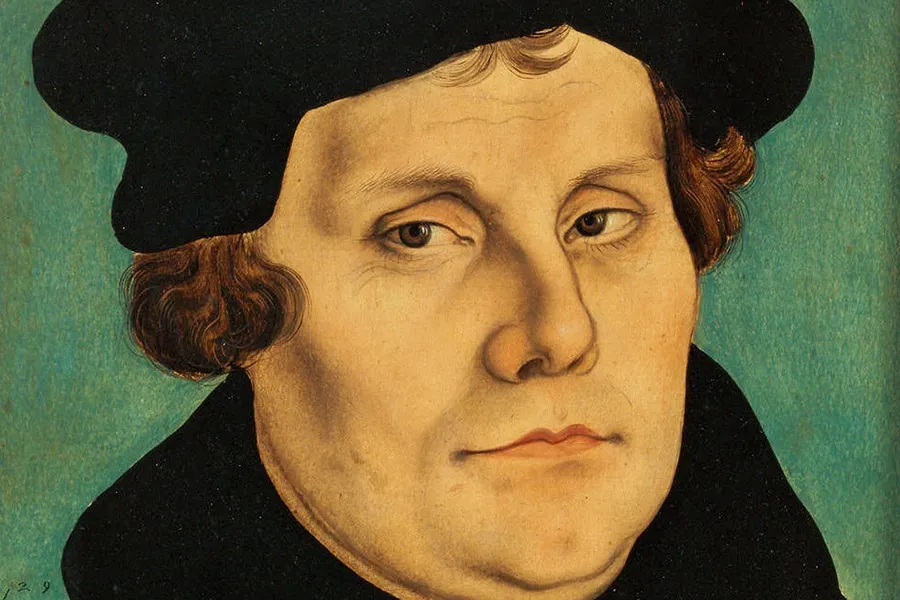
Washington D.C., Oct 30, 2017 / 04:36 pm (CNA/EWTN News).- One fated Halloween, 500 years ago, Martin Luther nailed his 95 theses to the door of Wittenberg Castle in a dramatic act of defiance against the Catholic Church.
Or, he may have just hung it on the doorknob. Or mailed out copies.
Or, if he did nail it, the act of the nailing itself would not have been all that significant, because the door may have been used as a bulletin board where everyone was nailing announcements.
And he probably wasn’t all that defiant; he likely had the attitude of a scholar trying to raise questions and concerns. At that point, Luther didn’t know how defiant he would eventually become, or that his act, and his subsequent theological work, would lead to one of the greatest disruptions of unity in the Church’s history.
“This was not a declaration of war against the Catholic Church, nor was it a break,” Dr. Alan Schreck with Franciscan University of Steubenville told CNA.
“It was a concerned, Augustinian monk and biblical scholar correcting an abuse, and it was really a call for a dialogue.”
However, it took fewer than five years for this call for dialogue to transform into schism, rejection of the authority of the Church’s tradition and bishops and most of the sacraments, and a growing number of Protestant communities, united only by their rejection of the Catholic Church.
While historians debate just how dramatic was the actual posting of the 95 theses, its anniversary is an occasion to look back at what the role of the most popular Protestant was in the movement that ultimately split Western Christendom in two.
Who was Martin Luther?
Martin Luther was born on November 10, 1483, the oldest son of Hans and Margarethe Luther. His father, a successful business and civic leader, had grand visions for his eldest son’s life and sent him to school with the hopes he would become a lawyer.
While Luther completed his bachelor’s and master’s degree according to his father’s plan, he dropped out of law school, finding himself increasingly drawn to the subjects of philosophy and theology.
Soon after leaving law school, Luther entered an Augustinian monastery, a decision he would later attribute to a vow he made during a precarious horseback ride, when he was nearly struck by lightning in the midst of a storm. Terrified that he was about to die, the 21-year-old Luther cried out to St. Anne, promising that he would become a monk if he survived. He felt it was a vow he could not break; his father felt it was a waste of his education.
By all accounts, Luther was a Catholic success story before he became the leading figure of the Reformation. He joined the monastery in 1505, and by 1507 he was ordained a priest. He became a renowned theologian and biblical scholar within the order, as well as a powerful and popular preacher and lecturer at the University of Wittenberg in Germany.
During his years of study and growing popularity, Luther began developing the groundwork of his theology on salvation and scripture that would ultimately become deal-breakers in his relationship with the Catholic Church.
The offense of selling indulgences
But it wasn’t strictly theological ideas that first drove Luther to the ranks of reformation ringleader – it was his critique of the practice of selling indulgences, the central subject of his 95 theses, that catapulted him into the limelight.
According to Catholic teaching, an indulgence is the remission of all or part of the temporal punishment due to sins which have already been forgiven, and can be applied either to the person performing the prescribed act or to a soul in Purgatory.
To obtain an indulgence, one must complete certain spiritual requirements, such as going to the sacraments of Confession and Communion, in addition to some other act or good work, such as making a pilgrimage or doing a work of mercy.
But even years before Martin Luther, abuses of indulgences were rampant in the Church.
Instead of prescribing an act of prayer or a work of mercy as a way to obtain an indulgence, clerics began also authorizing a “donation” to the Church as a good work needed to remit the temporal punishment due to sin.
Increasingly, people grew critical of the sale of indulgences, as they watched money gleaned from people’s afterlife anxiety go to fund the extravagant lives of some of the clergy. The money was also often used to buy clerical offices, the sin of simony.
During Martin Luther’s time, in northern Germany, the young and ambitious prince-Archbishop Albrecht of Brandenburg was offered the position of the Archbishop of Mainz, but was unwilling to relinquish any of his previously-held power.
Meanwhile in Rome, Pope Leo X was demanding a considerable fee from Albrecht for his new position, as well as from the people of his dioceses for the fund to build St. Peter’s Basilica. Albrecht took out a loan and promised Rome 50 percent of the funds extracted from – as critics would describe it – preying on people’s fear of Purgatory.
For the St. Peter’s fund, the Pope had employed Dominican friar Johann Tetzel to be the Grand Commissioner for Indulgences for the country of Germany.
According to historians, Tetzel liberally preached the indulgence, over-promising remission of sins, extending it to include even future sins one might commit, rather than sins that had already been repented of and confessed. He even allegedly coined the gimmicky indulgence phrase: “As soon as a coin in the coffer rings / the soul from Purgatory springs.”
It was Tetzel’s activities that ultimately pushed Luther to protest by publishing his 95 theses.
The 95 theses and the seeds of reform
“When he posted the 95 theses, he wasn’t a Lutheran yet,” said Michael Root, professor of systematic theology at The Catholic University of America.
“In some ways they get things rolling, but what’s important is what happens after the 95 theses when Luther gets pushed into a more radical position.”
Regardless of how dramatically they were posted to the door of Wittenberg Castle on October 31, 1517, Luther nailed not only his theses but the feelings of many faithful at the time who were also frustrated with the corruption and abuse they saw in the Church.
Christian humanists such as Erasmus and St. Thomas More were contemporaries of Luther who also objected to abuses within Church while not breaking from it.
Meanwhile, Luther’s already-established reputation as a respected professor, as well as access to the printing press, allowed his theses and ideas to spread at a rate previously unmatched by previous reformers who had similar critiques of the Church.
“Clearly there was a kind of symbiosis between Luther and the development of the printing press,” Root said. “What he was writing was able to engage lots of people. Many of them were short pamphlets that could be printed up quickly, they sold well…so he was on the cutting edge of technology and he fit what the technology needed – short, energetic things people wanted to read.”
Most historians agree that Luther’s original intent was not to start a new ecclesial community – that idea would have been “unthinkable at the time,” Root noted. ??“So that’s too much to say; however, it’s too little to say all he want to do was reform abuses.”
By 1518, his theses spread throughout Germany and intellectual Europe. Luther also continued writing prolifically, engaging in disputes with Tetzel and other Catholic critics and further developing his own ideas.
For its part, the Church did not issue an official response for several years, while attempts at discussions dissolved into defensive disputations rather than constructive dialogue. As a result, early opportunities to engage Luther’s criticisms on indulgences instead turned into arguments about Church authority as a whole.
Swatting flies with a sledgehammer – Luther becomes a Lutheran
One of Luther’s most well-known critics was Catholic theologian Johann Eck, who declared Luther’s theses heretical and ordered them to be burned in public.
In 1519, the two sparred in a disputation that pushed Luther to his more extreme view that scripture was the only valid Christian authority, rather than tradition and the bishops.
“The Catholic critics quickly changed the subject from indulgences to the question of the Church’s authority in relation to indulgences, which was a more dangerous issue,” Root said. “Now you’re getting onto a touchy subject. But there was also an internal dynamic of Luther’s own thought,” that can be seen in his subsequent writings.
In 1520, Luther published three of his most renowned treatises: The Babylonian Captivity of the Church, On the Freedom of a Christian Man, and To the Christian Nobility of the German Nation.
By that time, it was clear that what Luther thought was wrong in the Church was not just the abuse of indulgences, but the understanding of the message of Christianity on some basic levels. Besides denouncing the Pope as a legitimate authority, Luther also declared that faith alone, sola fide, was all that was necessary for salvation, rather than faith and good works.
“Luther was definitely trying to fix what was a legitimate problem, which was pelagian tendencies, or people trying to work their way into heaven,” said Dr. Paul Hilliard, Assistant Professor and Chair of Church History at Mundelein Seminary. It had created a “mercantile attitude” in some people at the time of Luther – “if I do this, God will do this.”
“So Luther was trying to correct these things, but the phrase I sometimes say is that Luther swatted the fly of pelagianism with a sledgehammer. In order to keep any trace of humans earning salvation out of the system, he changed the system.”
Luther’s distrust of human beings did not particularly spring from his criticisms of indulgences and the subsequent pushback from the Church – it was in line with most anthropological thought at the time, which tended toward a very negative view of human nature. Therefore, in his Protestant views, he sought to get rid of any human involvement wherever possible – particularly when it came to interpreting scripture and salvation.
“On the scale of beasts to angels, most people (at the time) would have us a lot closer to beasts,” Hilliard noted.
The Catholic Church officially condemned Luther’s theses in a papal bull, Exsurge Domine, promulgated in June 1520, and in part authored by Eck. The declaration afforded Luther a 60-day window to recant his positions, lest he be excommunicated.
But by the time the papal bull was issued, Luther had not only denounced the authority of the Pope, but had declared him an anti-Christ. The window for reconciling views was all but closed.
The popular and political reforms
Despite Luther’s increasingly radical claims against the Pope and the Church, his popularity spread, due to his compelling and prolific writings and, to Luther’s dismay, his populist appeal.
Luther popularized the idea of a “priesthood of all believers” to the exclusion of an ordained, ministerial priesthood. Rather than bearing an indelible mark on their soul, in Luther’s view ministerial priests did not differ from the “priesthood of believers” except in office and work. This, along with his personality and background, appealed to the poor and working class of the time who were frustrated with the lavish lives of Church hierarchy, which typically came at the expense of the poor in rural areas.
“Luther was very much a populist, he was a man of the people, he was scruff, he came from sort of peasant stock, he spoke the language of the people, so I think a lot of the common people identified with him,” Shreck said.
“He was one of them, he wasn’t far away in Rome or a seemingly wealthy bishop or archbishop…so he appealed particularly to Germans because he wanted a German liturgy and a German bible, and the people said, ‘we want a faith that is close to us and accessible’.”
But Luther balked when his religious ideals spurred the Peasant’s War of 1525, as peasants in rural areas of German revolted, motivated by Luther’s religious language of equality. The year or so of subsequent bloody war seemed to justify those who dismissed Luther as nothing more than a social movement rather than a serious religious reformer.
In order to maintain the esteem of those higher up, Luther disavowed the unruly peasants as not part of the official reform movement, laying the groundwork for the Anabaptists to fill in the religious gaps for the peasants in the future.
However, the Peasant’s War wasn’t the only time the Reformation got political – or lethal. Because of the vacuum of authority that now existed in Luther’s pope-less, emerging ecclesial community, authority was handed over to the local princes, who took advantage of the reformation to break from the fee-demanding Pope.
Much of Germany had embraced Lutheranism by the mid 1500s, though some parts, such as Bavaria, retained their Catholic faith.
For his part, Holy Roman Emperor Charles V officially condemned Luther’s theology at the 1521 Diet of Worms, a meeting of German princes, during which Luther famously refused to recant his position with the words: “Here I stand. God help me. I can do no other.”
Despite Charles V’s opposition to Luther’s views, he allowed for Luther’s safe passage from the diet, rather than enforcing the customary execution of heretics, and thus forfeited his best chance for stomping out the Reformation at its roots.
Historians speculate that while Charles V personally opposed Luther’s views, he let him live because he also saw the decentralizing of power from the Vatican as something of which he could take political advantage.
Reformation fever was also catching throughout Europe, and soon Norway, Denmark, Sweden, Switzerland and England were all following Germany’s example of breaking from the Catholic Church and establishing state-run, Protestant ecclesial communities.
“I like to think of the story with the little Dutch boy with his the finger in the dyke,” Shreck said. “Once the breach was made, others follows his example. Once Luther did it, it was like the domino effect.”
“In a book by Owen Chadwick, he said the Reformation came not because Europe was irreligious, but because it was fervently religious,” Shreck added. “This was after the black death and a lot of social turmoil – people really wanted to turn to God and seek solace in faith.”
But the reformers were not all agreed on their beliefs, which led to the rise of numerous sects of Protestantism, including Calvinism, Anglicanism, and Anabaptism.
“Protestantism became very divided, though they all claimed to be doing the right thing because they believed they were maintaining the purity of the faith,” Schreck said.
Root noted that once the Protestant-Catholic divide “got embedded in political differences, between southern Europe and northern Europe, between Spain and England, and so the religious differences also became national differences, that just made matters far worse.”
“Once you have the wars of religion in 1546, then attitudes become very harsh. Once you start killing each other, it’s hard to sit down and talk,” he added.
The wars over religion would become especially pronounced in the 30 Years War of the 1600s, though at that point, religion had become more of a political tool for the state, Hilliard said.
“The 30 Years War is a really good indication that while religion was important, it was not the most important thing – it was a war between different competing princes to gain greater control of territories, during which religion was thrown into the mix,” Hilliard noted.
Could the Reformation have been avoided?
The million-dollar question at the center of Reformation history is whether the Reformation and the splitting of Western Christendom could have been avoided.
“Some would say by two years into the Reformation, the theological differences already ran very deep and there was no way you were going to get reconciliation,” Root said.
“But there are others who would argue that as late as the 1540s it was still possible that perhaps the right set of historical circumstances could have brought people together, and there’s no way of knowing, because you can’t run history again and change the variables.”
“Whether one could have settled it all then short of war, there were missed opportunities for reconciliation, that’s clear,” he added.
Luther’s fiery and rebellious personality, matched with the defiant and defensive stance that the Catholic Church took in response to his ideas, created a perfect storm that cemented the Protestant-Catholic divide.
Much of Luther’s thinking remained Catholic throughout his life, Schreck noted, including his devotion to the Blessed Virgin Mary.
“I think if there had been a sincere effort on the part of the Catholic hierarchy that his concerns were legitimate, history might have gone in a different direction.”
It wasn’t until Pope Paul III (1534–1549), 17 years after the fated theses first made their rounds, that the Catholic Church as a whole took a serious and official look at its own need for reform, and its need to respond to the Protestant Reformation.
This is Part 1 in a three-part series on the Reformation. Part 2 will discuss the Council of Trent and the Counter-Reformation. Part 3 will discuss ecumenism today.
 […]
[…]







I’ll go with Catholic Unscripted, Oct. 29, 2024.
Cardinal Grech is quoted as saying:
“It could be said that the final document re-proposes the ecclesiological doctrine of the council.”
Um, I don’t think so, Cardinal.
Respectfully, Vatican II’s teachings are so clear, so undeniable, so beautiful. Nothing I’ve seen from this bureaucratic Synodolytrous blather-fest can even begin to compare.
What’s this, a victory chant for the laity, but with the laity not invited? Walk the talk…
One is almost reminded of synodal ineptness on the bridge of the Titanic, with the hireling orchestra still playing on deck even as the ship slipped into the sea. Memories differ as to whether the lyrics were “Nearer my God to Thee,” or “Autumn,” or Songe d’ Autumne…”
But, as for today and the Barque of Peter, here with the clear ring of truth is a post-synodal dirge from layman George Weigel at First Things–“Overhyped, Overmanaged, Underwhelming—and Providentially Heartening” (10-28-24): https://www.firstthings.com/web-exclusives/2024/10/letters-from-the-synod-2024-12
Your antagonism towards the band that tried to provide some comfort in the face of certain death speaks very poorly of you, in addition to being wildly off topic.
An important comma, the ineptness was on the bridge. Going too fast in iceberg waters (the owner overriding the captain); the officer-of-the-deck restricting too-few binoculars to the bridge and away from the higher-up lookouts; and then ordering a turn to the LEFT (!) enabling the 300-foot long gash instead of a more survivable head-on collision, and then reversing the left propellers which causes cavitation bubbles such that the blades have no traction at all. And, the presumption that the ship–any ship–is unsinkable. The orchestra and the entire ship’s company all sorta sailing together, synodally.
But, I agree that there should be a better analogies…On January 28, 1986, the Space Shuttle CHALLENGER broke apart 73 seconds into its flight. The cause of the disaster? The failure of external “O-ring” seals rendered brittle by the weather…A significant detail—foreseen and reported by an underling, and then ignored by “hot-button” potentates in the launch center.
Might we be REMINDED of the also forwardist 2024 Synod on Synodality almost breaking apart four years into its flight?..But, then, jettisoning the explosive “LGBTQ” slogan (removed from the Final Report)…And, too, rediscovering the synodal course trajectory from the ignored 2018 International Theological Commission. Especially this:
“…It is ESSENTIAL that, taken as a whole, the participants give a meaningful and balanced image of the local Church, reflecting different vocations, ministries, charisms, competencies, social status and geographical origin. The bishop, the successor of the apostles [not “primarily as facilitators”!] and shepherd of his flock [!] who convokes and presides over the local Church synod, is called to exercise there the ministry of unity [!] and leadership with the authority [!] which belongs to him” (Synodality in the Life and Mission of the Church, 2018, n. 79).
QUESTION: Yes, how to “listen” to significant technical details from the laity or whomever, but without a new tribe of “hot-button” clericalists aborting coherent governance/doctrine into an inverted trajectory—the “inverted pyramid” (c)hurch? From the Final Report: Church authorities in the Barque of Peter “may not ignore” conclusions (“conclusions”?) reached by consultative, participatory bodies…“May not ignore” meaning what?
Surely not meaning the square circle of “may not reject”? Surely not double-speak voice overs against the successors of the Apostles of Lumen Gentium, nor deafness to the voice of Dei Verbum? Surely not local-option colonialism under continental red and purple hats? Think “continental drift” of Africa and others under the divisive Fiducia Supplicans…
So, this from so-called “rigid bigots”: Isn’t constant change the deepest rut of all?
Third phase “reception?” The Vatican can tie me to the rack. I refuse to join yet another denomination of Protestantism.
This Synod has just caused confusion, and has harmed the understanding of Catholics from around the world by causing conflict with and to Tradition and doctrine. It has been without any degree of listening to the Holy Spirit, but rather the imposition of a preset end point. Though I think the pope and his entourage of progressives are disappointed that they are consistently met by the those who still value Tradition, doctrine, and scriptural foundations.
The Church does not create doctrine out of whole cloth! This pope is determined to follow after the world at the expense of what should be our focus – Jesus Christ crucified and resurrected.
It seems that the purpose of bishops conferences in the US and Europe is to suppress and suffocate the voice of good shepherds, and decapitate and dismember the Body of Christ, and replace it with a “queer church.”
Exhibits: these “Eminences” of the queer-royal-court: Hollerich, McElroy, J. Tobin, Cupich, Radcliffe, Schonborn, Grech, etc, etc.
As Pope Benedict XVI observed, these conferences have no authority from Jesus.
They are concocted by men who prefer to preach “a different gospel.”
My advice: Give the Church 25 years to digest this Synod and then make whatever conclusions the Church wishes to draw from it. And before that time, refrain from making changes that are ill-considered and which we might regret. After all, 25 years is a drop in the bucket considering that the Church has been around 2,000 years.
or for eternity….
Addendum to my post about waiting for 25 years before drawing any conclusions about this Synod: The Church waited almost 400 years before codifying Sacred Scripture as definitive at the Council of Rome. Obviously, the Church had at its disposal Scripture in the interim years but all was not settled for a long, long time (and that was during a time when the eschaton was believed to be imminent).
So now we no longer have One, Holy, Catholic, and Apostolic Church, but “Churches.” “It will be the Churches above all that will do the work….”
“the Church at….” 🤭
In Laodicea, I think you mean.
Excellent observation.
That’s the model for “decapitating the Body of Christ” (to use the theme created by Fr. Robert Imbelli).
“Sojourners” who have “moved beyond Jesus” (to quote the neo-pagan “nun” Ms. Laurie Brink of the LCWR) are simply looking for a bishop or pontiff who will sacramentalize their “queer ideology.”
That’s the purpose of McElroy and Hollerich et al.
Ends not with a bang but rather a whimper. The hot air is slowly seeping out of the already deflated, limp balloon 🎈. Meanwhile the barque sails on, its course unaffected.
It is impossible to make sense of this mess without reference to the writings of Archbishop Marcel Lefebvre.
“debate welcomed and encouraged”? Perhaps “moderation”should be changed to obliteration! 🫣 God bless
Rereading a Church’s Journey may read rewriting a Church’s journey. CNA offers nothing substantive except to describe a process of implementation that doesn’t identify what should be implemented, rather a vague reference to the need for pastors to consult with “those engaged in theological research” (Cdl Grech). It reminds me of Queen Esther telling King Ahasuerus that she and her people were in mortal jeopardy, the King responding, Who and where?
The analogy is meant to underline the gravity of referring to what a pastor [and bishops, and bishops conferences] should teach, instill, educate his parishioners [what happened to Christ?]. Nothing can have greater import for the parishioners and the Church. Or as Bob above apprehends with clear vision that “It will be the Churches above all that will do the work”, clearly not the One, Holy, Apostolic Catholic Church.
Why “identify what should be implemented”?
“’When I use a word,’ Humpty Dumpty said in rather a scornful tone, ‘it means just what I choose it to mean — neither more nor less.’ ‘The question is,’ said Alice, ‘whether you can make words mean so many different things.’ ‘The question is,’ said Humpty Dumpty, ‘which is to be master — that’s all'” (Lewis Carroll, “Alice in Synodaland”).
These gentlemen need be yanked from their desk jobs and given something constructive to do…a few years occupancy at La Grande Chartreuse or a decade in the South Bronx might wake them up. Anything to get them off there seats — to their knees or on their feet. Presently they serve no purpose but to substitute the New World Order for the One True Faith.
That actually is too often the problem of our secular world leaders; no real life experience, never gotten their hands dirty in effect.
Sounds like they had three days of back-patting and celebrating themselves.
“The stage of celebration ends and the stage of reception begins,” [Cardinal Mario Grech] said.
Watch for incoming!
“Reception” stage? I must be skipping ahead.
I’m already at the “upchuck” stage.
Using the phrase “the people of God” when actually meaning “synod delegates in lockstep with ‘progressive’ secular ideology” is not just an example of hubris at its finest, but an insult to those of us who see this entire synodal process as less than inspired or inspiring. Speak for yourself, Ms. Wijlens, and keep “the people of God” out of it.
Disgusting to read the comments! Totally prejudiced and one-sided!