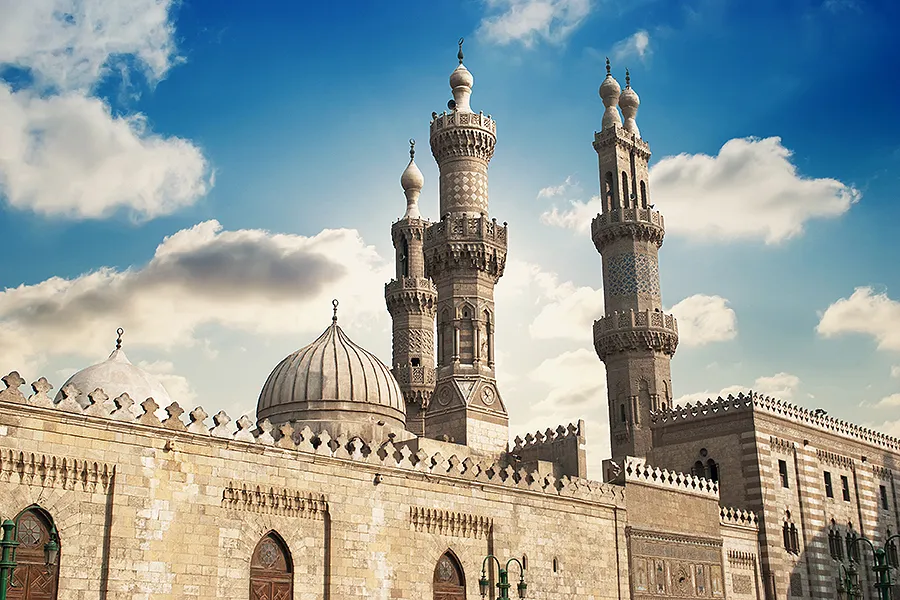
Rome, Italy, Apr 27, 2017 / 09:01 pm (CNA/EWTN News).- A leading scholar in the Arab world has applauded the goodwill of both the Vatican and the prestigious Islamic al-Azhar university Pope Francis will visit for aiming to increase Catholic-Muslim dialogue.
But she also issued a warning that goodwill isn’t enough for things to change.
“Dialogue is good, generally any dialogue is good. Any kind of debate and any steps to show goodwill, to show a commitment, to show a recognition of the other in principle is very good,” Mariz Tadros told CNA in an interview.
However, “the extent to which this will translate into a change in eliminating or reducing the appeal of militant Islam, that’s what I’m questioning.”
Tadros, who spoke over Skype from the U.K., is an author and scholar on persecution in the Arab world. She is currently a fellow at the Institute of Development Studies at Sussex University in the U.K.
She spoke ahead of Pope Francis’ April 28-29 visit to Cairo, where he is set to meet with Coptic Pope Tawadros II and the Grand Imam of the Mosque of al Azhar, Sheikh Ahmed Mohamed el-Tayyib, as well as Egypt’s president Abdel Fattah el-Sisi and the bishops of the local Catholic Church.
His visit comes as the result of a recent thawing in relations between the Vatican and the al-Azhar University, which had been strained since 2011. The imam of al-Azhar is considered by some Muslims to be the highest authority the 1.5-billion strong Sunni Muslim world and oversees Egypt’s al-Azhar Mosque and the prestigious University attached to it.
Dialogue picked up between the two after el-Tayyib visited the Vatican in May 2016 with a message condemning the acts of Islamic fundamentalism, culminating a year later in the Pope’s visit to Egypt this weekend.
However, in addition to the heightened prospect for dialogue, the trip will also have an inevitable undertone of the very real risks Christians still face in Egypt, particularly from extremist factions of militant Islam.
While Catholic-Muslim dialogue has picked up over the past year, so have attacks against Coptic Christians.
According to His Grace Bishop Angaelos, general bishop of the Coptic Orthodox Church in the United Kingdom, there have been at least 40 reported murders of Christians in Egypt in the past four months alone.
In February 2015, Egyptian society was shocked by the grisly beheading 20 Orthodox Coptic faithful in Libya carried out by ISIS, the video of which was circulated online. The extremists have also claimed responsibility for several other high-profile attacks, including a bombing at St. Mark’s Coptic Orthodox Cathedral in Cairo in December that killed 29 people.
Most recently, ISIS claimed responsibility for twin bombings in Tanta and Alexandria April 9 that left some 45-people dead. The blasts took place on Palm Sunday, one of the holiest days in the Christian calendar commemorating Jesus’ entrance into Jerusalem before his Passion and Death.
With these attacks looming closely in the rear-view mirror, many are asking whether the Pope’s attention to dialogue with Islam, particularly his relationship with al-Azhar and his trip to Egypt, will make a difference.
The debate surrounding al-Azhar
According to Tadros, the prospect of any dialogue is good and shouldn’t be discouraged. However, she cautioned that despite the well-intentioned gesture of meeting with the Pope and cementing good relations with the Holy See, there is still cause for concern regarding al-Ahar – particularly the university’s duplicitous curriculum.
“When we look at institutions such as al-Azher, there have been many Egyptian non-Islamist Muslims, very progressive Muslims, who have sought to hold al-Azhar accountable for the duality of its discourse,” she said.
On one hand, “al-Azhar will sit with you and say we love you, we care for you, we’re all one citizenship, we’re all one people.” But on the other hand, “if you look at the syllabi, what they are teaching the generations of scholars that graduate from that university about the religious other, it is horrendous.”
What they are teaching is “undoubtedly a message that these are infidels, and at best they should be tolerated and at worst, killing them is not such a travesty.”
If one actually looks at what comes out of al-Azhar, “there’s a massive, massive disconnect between the public discourse and what is being taught to people across the country,” she said, explaining that there have been several moderate Muslim activists who have called on the university to reform their syllabi, including a man who was jailed for his activism, but who has recently been released.
While al-Azhar is seen by many militant Islamic groups as lacking legitimacy for not following the “right path” of Islam, others have criticized the university for failing to speak out strongly enough when condemning extremist groups such as ISIS.
Many have asked al-Azhar to put their money where their mouth is, so to speak, and declare ISIS as “un-Islamic.” In short, it’s no longer good enough to simply condemn what they are doing, but the entity itself must be recognized as not being faithful to the Muslim religion.
“As a Christian you can tell me, ‘if you lie that is not consistent with Christianity,’ but you are not telling me, ‘for shooting people in the name of Christianity, you no longer belong to Christianity.’ Do you see the difference?” Tadros said.
But when it comes to Al-Azhar, they have “consistently cowed away from declaring ISIS as not part of the Islamic community.”
Although some might say making such a declaration is playing into the game of name-calling and labeling one another as infidels, Tadros stressed that “unless you tell the broader international community that those who kill and maim and commit genocide in the name of Islam no longer are part of the Islamic community, they do not have the right to claim themselves as Muslim,” nothing will change.
That, she said, is “a very different story and they have cowed away from doing that.”
Tadros clarified that she is “in no way” saying that dialogue between Pope Francis and al-Tayeeb isn’t good or that it shouldn’t happen. “All I’m saying is let’s not count on that as a way of making militant Islam less appealing.”
She stressed that there are “a lot of Muslims” that have shown solidarity with Christians in Egypt, including speaking out on their behalf after the most recent bombings earlier this month, proving that not all Muslims espouse the radical views of ISIS or other like-minded branches.
However, while not all Muslims are extremists, she said history has proven that no matter how much dialogue is done, fundamentalism will never entirely disappear from Islam.
When asked if she thought this was a realistic eventual outcome of the dialogue between the Vatican and al-Azhar, she said “absolutely not.”
“I think that is the biggest myth that exists in the West and it’s a myth that history has dispelled and is it a myth, the perpetuation of which, only serves to increase the vulnerability of religious minorities in the Middle East. In fact, I would say it directly contributes to it.”
The growing threat of militant Islam “is one that we should not take lightly,” she said, “because they are networked.”
“Even though organizationally they follow different leaders, there are links between them, they are well-resourced, they are recruiting people globally from around the world, and they represent an existential threat to Christians and religious pluralism and all kinds of pluralism in the region.”
So while the importance of dialogue as an expression of finding common values and forging friendships across religions should be appreciated, it should only be valued to the extent that true goodwill and respect for the religious other result, she said.
“But I do support those who challenge their effectiveness in making militant Islam more appealing or undermining its power and influence and implications for Christian minorities.”
A history of persecution
Christian persecution has happened on and off for centuries in Egypt, but this intolerance recently spiked in the 1970s under President Anwar Sadat, who empowered radical Islamists, but was assassinated by fundamentalist army officers in 1981.
A period of higher tolerance ensued after Sadat’s death, but attacks targeting Christians picked back up during the Egyptian Revolution of 2011.
The 2011 revolution, part of the Arab Spring, had overthrown Hosni Mubarak, a military officer who had been Egypt’s president since 1981. The following year Morsi, of the Islamist movement the Muslim Brotherhood, became the first democratically elected Egyptian president.
On July 3, 2013, Egypt’s military ousted Morsi, and in August began a crackdown on the Muslim Brotherhood. Violence then spread across the country, with Islamists killing hundreds of people from August to October. Churches were vandalized, burned, and looted, as were the homes and businesses of Christians.
In January 2014, the interim government approved a new constitution, leading to the May 2014 election of Abdel Fattah el-Sisi as the country’s new president. The elections were boycotted by the Muslim Brotherhood as well as other political groups.
Tadros explained that part of the chaos after the revolution was due to “a complete breakdown in public safety and law and order” in which police left the streets and organized groups of “thugs” took over, meaning public safety was no longer a guarantee.
With a lack of secure borders given the crisis in Egypt and the collapse of nearby Libya, extremists became emboldened, and began smuggling and trading weapons with greater confidence and ease.
Radical Islam also began to take on different forms in this time, Tadros said, explaining that whereas previously terrorists were homegrown and committed smaller acts of violence, the rise of factions such as ISIS looking to impose maximum damage through suicide bombs is new.
“The fact that ISIS is now a player is a game-changer,” she said, explaining that with an increase in deadly attacks, there is greater need for security. However, she voiced doubt that the current state of emergency declared by el-Sisi in wake of the April 9 bombings will be effective in terms of protecting Copts.
From a scholarly and historic point of view, emergency law has done nothing, she said, noting that it was implemented by both Mubarak and Morsi when they were in power, “and in both cases it was not conducive to the well-being of the Egyptian population in general.”
Since his election el-Sisi has been praised for receiving representatives from both the Orthodox and Catholics, as well as Protestants.
However, even though the situation has “officially” improved under el-Sisi, who has said and done the right things, Tadros said the improvement is due not so much to el-Sisi’s efforts as it is to the fact that Morsi was driven from power.
“The situation under el-Sisi is very complicated, because on the one hand there is an improvement in the Copts’ everyday experience. Not directly as a consequence of any of el-Sisi’s policies by any stretch of the imagination, but it is an unintended outcome of ousting Morsi,” she said.
“Never in the modern history of the Copts have they been such a target of militant targeting as they are today,” she said, explaining that if fundamentalists want to target Copts, there is realistically little that can be done to stop them.
How can Christians be helped?
With Christians in Egypt increasingly becoming a target of systematic violence and a bleak prospect of effective help from the government, Tadros suggested several things that can be done now to help the 9 million-strong Coptic community in Egypt.
First, “security is crucial,” she said, explaining that the ability to ensure basic protection of schools, places of worship such as churches and monasteries, and faith-based organizations, “is extremely important.”
Another essential help is “drying out the sources of funding,” Tadros said, noting that currently “we do have a problem with Saudi Arabia, Qatar and other Arab countries funding Islamist movements.”
“They have to be named and shamed, and even if it goes to the point of economic sanctions against any country that funds Islamist movements, that would significantly help the Christians,” she said, adding that this is “one of those unintended outcomes: if you remove their sources of income, they can’t buy arms, and therefore their ability to strike is significantly decreased.”
A third option Tadros mentioned is the growth and promotion of solidarity among the different churches in the region. As an example, the scholar noted how Pope Francis called Coptic Pope Tawadros personally to offer his sympathies after the April 9 attacks.
“We need to see more of that,” she said, stressing the need for Christians of all rites and practices to band together, because “divided we fall, united we’re strong.”
Finally, she pointed to the importance of raising awareness in international Christian communities of the “existential threat” that Christians in the Middle East face.
“We’re no longer talking about what we saw in Egypt four or five years ago where it’s a number of Muslim mobs burning a number of houses,” she said. “We are now talking about a broader, new strategic plan to eliminate Christianity from the region.”
The global community, she said, needs to “raise awareness and sensitize their congregations of the need to support the churches in the Middle East” in various ways, such as through prayer and concrete initiatives that will help those who have lost everything to rebuild their lives.
Another important aspect is “strengthening local Christian civil society,” she said, “because sometimes Church leadership, such as in the case of Egypt, find themselves in a position where they can’t come out and criticize governments, there’s too much at stake.”
“So you need Christian civil society that play the role of monitoring the situation, raising alarm bells when they see signs of genocide and of strengthening local initiatives.”
Holding governments accountable is also part of the equation, she said, sometimes by “criticizing the government, and sometimes mobilizing against government policy if it’s not going to be conducive to citizenship.”
 […]
[…]



Um, I have a question, Jorge.
What about Rupnik?
Why stop there?
The language of northern Belgium is Flemish (Vlaams). As in Vlaams Belang and Nieuw Vlaams Alliantie (N-VA), two of the political parties.
Little Sisters of the Poor are humbly serving the last, the least, and the lost. May the selfless servers and those served be blessed with joy and happiness.
Why should the Church be ashamed when Bergoglio is not ashamed? Here is the list of the sexual abusers he has and is protecting:https://opentabernacle.wordpress.com/2017/03/03/list-of-sexual-predators-protected-by-pope-francis-grows-and-grows/
Why not praise him for the flack he is taking by standing firm on abortion, no women priests, not accepting homosexuality and trans genderism ? Even the secular media is covering this. Give the man credit when credit is due! By the way he should be addressed as Pope Francis.
Probably because the article is about the Pope’s speech saying the Church should be ashamed of clerical abuse, not about everything he’s ever done.
Touché Amanda.
Bergoglio has continuously in word and deed promoted homosexuality and transgenderism, the heretical agenda of his Synod on women priests, and the raft of pro-abortion “experts” he has appointed just last week to his ruined Dicastery for the Doctrine of the Faith. These are all matters of public record for the past 11 years. If Bergoglio acted and spoke as pope, he could be addressed as pope, but he does not. In fact, serious doubts must be entertained of whether he is pope and not an apostate and heretical anti-pope. Again, these are issues that have been routinely addressed on the public record for the past 11 years.
James Connor: He has never been “firm” on any of those matters. Check again. Early in his pontificate, he even condemned being “obsessed” over abortion, and he has knowingly been praising the work of some of the world’s most notorious abortionists ever since under the pretest of environmentalism. He restructured the Pontifical Academy for Life from a pro-life think tank to an abortion advocacy cesspool. An all-male priesthood was solved definitively by JPII, yet Francis, the politician, keeps finding cynical ways to revive it. And he clearly supports the legitimization of homosexuality.
From no other than Bridget Bardot today —
On Bergoglio: “I have no admiration whatsoever for what Pope Francis says and does. I wrote to the Pope twice, happy to know that he was taking the name of Francis and convinced that he would do something for animals. I never received a reply.”
https://gloria.tv/post/iQwEUxRhkeDk4Zs6txEp1Ds3Z
I too, James, am saddened because those who attack Pope Francis are, like me, sinners and ingrates.
I would only like to add and remember, regarding abortion and euthanasia—topics that are very close to my heart, as they represent the foremost and principal abuses of the apostate Western ‘civilization,’ once Christian and now neo-pagan (let it not be said, as was reproached to the Pope in Belgium for paying homage to King Baldwin, that we have returned to the Middle Ages—we are the ones who change, becoming worse, we have become barbaric, but God and His holy law do not change!)—that King Philippe, precisely ten years ago, abdicated.
Not formally from his power, but essentially from his role. A role that, particularly as a Catholic, required him to serve all his subjects, especially the least among them, in obedience to the famous Gospel paradox which demands that the greatest make themselves small and place themselves at the service of the most defenseless. And who are the most defenseless if not children?
Yet Philippe, forgetful of his *munus* and the responsibilities it entails, signed into law the bill extending euthanasia to minors without any age limit, a law approved by Parliament on February 13, 2014.
The 210,000 signatures collected from every corner of the world and addressed to him, urging him to deny his assent and shield the children of his people with his crown, were in vain. Two hundred and ten thousand signatures to stop a single one. These signatures were gathered not because there was a true belief that without the monarch’s approval, the law would not pass, but because Philippe’s ‘No’ would have embodied the ‘No’ of hundreds of thousands of citizens who do not identify with a Belgium that has taken on the guise of Herod. That ‘No’ would have signified that the word of one man, precisely because he is King, holds far greater weight than parliamentary majorities and political calculations.
None of those issues are relevant to the article. Francis has actively, intentionally, and repeatedly failed to properly discipline and laicize members of the church hierarchy who are guilty of sexual abuse and assault. His behavior is inexcusable and totally unacceptable. I’ll start referring to him as pope when he starts acting like one.
Athanasius, your comment inspired me to revisit the words of Saint Catherine of Siena, who played a pivotal role in the history of the Church. She was instrumental in bringing Pope Gregory XI back to Rome from Avignon. Later, she was summoned by Pope Urban VI to address the cardinals and remained in Rome as his advisor. The challenges faced by the Popes and the Church during Saint Catherine’s time may not mirror our own, but they were nonetheless significant, causing widespread disaffection, especially towards Urban VI. In fact, even those who remained loyal to the Pope and opposed the Antipope were plotting his assassination, blaming him for the Church’s woes. Catherine suffered deeply from this and was tormented by the thought of what she called a potential “parricide.” She not only prayed but asked the Lord to let her bear all the suffering so that the Church might be spared. And the Lord listened to her.
I offer this context because we must always look at the Pope with the eyes of faith. With that very same vision of faith, Saint Catherine wrote: “I urge and desire that you love Christ on earth” (Letter 177, to Cardinal Pietro of Porto). She also requested that her spiritual children offer “a special daily prayer for the Holy Church and for the Pope” (Letter 324, to Stefano Maconi, the future founder of the Certosa of Pavia).
Here is one of Saint Catherine’s prayers for the Pope. It can be recited daily as a tangible expression of our love for the Church, offering it just a minute of our time:
“O eternal God and sweetest charity, I pray and beg your most holy clemency that you purify your vicar, so that his heart may burn with holy desire to recover the lost members of the holy Church. And if his negligence displeases you, O eternal love, punish my body for it, which I offer and return to you, so that you may afflict and destroy it with your scourges, if it pleases you so. I pray that he always does your will, does not heed the counsel of the flesh, and does not cower in the face of any adversity, for truly all things fall away except you, the highest God. Therefore, O eternal mercy, make your vicar a devourer of the food of souls, burning with holy desire for your honor, and uniting himself only with you, because you are supreme and eternal goodness, purify our infirmities for your sake, and restore your bride with his salutary counsel and virtuous deeds. Amen.”
In a letter to Bernabò Visconti, Lord of Milan, after reminding him that “the sweet Word, Son of God, has placed His blood in the body of the holy Church and wills that it be administered by the hands of His vicar,” she wrote: “Therefore, it is foolish for anyone to turn away and act against this vicar who holds the keys to the blood of Christ crucified. Even if he were a demon incarnate, I must not raise my head against him but always humble myself, asking for mercy through the blood, for there is no other way to obtain it, nor can you share in the fruit of the blood in any other way. I implore you, for the love of Christ crucified, not to act against your head” (Letter 28).
As you may have noticed, Athanasius, I haven’t engaged directly with the content of the debate. But I hope I have helped you love the Pope, who remains the Vicar of Christ, and encouraged you to pray for both him and the Church. The Lord will bless you abundantly.
To the staff of the CNA, and CWR readers:
Here is a photo of the Pontiff Francis on the fateful night after his election:
https://www.tldm.org/news41/francis-danneels.jpg
The man at the right of the photo is Cardinal Godfreed Daneels (who as the article admits, was the “protector” of his friend the nephew-raping-pederast-pedophile Bishop Roger Vangelhue), and who (in league with his fellow sociopath Cardinal Theodore McCarrick) helped engineer the campaign to elect Cardinal Jorge Bergoglio to the papacy.
And consistent with the Pontiff Francis’ continuing very deep personal esteem and eternal protection of his friend the sociopath sex abuser Rupnik, following upon similar protections and favors the Pontiff Francis has doled out to other sociopath sex abusers like his Argentinian friend bishop Zanchetta, etc, etc, we should all keep in mind that in his prior role as Archbishop of Buenos Aries and head if the Argentine Bishops Conference, then-Cardinal Bergoglio orchestrated a multi-million dollar secret legal campaign to defend his friend “Rev.” Julio Grassi, the most notorious sex abuser in Argentina, who was tried and convicted of raping orphans in his “orphanage charity organization.”
CNA might consider the option of facing reality of what it means that The Pontiff Francis and the late Cardinal Danneels and the former Cardinal McCarrick are of one mind.
I submit to CNA and all that their “one mind” is NOT THE MIND OF CHRIST.
Thank you Paul and Chris for this information and the devastating links. The Church is being attacked from the inside it seems. May God help the Church. I had heard of this before but had attributed it to de enemies of the Church. Then after checking your links I went and found other links:
ps://www.yahoo.com › news › swiss-guards-39-gay-mafia-104500440–politics.html
The Swiss Guards’ Gay Mafia – Yahoo
January 24, 2014. The Swiss Guards’ Gay Mafia. For more than a year now, there has been ample talk around Rome about a powerful gay lobby at work inside the Vatican. When Pope Benedict XVI ..
Yes, Michel Foucault, the patron saint of post-modernism and liberated sex (he had his own boy) would have been very proud of Danneels.
A possible cover-up by the Belgian Catholic hierarchy of a vast scandal of sex abuse of minors by priests and bishops is likely to be less shocking to a group of parents who spent years trying, with no success, to have a graphically sexually explicit “catechism” textbook withdrawn from Catholic schools.
On June 24, the very day police were raiding the offices of the Archdiocese of Brussels and the home of Cardinal Godfreed Danneels, an article appeared in the Brussels Journal detailing the cardinal’s opposition to efforts to stop the catechism that had been written and approved by Belgian Catholic authorities.
Alexandra Colen, a Catholic member of the Belgian parliament, wrote that because of this “perverted little catechism,” “Hundreds of children who were not raped physically were molested spiritually during the catechism lessons.”
They really were ahead of their times when you think about the content of books now found in school libraries.
Many are so blinded by the resentment they harbor against the Church that they believe it capable of committing the gravest monstrosities imaginable. The concept they have formed of the Church is that it is a criminal organization.
However, this is not the first time in history that some have thought this way. Others before have said, from different perspectives, that the Pope and the ecclesiastical hierarchy are inventions of the Antichrist.
But we need to bring the issue to its core.
The behavior of priests (or rather, we should say: of some priests) is not the object of my faith. The object of our faith is Jesus Christ, God made man, who for each of us is ‘the way, the truth, and the life’ (John 14:6).
Of course, hearing criticism of the Church always causes sorrow, because it is as if we were hearing our mother being criticized: it is the Church, in fact, that gave birth to our faith, and it is in the Church that we nurture our faith. Our mothers eventually leave us. And yet, once we are adults, we can manage on our own.
But this is not the case with the Church. We absolutely need it always, until the very end, because it is through the Church that we encounter Christ. We meet Him primarily in the sacraments.
When I go to confession, it is Christ I want to meet. I am interested in His forgiveness. I care about His grace.
When I am at Mass, it is Christ’s sacrifice that I seek.
His blood is my only treasure, that blood which has a voice more eloquent than that of Abel (Hebrews 12:24). I seek Him for myself, for the Church, for all humanity, even for those who are scandalized by the behavior of some men within the Church.
As you see, Chris, I am not trying to contrast the immense good that exists in the Church with the evil committed by some of its ministers.
Because the object of our faith is Christ. It is Him we follow.
Certainly, the witness of the Church is important. Because through its life and its word, it proclaims Christ. And yet, not even the Church—even if it were composed solely of saints—is our God.
Christ, and Christ alone, is ‘our great God and Savior’ (Titus 2:13).
Only Christ is ‘He who is over all, God blessed forever’ (Romans 9:5).
In the nascent Church, Jesus also co-opted Judas. He knew well that Judas would betray Him and that his behavior would cast a shadow over the Twelve.
Why did He do this?
St. Augustine says that Jesus wanted to use even Judas. He tolerated being betrayed by him to redeem us.
Well, even today, Christ uses those who do harm within the Church to spur others to redouble their zeal.
But even without resorting to Judas, not even the Twelve could boast of their faithfulness.
With this in mind, the Church is called to remain humble, with its head bowed, to play the low notes, as the humble—let me emphasize that word—Francis does continuously.
Despite its infinite merits, the Church must not glory in itself.
Its mission is not to proclaim itself, but Christ.
We must be certain that the Lord did not make a mistake in presenting Himself to the world with such a fragile face as that of the Church.
It must be clear to everyone that its preaching is so marvelous, and its action so transformative, not because of the skill of its men but because of the virtue of Christ that is in it.
Just as St. Paul once said: ‘But we have this treasure in jars of clay, to show that this all-surpassing power is from God and not from us’ (2 Corinthians 4:7).
Seeing the Church suffer from all these scandals, amplified by the social media, instead of discouraging us, reminds us that the object of our proclamation and our faith is our great God and Savior, Jesus Christ.”
I understand your passion, Paolo, but, what are we to say and do when corruption exists? Nothing. Maybe turning over the tables in the temple is also following Jesus. The thing is sexual abuse by (a few) clergy does, has and is causing people to give up, and even more so when those people go to the Church for help and get rejected. Does not the reality of around 50% of clergy not believing that chastity is integral to their celibacy not bother you? Yes, I know you will question that figure: based on research and experience, I don’t doubt it for a minute anymore. The scandals and depressed morale aren’t due to us highlighting the existence (ever-present- yes) of evil within the church and even ourselves, it’s because of those evils themselves. So, don’t shoot the messenger, man, turn over some of the tables in the temple, while maintaining your deep faith. Maybe doing so is part of the faith. But, you’re the better man: I’ve given up (because of abuse but more so because of my Bishop’s response to me and others I know), so, yeah, I suppose you can, therefore, reject everything I say. We all have points to make, though and together maybe we come closer to reality.
Paolo. Read this response second. Just after I read your comment and replied to it, I received an email from a woman I have come to know who has been deeply harmed by a forced adoption within the RC Church. He husband was also a victim of child sexual abuse. Both after trying to deal with the fallout through the Church have decided to leave, the husband even going so far as to be officially ‘de-baptised’. Here is a short section from her email:
“Ironic is it not? That the very people who profess to be “so-called Christians” but rather acted very non-Christian and became like judge and jury by punishing and condemning innocent children and adults (like myself, husband’s name redacted, and thousands of others) were the ones who turned me against the churches and Christianity in general”.
“I believe, however, that I am a spiritual being within a human physical body (for now). My spirituality resides more in nature. In a universal. divine. all-knowing presence”.
So, unless Francis and his Bishops and religious OPrder leaders can/will actually do something for the many hundreds of thousands of people like this couple (and others I am assisting – and encouraging to keep their faith), as well as fully enact a truly zero-tolerance, nothing will ‘get better’ for the Church nor for the society it could and should be really being a light.
Well, that’s how I see it for now. Maybe I haven’t given up, but at present I also just can’t be part of the Body, and I do miss it.
“Many are so blinded by the resentment they harbor against the Church that they believe it capable of committing the gravest monstrosities imaginable. The concept they have formed of the Church is that it is a criminal organization.”
People have good cause, and plenty of evidence, to support these beliefs. Given Francis’ repeated refusal to properly and decisively address this and hold people accountable, it’s perfectly understandable that the church’s reputation has been tarnished. People aren’t stupid.
I continue to have an objection to the Bishop of Rome fashioning himself as a Head of State and meeting with his counterparts like the King and Queen of Belgium.
This globetrotting activity of the modern day papacy began with Paul VI and went on steroids during Pope John Paul’s tenure. There was less of it under Benedict. We live in an age of superstars, stadiums filled with screaming fans and a hypercommercialism of just about everything which now includes the person of the Bishop of Rome. If the Church were to be truly collegial, it would leave shepherding to the the bishop of each diocese.
I would make this applicable to WYDs and all the globetrotting and expense that yhose events involve. Wouldn’t it make sense to have Diocesan Youth Days when bishops meet with the youth of their individual dioceses, have Mass and conferences for youth to attend and then do a Billy Graham-style altar call for all the young willing to engage in missions of evangelizelization? I think the days of Church-as-Rock-Concert and globetrotting Popes should end.
I’m not a fan of altar calls in the Catholic Church (I mean, besides the entire Mass). I’m not sure about the globetrotting. Popes have been involved in diplomacy since approximately the time of Constantine. For some at least it was probably the right call.
But it would be nice for bishops to be more visible in their dioceses. I suspect most people only see him at their Confirmation, and some don’t even see him then. There are some large dioceses in the US, that take a day (or more) to drive across. Just to have the bishop come to a few regional parishes in a year (so that most people could make it without needing to pay for a hotel), say Mass, and give a conference or two, would probably make a world of difference in the relationship between bishop and people, without requiring him to visit each parish every year.
The appropriate position is for The Church to be ashamed of and shun the Pontiff Francis for his lifelong allegiance to clerical and episcopal sex abusers and sex abuse coverup hierarchs.
The key word in the headline is indeed,’should’. But he/they have an out – ‘the church is both holy and sinful’, the same ‘excuse so many abusers of children AND adults use, like the Salesian who was interrupted while raping a boy and who responded; “Well, God made me this way”. Or like the abusers who sexually harm then go to confession, often to other clerical sex abusers, as ex-Fr Kevin Lee explained in a video shortly before he ‘died’ see https://www.youtube.com/watch?v=CHVhYXLNvlw . No, Francis, words are cheap and will only have value when you deal seriously with the offenders you already know about, such as Punik, for one.
Sorry, typo – not Punik…Rupnik, but I suspect most would know who I meant. By the way, if anyone would like a copy of Kevin Lee’s book, “Unholy Silence: Covering up the sins of the fathers”, I’m pretty sure you can’t get it anymore since his death but I am happy to send anyone a copy.
Sorry, typo – not Punik…Rupnik, but I suspect most would know who I meant. By the way, if anyone would like a copy of Kevin Lee’s book, “Unholy Silence: Covering up the sins of the fathers”, I’m pretty sure you can’t get it anymore since his death but I am happy to send anyone a copy. Email me.
I wish there was an edit button here. I meant to include an article about Foucault, who it wouldn’t be beyond reasonable doubt, to think that Danneels and much of the modern Catholic Church would uphold as a guru of some sort: Read it and weep: https://www.aljazeera.com/opinions/2021/4/16/reckoning-with-foucaults-sexual-abuse-of-boys-in-tunisia. Of course many scholars try to explain this away – they have to, he is one of the main foundational theorists for current thinking about sex and sexuality. For him to be a ‘true paedophile’ would shake their self-righteous certainties to the ground. Interesting that Foucoult was raised Catholic. So many of our revolutionaries were. One has to ask: was he ‘abused’? There is so, so much more to this issue, it’s not just about a mere sin of the flesh. For example, see http://www.awrsipe.com/click_and_learn/2008-10-preliminary_considerations.html.
Ive heard the rumors about Foucault but is there actually evidence?
Thank you.
Hmmm….
National Catholic Register had this: https://www.ncregister.com/news/abuse-commission-of-church-in-germany-defends-citing-michel-foucault
NCR’s article explained that Germany’s RCC abuse Commission cited Foucault (I don’t know in what way), in a report in January 2021. At the end of March 2021, an American writer alleged Foucault’ abuse of minors. Foucault died in 1984.
This is too big a can of worms for me to find any clarity in it—-the report by Gremany’s abuse commission was intended for the Synod. The darkness increases by the day!
Unknown to me until today in searching for Foucault and RCC, this site intrigued me: https://catholiccritique.com/2024/09/08/from-creation-and-family-to-the-petri-dish/
Thank you so much meiron, I’ll look at those links a little later.
Foucault’s not my hero but I have heard that the evidence for his misdeeds wasn’t clear.
I have a fantasy dream now and again, it comes from the alternative history genre. I imagine the power for good the Church would be if abuse in its ranks didn’t exist since all had taken their calling seriously! What a lovely vision!!!
Sexual abuse of whatever kind isn’t just a «Catholic» matter, although the secularists would have you believe that to be the case.
In a land whose law allows «euthanasia» for young children the shock and horror from Belgium rings like a cracked bell.
The Holy Father deserves praise for actually setting foot in the country.
My dear friend, I thank you sincerely for the warm, honest, and deeply heartfelt tone of your comment. Thank you from the bottom of my heart! Your humility is undoubtedly the result of a special grace.
Just this morning, I too received a “confession” from an elderly person about a tragic case of abuse by a laywoman, the head of a boarding school, and unfortunately, it wasn’t an isolated case.
I see a bright aspect in your spiritual life (“I haven’t completely given up”), and I am convinced that your prayer is a particularly precious good work.
Even though priests are endowed with a special holiness by virtue of the character imprinted on their souls on the day of their ordination, they are not immune to the temptations of the evil one. When Saint Thomas Aquinas asks why Jesus allowed Himself to be tempted, he replies that He did so “for our instruction: so that no one, no matter how holy, should believe they are secure or immune from temptation. And for this reason, He wanted to be tempted right after baptism: because, as He says to Saint Hilary, ‘the devil launches his attacks especially against the saints, for a victory over them is more coveted'” (In Mt 3).
That’s why the Holy Scriptures tell us: “My child, if you come forward to serve the Lord, prepare yourself for temptation” (Sirach 2:1) (Summa Theologica, III, 41, 1).
Alexis Carrel, a Nobel Prize-winning doctor who converted to Christianity after witnessing a miraculous event at Lourdes, once said that “prayer is the most powerful form of energy we can generate.”
After yet another scandal involving priests—something you document in your comment in such a timely and painful way—may the Lord stir in you the desire to pray for them! It is the Lord who “works in you to will and to act according to His good purpose” (Philippians 2:13).
By responding to this call, it is as if you are opening the door to the Lord, who then enters your life once again. Saint Thérèse of the Child Jesus was right when she said that one well-received grace is followed by many others.
There are many types of temptations that priests face. I will mention just one: the danger of becoming desensitized to what they do. Priests, accustomed to being in church and moving around the altar, can sometimes lose the sense of the greatness of their mission.
I am part of a Padre Pio prayer group, to whom I am devoted, and whose feast day we celebrated on September 23. Here are some of the instructions Padre Pio gave to one of his spiritual daughters: “Enter the church in silence and with great respect, considering yourself unworthy to appear before the Majesty of the Lord.”
Priests enter the church continuously for many reasons. The risk is that they may not even think about standing in the presence of the Majesty of the Lord.
Padre Pio also wrote to the same person: “When leaving the church, have a calm and collected demeanor: first, greet Jesus in the Blessed Sacrament, ask Him for forgiveness for the failings committed in His divine presence, and do not leave Him until you have asked for His fatherly blessing.”
Entering and exiting continuously, a priest may be tempted to forget the profound significance of those moments both for himself and for the faithful entrusted to him. If a priest lives in this awareness, his life becomes a continuous blessing from the Lord for him and a blessing from him to his people.
In a letter sent to his spiritual director, Padre Pio wrote: “Pietrelcina, April 7, 1913. My dearest father, on Friday morning I was still in bed when Jesus appeared to me. He was all battered and disfigured. He showed me a great multitude of regular and secular priests, among whom were several ecclesiastical dignitaries. Some were celebrating, some were vesting, and some were unvesting from their sacred garments. The sight of Jesus in such agony caused me great sorrow, and I wanted to ask Him why He was suffering so much. I received no answer. Instead, His gaze turned toward those priests; but shortly afterward, almost horrified and as if tired of looking, He withdrew His gaze. When He raised His eyes back to me, with great horror, I noticed two tears running down His cheeks. He turned away from that crowd of priests with an expression of great disgust on His face, and shouted: ‘Butchers!’
And then, turning to me, He said: ‘My son, do not think that My agony lasted for three hours, no; I shall be in agony until the end of the world because of the souls I have benefitted most, and they repay me with ingratitude. During the time of My agony, My son, one must not sleep. My soul seeks some consolation from human pity, but alas, I am left alone under the weight of indifference. The ingratitude and slumber of My ministers make My agony even heavier. Oh, how poorly they respond to My love! What afflicts Me most is that they add their disdain and disbelief to their indifference. Many times I was ready to strike them down, but I was held back by the angels and by the souls who love Me. Write to your spiritual father and tell him what you have seen and heard from Me this morning. Ask him to show your letter to the Provincial Father.’”
This vision of Padre Pio is truly dramatic and gives much to reflect on. Let us continue—or begin—to pray fervently for priests so that they may be fully aware of their vocation and of the holy realities they are ministers of.
In proportion to our prayers, the Lord will bless us more and more. I thank you deeply because I know you will include me—a poor sinner—in your prayers. I wish you all the best!
Thank you Paolo. I appreciate your response.