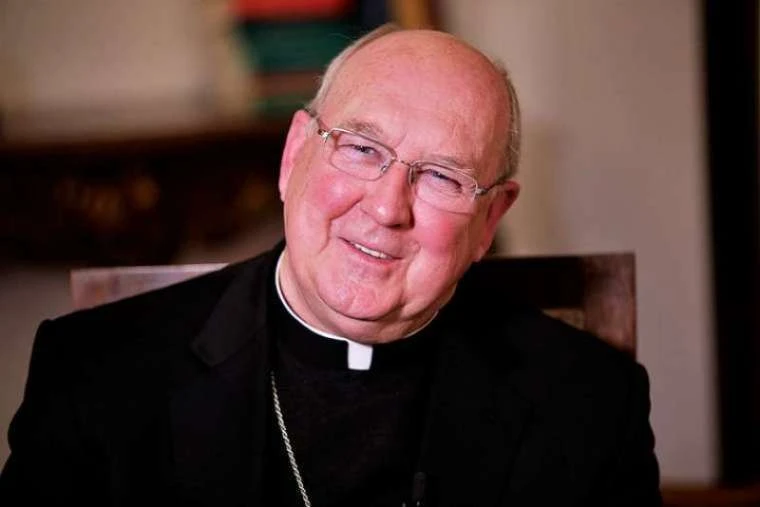
Cardinal Kevin Farrell, prefect of the Vatican Dicastery for the Laity, the Family and Life. / Credit: Lucia Ballester/CNA
ACI Prensa Staff, May 20, 2024 / 17:51 pm (CNA).
The Vatican announced that Pope Francis has appointed Cardinal Kevin Joseph Farrell, prefect of the Dicastery for the Laity, the Family, and Life, as his special envoy for the 53rd International Eucharistic Congress (IEC), which will be held in Quito, Ecuador, from Sept. 8–15.
Farrell, 76, was born on Sept. 2, 1947. He was ordained a priest of the Legionaries of Christ on Dec. 24, 1978. Six years later, in 1984, he was incardinated as a priest of the Archdiocese of Washington, D.C., where he was named auxiliary bishop in December 2001.
He received episcopal consecration on Feb. 11, 2002. On March 6, 2007, Farrell was named bishop of Dallas, where he served until 2016, when he was named prefect of the Dicastery for the Laity, the Family, and Life.
Pope Francis elevated him to the College of Cardinals at the Nov. 19, 2016, consistory.
Since 2019 Farrell is the “camerlengo of the Holy Roman Church,” the cardinal who presides over the Apostolic Chamber (office) and carries out the task of caring for and administering the temporal goods and rights of the Holy See during the interregnum after the death or resignation of the pope.
The congress, whose theme is “Fraternity to Heal the World,” was presented Monday in the Vatican pressroom.
In the presentation, Archbishop Alfredo Espinoza of Quito noted that this Eucharistic congress coincides with the 150th anniversary of the consecration of Ecuador to the Sacred Heart of Jesus, which made the South American country the first nation consecrated to Christ under this devotion.
After recalling that in 2021 they received the news that Quito would be the venue for the ecclesial event, Espinoza said that “the Eucharistic congress to be held in Quito ought to be a voice, with a Latin American accent, for the Church of the entire world.”
“It will be a voice of hope that is announced from this continent of hope. It will seek to be that prophetic voice that will proclaim to everyone that brotherhood is the only possible way to make and build a new world,” he emphasized.
Father Juan Carlos Garzón, secretary-general of the IEC, went on to discuss the foundational document for the Eucharistic congress, noting that “we live the urgency of a fraternity that springs from the Eucharistic experience and tends toward it as its end.”
Father Corrado Maggioni, president of the Pontifical Committee for International Eucharistic Congresses, reviewed the history of these events in the Church and explained how they are understood now.
“The re-understanding of the Eucharistic mystery that began with the liturgical movement and matured with the Second Vatican Council has also reoriented Eucharistic congresses to promote the inseparable link between the Mass and Eucharistic worship outside of it, paying attention to the lived experience,” the Italian priest highlighted.
In this way, “the Eucharistic congress has then become an opportunity to express the Church of the Eucharist in the light of Vatican II and the liturgical reform that followed.”
Topics to be discussed during the five days of the congress are: “Wounded World, Fraternity Redeemed in Christ, Eucharist and Transformation of the World, for a Synodal Church” and “Eucharist: Psalm of Fraternity.”
This story was first published by ACI Prensa, CNA’s Spanish-language news partner. It has been translated and adapted by CNA.
If you value the news and views Catholic World Report provides, please consider donating to support our efforts. Your contribution will help us continue to make CWR available to all readers worldwide for free, without a subscription. Thank you for your generosity!
Click here for more information on donating to CWR. Click here to sign up for our newsletter.
CNA Staff, Nov 20, 2023 / 16:56 pm (CNA).
Lawmakers in Texas on Friday voted down a section of a major education bill that would have created a publicly-funded education savings account (ESA) for stu… […]
Amanda Achtman’s last photo with her grandfather, Joseph Achtman. / Credit: Photo courtesy of Amanda Achtman
CNA Staff, Nov 5, 2023 / 06:00 am (CNA).
When the Canadian government began discussing the legalization of euthanasia for those whose deaths were “reasonably foreseeable,” 32-year-old Amanda Achtman said something in her began to stir. Her grandfather was in his mid-90s at the time and fit the description.
“There were a couple of times, toward the end of his life, that he faced some truly challenging weeks and said he wanted to die,” Achtman recalled. “But thank God no physician could legally concede to a person’s suicidal ideation in such vulnerable moments. To all of our surprise — including his — his condition and his outlook improved considerably before his death at age 96.”
Achtman said she and her grandfather were able to have a memorable final visit that “forged her character and became one of the greatest gifts he ever gave me.”
The experience of walking with her grandfather in his last days led Achtman to work that she believes is a calling. On Aug. 1, she launched a multifaceted cultural project called Dying to Meet You, which seeks to “humanize our conversations and experiences around suffering, death, meaning, and hope.” This mission is accomplished through a mix of interviews, short films, community events, and conversations.
Amanda Achtman speaks during the Evening Program at St. Mary’s Cathedral during “The Church as an Expert in Humanity” event in Calgary Sept. 23, 2023. Credit: Edward Chan/Community Productions
“This cultural project is my primary mission, and I am grateful to be able to dedicate the majority of my energy to it,” Achtman told CNA.
Early years
Achtman was born and raised in Calgary, Alberta, Canada. She grew up in a Jewish-Catholic family with, she said, “a strong attachment to these two traditions that constitute the tenor of my complete personality.”
Her Polish-Jewish grandfather, with whom she had a very close relationship as a young adult, had become an atheist because of the Holocaust and was always challenging her to face up to the big questions of mortality and morality.
“One of the ways I did this was by traveling on the March of Remembrance and Hope Holocaust study trip to Germany and Poland when I was 18,” Achtman said. “My experiences listening to the stories of Holocaust survivors and Righteous Among the Nations have undeniably forged my moral imagination and instilled in me a profound sense of personal responsibility.”
Shortly after her grandfather’s death, Achtman discovered a new English-language master’s program being offered in John Paul II philosophical studies at the Catholic University of Lublin in Poland.
“Immediately, I felt as though God were saying to me, ‘Leave your country and go to the land that I will show you — it’s Poland.’ At the time, the main things I knew about Poland were that the Holocaust had largely been perpetrated there and that Sts. John Paul II, Maximilian Kolbe, and Faustina were from there,” Achtman explained. “I wanted to be steeped in a country of saints, heroes, and martyrs in order to contemplate seriously what my life is actually about and how I could spend it generously in the service of preventing dehumanization and faithfully defending the sanctity of life in my own context.”
On Sept. 23, 2023, Amanda Achtman organized a daylong open-house-style event called “The Church as an Expert in Humanity” in Calgary, Alberta. Participants added ideas for how we, the Church, can prevent euthanasia and encourage hope. Credit: Edward Chan/Community Productions
The rise of euthanasia in Canada
In 2016, the Canadian government legalized euthanasia nationwide. The criterion to be killed in a hospital was informed consent on the part of an adult who was deemed to have a “grievous and irremediable condition.”
“The death request needed to be made in writing before two independent witnesses after a mandatory time of reflection. And, consent could be withdrawn any time before the lethal injection,” Achtman explained.
Then, in 2021, the Canadian government began to remove those safeguards. “The legislative change involved requiring only one witness, allowing the possible waiving of the need for final consent, and the removal, in many cases, of any reflection period,” Achtman told CNA.
“Furthermore, a new ‘track’ was invented for ‘persons whose natural death is not reasonably foreseeable.’ This meant that Canadians with disabilities became at greater risk of premature death through euthanasia. Once death-by-physician became seen as a human right, there was practically no limit as to who should ‘qualify.’ As long as killing is seen as a legitimate means to eliminate suffering, there is no limit to who could be at risk.”
Euthanasia — now called medical assistance in dying (MAiD) in Canada — is set to further expand on March 17, 2024, to those whose sole underlying condition is “mental illness.” Last year, Dr. Louis Roy of the Quebec College of Physicians and Surgeons testified before a special joint committee that his organization thinks euthanasia should be expanded to infants with “severe malformations” and “grave and severe syndromes.”
Renewing the culture
Achtman followed the debates around end-of-life issues in Canada and wanted to figure out a way to restore “a right response to the reality of suffering and death in our lives.”
“The fact is, our mortality is part of what makes life precious, our relationships worth cherishing, and our lives worth giving out of love. That’s why we need to bring cultural renewal to death and dying, restoring our understanding of its meaning to the human condition.”
At the Sept. 23, 2023, open-house event called “The Church as an Expert in Humanity,” there were table displays of ministries in the diocese who are doing the best work on suffering, death, grief, and caregiving. Credit: Edward Chan/Community Productions
On Jan. 1, 2021, Achtman made a new year’s resolution to blog about death every single day for an entire year in a way that was “hope-filled and edifying.”
It ended up being very fruitful to Achtman personally, but she said “it also touched a surprising number of people, inspiring them to take concrete actions in their own lives that I could not have anticipated.”
The experience, Achtman said, made her realize that it’s possible to contribute to cultural renewal through things like coffee shop visits, informal interviews, posting on social media, being a guest on podcasts and webinars, organizing community events, and making videos.
“Basically, there are countless practical and ordinary ways that we can humanize the culture — wherever we are and whatever we do the rest of the time.”
The Dying to Meet You project
When it comes to the mission of Dying to Meet You, Achtman told CNA that “God has put on my heart two key objectives: the prevention of euthanasia and the encouragement of hope” and added that “the aim of this cultural project is to improve our cultural conversation and engagement around suffering, death, meaning, and hope through a mix of interviews, writing, videos, and events.”
Achtman said the project is an experiment in the themes Pope Francis speaks about often — encounter, accompaniment, going to the peripheries, and contributing to a more fraternal spirit.
“There is a strong basis for opposition to euthanasia across almost all religions and cultures, traditionally speaking,” Achtman said. “Partly from my own upbringing in a Jewish-Catholic family, I am passionate about how the cultural richness of such a plurality of traditions in Canada can bolster and enrich our value of all human life.”
To that end, one of the projects Achtman has in the works is a short film on end of life from an Indigenous perspective to be released mid-November.
“It’s not so much that we have a culture of death as we now seem to have death without culture,” said Achtman, who hopes her efforts will help change that.
An inspiring hometown event
This past Sept. 23, Achtman organized a daylong open-house-style event called “The Church as an Expert in Humanity” in her home city of Calgary, which took place at Calgary’s Cathedral, the Cathedral Hall, and the Catholic Pastoral Centre. The morning featured a ministry hall of exhibits with 18 table displays of ministries throughout the diocese doing the best work on suffering, death, grief, and caregiving. In the afternoon, there were three-panel presentations.
The morning of “The Church as an Expert in Humanity” in St. Mary’s Cathedral Hall in Calgary, Alberta, featured a ministry hall of exhibits with table displays of ministries in the diocese doing the best work on suffering, death, grief, and caregiving. Credit: Edward Chan/Community Productions
The first involved Catholics of diverse cultural backgrounds speaking about hospitality and accompaniment in their respective traditions. It included a Filipino diaconal candidate, a Ukrainian laywoman working with refugees, an elderly Indigenous woman who is a community leader, and an Iraqi Catholic priest.
The second was called “Tell Me About the Hour of Death,” where participants heard from two doctors, a priest, and a longtime pastoral care worker.
The third panel focused on papal documents pertaining to death, hope, and eternal life. A Polish Dominican sister who has worked extensively with the elderly spoke about John Paul II’s “Letter to the Elderly.”
Later, an evening program was held in Calgary’s Catholic Cathedral and included seven short testimonies by different speakers that “were narratively framed as echoes of the Seven Last Words of Christ.” Among the speakers were a privately sponsored Middle Eastern Christian refugee, a L’Arche core member who has a disability, and a young father whose daughter only lived for 38 minutes. Afterward, Calgary’s Bishop William McGrattan gave some catechesis on the Anima Christi prayer, with a special emphasis on the line “In your wounds, hide me.”
“The day was extremely uplifting and instilled the local Church with confidence that the Church indeed is an expert in humanity, capable of meeting Christ in all who suffer with a gaze of love and the steadfast insistence, ‘I will not abandon you,’” Achtman told CNA.
Calgary’s Bishop William McGrattan listens to the seven testimonies echoing the seven last words of Christ during the evening program. Credit: Edward Chan/Community Productions
Our lives are not wholly our own
Many believe euthanasia is compassionate care for those who suffer. Shouldn’t we be able to do what we want with our own lives? And can suffering have any meaning for someone who doesn’t believe in God?
Achtman said these questions remind her of something Mother Teresa said: “If we have no peace, it is because we have forgotten that we belong to each other,” as well as the John Donne quote “Each man’s death diminishes me, for I am involved in mankind.”
“Our lives are not wholly our own and how we live and die affects the communities to which we belong,” Achtman said. “That is not a religious argument but an empirical observation about human life. If someone lacks ties and is without family and social support, then that is the crisis to which the adequate response is presence and assistance — not abandonment or hastened death. As one of my heroes, Father Alfred Delp, put it, a suffering person makes an ongoing appeal to your inner nobility, to your sacrificial strength and capacity to love. Don’t miss the opportunity.”
Amanda Achtman pictured with Christine, an 88-year-old woman who got a tattoo that says “Don’t euthanize me,” which is featured in a short four-minute documentary. Credit; Photo courtesy of Amanda Achtman
The mission continues
Achtman also organized a “Mass of a Lifetime,” a special Sunday Mass for residents of a local retirement home, on Oct. 15.
Attendees at the Mass of a Lifetime event, a special Sunday Mass for residents of a local retirement home held on Oct. 15, 2023, in Calgary, Alberta. Credit: Amanda Achtman
“I was inspired by a quotation of Dietrich von Hildebrand, who said: ‘Wherever anything makes Christ known, there nothing can be beautiful enough,’” Achtman said. “Applying that spirit to this Mass, we made it as elaborate as possible to show the seniors that they are worth the effort.”
Achtman also recently produced a four-minute short film about an 88-year-old woman named Christine who got a tattoo that says “Don’t euthanize me.” It can be viewed here:
Throughout 2023-2024, Achtman told CNA, she is basing herself in four different Canadian cities for three months each “in order to empower diverse faith and cultural communities in the task of preventing euthanasia and encouraging hope.” She started in her hometown of Calgary and is off to Vancouver this month.
In addition to her work with the Dying to Meet You project, Achtman does ethics education and cultural engagement with Canadian Physicians for Life and works to promote the personalist tradition with the Hildebrand Project.
Denver Newsroom, Sep 30, 2021 / 09:33 am (CNA).
St. Junipero Serra’s heroism did not change when California Gov. Gavin Newsom signed a bill to ensure that his statue will no longer stand on the state capitol grounds,… […]
1 Comment
Cardinal Farrell, now the prefect for the dicastery for the Laity, the Family, and life, lived with another clericalist, now no better than a layman by the name of McCarrick, from 2002 to 2006…
Bad timing! Had both of their calendars been more current, today Farrell could openly choose to notice and then informally witness the spontaneous blessing of McCarrick in fraternal “dialogue” with his beach-house consorts–Fiducia Supplicans, 2023 (Merry Christmas, or is it married?, or maybe just gay?).
“Time is greater than space” (Evangelii Gaudium, 2013).
Cardinal Farrell, now the prefect for the dicastery for the Laity, the Family, and life, lived with another clericalist, now no better than a layman by the name of McCarrick, from 2002 to 2006…
And yet, back in the day, Farrell was so intent on his “fraternal collegiality” and prayer life that he noticed and suspected absolutely nothing of McCarrick’s busy social calendar: https://www.catholicworldreport.com/2020/10/13/analysis-what-does-cardinal-farrells-promotion-say-about-the-mccarrick-report/
Bad timing! Had both of their calendars been more current, today Farrell could openly choose to notice and then informally witness the spontaneous blessing of McCarrick in fraternal “dialogue” with his beach-house consorts–Fiducia Supplicans, 2023 (Merry Christmas, or is it married?, or maybe just gay?).
“Time is greater than space” (Evangelii Gaudium, 2013).