A young Edith Stein as a student (c. 1913-14) and later as Teresa Benedicta of the Cross (c 1938). (Images: Wikipedia)
Rome Newsroom, May 6, 2024 / 11:12 am (CNA).
Edith Stein could be declared a doctor of the Church with the title “doctor veritatis,” or “doctor of truth,” following a petition from the Discalced Carmelites.
Pope Francis received an official request from the superior general of the Discalced Carmelites, Father Miguel Márquez Calle, on April 18 in a private audience at the Vatican to recognize the theological legacy of the saint who was martyred in Auschwitz.
If accepted, Stein, also known by her religious name St. Teresa Benedicta of the Cross, could become the fifth woman to be declared a doctor of the Church, a title that recognizes a substantial contribution to the Church’s theology and moral life.
With the petition, the Vatican Dicastery for the Causes of Saints can officially begin the required process to grant Stein the title.
The Carmelites first launched an international commission to gather the necessary documentation required by the Vatican in 2022, a year that marked both the 100th anniversary of Stein’s baptism and the 80th anniversary of her martyrdom.
A title that was proposed for her at the time was “doctor veritatis” because of her relentless intellectual pursuit of truth, which after her conversion she recognized in the person of Jesus Christ.
Stein was born in 1891 into a Jewish family in what is now Wrocław, southwestern Poland. The city was then known as Breslau and located in the German Empire.
After declaring herself to be an atheist at the age of 20, she went on to earn a doctorate in philosophy.
She decided to convert to Catholicism after spending a night reading the autobiography of the 16th-century Carmelite nun St. Teresa of Avila while staying at a friend’s house in 1921.
“When I had finished the book,” she later recalled, “I said to myself: This is the truth.”
Stein was baptized on Jan. 1, 1922, at the age of 30. She took the name Teresa Benedicta of the Cross when she became a novice Carmelite nun 12 years later.
Ten years after Stein entered the Carmelite convent, she was arrested along with her sister Rosa, who had also become a Catholic, and the members of her religious community.
She had just finished writing a study of St. John of the Cross titled “The Science of the Cross.”
St. Teresa Benedicta of the Cross died in the Auschwitz concentration camp on Aug. 9, 1942. Pope John Paul II canonized her in 1998 and proclaimed her a co-patroness of Europe the following year.
“God is truth,” Stein wrote after her conversion. “Anyone who seeks truth seeks God, whether or not he is aware of it.”
If you value the news and views Catholic World Report provides, please consider donating to support our efforts. Your contribution will help us continue to make CWR available to all readers worldwide for free, without a subscription. Thank you for your generosity!
Click here for more information on donating to CWR. Click here to sign up for our newsletter.
Vatican City, Jun 26, 2019 / 03:00 am (CNA).- Pope Francis said Wednesday that there is no room for selfishness in the Christian life, pointing to the example of the lives of the early Christians in the Acts of the Apostles.
Bamako, Mali, Jun 23, 2021 / 05:00 am (CNA).
A Catholic priest is among five people kidnapped on Monday in the West African nation of Mali.ACI Africa, CNA’s African news partner, reported that Fr…. […]
Anna Lulis from Moneta, Virginia, (left) who works for the pro-life group Students for Life of America, stands beside an abortion rights demonstrator outside the U.S. Supreme Court in Washington, D.C., on June 24, 2022, after the court’s decision in the Dobbs abortion case was announced. / Katie Yoder/CNA
Washington, D.C. Newsroom, Oct 5, 2022 / 13:31 pm (CNA).
U.S. Catholic voters are split on the Supreme Court’s decision to overturn Roe v. Wade, but a majority agrees that abortion should be restricted and that there should be at least some protections for the unborn child in the womb, according to a new EWTN News/RealClear Opinion Research poll.
The court’s June 24 ruling in the Mississippi abortion case Dobbs v. Jackson Women’s Health Organization upended 49 years of nationwide legalized abortion and freed states to regulate abortion as they see fit.
When asked whether they agreed or disagreed with Roe being overturned, 46.2% agreed, 47.8% disagreed, and 6% said they weren’t sure.
Catholic voters were similarly split on whether they are more or less likely to support a candidate who agrees with Roe’s dismantling: 42% said they were more likely, 41.9% said they were less likely, and 16.1% were unsure.
At the same time, the poll results point to apparent inconsistencies in Catholic voters’ positions on abortion.
While nearly half of Catholic voters in the poll said they disagreed with Roe being overturned, a large majority (86.5%) said they support some kind of limit on abortion, even though Roe and related abortion cases allowed only narrow regulation at the state level. The breakdown is as follows:
26.8% said abortion should be allowed only in cases of rape, incest, or to save the life of the mother;
19.8% said abortion should be allowed until 15 weeks when the baby can feel pain;
13.1% said that abortion should be allowed only during the first six months of pregnancy;
9.9% said that abortion should be allowed only until a heartbeat can be detected, and
9.1% said that abortion should be allowed only to save the life of the mother.
Of special note for Catholic pro-life leaders, only a small minority of Catholic voters — 7.8% — were aligned with the clear and consistent teaching of the Catholic Church that abortion should never be allowed.
On the other end of the spectrum of abortion views, 13.4% of Catholic voters said that abortion should be available to a woman at any time during her pregnancy.
The poll, conducted by the Trafalgar Group from Sept. 12–19, surveyed 1,581 Catholic voters and has a margin of error of 2.5%. The questionnaire was administered using a mix of six different methods, including phone calls, text messages, and email.
The poll’s results echo surveys of the general U.S. population on abortion. A Pew Research Center survey from March found that 19% of U.S. adults say abortion should be legal in all cases, while 8% said it should be illegal in all cases. More recent Gallup data from May found that 35% of U.S. adults say abortion should be legal under any circumstances while 13% said it should be illegal in all circumstances.
The Pew Research Center data also looked at Catholic adults. Thirteen percent said abortion should be legal in all cases, while 10% said it should be illegal in all cases.
A previous EWTN News/RealClear Opinion Research poll released in July found that 9% of Catholic likely voters said abortion should never be permitted and 18% said that abortion should be available at any time. The poll similarly showed that a majority of Catholic voters (82%) support some kind of restriction on abortion.
Confused about what Roe said?
The poll’s results came as little surprise to Catholic pro-life public policy experts such as Elizabeth R. Kirk.
“This study confirms a phenomenon we have known for some time, i.e., that there is an enormous disconnect between the scope of abortion practices permitted by the Roe regime and what abortion practices Americans actually support,” Kirk, director of the Center for Law and the Human Person at The Catholic University of America, told CNA.
Kirk, who also serves as a faculty fellow for the Institute for Human Ecology and research associate and lecturer at the Columbus School of Law, noted the finding that nearly 42% of Catholic voters said they are less likely to support a candidate who agrees with Roe being overturned.
“At first glance that suggests that many Catholic voters wanted to keep Roe in place,” she said. “Yet, the study also reveals that 86.5% of Catholic voters want some type of restriction on abortion access.”
Why the inconsistency? “Most people do not realize that Roe allowed states to permit unlimited abortion access throughout the entire pregnancy and made it difficult, or even impossible, to enact commonsense restrictions supported by the majority of Americans,” Kirk observed.
“Many people who ‘support Roe’ actually disagree, unknowingly, with what it permitted,” she added. “All Dobbs has done is return abortion policy to the legislative process so that the people may enact laws which reflect the public consensus.”
Mass-goers more strongly pro-life
The new poll, the second of three surveys of Catholic voters tied to the midterm elections on Nov. 8, shows that the opinions of Catholic voters on abortion and other issues vary depending on how often respondents attend Mass.
Only a small portion of those who attend Mass at least once a week said that abortion should be allowed at any time: 0% of those who attend Mass daily, 1% who attend more than once a week, and 8% of those who attend weekly support abortion without restrictions. In contrast, 57.5% of Catholic voters who attend Mass daily, 21.5% of those who attend more than once a week, and 15.6% of those who attend weekly say abortion should never be permitted.
In addition to respondents’ apparent confusion about what Roe stipulated, the poll suggests that many Catholic voters don’t fully understand what their Church teaches about abortion.
Less than one-third of Catholic voters who said they accept all Church teachings (31.1%) said that abortion should never be permitted, and 5% who profess to fully accept the Church’s teachings said abortion should be permitted at any time.
Overall, 32.8% of respondents reported attending Mass at least once a week, with another 30.7% attending once a year or less. Only 15% agreed that they accept all of the Church’s teachings and live their lives accordingly, with another 34.5% saying they generally accept most of the Church’s teachings and try to live accordingly.
Pew Research Center also looked at how Mass attendance factors into Catholics’ views on abortion. Among those who attend Mass at least once a week: 4% said abortion should be legal in all cases, and 24% said it should be illegal in all cases, Pew found.
Strong support for pregnancy centers
The poll asked Catholic voters about a variety of other topics including abortion limits, Holy Communion for pro-abortion politicians, conscience protections for health care workers, and pro-life pregnancy centers.
EWTN
Among the findings:
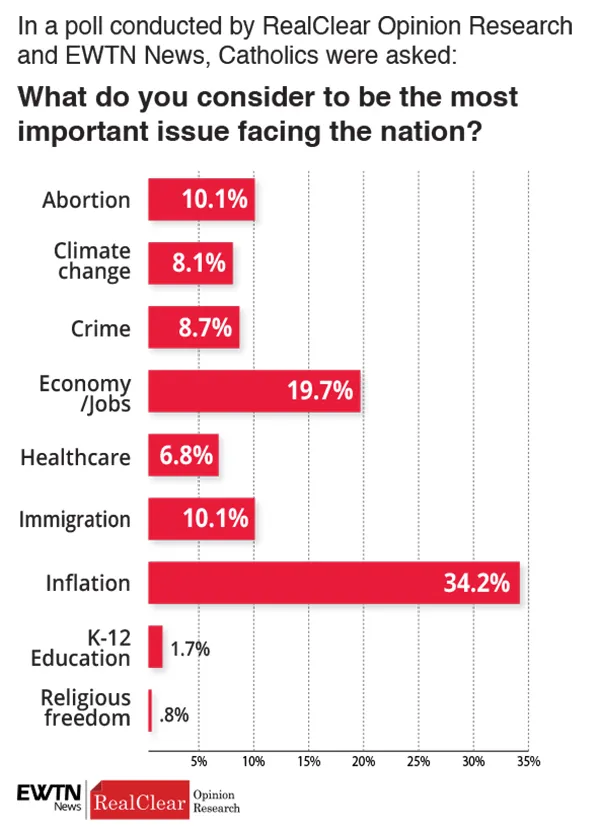
Catholic voters are prioritizing other issues above abortion. Only 10.1% of Catholic voters identified abortion as the most important issue facing the nation, falling behind inflation (34.2%) and the economy/jobs (19.7%) and tying with immigration. At the same time, a higher percentage of Catholic voters chose abortion than crime (8.7%), climate change (8.1% ), health care (6.8%), K–12 education (1.7%), or religious freedom (0.8%).
About half of Catholic voters (49.3%) disagreed that Catholic political leaders who support abortion publicly and promote policies that increase abortion access should refrain from taking Communion, while 36.7% said they should refrain.
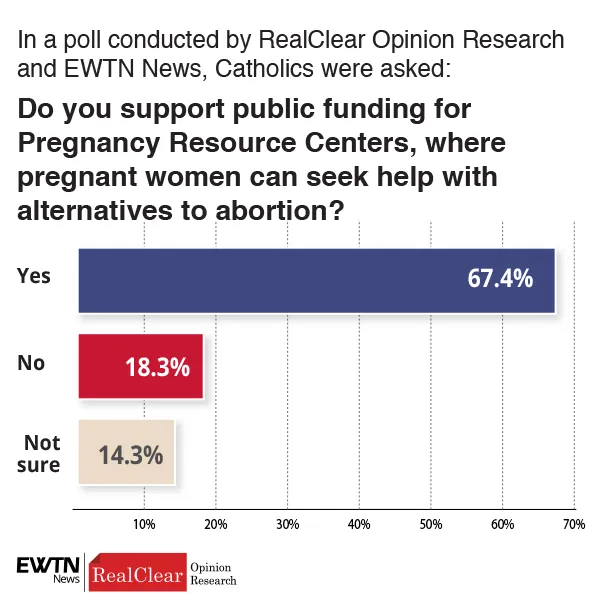
A majority (67.4%) of Catholic voters said they support public funding for pro-life pregnancy centers that offer pregnant women life-affirming alternatives to abortion, while 18.3% said they did not favor using tax dollars for this purpose.
A comparable majority (61.8%) said that political and church leaders should be speaking out against the recent attacks and acts of vandalism on pregnancy resource centers.
When asked about conscience protections for health care workers that would allow them to opt out of providing “services” such as abortion, a majority of Catholic voters (60.7%) said that health care workers should not be obligated to engage in procedures that they object to based on moral or religious grounds. Conversely, 25.3% said that health care workers should be obligated to engage in procedures that they object to based on moral or religious grounds.
Work to be done
What is the takeaway from the latest poll, where abortion is concerned?
“This polling shows that Catholics, like the overwhelming majority of Americans, support commonsense protections for women and the unborn,” Ashley McGuire, a senior fellow with The Catholic Association, told CNA.
“It also affirms other recent polling that found Americans by strong numbers support the work of pregnancy resource centers in providing women facing crisis pregnancies with a real choice and the chance to thrive as mothers despite difficult circumstances,” she noted.
EWTN
At the same time, McGuire added, “This new polling is also a reminder that more work needs to be done in catechizing Catholics on foundational Church teaching in support of vulnerable life in all stages — an effort that is continually undermined by Catholic politicians in the highest echelons of power who use their platforms to advocate for extreme abortion policies in direct violation of Church teaching.”
Nearly all of those surveyed (99.2%) said they plan to vote in the midterm elections on Nov. 8.
Anyone who seeks truth seeks God, itself an irrefutable truth whether one proceeds to identify God as truth itself. Doctor of truth, “A title that was proposed for her at the time was ‘doctor veritatis’ because of her relentless intellectual pursuit of truth, which after her conversion she recognized in the person of Jesus Christ”.
Edith Stein as she preferred to be called identified Christ with his Cross, which is to identify him as love. Her history, a life story of discovering truth in Christ during a philosophical search for truth makes her a perfect model and source for grasping our teleological end in this life. From this writer’s perspective her writing has the depth and clear focus on the acquisition of truth that would benefit the reader.
I am unaware that Teresa Benedicta of the Cross preferred to be know by her secular name. At her Baptism she was named Teresa. At her clothing with the Discalced Carmelite habit she once again deliberately chose Teresa, added Benedicta in honor of St. Benedict whose monks were instrumental in giving her a deep love for the liturgy and matured her personal spirituality. The title “of the Cross” was in honor of St. John of the Cross for whom she had great devotion. She thought of it as Teresa “blessed by the Cross.”
I am often disappointed and simultaneously amused at the contrived use of photos of Sts. Therese and Teresa Benedicta before they took the habit. There was not much that they desired more than to be clothed in the habit of Carmel. Presently we even have to strip the saints of their religious habits in order to be post-conciliar. I don’t have to wonder what they would think of the confection.
Assuming a new name upon monastic investiture is a very personal and deeply spiritual act. Her religious name framed her existence as a Discalced Carmelite which fulfilled the deepest longing of her heart.
Edith Stein no longer existed
How often do you see a book on John Paul using his image from a time before his papacy? Unless a photo is specific to a topic in the individuals life, why would use one that did not portray the person in the maturity? Or even his priesthood?
How often Padre Pio as a layman? Maximilian Kolbe in his civvies? How often a portrait of Ignatius in his armor?
The abandonment of the religious habit was instrumental eradicating religious life, particularly for women.
The attempt, frequent within the effort to justify the abandonment of the traditions of orders and congregations, to equate figures from their history assenting to the mutilation they have undergone is propaganda. Therese of the Child Jesus and the Holy Face fought hard to get that habit, Edith Stein sought for ten years to enter Carmel. Embraced in their spousal relationship with Christ the old woman was dead.
Therese of the Child Jesus died the Carmelite iron maiden, at the height of her religious maturity, no little girl.
Teresa Benedicta walked off to her death at the hands of the Nazis braced in her Carmelite habit, a nun, no longer the up and coming academic. What a comfort to her fellow prisoners, what a chill up a Nazi spine.
I understand the point you are making yet I have no problem with those two photos. In fact, I like them because they represent the development, the path of the person to God and this article does just that, outlines her path so two photos provide a good illustration. It is also very interesting and enlightening to see the transformation reflected on the face of the Saint.
I also disagree with “Edith Stein no longer existed”. She was incorporated. The academic did not disappear but very clearly seen in her last book, ‘The Science of the Cross’ (a discourse about St John of the Cross’s doctrine’.
I recently read ‘The Milestones’, Pope Benedict’s autobiography written while he was a Cardinal. I looked at his photos there, from the early age to older with great delight. By the way, his autobiography convinced me of his true and utmost humility and truthfulness = holiness. I think he is Blessed.
Yet you might well see books by Joseph Ratzinger from the time before he became Pope Benedict bearing photos of him from about the time he wrote the books. As Edith Stein, she wrote about philosophy, and, aside from her last days leading up to and including her martyrdom, these writings are what most people know about her.
To my understanding, Sr Teresa Benedicta of the Cross was not a martyr for Christian faith. She (so as her sister Rosa) was killed because she was a Jew. I have always thought that “Doctor of the Church” is the best title for her.
In connection to her, I also recall that the Discalced Carmelites organized a monastery on the territory of Auschwitz with the major purpose to pray there and make reparations and purify the place of horror, hell on earth. Unfortunately, they had to leave that place because of the pressure of Jews who claimed Holocaust as their own; they accused the nuns of “appropriating” the Jewish Holocaust. To settle the conflict, Pope JPII (I think it was him) ordered Carmelites to leave their house. Reportedly, many visitors of Auschwitz would drop into the monastery seeking some comfort after what they saw and so the removal of Carmelites was bad for everyone including non-Christians.
I think Sr Terresa Benedicta of the Cross would be appalled with the fact that some people of her race insisted on a removal of a group of the dedicated to God women from the sight the murder, of her and many others – Jews, Gypsies, Slavs, Christians, communists. I studied her life, she was deeply Jewish and deeply Christian, her Jewishness found its completion in her Christianity. Her zeal for God is something I believe to be innate in the Jewish people. That utmost dedication to One True God to the point of death is very Jewish, like in the Prophets.
I am not sure why I am writing about this. Probably because figures like Edith Stein highlight the tragic idiocy of humanity (“this is mine” – “no, this is mine”) making it truly unbearable.
No offense, but I would like some clarification on what it now means to be a “Doctor of the Catholic Church”. For centuries, the title seemed to designate a saint who had ALREADY had a remarkable influence on the Church as a whole, but more recently it seems to indicate someone whom the Pope then reigning HOPES will at some point in the near future have a larger influence on the Church. Sts. Athanasius, Anselm, Ambrose, and Augustine fall into the former category; St. Hildegard into the latter.
Wikipedia can be useful: “Doctor of the Church (Latin: doctor “teacher”), also referred to as Doctor of the Universal Church (Latin: Doctor Ecclesiae Universalis), is a title given by the Catholic Church to saints recognized as having made a significant contribution to theology or doctrine through their research, study, or writing.”
This certainly describes Edith Stein, even in her earlier writings on phenomenology which she wrote under her preceptor, Edmund Husserl.
“This certainly describes Edith Stein, even in her earlier writings on phenomenology which she wrote under her preceptor, Edmund Husserl.” At best, that is like saying that Lars Onsager is a famous physicist. He kind of is, but unless you are a physicist (or maybe a chemist, since he won a Nobel prize in chemistry), I’m pretty sure you’ve never heard of him.
Neil deGrasse Tyson, on the other hand, is basically a nobody that everyone has heard of. You might not think physics had the equivalent of a Paris Hilton, but that’s kind of what he is.
Then there are people like Einstein and Newton; physicists who are genuinely important and actually well-known. These are the physics equivalents of Sts. Augustine and Thomas Aquinas; they need no introduction.
If you really want to see what something means, sometimes you have to dig deeper than Wikipedia.
St. Teresa Benedicta of the Cross has been an object of devotion for me since I was a boy sixty years ago. What a heroic woman…she continues to leave me speechless. I made sure I was at her canonization. Her witness to Jesus Christ has been an anchor for my faith for many decades.
She was an impressive philosopher. I have found her theological and devotional writings rewarding. Do they support her being declared a Doctor of the Church? I think not. That sort of theological reflection was not her vocation.
Let us be honest in our recognition of heroic virtue and of superior theological contributions to the faith. There is no need to patronize any individual over and above their accomplishments achieved by cooperation with Grace. For some time now we have been canonizing individuals who, while good, very good even, are not exactly examples of heroic virtue.
The ambition to bestow the doctorate upon St. Teresa Benedicta of the Cross is, honestly, merely an ecclesiastical DEI job because of her identity as a woman, a Jew, a scholar. It has nothing to do with groundbreaking exceptional theological reflection. It is a vacuous effort, it is ultimately dishonest.
St. Teresa Benedicta of the Cross would not approve. She was a profoundly honest woman of exceptional common sense and virtue. Not a theologian. Her contemplative reflection does not rise to the level of Teresa, Catherine, Therese…
Well said. We need great theologians like St. Augustine, but we need great prayer warriors like St. Monica even more. St. Monica will never be a Doctor of the Church, nor should she, but she might be greater in the Kingdom of Heaven than her son, and we can be sure that for every famous theologian, there are hundreds or thousands of St. Monicas known only to God.
I too greatly admire the writing and the life of St. Teresa Benedicta together with her fellow Carmelite saints Teresa, Therese, and John of the Cross. I’ve read much of their work, some more than once. Teresa Benedicta wrote a treatise on St. John (The Science of the Cross), but she very meticulously repeated and clarified what St. John had written. She has a brilliantly detailed work on ’empathy’ which is philosophy, not theology. I believe she wrote biographical notes or essays on some other notable Carmelites. She also has some wonderfully thoughtful and insightful essays on womanhood.
Her heroic virtue in her arrest, time in the concentration camp and facing death was apparent to all. Her love for her natural family, particularly her mother, was heart-rending to us folk who shared Edith’s anguish on the days leading to the day in the parlor. There we share Edith’s sorrow at informing her Jewish mother of her wish for Catholic Baptism. Her biography inclines her to sainthood. But what inclines the Church to name her one of its doctors? Nothing that I know.
I don’t think anything ill is meant by it. We tend to call recently departed saints by the names they were best known by when they were alive. We’ll be saying “Mother Teresa” instead of “Saint Teresa of Calcutta” and “Padre Pio” instead of “Saint Pio of Pietrelcina”, which is not quite the same thing, but somewhat related.







Anyone who seeks truth seeks God, itself an irrefutable truth whether one proceeds to identify God as truth itself. Doctor of truth, “A title that was proposed for her at the time was ‘doctor veritatis’ because of her relentless intellectual pursuit of truth, which after her conversion she recognized in the person of Jesus Christ”.
Edith Stein as she preferred to be called identified Christ with his Cross, which is to identify him as love. Her history, a life story of discovering truth in Christ during a philosophical search for truth makes her a perfect model and source for grasping our teleological end in this life. From this writer’s perspective her writing has the depth and clear focus on the acquisition of truth that would benefit the reader.
I am unaware that Teresa Benedicta of the Cross preferred to be know by her secular name. At her Baptism she was named Teresa. At her clothing with the Discalced Carmelite habit she once again deliberately chose Teresa, added Benedicta in honor of St. Benedict whose monks were instrumental in giving her a deep love for the liturgy and matured her personal spirituality. The title “of the Cross” was in honor of St. John of the Cross for whom she had great devotion. She thought of it as Teresa “blessed by the Cross.”
I am often disappointed and simultaneously amused at the contrived use of photos of Sts. Therese and Teresa Benedicta before they took the habit. There was not much that they desired more than to be clothed in the habit of Carmel. Presently we even have to strip the saints of their religious habits in order to be post-conciliar. I don’t have to wonder what they would think of the confection.
Assuming a new name upon monastic investiture is a very personal and deeply spiritual act. Her religious name framed her existence as a Discalced Carmelite which fulfilled the deepest longing of her heart.
Edith Stein no longer existed
“I am often disappointed and simultaneously amused at the contrived use of photos of Sts. Therese and Teresa Benedicta before they took the habit.”
Weird Comment of the Day. Sigh.
How often do you see a book on John Paul using his image from a time before his papacy? Unless a photo is specific to a topic in the individuals life, why would use one that did not portray the person in the maturity? Or even his priesthood?
How often Padre Pio as a layman? Maximilian Kolbe in his civvies? How often a portrait of Ignatius in his armor?
The abandonment of the religious habit was instrumental eradicating religious life, particularly for women.
The attempt, frequent within the effort to justify the abandonment of the traditions of orders and congregations, to equate figures from their history assenting to the mutilation they have undergone is propaganda. Therese of the Child Jesus and the Holy Face fought hard to get that habit, Edith Stein sought for ten years to enter Carmel. Embraced in their spousal relationship with Christ the old woman was dead.
Therese of the Child Jesus died the Carmelite iron maiden, at the height of her religious maturity, no little girl.
Teresa Benedicta walked off to her death at the hands of the Nazis braced in her Carmelite habit, a nun, no longer the up and coming academic. What a comfort to her fellow prisoners, what a chill up a Nazi spine.
I understand the point you are making yet I have no problem with those two photos. In fact, I like them because they represent the development, the path of the person to God and this article does just that, outlines her path so two photos provide a good illustration. It is also very interesting and enlightening to see the transformation reflected on the face of the Saint.
I also disagree with “Edith Stein no longer existed”. She was incorporated. The academic did not disappear but very clearly seen in her last book, ‘The Science of the Cross’ (a discourse about St John of the Cross’s doctrine’.
I recently read ‘The Milestones’, Pope Benedict’s autobiography written while he was a Cardinal. I looked at his photos there, from the early age to older with great delight. By the way, his autobiography convinced me of his true and utmost humility and truthfulness = holiness. I think he is Blessed.
Yet you might well see books by Joseph Ratzinger from the time before he became Pope Benedict bearing photos of him from about the time he wrote the books. As Edith Stein, she wrote about philosophy, and, aside from her last days leading up to and including her martyrdom, these writings are what most people know about her.
To my understanding, Sr Teresa Benedicta of the Cross was not a martyr for Christian faith. She (so as her sister Rosa) was killed because she was a Jew. I have always thought that “Doctor of the Church” is the best title for her.
In connection to her, I also recall that the Discalced Carmelites organized a monastery on the territory of Auschwitz with the major purpose to pray there and make reparations and purify the place of horror, hell on earth. Unfortunately, they had to leave that place because of the pressure of Jews who claimed Holocaust as their own; they accused the nuns of “appropriating” the Jewish Holocaust. To settle the conflict, Pope JPII (I think it was him) ordered Carmelites to leave their house. Reportedly, many visitors of Auschwitz would drop into the monastery seeking some comfort after what they saw and so the removal of Carmelites was bad for everyone including non-Christians.
I think Sr Terresa Benedicta of the Cross would be appalled with the fact that some people of her race insisted on a removal of a group of the dedicated to God women from the sight the murder, of her and many others – Jews, Gypsies, Slavs, Christians, communists. I studied her life, she was deeply Jewish and deeply Christian, her Jewishness found its completion in her Christianity. Her zeal for God is something I believe to be innate in the Jewish people. That utmost dedication to One True God to the point of death is very Jewish, like in the Prophets.
I am not sure why I am writing about this. Probably because figures like Edith Stein highlight the tragic idiocy of humanity (“this is mine” – “no, this is mine”) making it truly unbearable.
No offense, but I would like some clarification on what it now means to be a “Doctor of the Catholic Church”. For centuries, the title seemed to designate a saint who had ALREADY had a remarkable influence on the Church as a whole, but more recently it seems to indicate someone whom the Pope then reigning HOPES will at some point in the near future have a larger influence on the Church. Sts. Athanasius, Anselm, Ambrose, and Augustine fall into the former category; St. Hildegard into the latter.
Wikipedia can be useful: “Doctor of the Church (Latin: doctor “teacher”), also referred to as Doctor of the Universal Church (Latin: Doctor Ecclesiae Universalis), is a title given by the Catholic Church to saints recognized as having made a significant contribution to theology or doctrine through their research, study, or writing.”
This certainly describes Edith Stein, even in her earlier writings on phenomenology which she wrote under her preceptor, Edmund Husserl.
“This certainly describes Edith Stein, even in her earlier writings on phenomenology which she wrote under her preceptor, Edmund Husserl.” At best, that is like saying that Lars Onsager is a famous physicist. He kind of is, but unless you are a physicist (or maybe a chemist, since he won a Nobel prize in chemistry), I’m pretty sure you’ve never heard of him.
Neil deGrasse Tyson, on the other hand, is basically a nobody that everyone has heard of. You might not think physics had the equivalent of a Paris Hilton, but that’s kind of what he is.
Then there are people like Einstein and Newton; physicists who are genuinely important and actually well-known. These are the physics equivalents of Sts. Augustine and Thomas Aquinas; they need no introduction.
If you really want to see what something means, sometimes you have to dig deeper than Wikipedia.
God, as Truth, has been for me a treasure beyond price. May He be so to every one of us – Mahatma Gandhi
St. Teresa Benedicta of the Cross has been an object of devotion for me since I was a boy sixty years ago. What a heroic woman…she continues to leave me speechless. I made sure I was at her canonization. Her witness to Jesus Christ has been an anchor for my faith for many decades.
She was an impressive philosopher. I have found her theological and devotional writings rewarding. Do they support her being declared a Doctor of the Church? I think not. That sort of theological reflection was not her vocation.
Let us be honest in our recognition of heroic virtue and of superior theological contributions to the faith. There is no need to patronize any individual over and above their accomplishments achieved by cooperation with Grace. For some time now we have been canonizing individuals who, while good, very good even, are not exactly examples of heroic virtue.
The ambition to bestow the doctorate upon St. Teresa Benedicta of the Cross is, honestly, merely an ecclesiastical DEI job because of her identity as a woman, a Jew, a scholar. It has nothing to do with groundbreaking exceptional theological reflection. It is a vacuous effort, it is ultimately dishonest.
St. Teresa Benedicta of the Cross would not approve. She was a profoundly honest woman of exceptional common sense and virtue. Not a theologian. Her contemplative reflection does not rise to the level of Teresa, Catherine, Therese…
Well said. We need great theologians like St. Augustine, but we need great prayer warriors like St. Monica even more. St. Monica will never be a Doctor of the Church, nor should she, but she might be greater in the Kingdom of Heaven than her son, and we can be sure that for every famous theologian, there are hundreds or thousands of St. Monicas known only to God.
Profoundly insightful, and wonderfully unsettling. Puts things in their supernatural perspective.
I too greatly admire the writing and the life of St. Teresa Benedicta together with her fellow Carmelite saints Teresa, Therese, and John of the Cross. I’ve read much of their work, some more than once. Teresa Benedicta wrote a treatise on St. John (The Science of the Cross), but she very meticulously repeated and clarified what St. John had written. She has a brilliantly detailed work on ’empathy’ which is philosophy, not theology. I believe she wrote biographical notes or essays on some other notable Carmelites. She also has some wonderfully thoughtful and insightful essays on womanhood.
Her heroic virtue in her arrest, time in the concentration camp and facing death was apparent to all. Her love for her natural family, particularly her mother, was heart-rending to us folk who shared Edith’s anguish on the days leading to the day in the parlor. There we share Edith’s sorrow at informing her Jewish mother of her wish for Catholic Baptism. Her biography inclines her to sainthood. But what inclines the Church to name her one of its doctors? Nothing that I know.
Correction: The days of anguish for Edith occurred not prior to her Baptism but prior to her entrance into convent.
Would that St. Benedicta and St. John of the Cross would help me reserve my exuberant sharing of inaccurate memory!
Why the bigotry of calling her by the wrong name? She is St. Theresa Benedicta of the Cross.
I don’t think anything ill is meant by it. We tend to call recently departed saints by the names they were best known by when they were alive. We’ll be saying “Mother Teresa” instead of “Saint Teresa of Calcutta” and “Padre Pio” instead of “Saint Pio of Pietrelcina”, which is not quite the same thing, but somewhat related.