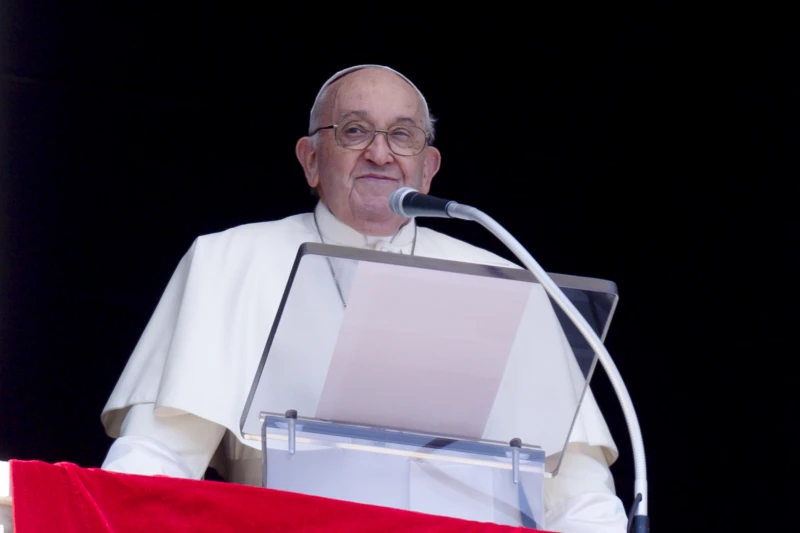
Pope Francis addresses pilgrims gathered in St. Peter’s Square at the Vatican after the recitation of the Regina Caeli prayer on April 14, 2024. / Credit: Vatican Media
Rome Newsroom, Apr 14, 2024 / 10:56 am (CNA).
Pope Francis expressed his concern over escalating tensions in the Middle East following Iran’s missile attack Saturday against Israel, a concern he raised after imploring Christians to share their stories of encountering Christ, which he said would create a richer and more beautiful environment for all.
“I follow in prayer and with concern, even pain, the news that has arrived in the last few hours on the worsening of the situation in Israel due to the intervention by Iran,” the pope said to all those gathered before him in St. Peter’s Square on April 14.
“I make a heartfelt appeal to stop any action that could fuel a spiral of violence with the risk of dragging the Middle East into an even greater conflict of war. No one should threaten the existence of others,” he added.
On Saturday evening Iran launched over 300 drones and missiles on military targets in Israel in retaliation for an Israeli attack on the Iranian Embassy in Syria’s capital Damascus on April 1, which killed seven.
Pope Francis also renewed his exhortation for peace as the Israel-Hamas war continues unabated, calling for “the Israelis and Palestinians to live in two states, side by side, in security, it is their deep and legitimate desire, and it is their right.”
Before the recitation of the Regina Caeli, the pope also exhorted Christians to share their personal encounters with Christ, noting that it is “the most beautiful thing we have to tell.”
The pope made this reflection against the backdrop of today’s reading from the Gospel of Luke, where two disciples, returning from Emmaus, meet with the apostles in the upper room and recount their encounter with Christ.
“Jesus arrives precisely while they are sharing the story of the encounter with him,” a message, the pope observed, that for us today underscores “the importance of sharing the faith.”
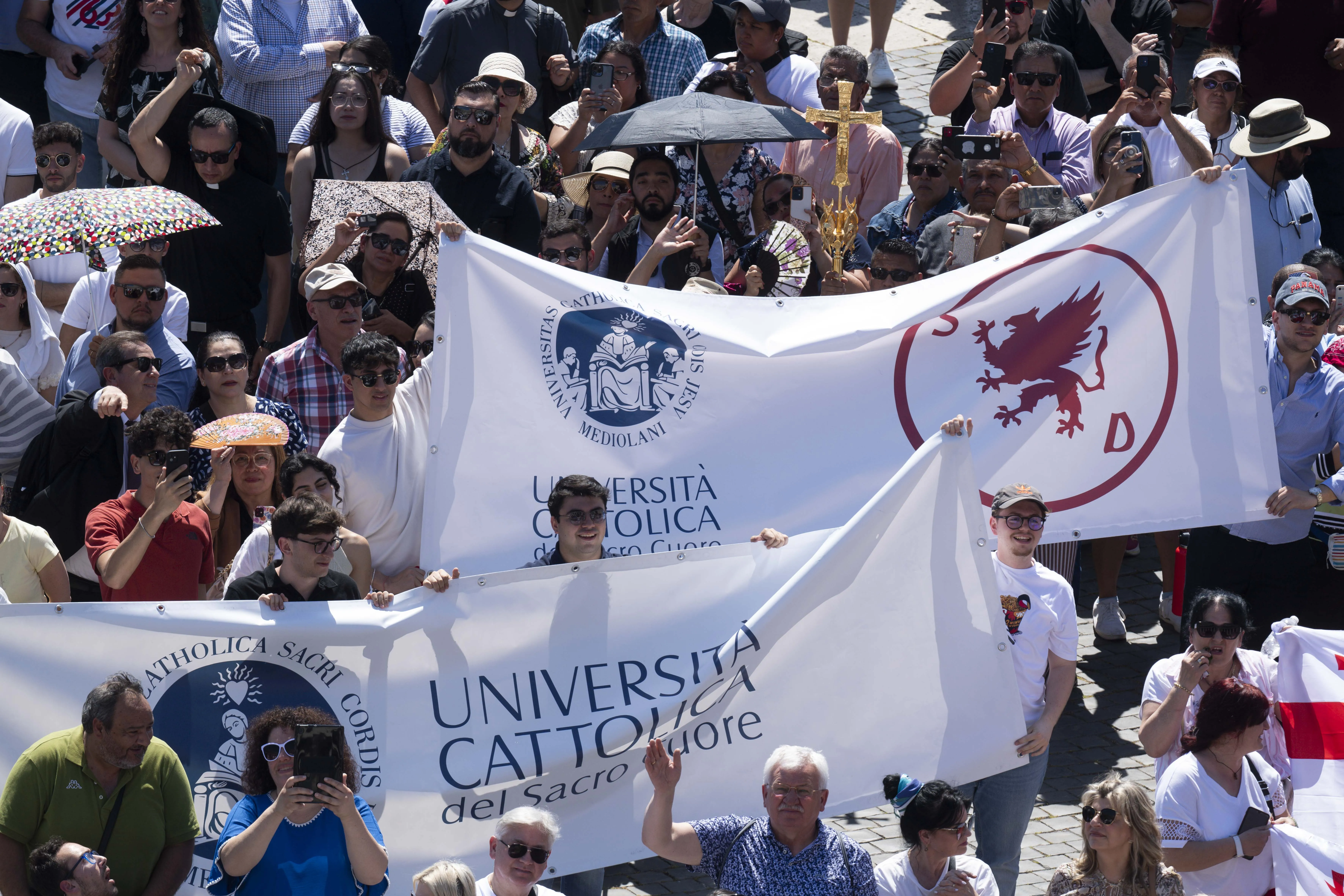
Pilgrims gathered in St. Peter’s Square at the Vatican hold banners during the recitation of the Regina Caeli prayer and address by Pope Francis on April 14, 2024. Credit: Vatican Media
The pope observed that today, this message is often drowned out by the frenzy of messages, which are often “superficial” and “useless,” and which often reveal “an indiscreet curiosity or, worse still, arise from gossip and malice.”
“They are news that have no purpose, on the contrary, they do harm,” the pope continued.
Amid the deluge of counterproductive messages, Pope Francis called on Christians to share their personal testimonies of encountering Christ, “not by being a lecturer to others, but by sharing the unique moments in which we perceived the Lord alive and close.”
While acknowledging that it can often be a “struggle” to discuss these encounters with family, friends, and the broader community, the pope advocated persistence in doing so as it will make our personal “encounters” and social environments “even more beautiful.”
In closing his address, the pope called upon all Christians to conduct a series of interior examinations, asking ourselves: “Have I ever spoken about it with someone? Have I ever simply made a gift of it to family members, colleagues, loved ones, and those I associate with? And finally: Am I, in turn, interested in listening to what others have to tell me about their encounter with Christ?”
If you value the news and views Catholic World Report provides, please consider donating to support our efforts. Your contribution will help us continue to make CWR available to all readers worldwide for free, without a subscription. Thank you for your generosity!
Click here for more information on donating to CWR. Click here to sign up for our newsletter.
St. Josemaria Escrivá, founder of Opus Dei / Flick Torreciudad Sanctuary (CC BY 2.0)
Rome Newsroom, Aug 8, 2023 / 10:00 am (CNA).
Pope Francis changed canon law on Tuesday regarding the governance of Opus Dei and any future personal prelatures…. […]
Sister Scholastica Radel (left) and Mother Abbess Cecilia Snell of the Benedictines of Mary, Queen of Apostles, discuss the recent exhumation of the order’s foundress, Sister Wilhelmina Lancaster, in an interview with EWTN News In Depth on May 30, 2023, at their abbey in Gower, Missouri. / EWTN News
Washington, D.C. Newsroom, Jun 4, 2023 / 08:00 am (CNA).
Her flashlight was dim, so when Mother Abbess Cecilia Snell first peered inside the cracked coffin lid and saw a human foot inside a black sock where one would expect to find only bone and dust, she didn’t say anything.
Instead, she took a step back, collected herself, and leaned in for another look, just to be sure. Then she screamed for joy.
“I will never forget that scream for as long as I live,” recalled Sister Scholastica Radel, the prioress, who was among the members of the Benedictines of Mary, Queen of Apostles, who were present to exhume the remains of their foundress, Sister Wilhelmina Lancaster.
“It was a very different scream than any other scream,” the abbess agreed. “Nothing like seeing a mouse or something. It was just pure joy. ‘I see her foot!’”
What the sisters discovered that day would cause a worldwide sensation: Roughly four years after her burial in a simple wooden coffin, Sister Wilhelmina’s unembalmed body appeared very much intact.
In an exclusive TV interview with EWTN News In Depth, the two sisters shared details of their remarkable discovery — revealing, among other things, that Sister Wilhelmina’s body doesn’t exhibit the muscular stiffness of rigor mortis — and reflected on the deeper significance of the drama still unfolding at their Abbey of Our Lady of Ephesus in rural Gower, Missouri.
They also clarified that Sister Wilhelmina’s coffin was exhumed on April 28, nearly three weeks earlier than CNA had understood. The sisters explained that it took about two weeks to remove dirt, mold, and mildew before they moved her body to the church. You can hear excerpts from the interview and other commentaries in the video at the end of this story.
Pilgrims visit the body of Sister Wilhelmina Lancaster, the foundress of the Benedictines of Mary, Queen of Apostles, in Gower, Missouri. EWTN News
Of particular significance to the members of the contemplative order, known for their popular recordings of Gregorian chants and devotion to the Traditional Latin Mass, is that the traditional habit of their African American foundress also is surprisingly well-preserved.
“It’s in better condition than most of our habits,” Mother Cecilia told EWTN’s Catherine Hadro.
“This is not possible. Four years in a wet coffin, broken in with all the dirt, all the bacteria, all the mildew, all the mold — completely intact, every thread.”
For the sisters, the symbolism is profound. A St. Louis native, Sister Wilhelmina spent 50 years in another religious order but left after it dispensed with the requirement of wearing its conventional habit and altered other long-established practices. She founded the Benedictines of Mary in 1995 when she was 70 years old.
“It’s so appropriate, because that’s what Sister Wilhelmina fought for her whole religious life,” Mother Cecilia said of the habit.
“And now,” Sister Scholastica said, “that’s what’s standing out. That’s what she took on to show the world that she belonged to Christ, and that is what she still shows the world. Even in her state, even after death, four years after the death, she’s still showing the world that this is who she is. She’s a bride of Christ, and nothing else matters.”
‘I did a double take’
The Benedictine community exhumed Sister Wilhelmina, almost four years after her death, after deciding to move her remains to a new St. Joseph’s Shrine inside the abbey’s church, a common custom to honor the founders of religious orders, the sisters said.
Members of the community did the digging themselves, “a little bit each day,” Mother Cecilia said. The process began on April 26 and culminated with a half-dozen or so sisters using straps to haul the coffin out of the ground on April 28.
The abbess revealed that there was a feeling of anticipation among the sisters to see what was inside the coffin.
“There was a sense that maybe God would do something special because she was so special and so pure of heart,” Mother Cecilia said.
It was the abbess who looked through the cracked lid first, shining her flashlight into the dark coffin.
“So I looked and I kind of did a double take and I kind of stepped back. ‘Did I just see what I think I saw? Because I think I just saw a completely full foot with a black sock still on it,'” she recalled saying to herself.
Members of the Benedictines of Mary, Queen of Apostles, lead a procession with the body of their foundress, Sister Wilhelmina Lancaster, at their abbey in Gower, Missouri, on May 29, 2023. Joe Bukuras/CNA
Sister Wilhelmina’s features were clearly recognizable; even her eyebrows and eyelashes were still there, the sisters discovered. Not only that, but her Hanes-brand socks, her brown scapular, Miraculous Medal, rosary beads, profession candle, and the ribbon around the candle — none of it had deteriorated.
The crown of flowers placed on her head for her burial had survived, too, dried in place but still visible. Yet the coffin’s fabric lining, the sisters noted, had disintegrated. So had a strap of new linen the sisters said they used to keep Sister Wilhelmina’s mouth closed.
“So I think everything that was left to us was a sign of her life,” Sister Scholastica reflected, “whereas everything pertaining to her death was gone.”
Another revelation from the interview: Contrary to what one would expect in the case of a four-year-old corpse, Sister Wilhelmina’s body is “really flexible,” according to Sister Scholastica.
“I mean, you can take her leg and lift it,” Mother Cecilia observed.
EWTN News In Depth also spoke with Shannen Dee Williams, an author and scholar who is an expert on the history of Black Catholicism. Sister Wilhelmina’s story, she said, is an important reminder of “the the great diversity and beauty of the Black Catholic experience across the spectrum.”
“It’s a really important story that reminds us of what is the great diversity of what is the Black Catholic experience.” – @BlkNunHistorian explains the significance of Sister Wilhelmina choosing a traditional habit for her community. pic.twitter.com/nJmyQ6UYjA
— EWTN News In Depth (@EWTNNewsInDepth) June 3, 2023
‘A unifying moment’
There has been no formal declaration by Church authorities that Sister Wilhelmina’s body is incorrupt, nor has an independent analysis been conducted of her remains, the condition of which has puzzled even some experienced morticians. Neither is there any official process yet underway to put the African American nun on a possible path to sainthood.
Pilgrims visit the body of Sister Wilhelmina Lancaster, foundress of the Benedictines of Mary, Queen of Apostles, in Gower, Missouri. EWTN News
In the interview, Mother Cecilia called what’s happening at the abbey “a unifying moment for everybody” in a time of discord.
“There’s so much division, and it’s crazy,” she said. “We’re children of God the Father, every single one of us. And so you see, Sister Wilhelmina is bringing everyone together . . . I mean, this is God’s love pouring forth through people of every race, color,” she said.
“They come and they’re blown away, and it makes them think,” the abbess said. “It makes them think about God, about, ‘OK, why are we here? Is there more than just my phone, and my job, and my next vacation?’”
As for what comes next, no one can say. “We love God so much, his sense of humor, the irony, this humble little black nun hidden away in a monastery is a catalyst for this. It’s like a spark to send fire to the world,” Mother Cecilia said.
“It’s just remarkable,” she said. “But this is the kind of thing that God does when we need a wake-up call.”
Pope Francis waves to the crowd in St. Peter’s Square on March 5, 2023, during his Sunday Angelus reflection. / Vatican Media
Washington, D.C. Newsroom, Mar 5, 2023 / 08:20 am (CNA).
During his Sunday morning Angelus address, Pope Francis urged the faithful to reflect on the miracle of the Transfiguration and to see the same beauty in the faces of the people we interact with every day.
In the March 5 address, the pope discussed the “beauty” shown in Sunday’s Gospel reading of Matthew 17:1-9. In this passage, Peter and James and his brother John witness Christ “transfigured before them” with his face shining “like the sun” and his clothes “dazzling white” as he conversed with Moses and Elijah on the top of a mountain.
Pope Francis said that we must “see the same beauty on the faces of the people who walk beside us every day,” such as family, friends, and colleagues.
“How many luminous faces, how many smiles, how many wrinkles, how many tears and scars reveal love around us,” the pope said.
“Let us learn to recognize them and to fill our hearts with them. And then let us set out in order to bring the light we have received to others as well, through concrete acts of love diving into our daily occupations more generously, loving, serving, and forgiving with greater earnestness and willingness,” the Holy Father said. “The contemplation of God’s wonders, the contemplation of God’s face, of the Lord’s face, must move us to the service of others.”
Reflecting on beauty the apostles respond to in the Gospel account, the pope asked, “Of what does this beauty consist? What do the disciples see? A special effect? No, that is not it.
“They see the light of God’s holiness shining on the face and on the clothing of Jesus, the perfect image of the Father,” the pope continued.
“God’s majesty, God’s beauty is revealed. But God is Love. Therefore, the disciples had been beholding with their eyes the beauty and splendor of divine Love incarnate in Christ. They had a foretaste of paradise. What a surprise for the disciples!” he said. “They had the face of Love before their very eyes for so long without ever being aware of how beautiful it was! Only now do they realize it with such joy, with immense joy.”
Pilgrims in St. Peter’s Square to hear Pope Francis’ Sunday Angelus reflection on March 5, 2023. Vatican Media
Pope Francis warned against reducing the miracle to simply a “magical moment,” which he said would be “false, artificial, something that would dissolve into the fog of passing sentiment.” He said, rather, this demonstrates something deeper.
“Christ is the light that orients our journey like the pillar of fire for the people in the wilderness,” the pontiff explained. “Jesus’ beauty does not alienate his disciples from the reality of life, but gives them the strength to follow him all the way to Jerusalem, all the way to the cross. Christ’s beauty is not alienating. It always brings you forward. It does not make you hide. Go forward!”
The Gospel reading also “traces a path for us,” according to Pope Francis. He explained how the passage “teaches us how important it is to remain with Jesus even when it is not easy to understand everything he says and does for us.” By staying with Christ, he said “we learn to recognize on his face the luminous beauty of love he gives us, even when it bears the marks of the cross.”
Near the end of his address, Pope Francis told people to ask themselves whether they “recognize the light of God’s love in our lives” and whether they “recognize it with joy and gratitude on the faces of the people who love us.”
“Do we look around us for the signs of this light that fills our hearts and open them to love and service?” the pope told people to ask themselves. “Or do we prefer the straw fires of idols that alienate us and close us in on ourselves? The great light of the Lord and the false, artificial light of idols. Which do I prefer?”
Following his address, Pope Francis said he is continuing to pray for the victims of a Feb. 28 train accident in Greece, many of whom are young students. He said he is also praying for the victims of a Feb. 26 shipwreck near Crotone, Italy. The pope also welcomed pilgrims and asked people to continue praying for him.
We all should be able to support the Pope’s plea for peace in the Middle East. The key point regarding the weekend’s excitement is that Israel instigated the attack by bombing Iran’s embassy in Syria. The Netanyahu government is clearly intent on starting a war with a Iran that it will want the US to finish. This must not be allowed to happen.
During the last week, I suffered a case of Covid and sought chores which didn’t require much energy. I determined to cull a decrepit box of old Catholic pamphlets, pictures, holy cards, etc., so I could claim to have made a dent in the over-stuffed storage state of my garage.
Serendipitously discovered in the box was a high-quality glossed card with Pope Benedict’s picture, coat of arms, signature, and a few lines of text from his homily of Sunday, April 24, 2005. I don’t remember how the card came to be in that box in my garage. I don’t remember who gave it to me or how I received it.
The homily was from the 5th Sunday of Easter on the occasion of the “MASS, IMPOSITION OF THE PALLIUM AND CONFERRAL OF THE FISHERMAN’S RING FOR THE BEGINNING OF THE PETRINE MINISTRY OF THE BISHOP OF ROME.” IOW, it was Benedict’s homily for his first public Sunday Mass, as Pope.
Curiously, Benedict said things in words arranged similar to Francis’: “There is nothing more beautiful than to be surprised by the Gospel, by the encounter with Christ. There is nothing more beautiful than to know Him and to speak to others of our friendship with him.”
Question: Did you catch the charism? Did you feel the warmth and the joy from the words of the Shepherd Pope Benedict?
Do you feel and think the same when you read the words of Francis? I didn’t.
We all should be able to support the Pope’s plea for peace in the Middle East. The key point regarding the weekend’s excitement is that Israel instigated the attack by bombing Iran’s embassy in Syria. The Netanyahu government is clearly intent on starting a war with a Iran that it will want the US to finish. This must not be allowed to happen.
This article continually troubles me.
During the last week, I suffered a case of Covid and sought chores which didn’t require much energy. I determined to cull a decrepit box of old Catholic pamphlets, pictures, holy cards, etc., so I could claim to have made a dent in the over-stuffed storage state of my garage.
Serendipitously discovered in the box was a high-quality glossed card with Pope Benedict’s picture, coat of arms, signature, and a few lines of text from his homily of Sunday, April 24, 2005. I don’t remember how the card came to be in that box in my garage. I don’t remember who gave it to me or how I received it.
The homily was from the 5th Sunday of Easter on the occasion of the “MASS, IMPOSITION OF THE PALLIUM AND CONFERRAL OF THE FISHERMAN’S RING FOR THE BEGINNING OF THE PETRINE MINISTRY OF THE BISHOP OF ROME.” IOW, it was Benedict’s homily for his first public Sunday Mass, as Pope.
Curiously, Benedict said things in words arranged similar to Francis’: “There is nothing more beautiful than to be surprised by the Gospel, by the encounter with Christ. There is nothing more beautiful than to know Him and to speak to others of our friendship with him.”
Question: Did you catch the charism? Did you feel the warmth and the joy from the words of the Shepherd Pope Benedict?
Do you feel and think the same when you read the words of Francis? I didn’t.
May God have mercy.