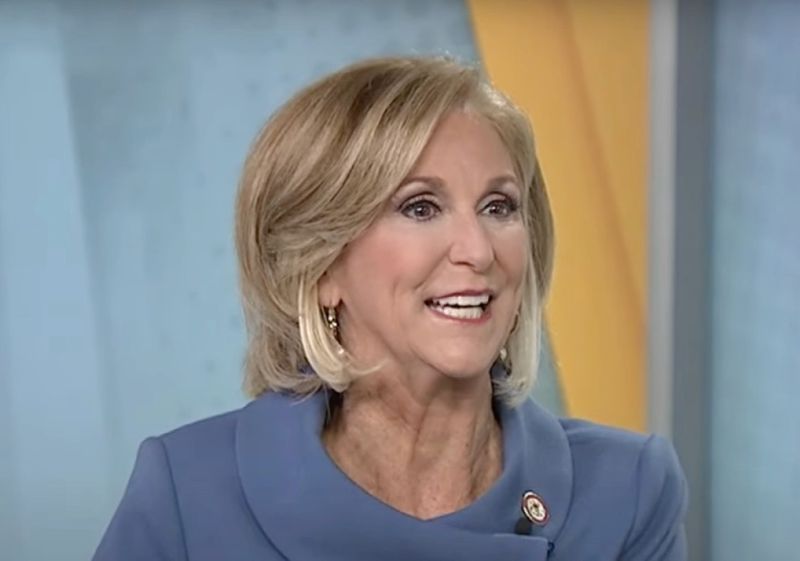
 Mississippi Attorney General Lynn Fitch was among the honorees of Live Action’s Life Gala in Dana Point, California, on Sept. 17, 2022. / Screenshot of ETWN YouTube video
Denver, Colo., Jan 20, 2023 / 10:10 am (CNA).
This year’s National March for Life is the first since the U.S. Supreme Court overturned the 1973 pro-abortion precedent Roe v. Wade on June 24, 2022.
Among its scheduled speakers is Lynn Fitch, attorney general for the state of Mississippi, who helped defend Mississippi’s 15-week abortion ban before a court primed to revisit precedent in the case Dobbs v. Jackson Women’s Health Organization. The court sided with Fitch and other critics, overturning Roe in a 5-3 decision.
1. For Fitch, the Dobbs era is a new chapter for America.
“This year’s March is unlike any other,” Fitch told CNA on Thursday. “We are saying goodbye to one chapter of American history and starting a new one. In this new Dobbs era, the task now falls to us to ensure our laws reflect the compassion we have always felt for woman and child.”
“As we march into this new chapter, we do so with the same hope and resolve to ensure our laws empower women and their families and respect the dignity of all life,” Fitch said.
Mississippi’s 15-week abortion ban passed in 2018, before Fitch had announced her campaign for attorney general. Challenges to the ban proceeded through the federal courts, and in 2019 an appeals court struck down the law. When she won the election in November 2019, it was left to her, the first woman to serve as Mississippi attorney general, to appeal to the U.S. Supreme Court to uphold the law.
2. Fitch grew up on a farm.
Fitch is Mississippi’s first Republican attorney general since 1878 and the first woman to serve in the role.
The 61-year-old is a native of Holly Springs, Mississippi, near the Tennessee border. There, her father inherited land on the former Galena Plantation and worked to restore the family farm, BBC News reported. Fitch Farms became a famous hunting destination for figures including the late U.S. Supreme Court Justice Antonin Scalia, another skeptic of the Supreme Court’s Roe precedent.
As a young woman, Fitch’s interests included riding horses and hunting quail on the farm. Her former campaign manager Hayes Dent told BBC News she was the “prototypical popular girl… leader, cheerleader, athletic, the whole nine yards.”
She attended the University of Mississippi, where she joined a sorority and earned an undergraduate degree and a law degree. After graduation, she worked for the state attorney general’s office before entering private practice. Her hard work, and some family connections, aided her ascent in Mississippi politics.
Before she took office as attorney general, she served as Mississippi state treasurer from 2012 to 2020. She previously served in the administration of Gov. Haley Barbour and as a legal counsel to the Mississippi House of Representatives Ways and Means and Local and Private Legislation Committees.
She was a member of the 2016 Republican National Convention platform committee and worked for pro-life principles there, World Magazine reported in November 2021.
Her official biography reports her support for charities for first responders and juvenile diabetes. She also supports Goodwill Industries and the American Red Cross. Fitch is co-chair of the National Association of Attorneys General Human Trafficking Committee.
According to her 2020 campaign website, she and her family are “active members” of Madison United Methodist Church in the city of Madison, Mississippi.
3. Her campaign theme was “Empower Women, Promote Life.”
After her divorce, Fitch raised two daughters and a son as a single mother. Her personal success, and the success of many mothers, helped inspire her campaign to defend Mississippi’s abortion ban and overturn Roe. For this campaign, she used the motto “Empower Women, Promote Life.”
One of her arguments against Roe v. Wade is that women’s situations have much improved since the 1970s.
In a Sept. 19, 2021, opinion essay for the Dallas Morning News, Fitch invoked the “Olympic Supermoms,” peak athletes who are also mothers.
“As a single, working mother, I raised three children and went from launching the Mississippi Bar’s first Women in the Profession Committee to becoming our first female attorney general. I know from experience that there is nothing easy about this, which is why I commend those Olympic Supermoms for proudly displaying their motherhood while the spotlight is on their professional accomplishments.”
“Abortion policy has been tethered to 1973, but women, men, and the workplace have all changed, facilitating our ability to have both a full family life and successful career,” she said.
“Over the past five decades, revolutions in cultural norms and public policy have opened opportunities for women who were previously told you could be a mother or a career woman, but not both,” Fitch continued. She noted that mothers of young children had doubled their workforce participation from 1975 to 2016.
“Technology and the advent of the gig economy have only increased options for freelancing, part-time work, and independent contracting for women to have more choices in life,” the attorney general said.
4. Fitch authored Mississippi’s Supreme Court brief for the Dobbs case.
Fitch made her case in favor of the Mississippi law and against Roe in a written submission to the court, leaving oral arguments to Mississippi solicitor general Scott Stewart.
She emphasized the need to strike down Roe v. Wade and Planned Parenthood v. Casey. They “shackle states to a view of the facts that is decades out of date,” she wrote.
“It is time for the Court to set this right and return this political debate to the political branches of government,” she said. “State legislatures, and the people they represent, have lacked clarity in passing laws to protect legitimate public interests, and artificial guideposts have stunted important public debate on how we, as a society, care for the dignity of women and their children.”
She repeated her case that women’s situations, and the ability to care for families, have much improved.
“A lot has changed in five decades. In 1973, there was little support for women who wanted a full family life and a successful career. Maternity leave was rare. Paternity leave was unheard of. The gold standard for professional success was a 9-to-5 with a corner office. The flexibility of the gig economy was a fairy tale,” she said. “In these last 50 years, women have carved their own way to achieving a better balance for success in their professional and personal lives.”
5. Fitch is continuing her legal efforts against pro-abortion federal policy.
After Dobbs, Fitch has continued legal efforts to challenge the spread of abortion.
On Jan. 18 of this year, she joined a brief supporting a Texas nurse’s lawsuit in a challenge to the U.S. Department of Veterans Affairs. The VA is implementing the Biden administration’s plan to allow abortion at its hospitals, the Jackson Clarion-Ledger reported.
“In direct contravention of the Supreme Court’s opinion in Dobbs, President Biden has taken abortion policy away from state legislators, Congress, and, most importantly, the people and given it to political appointees in his own administration,” Fitch said in a statement. “The Dobbs decision was about the rule of law. This VA rule is precisely the opposite.”
Seventeen other states’ attorneys general have joined the brief.
6. Fitch supports a “safety net” for women and babies.
After the Dobbs decision overturned Roe v. Wade, a different Mississippi ban on abortion took effect, barring the procedure except in cases of rape or when the mother’s life is in danger.
In response to the new political and cultural landscape created by Dobbs, Fitch insisted on the need for a strong safety net.
“Now, we must all work together to strengthen the safety net that women need not only for healthy pregnancies but also as they build families where both they and their children thrive,” she said in July 2022. “We need our laws to reflect our compassion for these women and their children.”
She called for action to help address the affordability and accessibility of child care, child support enforcement, and requirements for fathers to be equally responsible for their children, workplace policies like maternity and paternity leave, streamlining adoption, and improving foster care.
[…]






How do we interpret, to wit, explain a parallel of what appears to be occurring in the greater universal Synod and the German Synodale Weg? Referenced in my comment to Fr Pokorsky’s article ‘Pope’s remarks about the +LGBT community’ that “Francis’ main objective is the approval by the Church of same sex consensual adult relations, noticed in the change of messaging by Cardinals Hollerich and McElroy in favor of the adult more compatible with scripture interpretation advocated by McElroy. The danger for the Church is the subtleness of a seeming policy of the lesser evil eventually accepted as a good”.
While the Vatican perceives schism with the German Synod’s objective, whose “Participants have voted in favor of draft documents calling for the priestly ordination of women, same-sex blessings, and changes to Church teaching on homosexual acts”, what distinguishes that from the Synod on Synodality except that the same propositions are at the discussion stage in the universal Church Synod. Does it display a symbiotic relationship as a subtle means of developing change to doctrine in practice, rather than by a more formal means causing too much stir?
Exactly so, not “causing too much stir.” Is the concern not the (mis)direction being taken in ambulatory Germania, but rather that all of the lemmings go “forward” together?
And, yet, is there another distinction between Germania and Synod 2024…this being the former’s “walking together” into a permanently-ongoing focus group–as its parting step from such fixities as backwardist “propositions;” whilst Synod 2024, still only in its discussion phase, remains less evolved?
Moreover, unlike Germania, the polyhedral Synod 2024 and its “experts” and facilitator-bishops still retain a roundtable setting (with pen and notepad!) for a peripheralized papacy.
So, for example, of an ordained female diaconate we consult Alice in Wonderland: “Would you tell me, please, which way I ought to go from here?” “That depends a good deal on where you want to get to,” said the Cat. “I don’t much care where–” said Alice. “Then it doesn’t matter which way you go,” said the Cat.
Just go there together…
Charles Dodgson [pen name Lewis Carroll] suffered adults as badly as he suffered several maladies but loved children, took to Alice Pleasance Liddell, the daughter of the dean of Christ Church Oxford. Alice delighted in an ad hoc fairytale he created which became the rabbit hole adventure of Alice in Wonderland.
Whether you’re aware of the literary history, Alice, as a child, loved Carroll’s nonsense. Nonsense was his signature even in his more serious mathematics riddles [he taught math]. Alice grew up like most women and grew out of her child’s infatuation. Carroll was displeased with the adult woman. She had three sons two lost on the battlefield during the Great War. She sent flowers when learning of his death. Wonder whether the women of our Synodal wonderland will follow (historic outline taken from Rebecka Ferneklint Historic UK).
We read: “[Pope Francis] warned that these [steps in Germany] ‘threaten to steer it increasingly away from the universal Church’s common path’.”
And, what is that common path? If clearly “not a parliament,” then how does the synodal path differ from the ambulatory path of, say, Ijtihad–the path of consensus in (pre-parliamentary) Islam at least until the 9th-century? A process of occasional abrogation (!) still recognized today by one major faction of sectarian Islam but not the other.
How might our synodal “experts” retrack the synodal “common path” to also fully recognize the voted Documents of Vatican II, and the Magisterium, in both doctrine and practice, and the continued stature of those “special cases,” e.g., Africa, now being edged to the new periphery by both the Germans and Fiducia Supplicans?
My feelings, given my ennui with regard to this entire world, and given the immoral opinions of the German Catholic people in general, who, in turn, are lead by the spineless immoral quasi-shepherds of the German Catholic Church — yes, the bishops who indirectly made Pope Francis come out with the immoral Fiducia Supplicans doctrine, a doctrine that has only proven to be one DIVIDING the Catholic Church; well, all I can say is that the German Church would be better off to not be part of the Catholic Church.
Germany has a history of disagreeing with Rome; the Martin Luther is point in case. The Holy Spirit is not invoked. Let the leaders com to their senses to keep the Church as one. They are entertaining human weaknesses, especially sexually oriented. Gender issues. Let the rest of us pray for the Germans, especially during this lent. There is nothing impossible with God.
If the Germans would just accept that pastoral heresies are the only way to go. Why do they always insist on open war with dogma? Time is greater than space, etc. The Germans have the wrong style!
And yet, this pontificate is right to pamper these pesky prelates. Like Elon Musk and that Soros kid, there are billions of reasons why the Germans need private Synodaling…
It would be interesting to know how large this “ significant segment” is in Germany. Is there a silent majority in opposition to this rebellion that we seldom hear from, both lay and clerical? If a schism were to result, how strong is the sleeping Church? Would it not be prudent for the Vatican to pay more attention to them now when their need is greatest? Fidelity should be rewarded and given more press coverage. The spotlight always seems to be on the rebels which only makes them stronger.