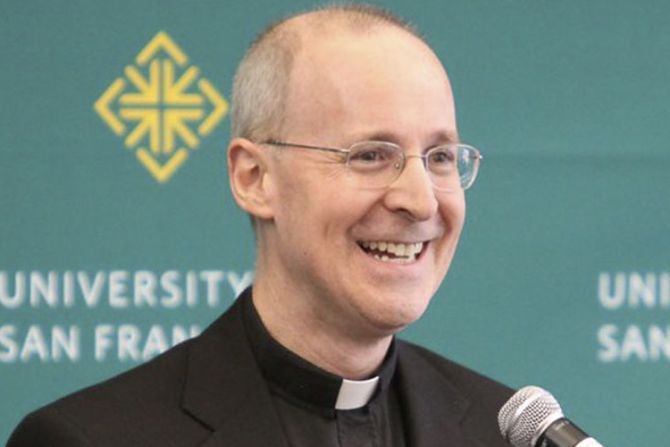
Father James Martin, SJ. / Credit: Shawn’s Flickr (CC BY-NC 2.0)
ACI Prensa Staff, Oct 2, 2023 / 18:30 pm (CNA).
Jesuit Father James Martin, who will attend the first session of the Synod on Synodality as a participant appointed by Pope Francis, said that “without a doubt, there are many chaste and celibate gay priests in the Church. It’s important that that be said.”
In an Oct. 1 interview with the Spanish newspaper El Periódico, Martin stressed that “it is crucial to point out that these priests lead a chaste and celibate life, like their heterosexual colleagues, and dedicate their lives to service in the Church. It’s probably always been this way.”
In his opinion, “it is impossible” to know their number “due to the stigma that still exists” for which “many have suffered in silence due to ridicule.”
The priest, known for his pro-LGBTQ activism within the Catholic Church, said that those who prepared the Instrumentum Laboris for the Synod on Synodality have told him that “half of the dioceses around the world have mentioned the need for greater welcoming and inclusion” of these persons.
“This is not limited to the West,” Martin added, “but is spread throughout the world. However, it’s not surprising either. As more people identify as LGBTQ, more families, parishes, and dioceses are affected. Therefore, there is a natural and growing interest in understanding how to provide pastoral care to the LGBTQ community.”
Asked if his goal is “mission impossible” because of the presence at the synod of very conservative Catholics, some of them high-ranking, Martin commented: “My goal is to listen to the Holy Spirit, and I think that should be everyone’s goal.”
‘I don’t know what to expect’
Regarding the possibility of tensions within the first session of the Synod on Synodality, Martin said “it’s probably inevitable, but we should not fear tensions” because, for example, “the first synod in the history of the Church was the Council of Jerusalem, which took place around the year 50 A.D. There was a lot of tension at that time, but the Holy Spirit was still able to act.”
Regarding the possibility that some of his postulates will be accepted in this first session of the Synod of Synodality, Martin said: “To be honest, I really don’t know what to expect. I think that at this first meeting we will focus on how to dialogue with each other and listen to each other.”
As for why he thought that some of the more conservative voices in the Church are in the American clergy, Martin replied: “Perhaps it’s because many people admired Pope John Paul II and Benedict XVI, as is also the case with me. However, now Pope Francis has taken a different approach. Fundamentally speaking, there has been no change, but some people may be confused.”
“What I find truly disconcerting,” Martin continued, “is that in the United States, some of the same people who argued that a pope should never be criticized during the pontificates of John Paul II and Benedict, now do so every day under the pontificate of Francis.”
Asked how he views the criticism by some U.S. clergy of the German Synodal Way, the Jesuit priest replied: “I don’t see it as a fight. Both churches are responding to what they see as the needs of their people. It’s true that some German Church leaders may have a more progressive approach in some respects, but fundamentally there is no difference. After all, we all recite the same Creed on Sundays.”
This story was first published by ACI Prensa, CNA’s Spanish-language news partner. It has been translated and adapted by CNA.
If you value the news and views Catholic World Report provides, please consider donating to support our efforts. Your contribution will help us continue to make CWR available to all readers worldwide for free, without a subscription. Thank you for your generosity!
Click here for more information on donating to CWR. Click here to sign up for our newsletter.
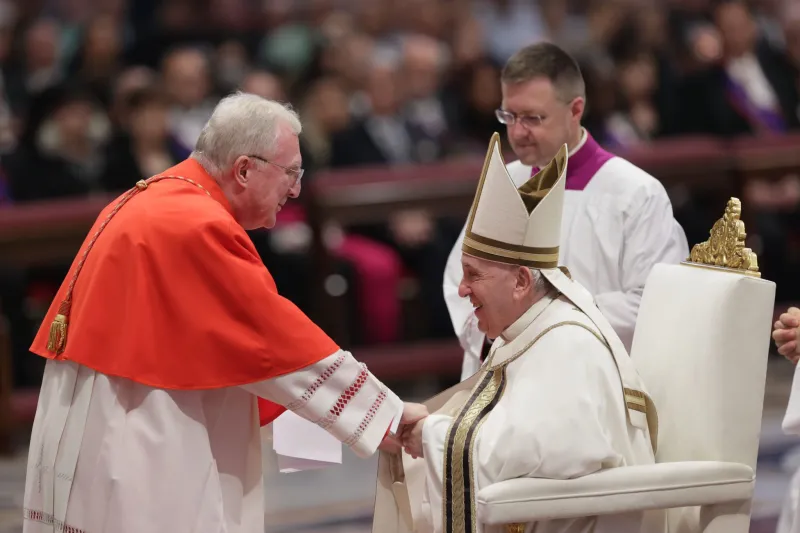
Pope Francis with Cardinal Arthur Roche, Prefect of the Vatican’s Dicastery of Divine Worship and Discipline of Sacraments, at the consistory in St. Peter’s Basilica, Aug. 27, 2022 / Daniel Ibáñez / CNA
Rome Newsroom, Aug 27, 2022 / 08:31 am (CNA).
Pope Francis created 20 new cardinals for the Catholic Church during a liturgy in St. Peter’s Basilica Saturday.
“Jesus calls us by name; he looks us in the eye and he asks: Can I count on you?” Pope Francis said in a homily addressed to the College of Cardinals and its new members on Aug. 27.
“The Lord,” he said, “wants to bestow on us his own apostolic courage, his zeal for the salvation of every human being, without exception. He wants to share with us his magnanimity, his boundless and unconditional love, for his heart is afire with the mercy of the Father.”
The pope’s reflection followed a reading from the Gospel of Luke, chapter 12, verses 49-50: “In that time, Jesus said to his disciples: ‘I have come to set the earth on fire, and how I wish it were already blazing! There is a baptism with which I must be baptized, and how great is my anguish until it is accomplished!’”
“The words of Jesus, in the very middle of the Gospel of Luke, pierce us like an arrow,” Francis said.
“The Lord calls us once more to follow him along the path of his mission,” he said. “A fiery mission – like that of Elijah – not only for what he came to accomplish but also for how he accomplished it. And to us who in the Church have been chosen from among the people for a ministry of particular service, it is as if Jesus is handing us a lighted torch and telling us: ‘Take this; as the Father has sent me so I now send you.’”
The pope ended his homily mentioning that one cardinal-elect, Richard Kuuia Baawobr of Wa (Ghana), was not present. Francis asked for prayers for the African prelate, explaining Baawobr had been taken ill.
At the beginning of the consistory, Pope Francis pronounced the opening prayer of the ceremony in Latin.
During the ceremony, the new cardinals made a profession of faith by reciting the Creed. They then pronounced an oath of fidelity and obedience to the pope and his successors.
Each cardinal then approached Pope Francis, kneeling before him to receive the red birretta, the cardinal’s ring, and a document naming the titular church he has been assigned.
Pope Francis embraced each new cardinal, saying to him: “Pax Domini sit semper tecum,” which is Latin for “the peace of the Lord be with you always.” Each cardinal responded: “Amen.”
The new cardinals also exchanged a sign of peace with a number of the members of the College of Cardinals, representative of the whole college.
While placing the red biretta on the head of each cardinal, the pope recited these words: “To the glory of almighty God and the honor of the Apostolic See, receive the scarlet biretta as a sign of the dignity of the cardinalate, signifying your readiness to act with courage, even to the shedding of your blood, for the increase of the Christian faith, for the peace and tranquility of the people of God and for the freedom and growth of the Holy Roman Church.”
As he gave each new cardinal the ring, Francis said: “Receive this ring from the hand of Peter and know that, with the love of the Prince of the Apostles, your love for the Church is strengthened.”
In his homily, the pope said: “The Lord wants to bestow on us his own apostolic courage, his zeal for the salvation of every human being, without exception. He wants to share with us his magnanimity, his boundless and unconditional love, for his heart is afire with the mercy of the Father.”
He also recalled another kind of fire, that of charcoal. “This fire,” he said, “burns in a particular way in the prayer of adoration, when we silently stand before the Eucharist and bask in the humble, discreet and hidden presence of the Lord. Like that charcoal fire, his presence becomes warmth and nourishment for our daily life.”
“A Cardinal loves the Church, always with that same spiritual fire, whether dealing with great questions or handling everyday problems, with the powerful of this world or those ordinary people who are great in God’s eyes,” he said.
The pope named three men as examples for the cardinals to follow: Saint Charles de Foucauld, Cardinal Agostino Casaroli, and Cardinal Van Thuân.
The consistory to create cardinals also included a greeting and thank you to Pope Francis, expressed by Cardinal Arthur Roche, prefect of the liturgy dicastery, on behalf of all the new cardinals.
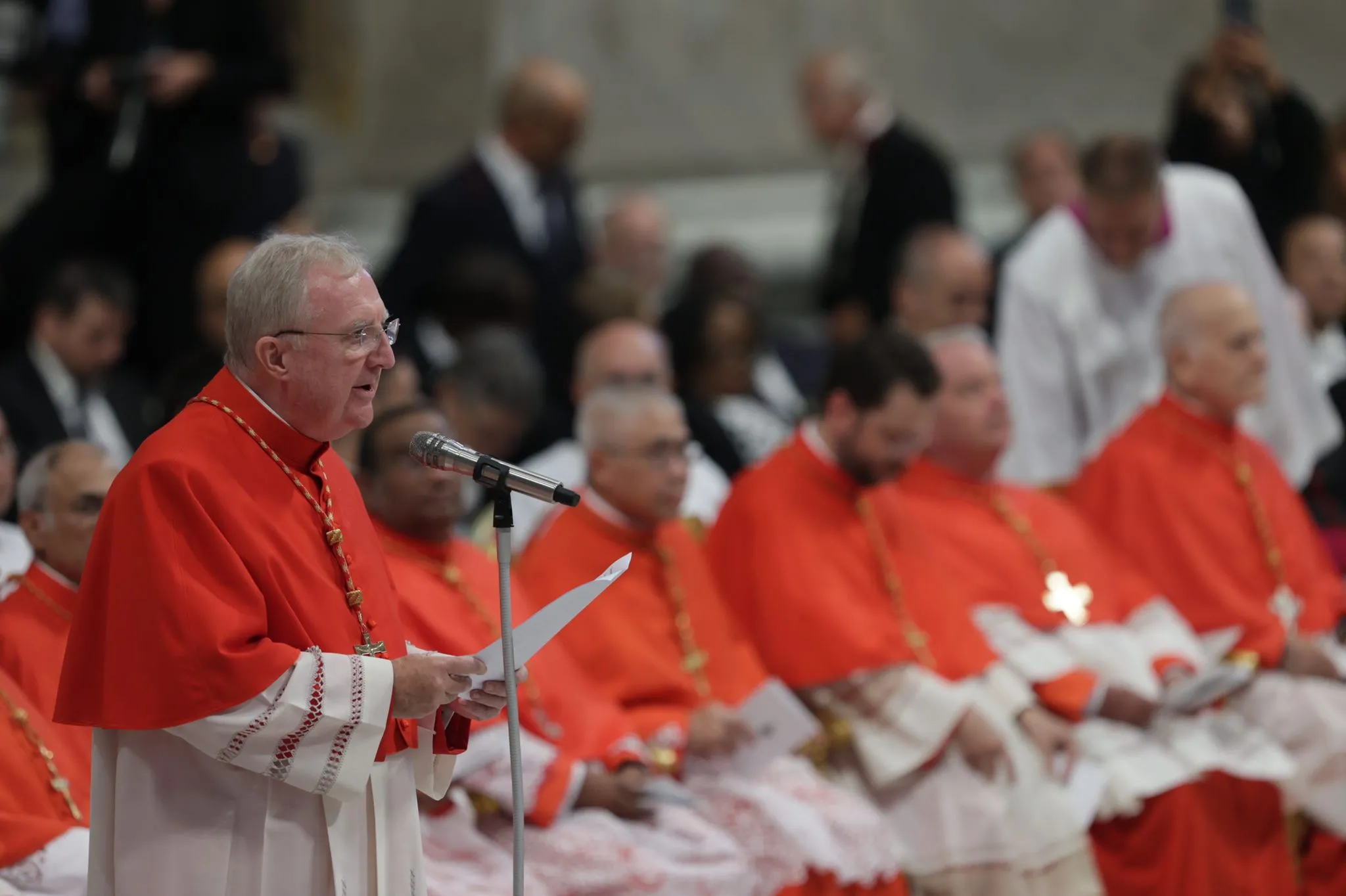
Cardinal Arthur Roche speaking on behalf of the new cardinals in St. Peter’s Basilica, Aug. 27. 2022. Daniel Ibáñez / CNA
“All of us, coming from different parts of the world, with our personal stories and different life situations, carry out our ministry in the vineyard of the Lord. As diocesan and religious priests, we are at the service of preaching the Gospel in many different ways and in different cultures, but always united in the one faith and the one Church,” Roche said.
“Now, in manifesting your trust in us, you call us to this new service, in an even closer collaboration with your ministry, within the broad horizon of the universal Church,” he continued. “God knows the dust of which we are all made, and we know well that without Him we are capable of falling short.”
Roche quoted Saint Gregory the Great, who once wrote to a bishop: “We are all weak, but he is weakest of all who ignores his own weakness.”
“However, we draw strength from you, Holy Father,” he said, “from your witness, your spirit of service and your call to the entire Church to follow the Lord with greater fidelity; living the joy of the Gospel with discernment, courage and, above all, with an openness of heart that manifests itself in welcoming everyone, especially those who suffer the injustice of poverty that marginalizes, the suffering of pain that seeks a response of meaning, the violence of wars that turn brothers into enemies. We share with you the desire and commitment for communion in the Church.”
At the end of the consistory to create cardinals, Pope Francis convened a consistory for the cardinals to give their approval to the canonizations of Blessed Artemide Zatti and Giovanni Battista Scalabrini.
The new cardinals are:
— Cardinal Arthur Roche, 72, prefect of the Congregation for Divine Worship and former Bishop of Leeds (England);
— Lazarus You Heung-sik, 70, prefect of the Congregation for Clergy and former Bishop of Daejeon (South Korea);
— Jean-Marc Noël Aveline, 63, Archbishop of Marseille, the first French diocesan bishop to get the honor during Pope Francis’ pontificate;
— Peter Ebere Okpaleke, 59, Bishop of Ekwulobia in the central region of Nigeria, who was created bishop in 2012 by Benedict XVI;
— Leonardo Ulrich Steiner, 77, Archbishop of Manaus, in Brazil’s Amazon region, a Franciscan who played a leading role during the Amazon Synod and as Vice President of the recently created Amazonian Bishops’ Conference;
— Filipe Neri António Sebastião do Rosário Ferrão, 69, Archbishop of Goa (India), appointed bishop by St. John Paul II in 1993;
— Robert McElroy, 68, Bishop of San Diego (United States), whose diocese is suffragan to the Archdiocese of Los Angeles, led by the President of the USCCB, Archbishop José Gomez;
— Virgilio do Carmo Da Silva, 68, a Salesian, since 2019 the Archbishop of Dili (East Timor);
— Oscar Cantoni, 71, Bishop of Como (Italy), appointed in January 2005 by St. John Paul II, who is suffragan to Milan;
— Archbishop Fernando Vérgez Alzaga, L.C., 77, president of the Governorate of the Vatican City State and of the Pontifical Commission for the Vatican City State; the Spaniard is the first Legionary of Christ to become a cardinal;
— Anthony Poola, 60, Archbishop of Hyderabad (India), a bishop since 2008 and the first dalit to become a cardinal;
–Paulo Cezar Costa, 54, Archbishop of Brasilia (Brazil), the fourth archbishop of the Brazilian capital to become a cardinal;
— Richard Kuuia Baawobr, 62, Bishop of Wa (Ghana), former Superior General of the White Fathers, and bishop since 2016;
— William Goh Seng Chye, 65, Archbishop of Singapore since 2013;
— Adalberto Martinez Flores, 71, Archbishop of Asunción (Paraguay) and the first Paraguayan cardinal;
— Giorgio Marengo, 47, Italian Missionary of the Consolata and Apostolic Prefect of Ulan Bator in Mongolia, the youngest cardinal in recent history, along with Karol Wojtyla, who also was created a cardinal at 47, during the consistory of June 26, 1967.
Furthermore, Pope Francis appointed the following prelates over the age of 80, who are therefore excluded from attending a future conclave.
Jorge Enrique Jiménez Carvajal, 80, Archbishop Emeritus of Cartagena (Colombia); Arrigo Miglio, 80, Archbishop Emeritus of Cagliari (Italy); Fr. Gianfranco Ghirlanda, a Jesuit and former rector of the Pontifical Gregorian University, who extensively collaborated in the drafting of the Apostolic Constitution Praedicate Evangelium; and Fortunato Frezza, 80, (Italy) currently a Canon at the Basilica of St. Peter, who collaborated for several years at the Secretariat General for the Synod of the Bishops.
Pope Francis had originally also nominated Ghent Bishop Luc Van Looy, 80, who later declined to accept the post because of criticism of his response to clergy abuse cases.
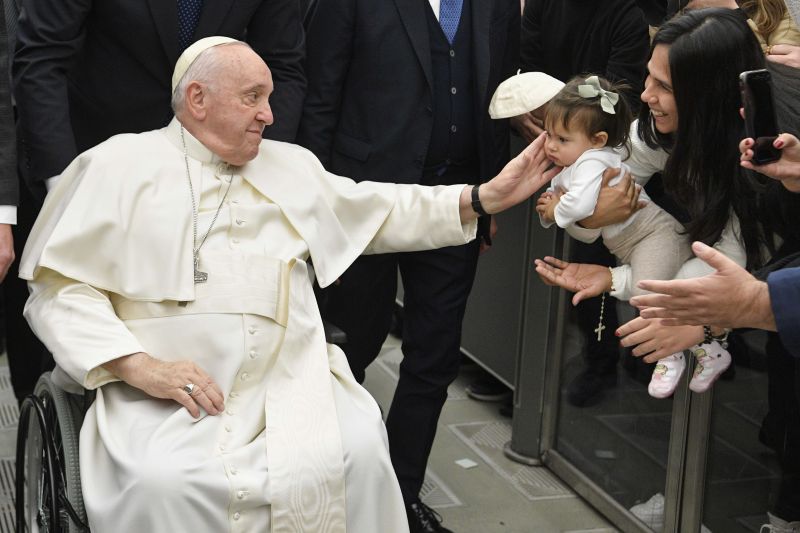
Pope Francis, seated in a wheelchair, greets a child during the pope’s general audience at the Vatican on Jan. 25, 2023. / Vatican Media
Washington, D.C. Newsroom, Jan 25, 2023 / 08:30 am (CNA).
Pope Francis has revealed a recurrence of the intestinal ailment that has plagued him in recent years while also professing to be in good health for his age.
He also indicated he has no plans to resign, although if he were to step down he reiterated that he would want to be called “bishop emeritus of Rome,” rather than “pope emeritus,” the title given his predecessor, Benedict XVI.
In a wide-ranging interview with the Associated Press published Wednesday that also included pointed remarks about homosexuality, the pope disclosed that diverticulosis, or bulges in his intestinal wall, had “returned.”
At the same time, however, the 86-year-old pontiff — who is preparing to embark on a pilgrimage to South Sudan and the Democratic Republic of Congo next week — insisted he was in relatively good condition.
“I’m in good health. For my age, I’m normal,” he told the AP on Jan. 24.
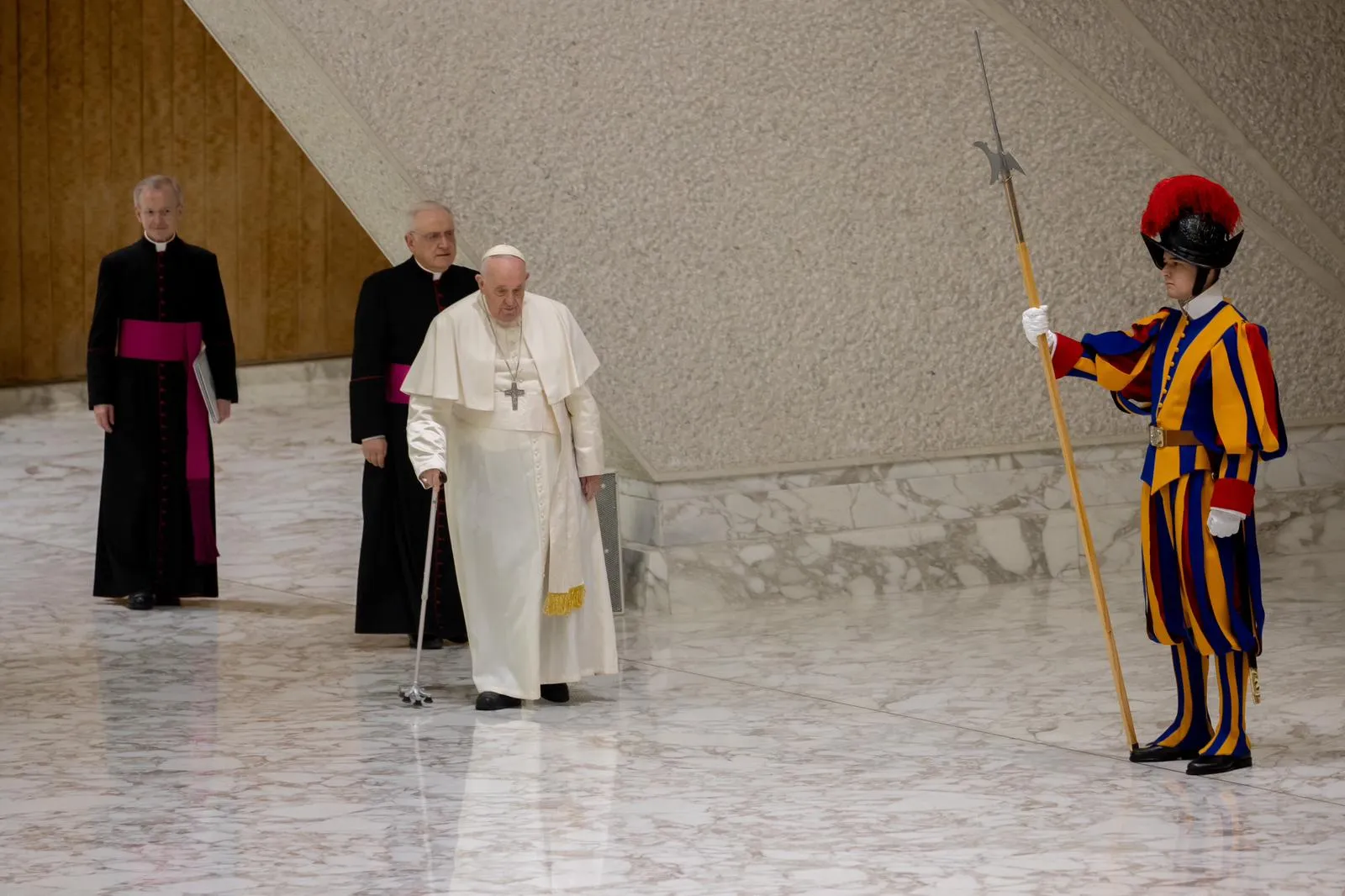
Pope Francis arrived at Paul VI Hall using a cane to walk on Jan. 18, 2023. Daniel Ibanez/CNA
Rumors of Francis’ possible resignation, and speculation that his health problems are more serious than the Vatican has acknowledged, have swirled since he underwent surgery in 2021 to have 33 centimeters (13 inches) of his large intestine removed for what the Vatican said was inflammation of his colon.
A slight fracture in his knee Francis suffered in a fall also has made it visibly painful for him to walk, making it necessary for him to rely on a cane and a wheelchair. But Francis told the AP that the fracture had healed without surgery after laser and magnet therapy.
Speaking about papal retirements, Francis dismissed speculation that he is preparing to issue norms for how future papal abdications will be handled.
“I’m telling you the truth,” he said, adding that it was premature to “regularize or regulate” papal retirements because the Vatican had too little experience upon which to draw. Benedict XVI, who died Dec. 31, 2022, after nearly a decade of retirement, was the first pope to step down in nearly 600 years.
Francis hasn’t ruled out retiring, and he repeated Tuesday that if he did so he would be called the bishop emeritus of Rome and would live in the residence for retired priests in the Diocese of Rome.
Benedict’s decision to live in a converted monastery in the Vatican Gardens was a “good intermediate solution,” he told the AP, but future retired popes might want to choose a different course.
“He was still ‘enslaved’ as a pope, no?” Francis said. “Of the vision of a pope, of a system. ‘Slave’ in the good sense of the word: in that he wasn’t completely free, as he would have liked to have returned to his Germany and continued studying theology.”
Vatican City, Oct 2, 2019 / 05:34 am (CNA).- Guidance by the Holy Spirit is integral to sharing the Gospel with others and bringing them to Christ, Pope Francis said during the general audience Wednesday.
To try to convince people that Jesus is God wi… […]
12 Comments
Does Father Martin have any research data behind his comments about the number of chaste SSA clergy?
I’m guilty of making unqualified statements too but I’m not a priest nor a public figure being interviewed.
Father Martin’s statement is likely correct but he should acknowledge it’s his personal opinion unless he has additional information to back it up.
To fully understand Martin’s role at the Synod, it is necessary to fully understand the MINDSET of Pope Francis…
Namely (as a mere bystander, I humbly propose), his proposition that instead of dynamically “handing on the deposit of faith,” this deposit itself, within the patience of time, is more of a polarizing space. A polarity within a dynamic tension (no longer deposit) with the different and more concrete pole of the particular. Almost as if the Incarnation of the Creed—two natures in one Person—is no longer the “concrete universal.”
But instead, only the universal in tension with the concrete… Situated morality becomes Situation Ethics, butt with orthodoxy not rejected, but still retained and reaffirmed, as an OPTION within the broader or ostensibly higher mix. This Francis proposition/mindset is favorably and well set forth by one of his tribe, Ivereigh, in this article posted in 2017 on CRUX: https://cruxnow.com/book-review/2017/11/new-book-looks-intellectual-history-francis-pope-polarity.
Regarding Fr. Martin, then, homosexual activity is the “third option” of a transcendent synthesis which does not replace, but which continues to include on the menu the more “rigid” and binary human sexuality (therefore, the new synthesis/ dispensation is not Hegelian). For the real Catholic Church, however, this particular “third option”—and others of its kind: a male alongside female priesthood, authentic alongside bigamous marriages, the “hierarchical communion” alongside redefined synodality, etc.–is really the THIRD RAIL.
Butt, Francis, long before becoming pope, was of the mind that the Church itself [!]—by its very nature (if there still is a “nature”)—is instead more like a “catalyst” (my word, but recalling his early chemistry background) of the Holy Spirit always on the move with the particular, as in “walking together.” Rather than, say, standing STEADFAST together! Evangelii Gaudium: “time is greater than space!” Can we not see, then, that Francis’s hypothesis probably brands even the Faith & Reason polarities(!) as “backwardist” stuff?
Where Francis would have us make “decisions” in the concrete, for example, the Catechism and Veritatis Splendor (VS) already clarify that–with a well-formed conscience (!)–each of us is personally(!) responsible for making concrete(!) moral “judgments” (VS, nn. 56, 95), particularly(!) with regard to moral absolutes (“Thou shalt not…”).
But, then, “who am I to ‘judge’”? Now meaning, let us “decide,” synodally! Now, with the laity recruited as a useful pawn in a theological parlor game—like a black star, Fernandez even absorbs the dubia as synodal!
Ivereigh (in the linked CRUX) then also reasons that Chesterton is also into the polarity thingy, with: “G.K. Chesterton once described a heresy as a good idea gone mad.” CHESTERTON, who said this of what’s truly mad:
“The madman is not the man who has lost his reason. The madman is the man who has lost everything except his reason [….] that his mind moves in a perfect but narrow circle. A small circle is quite as infinite as a large circle; but though quite infinite, it is not so large [that is] the insane explanation is quite as complete as the sane one, but it is not so large.” The small circle: the tautological and self-validating (!) Synod on Synodality. With Chesterton, are the lunatics in charge of the asylum?
Or instead, this: “The Catholic Church is the only thing that frees a man from the degrading slavery of being a child of his age.”
Every priest is human and has his own struggles. No doubt there are many priests who struggle with disordered sexual attractions, but any priest who identifies himself by these attractions, (e.g., “I am gay.”) is going to find it very difficult to live out his priesthood.
It is sad that Fr. Martin falls into the pop culture error of seeing a person through the lens of his or her disordered desires. Christ came to free us from all that.
How does Fr. Martin know if someone else is chaste? He says many are. So does that mean more are not? Perhaps he knows priests who are not chaste? And to be sure, he knows many priests who have homosexual attractions. Why doesn’t he say if he is chaste? St. Paul had a lot to say in Sacred Scripture about chastity. And he used himself as an example. Perhaps Fr. Martin can preach from his own experience? Is all of this about his own experience?
Fr. Martin has no data. But there is sound data that shows that over 80% of sexual crimes in the Church against children are committed by men with boys. Obviously, legitimizing pererastry is next step on the agenda after “blessings” for same-sex unions. It’s just a matter of time, which is greater than space.
The problem for me is not that same sex attracted priests will be sexually active, it is the immature and childish behavior that they bring into the priesthood. I have witnessed this firsthand and lament the forced revision of the Diagnostic and Statistical Manual so many years ago.
It sounds as though homosexualists can find you guilty in conscience of whatever they decide to identify in you as disfavouring them as to be against faith even; while at the same time it is impossible for the faithful to point out their folly and faux that they themselves have declared integral in their identity.
It is anathema and upholding it is worse anathema.
Regarding being harassed by “ssa”, you shouldn’t be saying merely that it’s your cross and Bob’s your uncle; you must want to have a very reactive mind and heart against it.





Does Father Martin have any research data behind his comments about the number of chaste SSA clergy?
I’m guilty of making unqualified statements too but I’m not a priest nor a public figure being interviewed.
Father Martin’s statement is likely correct but he should acknowledge it’s his personal opinion unless he has additional information to back it up.
Perhaps the priest has heard the word, “No”?
To fully understand Martin’s role at the Synod, it is necessary to fully understand the MINDSET of Pope Francis…
Namely (as a mere bystander, I humbly propose), his proposition that instead of dynamically “handing on the deposit of faith,” this deposit itself, within the patience of time, is more of a polarizing space. A polarity within a dynamic tension (no longer deposit) with the different and more concrete pole of the particular. Almost as if the Incarnation of the Creed—two natures in one Person—is no longer the “concrete universal.”
But instead, only the universal in tension with the concrete… Situated morality becomes Situation Ethics, butt with orthodoxy not rejected, but still retained and reaffirmed, as an OPTION within the broader or ostensibly higher mix. This Francis proposition/mindset is favorably and well set forth by one of his tribe, Ivereigh, in this article posted in 2017 on CRUX: https://cruxnow.com/book-review/2017/11/new-book-looks-intellectual-history-francis-pope-polarity.
Regarding Fr. Martin, then, homosexual activity is the “third option” of a transcendent synthesis which does not replace, but which continues to include on the menu the more “rigid” and binary human sexuality (therefore, the new synthesis/ dispensation is not Hegelian). For the real Catholic Church, however, this particular “third option”—and others of its kind: a male alongside female priesthood, authentic alongside bigamous marriages, the “hierarchical communion” alongside redefined synodality, etc.–is really the THIRD RAIL.
Butt, Francis, long before becoming pope, was of the mind that the Church itself [!]—by its very nature (if there still is a “nature”)—is instead more like a “catalyst” (my word, but recalling his early chemistry background) of the Holy Spirit always on the move with the particular, as in “walking together.” Rather than, say, standing STEADFAST together! Evangelii Gaudium: “time is greater than space!” Can we not see, then, that Francis’s hypothesis probably brands even the Faith & Reason polarities(!) as “backwardist” stuff?
Where Francis would have us make “decisions” in the concrete, for example, the Catechism and Veritatis Splendor (VS) already clarify that–with a well-formed conscience (!)–each of us is personally(!) responsible for making concrete(!) moral “judgments” (VS, nn. 56, 95), particularly(!) with regard to moral absolutes (“Thou shalt not…”).
But, then, “who am I to ‘judge’”? Now meaning, let us “decide,” synodally! Now, with the laity recruited as a useful pawn in a theological parlor game—like a black star, Fernandez even absorbs the dubia as synodal!
Ivereigh (in the linked CRUX) then also reasons that Chesterton is also into the polarity thingy, with: “G.K. Chesterton once described a heresy as a good idea gone mad.” CHESTERTON, who said this of what’s truly mad:
“The madman is not the man who has lost his reason. The madman is the man who has lost everything except his reason [….] that his mind moves in a perfect but narrow circle. A small circle is quite as infinite as a large circle; but though quite infinite, it is not so large [that is] the insane explanation is quite as complete as the sane one, but it is not so large.” The small circle: the tautological and self-validating (!) Synod on Synodality. With Chesterton, are the lunatics in charge of the asylum?
Or instead, this: “The Catholic Church is the only thing that frees a man from the degrading slavery of being a child of his age.”
Every priest is human and has his own struggles. No doubt there are many priests who struggle with disordered sexual attractions, but any priest who identifies himself by these attractions, (e.g., “I am gay.”) is going to find it very difficult to live out his priesthood.
It is sad that Fr. Martin falls into the pop culture error of seeing a person through the lens of his or her disordered desires. Christ came to free us from all that.
Well said! If we love someone, we want union with God for them, not sin that can turn us away from God.
How does Fr. Martin know if someone else is chaste? He says many are. So does that mean more are not? Perhaps he knows priests who are not chaste? And to be sure, he knows many priests who have homosexual attractions. Why doesn’t he say if he is chaste? St. Paul had a lot to say in Sacred Scripture about chastity. And he used himself as an example. Perhaps Fr. Martin can preach from his own experience? Is all of this about his own experience?
Fr. Martin has no data. But there is sound data that shows that over 80% of sexual crimes in the Church against children are committed by men with boys. Obviously, legitimizing pererastry is next step on the agenda after “blessings” for same-sex unions. It’s just a matter of time, which is greater than space.
The problem for me is not that same sex attracted priests will be sexually active, it is the immature and childish behavior that they bring into the priesthood. I have witnessed this firsthand and lament the forced revision of the Diagnostic and Statistical Manual so many years ago.
It sounds as though homosexualists can find you guilty in conscience of whatever they decide to identify in you as disfavouring them as to be against faith even; while at the same time it is impossible for the faithful to point out their folly and faux that they themselves have declared integral in their identity.
It is anathema and upholding it is worse anathema.
If they are chaste single men then they are not gay.
A celibate Priest or layman with SSA can be a good Catholic. SSA is a cross to bear. Those who have it deserve our support and encouragement.
Regarding being harassed by “ssa”, you shouldn’t be saying merely that it’s your cross and Bob’s your uncle; you must want to have a very reactive mind and heart against it.