Pope Francis gives the weekly Angelus address on Aug. 27, 2023. / Vatican Media
Rome Newsroom, Aug 28, 2023 / 11:43 am (CNA).
Pope Francis has asked for prayers as he prepares to visit “the heart of Asia,” the sparsely-populated country of Mongolia.
The pope will travel approximately 5,600 miles to Ulaanbaatar, the Mongolian capital, from Aug. 31 to Sept. 4.
“It is a much-desired visit,” he said on Aug. 27 after his weekly Angelus address at the Vatican.
The trip, he said, “will be an opportunity to embrace a Church that is small in number but vibrant in faith and great in charity, and also to meet at close quarters a noble, wise people with a strong religious tradition that I will have the honor of getting to know, especially in the context of an interreligious event.”
During the four-day visit, Pope Francis is scheduled to meet with government leaders, engage in interreligious dialogue, and offer Mass for the small Catholic population, which numbers just 1,450 in a country of about 3 million people.
“I would now like to address you, brothers and sisters of Mongolia, to tell you that I am happy to travel to be among you as a brother of all,” Francis said from a window overlooking St. Peter’s Square.
“I thank your authorities for their kind invitation and those who, with great commitment, are preparing for my arrival,” he added. “I ask all of you to accompany this visit with your prayers.”
If you value the news and views Catholic World Report provides, please consider donating to support our efforts. Your contribution will help us continue to make CWR available to all readers worldwide for free, without a subscription. Thank you for your generosity!
Click here for more information on donating to CWR. Click here to sign up for our newsletter.
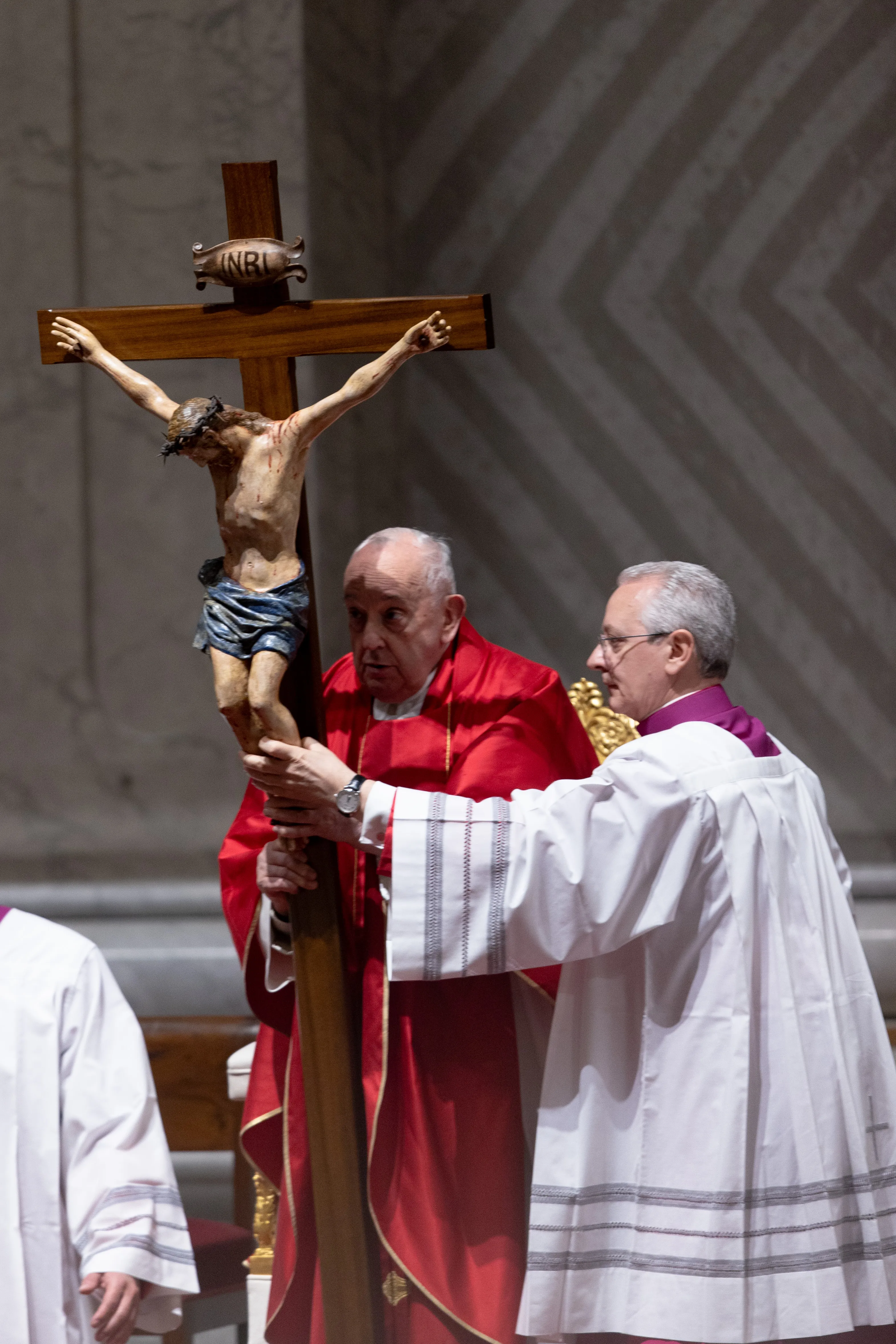
Pope Francis celebrates the Passion of the Lord on Good Friday in St. Peter’s Basilica in Rome. March 29, 2024. / Credit: Daniel Ibañez/CNA
Vatican City, Mar 29, 2024 / 15:20 pm (CNA).
During the Good Friday liturgy at the Vatican, presided over by Pope Francis, the papal preacher reflected on the triumph of the cross, noting that it is an event that changed the universal perception of God’s omnipotence, revealing his humility.
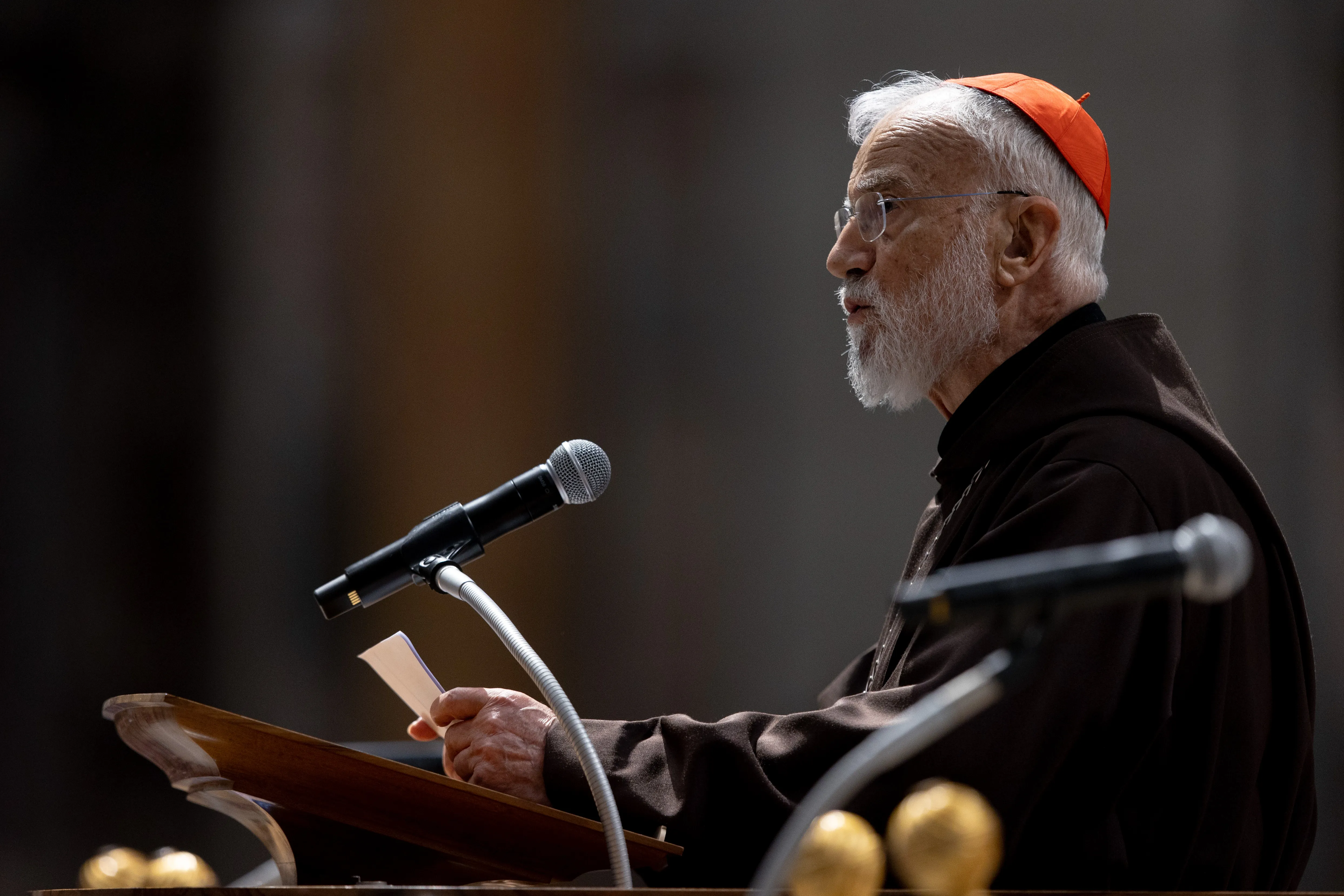
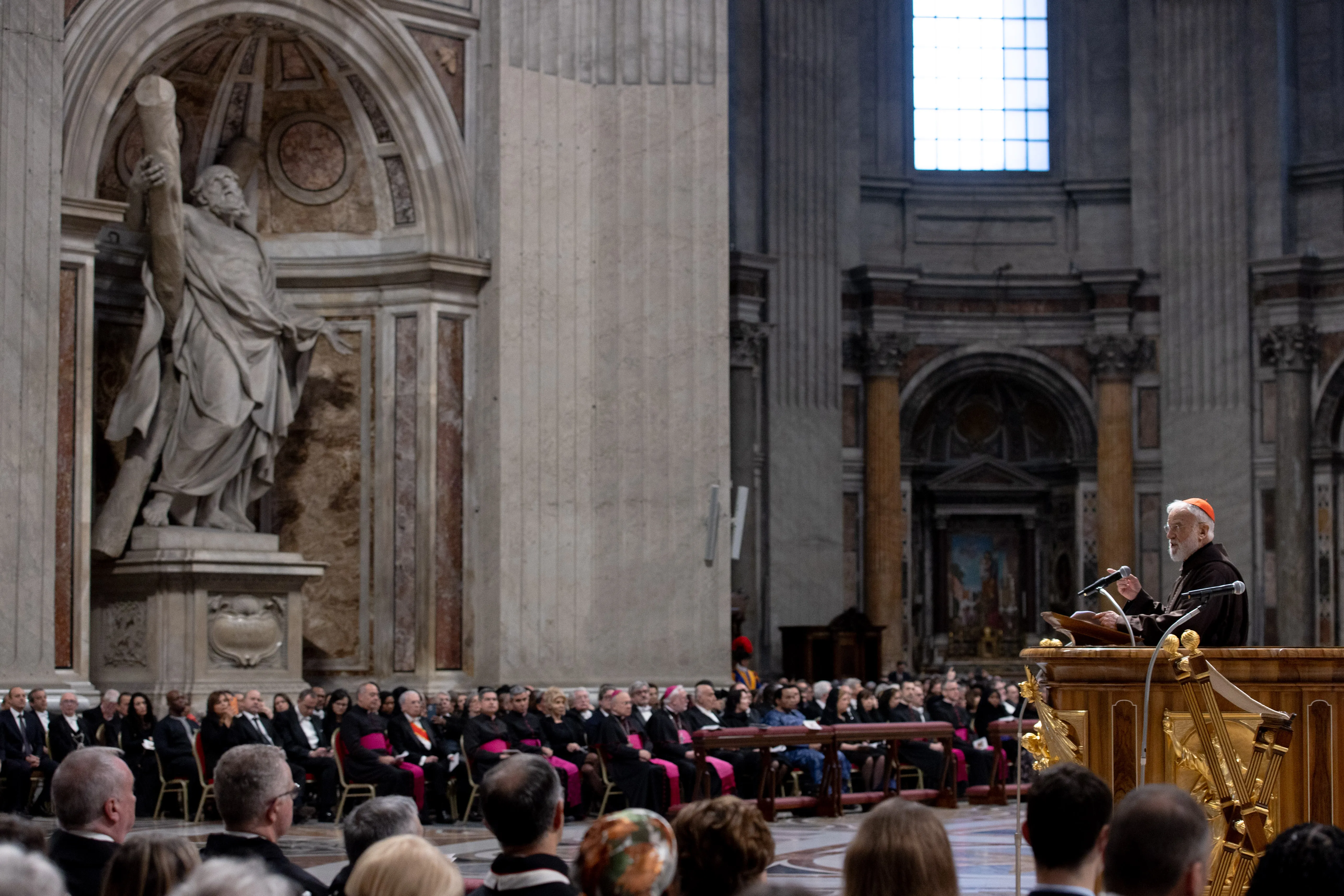
“The true omnipotence of God is the total powerlessness of Calvary,” Cardinal Raniero Cantalamessa, O.F.M. Cap., said during his homily.
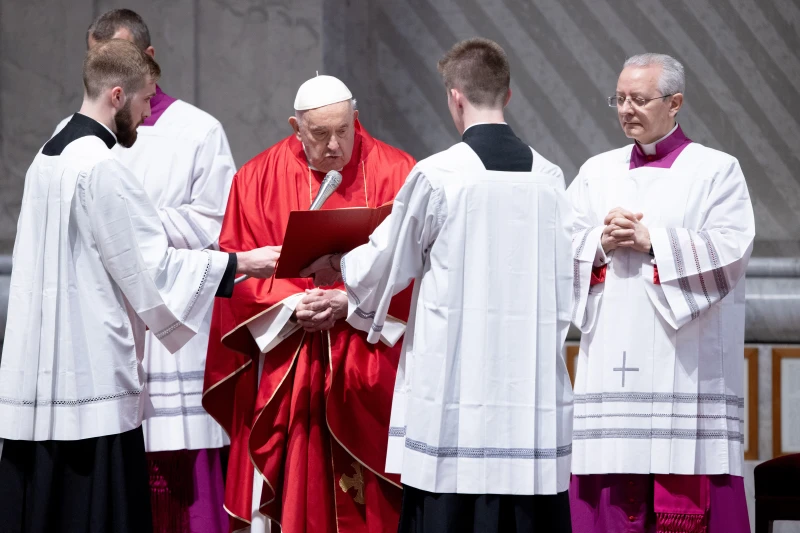
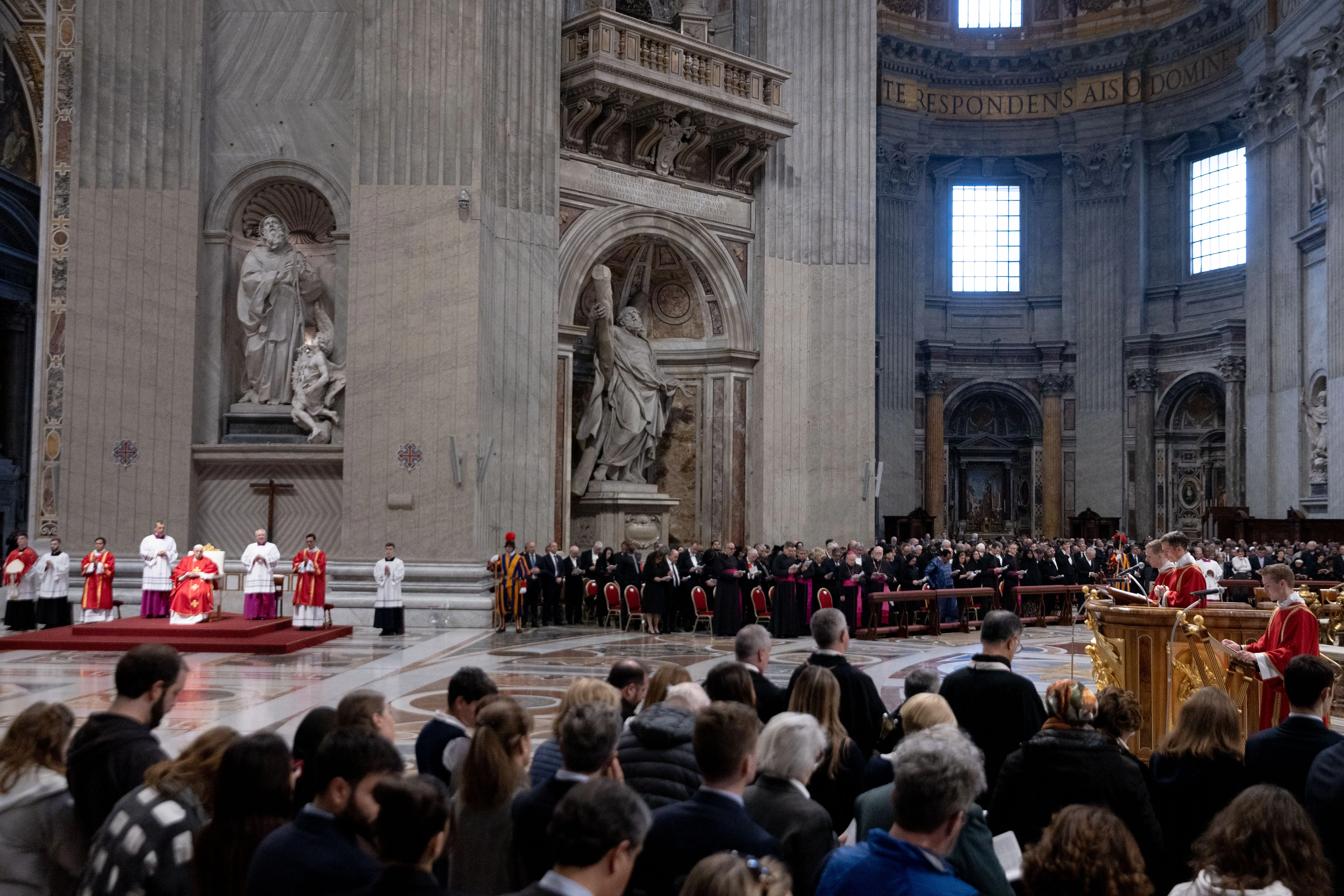
Celebration of the Passion of the Lord on Good Friday in St. Peter’s Basilica, Rome. March 29, 2024. Credit: Daniel Ibañez/CNA
At approximately 5 p.m. Rome time, Pope Francis made his way into Saint Peter’s Basilica, in a wheelchair, vested in a red chasuble. Cast against the backdrop of complete and palpable silence, the Holy Father paused in meditation before the Papal Altar underneath Bernini’s Baldacchino (covered in scaffolding for its restoration), while the congregation knelt.
For the past several years the pope has been unable to lay prostrate due to his fragile health, which includes persistent knee problems and several bouts of pulmonary inflammation.
After the chanting of the passion from the Gospel of John, Cantalamessa — who was made a cardinal in 2020 after more than 40 years as Preacher of the Papal Household — opened his homily reflecting on Christ’s self-affirmation of “I am,” words he said come without any qualification and carry “an absolute, metaphysical significance” and is an “unprecedented novelty.”
“Jesus did not come to retouch and perfect the idea that men had of him God, but, in a certain sense, to overturn it and reveal the true face of God,” Cardinal Raniero Cantalamessa, O.F.M. Cap. said during his homily at the Good Friday liturgy in St. Peter’s Basilica in Rome. March 29, 2024. Credit: Daniel Ibañez/CNA
The cardinal stressed that this new paradigm can only be understood by looking at Christ’s preceding words heard in the passion: “When you have lifted up the Son of Man.”
Observing that “to be lifted up” refers to the crucifixion, the cardinal noted that the sum of these words express a “total reversal of the human idea of God,” revealing “the true face of God.”
“Jesus did not come to retouch and perfect the idea that men had of him, but, in a certain sense, to overturn it and reveal the true face of God,” he said. ““He humbly behaves in the glory of the resurrection as in the annihilation of Calvary. The concern of the risen Jesus is not to confuse his enemies, but to immediately go and reassure his lost disciples and, before them, the women who had never stopped believing in him.”
“The true omnipotence of God is the total powerlessness of Calvary,” Cardinal Raniero Cantalamessa, O.F.M. Cap. said during his homily at the Good Friday liturgy in St. Peter’s Basilica in Rome. March 29, 2024. Credit: Daniel Ibañez/CNA
“Understood in this light,” Cantalamessa continued, “the word of Christ takes on a universal significance that challenges those who read it, in any era and situation, including ours.”
The cardinal warned not to conflate God’s omnipotence, and the “definitive and irreversible triumph” of the cross with temporal triumphs, as God’s triumph showcases humility.
“It takes little power to show off,” the cardinal noted, “Instead, it takes a lot to step aside, to cancel. God is this limitless power of self-concealment.”
“The resurrection takes place in the mystery,” he continued. “As a resurrected one, Jesus appears only to a few disciples, out of the spotlight. With this he wanted to tell us that after suffering, we must not expect an external, visible triumph, like an earthly glory.”
Pope Francis celebrates the Passion of the Lord on Good Friday in St. Peter’s Basilica in Rome. March 29, 2024. Credit: Daniel Ibañez/CNA
At the end of Cantalamessa’s homily, the faithful sat in a moment of deep silence and reflection. This was followed by the reading of the Oratio Universalis, the universal prayer also known as the Solemn Intercessions.
Then, a deacon, flanked by two candle bearers, stopped at three separate points in the central nave of the basilica, proclaiming, with an increasing pitch, “Ecce lignum crucis” (“behold the wood of the cross”). After the third proclamation, the deacon, holding an unveiled crucifix, brought it to the papal chair for the pope’s veneration.
Once the crucifix was fixed in a central place, the Sistine Chapel Choir chanted the Improperia, or the Good Friday Reproaches, a series of antiphons sung in alternating manner between a cantor and the choir. The cardinals, who sat opposite the pope, filed in line to kneel before and kiss the crucifix.
After the final prayer over the people, the pope left the basilica just as he entered: solemn, and in silence.
Bishop Dominique Rey (left), and Coadjutor Bishop François Touvet of Fréjus-Toulon, France. / Credit: Claude Truong-Ngoc via Wikimedia (CC BY-SA 3.0) and G.Garitan, CC BY-SA 4.0, via Wikimedia Commons
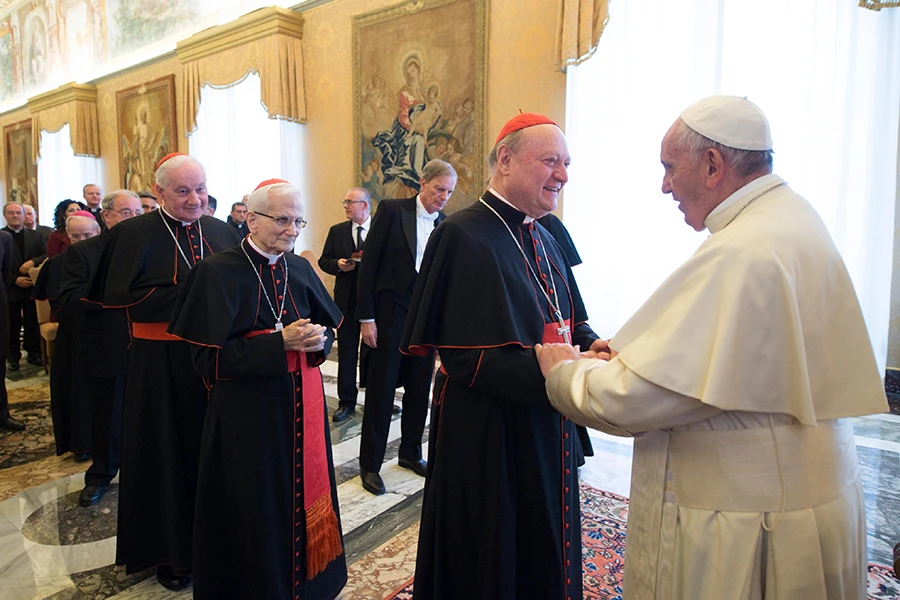
Vatican City, Jan 26, 2018 / 10:04 am (CNA/EWTN News).- Pope Francis met with the members of the Congregation for the Doctrine of the Faith Friday, affirming the dignity of every person and emphasizing the Church’s task of accompanying the ill and suffering, especially in the face of increasing support for euthanasia.
Pain, suffering, and the meaning of life and death are all problems the contemporary mind does not know how to face with hope, the Pope said Jan. 26, and therefore “this is one of the duties that the Church is called to render to contemporary man.”
“It is clear that where life is valid not for its dignity, but for its efficiency and productivity, [euthanasia] becomes possible. In this scenario it must be reiterated that human life, from conception to its natural end, has a dignity that renders it inviolable.”
Pope Francis met at the Vatican’s Clementine Hall with the members of the Congregation for the Doctrine of the Faith at the conclusion of their plenary session, praising their study of “the sensitive issues” surrounding the accompaniment of terminally ill patients.
Secularization and the emphasis on self-determination and personal autonomy have increased the demand for euthanasia, he noted, and many people believe that the “voluntary interruption of human existence [is] a choice of ‘civilization.’”
Therefore, authentic pastors have an opportunity to accompany people in difficult circumstances, with an accompaniment that does not “abandon man to himself, nor leave him in the grip of his disorientation and his errors, but with truth and mercy,” brings him back to the good, Francis said.
“Authentic pastoring therefore is every action aimed at taking man by the hand, when he has lost the sense of his dignity and his destiny, to lead him with confidence to rediscover the loving fatherhood of God, his good destiny and the ways to build a more human world.”
The Pope also expressed his appreciation for the congregation’s commitment to protecting the faith and the sanctity of the sacraments.
In particular, he pointed to their work examining cases concerning graviora delicta, external violations against faith and morals or in the celebration of the sacraments; and applications for the dissolution of the matrimonial bond in favor of the faith.
This is especially important today, he said, as man’s understanding of self becomes ever more fluid and changeable, influencing his existential and ethical choices.
“The man of today no longer knows who he is and, therefore, struggles to recognize how to act well.”
“In this sense, the task of your Congregation appears decisive in recalling the transcendent vocation of man and the indivisible connection of his reason with truth and goodness, which introduces faith in Jesus Christ,” he said.
“Nothing helps man to know himself and God’s plan for the world like the opening of reason to the light that comes from God.”



Prayerful wishes. Wishing the Holy Father and the people of Mongolia good moments of togetherness.