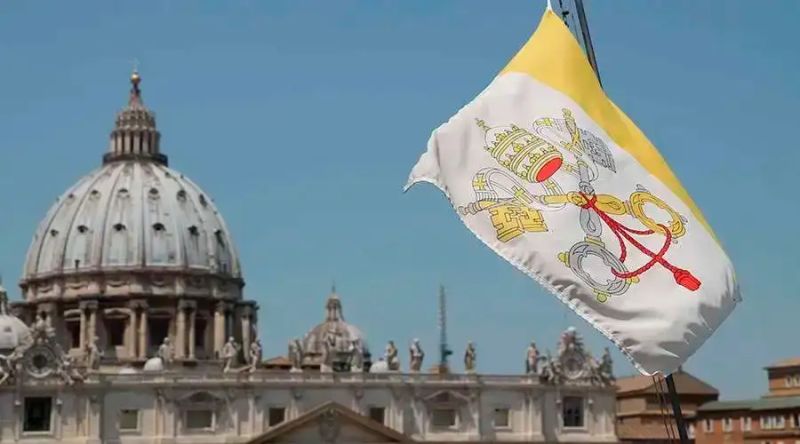
The Vatican flag and the dome of St. Peter’s Basilica. / Credit: Bohumil Petrik/ACI
ACI Prensa Staff, Mar 20, 2023 / 17:00 pm (CNA).
The Holy See reported on Saturday that the Vatican’s diplomatic headquarters in Nicaragua was forced to close.
“Yesterday, March 17, the chargé d’affaires of the apostolic nunciature in Nicaragua, Monsignor Marcel Diouf, left the country for Costa Rica. The closure of the diplomatic headquarters of the Holy See occurred as a result of a request from the Nicaraguan government on March 10, 2023,” Vatican News reported.
The Vatican news outlet indicated that “by virtue of the Vienna Convention on Diplomatic Relations, custody of the apostolic nunciature and its assets was entrusted to the Italian Republic.”
“Before his departure, Diouf was greeted by diplomatic representatives accredited in Nicaragua from the European Union, Germany, France, and Italy,” it said.
Diouf was the last Vatican official in Nicaragua and assumed the role of business manager after the government of Daniel Ortega expelled the apostolic nuncio, Archbishop Waldemar Stanislaw Sommertag, in March 2022.
On March 12, the Nicaraguan Ministry of Foreign Affairs reported that it was considering suspending diplomatic relations with the Vatican.
This occurred two days after an interview with Pope Francis was published in which he harshly criticized the Ortega regime — where the Catholic Church is persecuted — and compared it to “the communist dictatorship of 1917 or the Hitler dictatorship of 1935.”
He also mentioned the bishop of Matagalpa, Rolando Álvarez, who was sentenced to 26 years in prison for his opinions against the regime. “A very serious man, very capable. He wanted to give his testimony and did not accept exile,” the Holy Father said.
Likewise, in reference to Ortega, the pope pointed out that “with great respect, I have no choice but to think there’s an imbalance in the person who leads” Nicaragua.
If you value the news and views Catholic World Report provides, please consider donating to support our efforts. Your contribution will help us continue to make CWR available to all readers worldwide for free, without a subscription. Thank you for your generosity!
Click here for more information on donating to CWR. Click here to sign up for our newsletter.
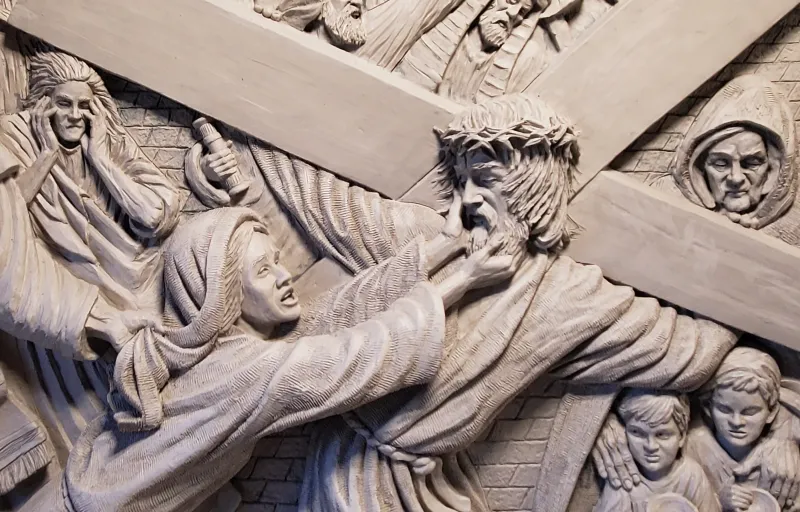
A detail of Timothy P. Schmalz’s fourth station: Jesus meets his mother. / Courtesy of Timothy P. Schmalz
Washington, D.C. Newsroom, Sep 18, 2022 / 04:00 am (CNA).
Catholic artist Timothy P. Schmalz sought to find and bring to life the most important subject matter an artist could ever express.
“I wanted to create a sculpture project that would be the heart of Christianity,” the Canadian sculptor said.
He settled on Christ’s crucifixion and death.
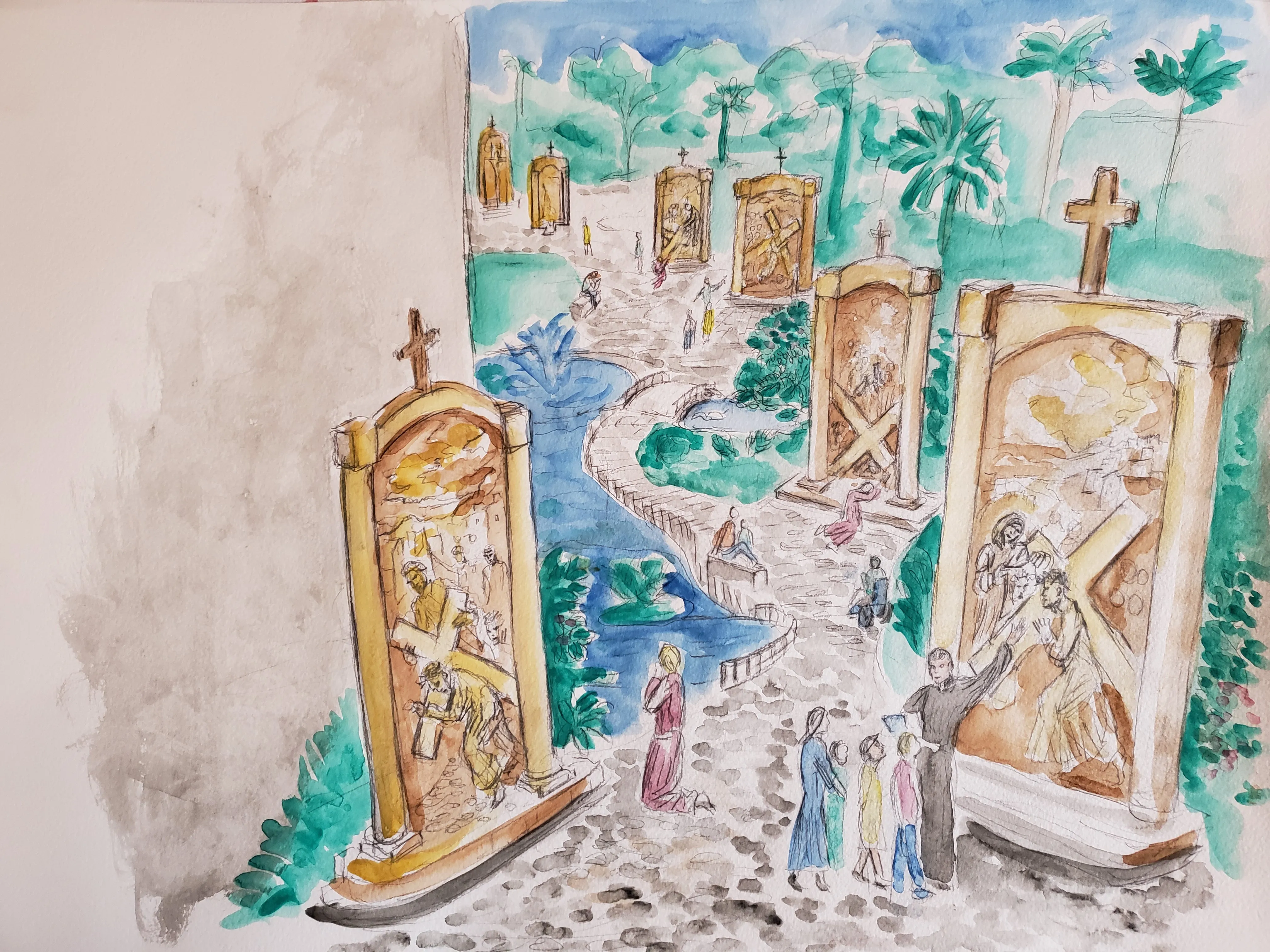
His new creation, once finished, will be a life-size set of the 14 Stations of the Cross — scenes depicting Christ’s journey from being condemned to death to his burial — placed right next to Disney World. The faithful will be able to encounter the 12-foot tall, 11-feet wide sculptures at the Basilica of Our Lady Queen of the Universe, in Orlando, Florida.
“I hope to rival Universal Studios, Walt Disney, and every other feature in Orlando by creating what has never been done before, and that is one of the biggest, most complex Stations of the Cross,” Schmalz said.
Once completed, visitors will encounter the 12-foot tall, 11-feet wide sculptures at the Basilica of Our Lady Queen of the Universe, in Orlando, Florida. “It’s right in the center of a place that desperately needs a spiritual Catholic oasis,” sculptor Timothy P. Schmalz says. Courtesy of Timothy P. Schmalz
Schmalz is not new to sculpting. The experienced artist’s work can be found worldwide, from St. Peter’s Square in the Vatican to Washington, D.C. He is perhaps best known for his “Homeless Jesus” sculpture and the “Angels Unaware” statue.
His new Stations of the Cross, he hopes, will serve as a tool for evangelization and conversion for the roughly 50 million people that visit Disney each year.
“It’s right in the center of a place that desperately needs a spiritual Catholic oasis,” he said, adding that bringing the Stations of the Cross to Orlando is “bringing the Gospels [to] where the people are, in a sense.”
The stations — which combine mural painting and sculpture — will offer visitors “visual doorways into a Catholic-Christian experience,” he said.
So far, he has completed the first four stations: Jesus is condemned to death, Jesus carries his cross, Jesus falls for the first time, and Jesus meets his mother.
It will take another year, he says, before all 14 are done. On his YouTube channel, Schmalz walks viewers through the process of creating each station, from sketching them on paper to sculpting them in bronze.
Each scene, made of bronze, bursts with symbolism, movement, and emotion. The foreground shows Jesus’ passion. In the background, Schmalz plans to include every single parable found in the New Testament.
“When you see Jesus in the front, you’re going to see … a raw, hardcore scene from the passion,” he said. “But in the distance, you’re going to see the parables that he taught us. So it might be in the distance, you’ll see a camel trying to get through a little hole in the wall or the eye of the needle.”
While he works in his studio located in St. Jacobs, in Ontario, Canada, he listens to an audio recording of the New Testament, he said.
“Things are pulled out and things describe themselves as I create,” he explained, comparing his role to a “passenger” or “director.”
The stations are getting funded by various donors, he said, as he works on them. As they progress from one to 14, each station will become “more and more intense.”
“The passion now has become my passion,” he said.
He hopes that viewers will feel like they are a part of the stations.
“We know there’s a lot of kids going to Walt Disney in Orlando every year,” he said, giving one example. “I’m putting a lot of children within them so they can see themselves in the scene.”
The 53-year-old artist also sees himself in them.
“It’s fascinating because you really become a part of the subject matter as you’re working on it,” he said. “It evolves and it grows as you’re working on it, and it’s almost like it tells you what to do in a sense where I don’t necessarily know exactly how the piece will end up.”
He called the project mentally, spiritually, and physically taxing. He might dedicate one entire day to creating a little corner of one of the stations, he said, and another day just focusing on the face of Jesus.
But, he added, the work is worth it. These stations allow him, as an artist, to “get to the absolute essence of Christianity” in the hope that “it will be one of the greatest tools to convert and inspire Christianity.”
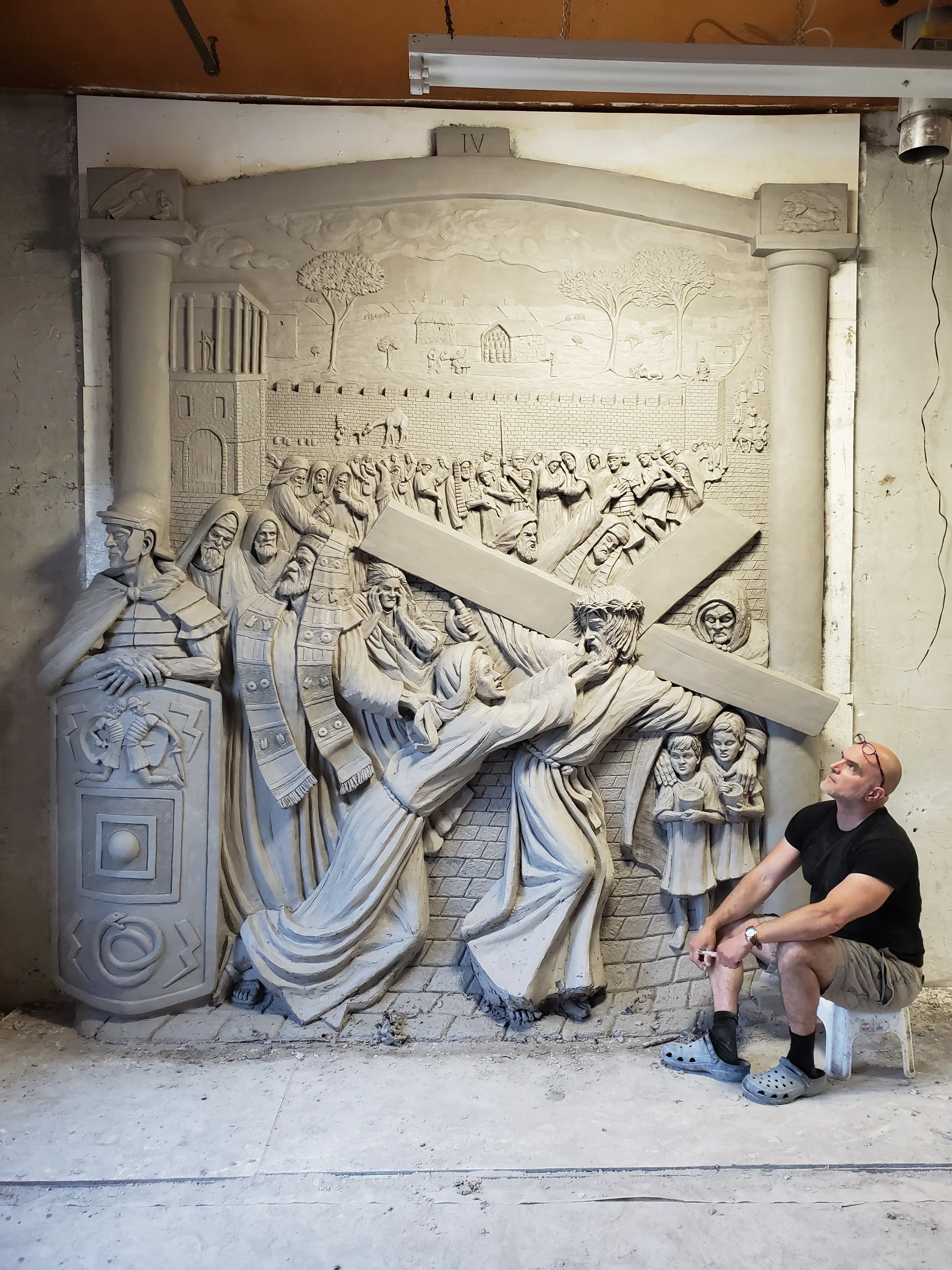
“I hope to rival Universal Studios, Walt Disney, and every other feature in Orlando by creating what has never been done before, and that is one of the biggest, most complex Stations of the Cross,” says Timothy P. Schmalz, shown here in his studio looking at the fourth station. Courtesy of Timothy P. Schmalz
“I want [people] to come back from Orlando and, sure, talk about the rides, talk about Mickey Mouse. But I want them to say that the most exciting and most interesting and most moving thing with their vacation was this Stations of the Cross project,” he said. “And if I can do that with this piece of artwork, I have succeeded.”
At a time when many people are attacking Christianity and Christian symbols, Schmalz’s response is to create new, stronger symbols. “Sculptures that are bold, sculptures that celebrate and glorify Christ, but also encourage people to walk through that doorway and see Christ in focus,” he said.
“As they try to make us invisible, we have to sharpen,” he concluded. “And me, as an artist, that is my job, to sharpen our identity with these symbols and art.”
Pope Francis meeting with Roberto Benigni, Dec. 7, 2022. / Vatican Media
Rome Newsroom, Dec 7, 2022 / 08:17 am (CNA).
Pope Francis enthusiastically greeted Italian actor and comedian Roberto Benigni at the Vatican on Wednesday morning.Benigni, … […]
Cardinal Angelo Sodano speaks at the funeral Mass for the former archbishop of Boston, Cardinal Bernard Law, who died in 2017. / Daniel Ibanez/CNA.
Vatican City, May 28, 2022 / 04:15 am (CNA).
Cardinal Angelo Sodano, former Vatican diplomat and… […]
2 Comments
Vatican diplomacy Nicaragua elicits interest in Vatican diplomacy elsewhere, China of major interest. A Pentin NCReg article, ‘Vatican Largely Silent as China Forces Catholics to Adapt to Socialist Society’.
“Mosher said Secy of State Card Parolin conceded that the Vatican had ‘no objection to the requirement that everyone register with the authorities”(Steven Mosher president Population Research Institute PRI). Mosher’s source unknown, although Mosher has a reputation to protect. And in this there’s precedent with a previous Vatican diplomat praising China’s communism as parallel to Christian social justice ideals.
For the Vatican Secretary of State to agree to registration is capitulation. It requires complete compliance with the CCP when and where Catholics can worship, and more significantly what the Church must teach, the supremacy of China Marxist doctrine. In China that includes State enforced abortion, contraception, organ harvesting from dissidents.
Certainly Cardinal Parolin, long involved in China diplomacy is aware, as well as Cardinal Zen who justly condemns the Parolin accords with the CCP. Vatican China policy reflects a world turn to rationalist egalitarianism, and in Vatican sacramentalization of diversity.
Anomaly exists in Vatican policy Nicaragua compared to China. Pope Francis defended the Church in Nicaragua, the bishops, and strongly condemned the brutal, harsh treatment by Marxist dictator Ortega of those bishops and Catholic population alike. It’s difficult to reconcile one policy to the other. Whereas Card Parolin spoke favorably of acculturation of Catholic Chinese to XI’s Sinicization, a complete dominance of China Marxist doctrine, there seemed little opportunity for reconciliation with Ortega.
Daniel Ortega, long a revolutionary, is considered a Leninist Marxist. The Somoza regime he opposed was quite brutal according to Jesuit missionaries who lectured in the US. Ortega seems in the mold of a Fidel Castro. Nevertheless there were periods of reconciliation with the Church, then a severe falling out.
What Nicaragua lacks is China’s enormous industrial, manufacturing, technological success. And its vast wealth [some allege financial payoff for Vatican support], worldwide holdings and investment. Modern airports, transportation. If one leaned toward Marxist socialism the China model would be the preference, unless you held reservations against its moral excesses, forced population control, organ harvesting from the living, prisoners, Uygurs.





Vatican diplomacy Nicaragua elicits interest in Vatican diplomacy elsewhere, China of major interest. A Pentin NCReg article, ‘Vatican Largely Silent as China Forces Catholics to Adapt to Socialist Society’.
“Mosher said Secy of State Card Parolin conceded that the Vatican had ‘no objection to the requirement that everyone register with the authorities”(Steven Mosher president Population Research Institute PRI). Mosher’s source unknown, although Mosher has a reputation to protect. And in this there’s precedent with a previous Vatican diplomat praising China’s communism as parallel to Christian social justice ideals.
For the Vatican Secretary of State to agree to registration is capitulation. It requires complete compliance with the CCP when and where Catholics can worship, and more significantly what the Church must teach, the supremacy of China Marxist doctrine. In China that includes State enforced abortion, contraception, organ harvesting from dissidents.
Certainly Cardinal Parolin, long involved in China diplomacy is aware, as well as Cardinal Zen who justly condemns the Parolin accords with the CCP. Vatican China policy reflects a world turn to rationalist egalitarianism, and in Vatican sacramentalization of diversity.
Anomaly exists in Vatican policy Nicaragua compared to China. Pope Francis defended the Church in Nicaragua, the bishops, and strongly condemned the brutal, harsh treatment by Marxist dictator Ortega of those bishops and Catholic population alike. It’s difficult to reconcile one policy to the other. Whereas Card Parolin spoke favorably of acculturation of Catholic Chinese to XI’s Sinicization, a complete dominance of China Marxist doctrine, there seemed little opportunity for reconciliation with Ortega.
Daniel Ortega, long a revolutionary, is considered a Leninist Marxist. The Somoza regime he opposed was quite brutal according to Jesuit missionaries who lectured in the US. Ortega seems in the mold of a Fidel Castro. Nevertheless there were periods of reconciliation with the Church, then a severe falling out.
What Nicaragua lacks is China’s enormous industrial, manufacturing, technological success. And its vast wealth [some allege financial payoff for Vatican support], worldwide holdings and investment. Modern airports, transportation. If one leaned toward Marxist socialism the China model would be the preference, unless you held reservations against its moral excesses, forced population control, organ harvesting from the living, prisoners, Uygurs.