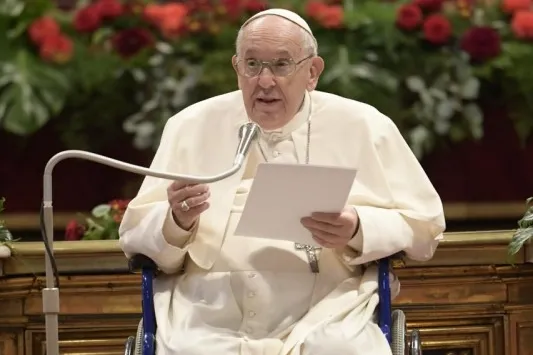
 Pope Francis delivered his homily from a wheelchair in front of the main altar of St. Peter’s Basilica on June 5, 2022. / Vatican Media
Vatican City, Jun 5, 2022 / 05:30 am (CNA).
Here is the full text of Pope Francis’ homily for the Solemnity of Pentecost 2022, which was celebrated in St. Peter’s Basilica on June 5, 2022.
In the final words of the Gospel we have just heard, Jesus says something that can offer us hope and make us think. He tells his disciples: “The Holy Spirit, whom the Father will send in my name, will teach you everything, and remind you of all I have said to you (Jn 14:26). “Everything,” “all” – these words are striking; they make us wonder: how does the Spirit give this new and full understanding to those who receive him? It is not about quantity, or an academic question: God does not want to make us encyclopedias or polymaths. No. It is a question of quality, perspective, perception. The Spirit makes us see everything in a new way, with the eyes of Jesus. I would put it this way: in the great journey of life, the Spirit teaches us where to begin, what paths to take, and how to walk.
First, where to begin. The Spirit points out to us the starting point of the spiritual life. What is it? Jesus speaks of it in the first verse of the Gospel, when he says: “If you love me, you will keep my commandments” (v. 15). If you love me, you will keep … this is the “logic” of the Spirit. We tend to think the exact opposite: if we keep the commandments, we will love Jesus. We tend to think that love comes from our keeping, our fidelity and our devotion. Yet the Spirit reminds us that without love as our basis, all the rest is in vain. And that love comes not so much from our abilities, but as his gift. He teaches us to love and we have to ask for this gift. The Spirit of love pours love into our hearts, he makes us feel loved and he teaches us how to love. He is the “motor” of our spiritual lives. He set it in motion within us. But if we do not begin from the Spirit, or with the Spirit or through the Spirit, we will get nowhere.
The Spirit himself reminds us of this, because he is the memory of God, the one who brings to our minds all that Jesus has said (cf. v. 26). The Holy Spirit is an active memory; he constantly rekindles the love of God in our hearts. We have experienced his presence in the forgiveness of our sins, in moments when we are filled with his peace, his freedom and his consolation. It is essential to cherish this spiritual memory. We always remember the things that go wrong; we listen to the voice within us that reminds us of our failures and failings, the voice that keeps saying: “Look, yet another failure, yet another disappointment. You will never succeed; you cannot do it.” This is a terrible thing to be told. Yet the Holy Spirit tells us something completely different. He reminds us: “Have you fallen? You are a son or daughter of God. You are a unique, elect, precious and beloved child. Even when you lose confidence in yourself, God has confidence in you!” This is the “memory” of the Spirit, what the Spirit constantly reminds us: God knows you. You may forget about God, but he does not forget about you. He remembers you always.
You, however, may well object: these are nice words, but I have problems, hurts and worries that cannot be removed by facile words of comfort! Yet that is precisely where the Holy Spirit asks you to let him in. Because he, the Consoler, is the Spirit of healing, of resurrection, who can transform the hurts burning within you. He teaches us not to harbor the memory of all those people and situations that have hurt us, but to let him purify those memories by his presence. That is what he did with the apostles and their failures. They had deserted Jesus before the Passion; Peter had denied him; Paul had persecuted Christians. We too think of our own mistakes. How many of them, and so much guilt! Left to themselves, they had no way out. Left to themselves, no. But with the Comforter, yes. Because the Spirit heals memories. How? By putting at the top of the list the thing that really matters: the memory of God’s love, his loving gaze. In this way, he sets our lives in order. He teaches us to accept one another, to forgive one another and to forgive ourselves; he teaches us to be reconciled with the past. And to set out anew.
In addition to reminding us where to begin, the Spirit teaches us what paths to take. We see this in the second reading, where Saint Paul explains that those “led by the Spirit of God” (Rom 8:14) “walk not according to the flesh but according to the Spirit” (v. 4). The Spirit, at every crossroads in our lives, suggests to us the best path to follow. It is important, then, to be able to distinguish his voice from the voice of the spirit of evil. Both speak to us: we need to learn to distinguish the voice of the Spirit, to be able to recognize that voice and follow its lead, to follow the things he tells us.
Let us consider some examples. The Holy Spirit will never tell you that on your journey everything is going just fine. He will never tell you this, because it isn’t true. No, he corrects you; he makes you weep for your sins; he pushes you to change, to fight against your lies and deceptions, even when that calls for hard work, interior struggle and sacrifice. Whereas the evil spirit, on the contrary, pushes you to always do what you want, what you find pleasing. He makes you think that you have the right to use your freedom any way you want. Then, once you are left feeling empty inside – it is bad, this feeling of emptiness inside, many of us have felt it – and when you are left feeling empty inside, he blames you and casts you down. He blames you, becomes the accuser. He throws you down, destroys you. The Holy Spirit, correcting you along the way, never leaves you lying on the ground, never. He takes you by the hand, comforts you and constantly encourages you.
Then again, whenever you feel troubled by bitterness, pessimism and negativity – how many times have we fallen into this! – then it is good to remember that these things never come from the Holy Spirit. Bitterness, pessimism, sad thoughts, these never come from the Holy Spirit. They come from evil, which is at home with negativity. It often uses this strategy: it stokes impatience and self-pity, and with self-pity the need to blame others for all our problems. It makes us edgy, suspicious, and querulous. Complaining is the language of the evil spirit; he wants to make you complain, to be gloomy, to put on a funeral face. The Holy Spirit on the other hand urges us never to lose heart and always to start over again. He always encourages you to get up. He takes you by the hand and says: “Get up!” How do we do that? By jumping right in, without waiting for someone else. And by spreading hope and joy, not complaints; never envying others, never — envy is the door through which the evil spirit enters. The Bible tells us this: by the envy of the devil, evil entered the world. So never be envious! — but the Holy Spirit brings you goodness; he leads you to rejoice in the success of others.
The Holy Spirit is practical, he is not an idealist. He wants us to concentrate on the here and now, because the time and place in which we find ourselves are themselves grace-filled. These are concrete times and places of grace, here and now. That is where the Holy Spirit is leading us. The spirit of evil, however, would pull us away from the here and now, and put us somewhere else. Often he anchors us to the past: to our regrets, our nostalgia, our disappointments. Or else he points us to the future, fueling our fears, illusions and false hopes. But not the Holy Spirit. The Spirit leads us to love, concretely, here and now, not an ideal world or an ideal Church, an ideal religious congregation, but the real ones, as they are, seen in broad light of day, with transparency and simplicity. How very different from the evil one, who foments gossip and idle chatter. Idle chatter is a nasty habit; it destroys a person’s identity.
The Holy Spirit wants us to be together; he makes us Church and today – here is the third and final aspect – he teaches the Church how to walk. The disciples were cowering in the Upper Room; the Spirit then came down and made them go forth. Without the Spirit, they were alone, by themselves, huddled together. With the Spirit, they were open to all. In every age, the Spirit overturns our preconceived notions and opens us to his newness. God, the Spirit, is always new! He constantly teaches the Church the vital importance of going forth, impelled to proclaim the Gospel. The importance of our being, not a secure sheepfold, but an open pasture where all can graze on God’s beauty. He teaches us to be an open house without walls of division. The worldly spirit drives us to concentrate on our own problems and interests, on our need to appear relevant, on our strenuous defense of the nation or group to which we belong. That is not the way of the Holy Spirit. He invites us to forget ourselves and to open our hearts to all. In that way, he makes the Church grow young. We need to remember this: the Spirit rejuvenates the Church. Not us and our efforts to dress her up a bit. For the Church cannot be “programmed” and every effort at “modernization” is not enough. The Spirit liberates us from obsession with emergencies. He beckons us to walk his paths, ever ancient and ever new, the paths of witness, poverty and mission, and in this way, he sets us free from ourselves and sends us forth into the world.
And finally, oddly, the Holy Spirit is the author of division, of ruckus, of a certain disorder. Think of the morning of Pentecost: he is the author… he creates division of languages and attitudes… it was a ruckus, that! Yet at the same time, he is the author of harmony. He divides with the variety of charisms, but it is a false division, because true division is part of harmony. He creates division with charisms and he creates harmony with all this division. This is the richness of the Church.
Brothers and sisters, let us sit at the school of the Holy Spirit, so that he can teach us all things. Let us invoke him each day, so that he can remind us to make God’s gaze upon us our starting point, to make decisions by listening to his voice, and to journey together as Church, docile to him and open to the world. Amen.
[…]




All well and good, the need to recognize: “…the interconnectedness of the world and the ways in which many of the actions of humans are harming the planet.” The sometimes-lost distinction (as retained in Centesimus Annus, nn. 37-40) between the “human ecology” and the “natural ecology” under Laudato Si’s useful-but-blurring neologism of an “integral ecology.”
Three interconnected (!) points:
FIRST, the key thesis of ecological urgency lies in “tipping points” and in “feedback loops.” An example of the latter is the way atmospheric warming in the Arctic leads to melting of the permafrost and the much more massive addition of methane into the atmosphere from the release of millions of years of frozen organics, and evidenced in the appearance on the tundra of massive sinkholes.
SECOND, Catholic universities should also attend to the tipping points and feedback loops within the distinct (but interrelated) human ecology. What is the connection, for example, between ambiguous signaling about both Humanae Vitae, and the indissolubility of marriage (Amoris Laetitia) and, say, the multiplication of the LGBTQ demographic (a demographic which, by its nature, does not reproduce physically, plus the connected and broader gender theory (“ideological colonization”), plus the erosion of Mystical Body of Christ in der Synodale Weg, with allied ideological sinkholes within Synodality itself? The knee-jerk Land O’Lakes Declaration, too, has certainly spawned tipping points and feedback loops. But who am I to judge?
THIRD, so, how to accomplish Cardinal Czerny’s goals not only under ecological alliances, but also and firstly under ex Cordia Ecclesia–which had something unblurred to say about the core integrity and transcendent dignity of the “integral (!) human person”? From the introduction: “…what is at stake is the very meaning of the human person” (italics in the original).
A online tree hugging course, elucidated by Papa! A cultural Marxist will also offer perspective! Papa likes to add his voice to the politically correct!
I love Nature and do my best to provide a little bit of habitat for wildlife on my property. But I find it strange that sometimes the people who endorse ecological practices the most ignore human ecology. To respect Creation is also to respect how we are created: male and female.
Even my cows have gender figured out. I’m not sure why it’s so difficult for us.
Young minds come to receive good all round formation. Toiling tax payers keep funding their institutions. Accountability, transparency, dialogue, and integrity still have their place in quality education.
Take a well deserved bow!
Following a little Wikipedia research on his background, it seems
(https://en.wikipedia.org/wiki/Michael_Czerny) Cardinal Michael Czervy is from Canada. Canada promotes fake science under environmentalism as a program for global governance on behalf of the German family of Royals residing in Britain and the WEF. The Paris Accord operation was run out of Canada by then Minister of the Environment Katherine McKenna aka the Climate Barbie. McKenna was little more than a bully with a mandate to coerce nations into signing onto the Paris Accord. Canada sent a disproportionate team to Paris in 2014 to accomplish this end … I think some 193ish nations signed on. So, one can know that Cardinal Czerny derives out of a cultural environment that is pretty superficial and corrupt to it’s very core. With all due respect to his Office, Cardinal Czerny himself seems to be a man with a whole lot of different hats and attitude. Why Pope Francis would select him as Cardinal within a day of being appointed Bishop is one of those scratch one’s head moments. As an aside, I question Cardinal Czerny’s role in the Pachamama incident with the Amazon synod at the Vatican – the timing of his appointment is too convenient not to have been a part of this scandal … also, Cardinal Czerny’s role in Canada when Pope Francis and fellow Cardinals were confronted with participating in pagan rituals with indigenous peoples who were brainwashed into believing, without any evidence whatsoever, the Church was somehow involved in abusing and disappearing their children. Again, could it be Cardinal Czerny may have encouraged Pope Francis to make an apology based on unsubstantiated claims in the interest of cultural syncretism under his banner of accompaniment? I submit an intelligence link to Episodes of Crime Scene Investigations … more specifically, check out Episode 22 (after the 14 min mark it speaks of this). https://awarriorcalls.com/ai-dominion-games/