The Trappist Sisters of Nicaragua announced Feb. 27, 2023, that they are leaving Nicaragua for Panama. / Credit: Facebook Trappist Sisters of Nicaragua
ACI Prensa Staff, Mar 1, 2023 / 15:30 pm (CNA).
The Trappist Sisters of Nicaragua, whose religious order arrived from Argentina in 2001, announced that they have left the Central American country after 22 years of work and service.
In a Feb. 27 post on their Facebook page, the nuns explained: “We, the Trappist Sisters of Nicaragua, have voluntarily left the country” and said they made the decision because of “reasons the order has,” the “lack of vocations,” and the “old age of several sisters, etc.”
“We will always remain united in prayer, in friendship, and in the love that the Lord has given us during these 22 years,” they added, announcing their “new destination is Panama.”
The first Trappist sisters arrived in Nicaragua in January 2001 from the town of Hinojo in Argentina and founded the Holy Mary of Peace monastery in the Chontales district of the country.
In recent days, the nuns handed over the monastery to the Diocese of Juigalpa, which has not yet made a statement on the transfer.
Although the nuns didn’t mention anything in their communiqué about their residency status in Nicaragua, the General Directorate for Migration and Foreigners has issued summons to various religious and foreign missionaries in the last two weeks.
According to the Nicaraguan media outlet 100% Noticias, new requirements are being demanded of these religious to remain in the country.
The departure of the Trappist nuns was announced a few days after the dictatorship of Daniel Ortega, in a new attack against the Catholic Church in Nicaragua, prohibited praying the Stations of the Cross in the streets.
This story was first published by ACI Prensa, CNA’s Spanish-language news partner. It has been translated and adapted by CNA.
If you value the news and views Catholic World Report provides, please consider donating to support our efforts. Your contribution will help us continue to make CWR available to all readers worldwide for free, without a subscription. Thank you for your generosity!
Click here for more information on donating to CWR. Click here to sign up for our newsletter.
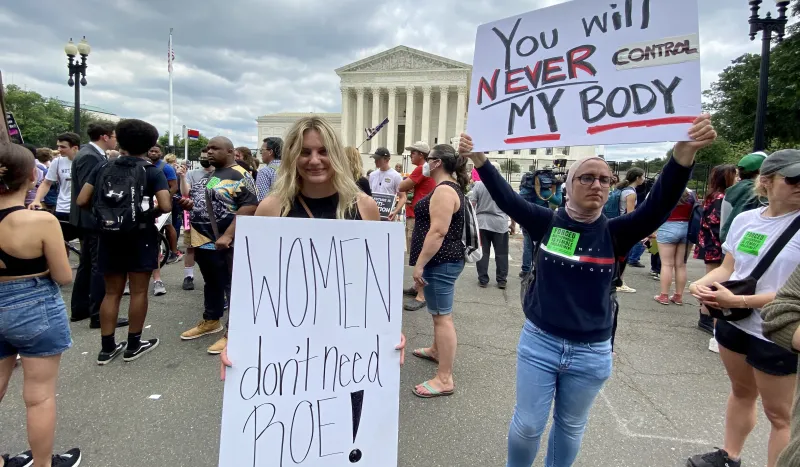
Anna Lulis from Moneta, Virginia, (left) who works for the pro-life group Students for Life of America, stands beside an abortion rights demonstrator outside the U.S. Supreme Court in Washington, D.C., on June 24, 2022, after the court’s decision in the Dobbs abortion case was announced. / Katie Yoder/CNA
Washington, D.C. Newsroom, Oct 5, 2022 / 13:31 pm (CNA).
U.S. Catholic voters are split on the Supreme Court’s decision to overturn Roe v. Wade, but a majority agrees that abortion should be restricted and that there should be at least some protections for the unborn child in the womb, according to a new EWTN News/RealClear Opinion Research poll.
The court’s June 24 ruling in the Mississippi abortion case Dobbs v. Jackson Women’s Health Organization upended 49 years of nationwide legalized abortion and freed states to regulate abortion as they see fit.
When asked whether they agreed or disagreed with Roe being overturned, 46.2% agreed, 47.8% disagreed, and 6% said they weren’t sure.
Catholic voters were similarly split on whether they are more or less likely to support a candidate who agrees with Roe’s dismantling: 42% said they were more likely, 41.9% said they were less likely, and 16.1% were unsure.
At the same time, the poll results point to apparent inconsistencies in Catholic voters’ positions on abortion.
While nearly half of Catholic voters in the poll said they disagreed with Roe being overturned, a large majority (86.5%) said they support some kind of limit on abortion, even though Roe and related abortion cases allowed only narrow regulation at the state level. The breakdown is as follows:
26.8% said abortion should be allowed only in cases of rape, incest, or to save the life of the mother;
19.8% said abortion should be allowed until 15 weeks when the baby can feel pain;
13.1% said that abortion should be allowed only during the first six months of pregnancy;
9.9% said that abortion should be allowed only until a heartbeat can be detected, and
9.1% said that abortion should be allowed only to save the life of the mother.
Of special note for Catholic pro-life leaders, only a small minority of Catholic voters — 7.8% — were aligned with the clear and consistent teaching of the Catholic Church that abortion should never be allowed.
On the other end of the spectrum of abortion views, 13.4% of Catholic voters said that abortion should be available to a woman at any time during her pregnancy.
The poll, conducted by the Trafalgar Group from Sept. 12–19, surveyed 1,581 Catholic voters and has a margin of error of 2.5%. The questionnaire was administered using a mix of six different methods, including phone calls, text messages, and email.
The poll’s results echo surveys of the general U.S. population on abortion. A Pew Research Center survey from March found that 19% of U.S. adults say abortion should be legal in all cases, while 8% said it should be illegal in all cases. More recent Gallup data from May found that 35% of U.S. adults say abortion should be legal under any circumstances while 13% said it should be illegal in all circumstances.
The Pew Research Center data also looked at Catholic adults. Thirteen percent said abortion should be legal in all cases, while 10% said it should be illegal in all cases.
A previous EWTN News/RealClear Opinion Research poll released in July found that 9% of Catholic likely voters said abortion should never be permitted and 18% said that abortion should be available at any time. The poll similarly showed that a majority of Catholic voters (82%) support some kind of restriction on abortion.
Confused about what Roe said?
The poll’s results came as little surprise to Catholic pro-life public policy experts such as Elizabeth R. Kirk.
“This study confirms a phenomenon we have known for some time, i.e., that there is an enormous disconnect between the scope of abortion practices permitted by the Roe regime and what abortion practices Americans actually support,” Kirk, director of the Center for Law and the Human Person at The Catholic University of America, told CNA.
Kirk, who also serves as a faculty fellow for the Institute for Human Ecology and research associate and lecturer at the Columbus School of Law, noted the finding that nearly 42% of Catholic voters said they are less likely to support a candidate who agrees with Roe being overturned.
“At first glance that suggests that many Catholic voters wanted to keep Roe in place,” she said. “Yet, the study also reveals that 86.5% of Catholic voters want some type of restriction on abortion access.”
Why the inconsistency? “Most people do not realize that Roe allowed states to permit unlimited abortion access throughout the entire pregnancy and made it difficult, or even impossible, to enact commonsense restrictions supported by the majority of Americans,” Kirk observed.
“Many people who ‘support Roe’ actually disagree, unknowingly, with what it permitted,” she added. “All Dobbs has done is return abortion policy to the legislative process so that the people may enact laws which reflect the public consensus.”
Mass-goers more strongly pro-life
The new poll, the second of three surveys of Catholic voters tied to the midterm elections on Nov. 8, shows that the opinions of Catholic voters on abortion and other issues vary depending on how often respondents attend Mass.
Only a small portion of those who attend Mass at least once a week said that abortion should be allowed at any time: 0% of those who attend Mass daily, 1% who attend more than once a week, and 8% of those who attend weekly support abortion without restrictions. In contrast, 57.5% of Catholic voters who attend Mass daily, 21.5% of those who attend more than once a week, and 15.6% of those who attend weekly say abortion should never be permitted.
In addition to respondents’ apparent confusion about what Roe stipulated, the poll suggests that many Catholic voters don’t fully understand what their Church teaches about abortion.
Less than one-third of Catholic voters who said they accept all Church teachings (31.1%) said that abortion should never be permitted, and 5% who profess to fully accept the Church’s teachings said abortion should be permitted at any time.
Overall, 32.8% of respondents reported attending Mass at least once a week, with another 30.7% attending once a year or less. Only 15% agreed that they accept all of the Church’s teachings and live their lives accordingly, with another 34.5% saying they generally accept most of the Church’s teachings and try to live accordingly.
Pew Research Center also looked at how Mass attendance factors into Catholics’ views on abortion. Among those who attend Mass at least once a week: 4% said abortion should be legal in all cases, and 24% said it should be illegal in all cases, Pew found.
Strong support for pregnancy centers
The poll asked Catholic voters about a variety of other topics including abortion limits, Holy Communion for pro-abortion politicians, conscience protections for health care workers, and pro-life pregnancy centers.
EWTN
Among the findings:
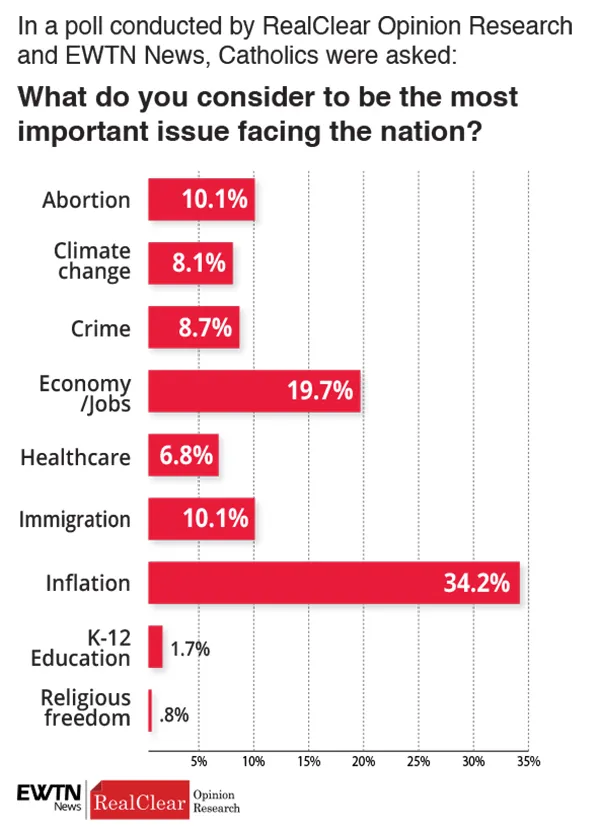
Catholic voters are prioritizing other issues above abortion. Only 10.1% of Catholic voters identified abortion as the most important issue facing the nation, falling behind inflation (34.2%) and the economy/jobs (19.7%) and tying with immigration. At the same time, a higher percentage of Catholic voters chose abortion than crime (8.7%), climate change (8.1% ), health care (6.8%), K–12 education (1.7%), or religious freedom (0.8%).
About half of Catholic voters (49.3%) disagreed that Catholic political leaders who support abortion publicly and promote policies that increase abortion access should refrain from taking Communion, while 36.7% said they should refrain.
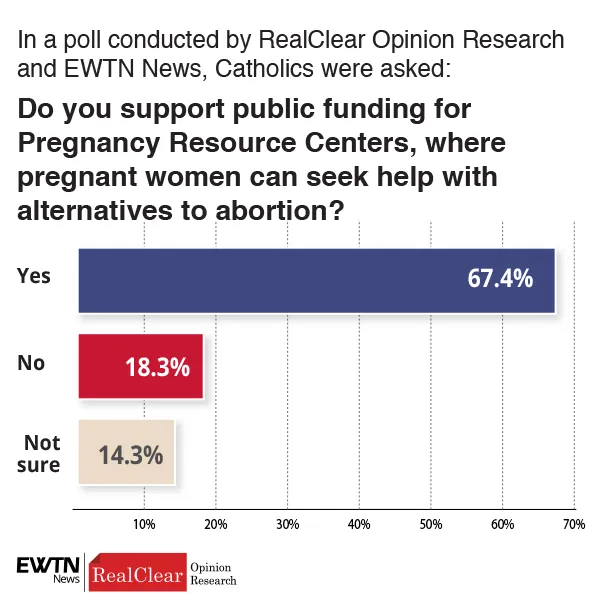
A majority (67.4%) of Catholic voters said they support public funding for pro-life pregnancy centers that offer pregnant women life-affirming alternatives to abortion, while 18.3% said they did not favor using tax dollars for this purpose.
A comparable majority (61.8%) said that political and church leaders should be speaking out against the recent attacks and acts of vandalism on pregnancy resource centers.
When asked about conscience protections for health care workers that would allow them to opt out of providing “services” such as abortion, a majority of Catholic voters (60.7%) said that health care workers should not be obligated to engage in procedures that they object to based on moral or religious grounds. Conversely, 25.3% said that health care workers should be obligated to engage in procedures that they object to based on moral or religious grounds.
Work to be done
What is the takeaway from the latest poll, where abortion is concerned?
“This polling shows that Catholics, like the overwhelming majority of Americans, support commonsense protections for women and the unborn,” Ashley McGuire, a senior fellow with The Catholic Association, told CNA.
“It also affirms other recent polling that found Americans by strong numbers support the work of pregnancy resource centers in providing women facing crisis pregnancies with a real choice and the chance to thrive as mothers despite difficult circumstances,” she noted.
EWTN
At the same time, McGuire added, “This new polling is also a reminder that more work needs to be done in catechizing Catholics on foundational Church teaching in support of vulnerable life in all stages — an effort that is continually undermined by Catholic politicians in the highest echelons of power who use their platforms to advocate for extreme abortion policies in direct violation of Church teaching.”
Nearly all of those surveyed (99.2%) said they plan to vote in the midterm elections on Nov. 8.
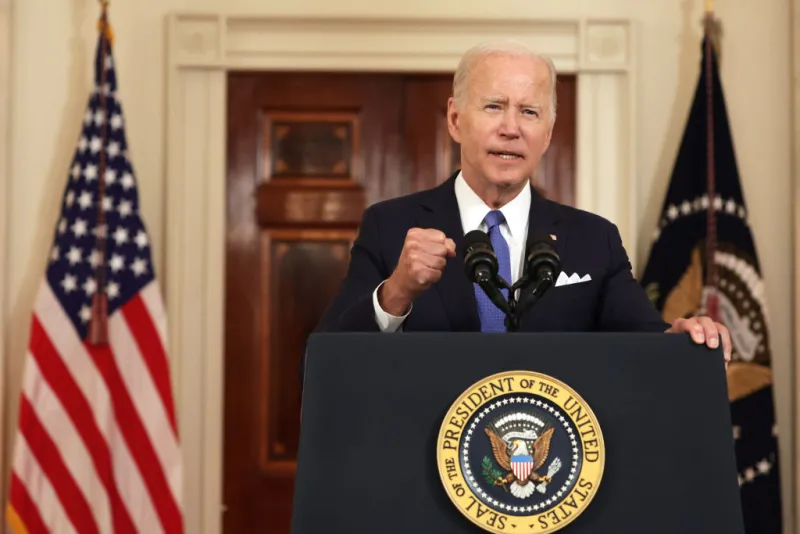
U.S. President Joe Biden addresses the Supreme Court’s decision on Dobbs v. Jackson Women’s Health Organization to overturn Roe v. Wade June 24, 2022 in Cross Hall at the White House in Washington, DC. / Alex Wong/Getty Images
Denver Newsroom, Jun 24, 2022 / 13:55 pm (CNA).
In a Friday press conference, U.S. President Joe Biden called on Congress to codify abortion access into federal law, following the Supreme Court’s overturning of Roe v. Wade that morning. The court’s decision returned the question of abortion policy to the states, which Biden labeled a “tragic error.”
He also said he had that day directed the Department of Health and Human Services to make abortion pills more widely available, and that he would do “everything in my power” to protect women traveling to obtain abortions.
“It’s a sad day for the court and for the country,” Biden, the nation’s second Catholic president, said June 24.
Calling abortion an “intensely personal decision,” Biden went on to lament that the decision had taken away women’s “right to choose” and the “power to control their own destiny.” He claimed that with Roe gone, the “life and health” of women in the United States is now “at risk.”
Biden has repeatedly expressed support for Roe v. Wade — which legalized abortion nationwide in 1973 — despite the teaching of his Catholic faith that abortion is a “grave evil.”
“I believe Roe v. Wade was the correct decision,” Biden stated, claiming that Roe represented a “broad national consensus” relating to the “fundamental right to privacy” that “most Americans of faith…found acceptable.”
This is despite evidence suggesting that more than 60% of all Americans disagreed with the central holding of Roe v. Wade, according to a January Knights of Columbus/Marist Poll survey.
“This decision is the culmination of a deliberate effort over decades to upset the balance of our law,” Biden continued, claiming that “the court has done what it has never done before, expressly take away a constitutional right that is so fundamental to so many Americans and had already been recognized. The court’s decision to do so will have real and immediate consequences.”
“It’s a realization of an extreme ideology and a tragic error by the Supreme Court, in my view.”
The only way to “secure a women’s right to choose,” Biden said, is for Congress to restore Roe as federal law, adding that “executive action can’t do that.” He urged the election of pro-choice legislators in the fall midterm elections.
Biden stated that he intends to provide aid to women living in pro-life states who want to travel to pro-abortion states. “If any state or local official, high or low, tries to interfere with a woman’s exercising her basic right to travel, I will do everything in my power to fight that deeply un-American attack,” Biden said.
The president also said he had directed the Department of Health and Human Services to “take steps” to ensure that mifepristone, the first drug in medical abortion regimen, is “available to the fullest extent possible.” Abortion supporters have pointed to medical abortions — which have been linked to numerous health risks — as a kind of workaround or backup plan for women to access abortion as states restrict abortion. According to the U.S. Centers for Disease Control’s most recent Abortion Surveillance report, for the year 2019, “early medical abortions” made up 42.3% of abortions that year.
“I call on everyone no matter how deeply they care about this decision to keep all protests peaceful. Peaceful. Peaceful. Peaceful. No intimidation. Violence is never acceptable. Threats and intimidation are not speech. We must stand against violence in any form regardless of your rationale,” Biden said Friday.
Biden concluded by claiming that the decision to overturn Roe had “made the United States an outlier among developed nations in the world,” despite the fact that the U.S. was previously one of only a handful of countries — including China and North Korea — that permitted elective abortions after 20 weeks’ gestation. Fourty-seven out of 50 European countries, independent states, and regions analyzed in 2014 either do not allow elective abortion or limit elective abortion to 15 weeks or earlier.
Bishop Georg Bätzing of Limburg. / Bistum Limburg.
Munich, Germany, Mar 4, 2022 / 11:30 am (CNA).
The chairman of the German Catholic bishops’ conference has called for changes to Church teaching on sex outside of marriage and homosexuality. In… […]






Leave a Reply