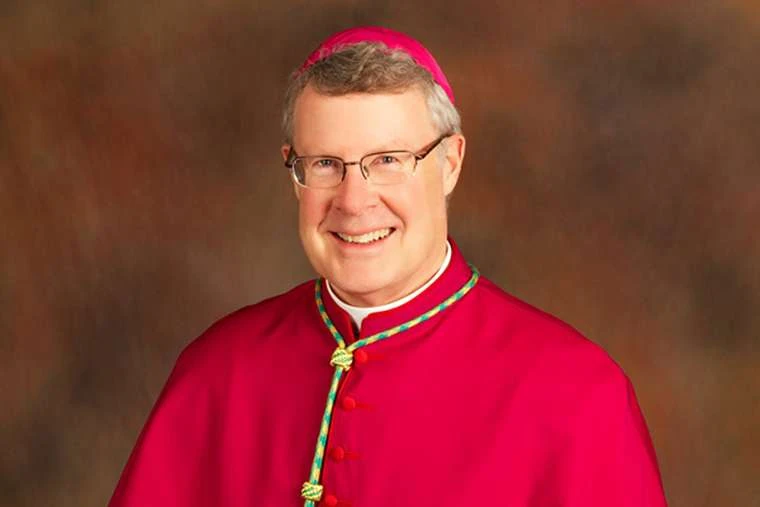
Sioux City, Iowa, Nov 6, 2018 / 01:54 pm (CNA).- A New Mexico man says that an Iowa diocese neglected to tell him about the extent of abuse committed by a priest living in his home. Leaders in the diocese told CNA they tried to warn the man about the priest’s past, and that current leaders have attempted to do everything possible to manage the priest’s situation, within the confines of canon law.
Fr. Jerry Coyle is a priest of Sioux City, Iowa, but he has lived in New Mexico for 32 years. He moved to the state in 1986, to take part in a treatment program at a facility for priests run by the Servants of the Paraclete. He was sent there after telling Bishop Lawrence Soens that over 20 years of priesthood he had abused about 50 male adolescents.
Coyle was removed from ministry and his faculties were revoked after that admission; he was not dismissed from the clerical state.
After Coyle’s time with the Paracletes was completed, he remained in New Mexico. There, more than 10 years ago, he befriended Reuben Ortiz.
Ortiz is a pious and practicing Catholic: he and his family do pro-life ministry, go to homeless shelters, feed the poor, pray the rosary frequently, and even performed music at a World Youth Day. Until recently, Ortiz was a daily Mass-goer.
When Coyle got into a car accident last year, Ortiz invited the priest to move into his Albuquerque home, to live with him, his wife, and his three teenaged children. Coyle lived with the family until June 29.
In a recent Associated Press report, Ortiz’ attorney said that the diocese did not disclose important information about the priest until he was already living in the Ortiz family home. The diocese, however, told CNA that it repeatedly discouraged the Ortiz family from taking in the priest.
Ortiz acknowledged that when he invited Coyle, 85, to live in his home, he already knew that the priest had committed an act of sexual abuse.
“He had told us that he had fondled a kid, and that, it wasn’t, you know, that he knew, he went through treatment for it, and he, he was ok,” Ortiz told CNA.
Ortiz said that even though he knew the priest had sexually assaulted a minor, he wasn’t nervous about his own children.
“No, because he was very secure about the fact that he was wrong about it. And he was also very secure that he wasn’t ever going to do it again,” Ortiz said.
“Because we asked him right out, ‘Well Jerry, what does that mean for our kids?’ And he said, ‘No, no, no, that was wrong, that’s the reason why I’m not doing [active ministry] anymore, I’m not going and serving at Mass; they didn’t take away my priesthood, I’m good that way.’”
“He really, he did have a certain way about him that looked like it was okay. But for him to go and deceive us from the very beginning was already wrong,” Ortiz added.
‘Redemption and forgiveness’
In November 2017, shortly after Coyle got in a car accident and had his license revoked, Ortiz phoned Bishop Walker Nickless of Sioux City, to let the bishop know about Coyle’s accident, and to inform him that the priest had come to live with the Ortiz family.
“Reuben Ortiz called me after Jerry had his automobile accident, and wanted me to know he couldn’t drive any more, and he needed a place to live because he couldn’t take care of himself, and he wanted to take him into his own home, because they were good friends and he wanted to help Jerry recover from the accident, and he told me he can stay here as long as he wants,” Bishop Nickless recounted to CNA.
“I said to him, ‘Reuben, do you know his history?’ And he said, ‘Yes. Father and I have talked about it; I know that he has abused minors in the past, and I believe in redemption and forgiveness.’”
Nickless said the diocese told Ortiz that because his minor children lived at home, “we think … that is not a good place for Jerry to be, and we’d like him to move.”
“He clearly said he wanted to keep Jerry living with him. We asked him to at least inform his children of Jerry’s history – he said he hadn’t done that – and he said, ‘I’m not going to do that to my children.’”
The problem of where Coyle was to live was taken to the diocesan review board. The review board met Feb. 5, 2018, to discuss Coyle’s living situation, and suggested that he go to a nursing home in New Mexico.
“They immediately recommended that he leave the house,” Nickless said. “I told Reuben that.”
The Diocese of Sioux City encouraged Ortiz to look for a nursing home for Coyle in the Albuquerque area.
“He refused to do that,” Nickless explained. “He kept saying, ‘No, no, I want him here, I want him here, I want him here.’”
On Feb. 8, Fr. Brad Pelzel, vicar general of the Sioux City diocese, spoke with Reuben and his wife, Tania, on the phone, relating what the review board had decided.
At the request of the review board, Pelzel also wrote to Reuben and Tania Feb. 12, following up on their phone conversation. Pelzel’s letter urged that Coyle move to a nursing home. It was thought that one in New Mexico would be most appropriate, because the priest had lived there for so long.
The letter said that the review board was seriously concerned about “Coyle’s self-revealed history of sexual attraction to and contact with boys.”
“When he self-reported his situation … Fr. Coyle admitted that, for a period of about 20 years, he victimized approximately 50 school boys, varying from 7th to 10th grade,” Pelzel wrote.
“The Review Board is grateful to you and your family for your kindness and the Christ-like attention and care you have provided Fr. Coyle, most notably your willingness to welcome him into your home following his traffic accident,” Pelzel wrote.
“While acknowledging the grace of Fr. Coyle’s repentance and the 30-plus years of apparent success he has experienced in living out celibate chastity since moving to the Albuquerque area, the Review Board cannot condone the risk you take by allowing Fr. Coyle to reside in your home and recommends in the strongest of terms that the best form of assistance you can provide Fr. Coyle would be to help him find an institution with Assisted Living facilities.”
Ortiz said that it was shocking to see the letter that said Coyle admitted to abusing 50 adolescents. While he was comfortable with having Coyle around his family when he believed the priest had abused one or two adolescents, he felt he had been misled.
“You know the shock that was, what we took on? It traumatized us to see these pages of who this guy was. It shocked us to such a degree that I didn’t want to let my wife know how scared I was.”
He related that he slept downstairs near Coyle, while the rest of his family was upstairs, from the time they received the Feb. 12 letter until Coyle left in June.
Ortiz told CNA fears that Coyle could have abused his son, who is 15.
Financial matters
Although Ortiz chose not to help Coyle find a nursing home, he did accept money from his boarder. Ortiz told CNA he asked the priest for financial contributions to the family home.
According to Nickless, Coyle gave Ortiz almost $30,000 during the eight months he lived in the family home.
Nickless said that Ortiz first told Coyle he needed to buy a larger car to take him to Mass; his family and Coyle could not all fit into their existing vehicle.
Coyle gave Ortiz $25,000 to buy a new car, Nickless told CNA.
A few weeks later, Ortiz said he needed some more money to handle some expenses.
Coyle gave Ortiz another $2,000, Nickless said.
Later, Ortiz said he needed an additional $3,000, “at which point Jerry balked,” Pelzel told CNA.
“Then Reuben demanded that Jerry give him power of attorney and access to his saving and checking account,” according to Pelzel.
“So then Jerry called us and said, ‘This is strange, I think I’m coming back’,” Nickless said.
Asked how much money the priest had given him, Ortiz declined to answer.
“Let me ask you something, okay? What do you, how do you think money has anything to do with this? How does money come into play? I curse the day I ever met him and if I could take back every time that we met, and everything that was spent, both ways, I would do it, gladly, just to avoid that one meeting with him,” Ortiz told CNA.
After Coyle decided to leave, the diocese began making arrangements for Coyle to return to Iowa. Within five days, on June 29, Coyle left the Ortiz’ home.
Month after Coyle left his home, lawyers representing Ortiz told diocesan officials and reporters that the Diocese of Sioux City was guilty of a cover-up.
Ortiz agreed.
“You know what it’s like when you go to your Church officials and they do absolutely nothing for you?” He asked. “They are totally bankrupt when it comes to morals.”
While Nickless told CNA that he tried to explain to Ortiz the allegations against Coyle from the beginning, Ortiz disagreed.
“They’re accepting sin, in such a way that it’s ok, and so they are shameless in this sin to such a point that they think we are going to agree with a letter of that magnitude. See, they told me that; they had gone and said that he had abused; I said he told us he abused a couple kids, we don’t know the extent. But they said, well you know, they didn’t really make it quite clear until the letter … do you know how scary it is to have somebody like this in your home?”
Although he acknowledged inviting Coyle into his home, Ortiz maintains he was used.
“I was used, as far as I’m concerned. I was used for the purpose of people who released this into our society as a plague, and it upsets me, it does. I don’t think I’m ever going to recover from it.”
Ortiz also said that his spiritual director, whom he described as “no slouch in the priesthood” also failed him, because he did not sufficiently warn him not to allow an admitted perpetrator of sexual assault into his home.
Homecoming
When Coyle returned to Iowa, he was placed at Marian Home, a diocesan retirement home in Fort Dodge.
While the board of directors at Marian Home wasn’t notified of Coyle’s past, several staff members at the residence were.
Pelzel says he told the activities director “explicitly what Jerry was accused of, and she promised to be vigilant.”
Marian Home is located across the street from both St. Edmond Catholic School and Fort Dodge Senior High. Students at St. Edmond’s sometimes visit Marian Home, but they did not have contact with Coyle as they do not go to the area in which he lived.
The schools were not informed when Coyle moved to the residence; “it did not occur to us that the school was there at that time,” Nickless said, acknowledging that “We made a mistake in not notifying the school … we should have done a better job of that.”
Coyle has since left Marian Home, and has been taken in by an acquaintance. Nickless said the priest is living “a life of prayer and penance.”
Nickless wrote a letter to the Sioux City diocese Oct. 31 discussing Coyle’s situation, noting that “No one presently at the diocese has firsthand knowledge about Jerry Coyle and that includes me. For the past few months, we have been attempting to put the pieces together about what happened during the 1980s with the files and records that we do have on Jerry Coyle.”
“During the ensuing 32 years, there were no complaints of any misbehavior by Jerry Coyle. Psychologists in Albuquerque advised the diocese that Coyle was highly motivated to change. We know that many disagree with this point, and so do I.”
The bishop wrote that police “were not contacted when Coyle self-admitted, but policies have changed since 1986. Now the policy is to contact civil authorities, which we will follow, since we have [now] named victims of Jerry Coyle.”
In a Nov. 6 statement, the diocese elaborated.
“The issue that is most important for the public to understand is that many of the allegations made in the past, prior to the 2002 ‘Charter for the Protection of Children and Young People’ were not followed up with an investigation by civil authorities. The Church often sent priests to treatment, in hopes that any actions of misconduct could be cured. We know now that is not the way to handle any allegation of sexual misconduct, and with the 2002 Charter to guide us, we have protocols in place to follow, which we do,” the statement said.
“As far as Jerry Coyle, he has had no criminal charges made against him. He self-admitted, and there was not one allegation until 1986, and this individual was an adult, so the statute of limitations had run out. We recognize that when Coyle self-admitted, each parish should have been notified, and we should have asked victims to come forward. We apologize that this did not happen under the leadership of the Diocese of Sioux City at that time.”
Nickless wrote to the diocese last month: “If you are a victim of Jerry Coyle or any priest or person associated with the Diocese of Sioux City, please come forward.” In recent weeks, several alleged victims of Coyle have come forward to the diocese.
But in 2002, when the diocese initially reviewed its records with local prosecutors, there were no identifiable victims of Coyle. Pelzel said that at that time, a student at a local university had made allegations against Coyle to another priest; but the allegation was anonymous and the diocese had no way to contact the alleged victim.
Another individual had said Coyle had acted “kind of weird” in the sacristy, but didn’t remember “anything else much.”
While Coyle was removed from ministry in 1986, he was not dismissed from the clerical state, and remains a priest of the Diocese of Sioux City. As such, the diocese is obliged under canon law to provide housing and board for him. The diocesan conduct review board is now discussing the possibility of pursuing a dismissal from the clerical state for Coyle.
However, “once a priest is elderly and frail and sick, as Fr. Coyle is, most of the time it’s recommended [by the Vatican] that he live a life of prayer and penance,” Nickless explained.
In fact, the Sioux City diocese attempted to have another elderly priest dismissed from the clerical state, but the Congregation for the Doctrine of the Faith refused, citing his advanced age.
The review board has also been discussing the preparation and release of a list of credibly accused clerics of the diocese, especially how to make sure that such a list would be accurate. The diocese has stated that a list of credibly accused priests will be published “as soon as we know we have all of the information we need to move forward.”
The Nov. 6 statement said that Coyle’s case raises important questions about how the Church addresses sexual abuse.
“Bishop Nickless inherited many issues from the past. These are the ones we are dealing with today. One of the most difficult issues is this: where do we put known alleged abuser priests that are still alive, but have no charges against them? What do we do with these men? We know that you do not want them in your community. Many care facilities will not, or cannot, take them. Their families sometimes will take them in, but not always. They cannot go to a prison, as civil authorities say that the statute of limitations has run out to prosecute them. This leaves us with very few choices. We understand that the many members of the public are anxious and fearful about sex offenders, because the crime is so egregious. However, if they are not charged and sent to prison, there are few options for housing them.”
“Local Bishops do not have the authority to ‘defrock’ a priest, properly known as laicization. Laicization is a complicated process that is handled by the Vatican; however, a Bishop can remove a priest’s ability to function as a priest, and this has been done. Additionally, once laicized, Diocesan officials lose all ability to supervise formerly accused clergy,” the statement added.
“The Diocese of Sioux City does follow the Charter’s guidelines for all claims of abuse in the present day. As we follow up on past cases, we want to do that in a way that helps victims to feel that have some peace and justice. We set up a meeting on December 6, 2018 with the Attorney General of Iowa to discuss matters further. A list of credibly accused priests will be published, as soon as we know we have all of the information we need to move forward.”
 […]
[…]






There is something else that is “only temporary and will expire after a certain amount of time”, this increasingly aggravating and cruel papacy.
We were told that TC was needed because the bishops of the world believed the TLM was causing problems in the church. Now we are told the same bishops are largely ignoring TC so the rescript was needed take away their rights. You expect this type of duplicity and skulduggery from politicians, not princes of the Church.
Not much “diversity” here: Four men who know what they are talking about (video: 59 min. 45 sec.)
The World Over February 23, 2023 | NEW RESTRICTIONS & BE AN ANGEL!
The article states:
“Pope Francis justified his initial restrictions [on the Latin Mass] by alleging that the celebration of the more ancient form of the Mass ‘is often characterized by a rejection not only of the liturgical reform, but of the Vatican Council II itself.’”
If this is actually the reason given for the crackdown on those attending Latin Masses, it’s extremely, incredibly, colossally stupid.
If the pope is upset that some people are critical of Vatican II, then, um, why not, say, try to better inform them of the council’s statements, concerns and actions?
How in heaven’s name does depriving them of the Latin Mass in any way alter their views of Vatican II?
I mean, come on. Seriously.
It’s like the Roman Curia is a brightly costumed comedy troupe specializing in slapstick.
The latin phrase ‘Traditionis Custodes’ has been newly translated – it now means “How to drive the faithful away from the celebration of the Mass that is approximately 18 centuries old”.
There is NO way ANY of this makes any sense.
It makes sense if one is as bitterly hostile to the TLM as Francis and his liturgical bureaucrats appear to be.
“It wasn’t the Holy Father taking the initiative,” Bishop Paprocki said, but rather an “initiative of Cardinal Roche.” This is another silly comment from a conservative bishop. Francis and Roche are of the same mind on this matter. Roche was chosen for his role precisely because the Pope knew he would enforce TC ruthlessly. As for Latin Mass Catholics being faithful, well, that is more of liability than an asset in Francis’ eyes.
Huh, this is apparently an emanation nor from either Roche or Francis but from Tony. Rather a presumptuous one at that.
There’s a cabal in Rome that hates Christ and hates those who follow Christ. How else can you explain the emanations of the Eternal City.
Unconscious atheism is synonymous with progressivism, essentially premised on the notion that we can improve upon the work of God. Presuming God to be an idiot child is to presume His nonexistence.
In the degraded language of the propaganda media in the secular world, Bergoglio’s tyrannical diktats would be accurately described as a “s**t show”. As Brineyman has posted above, they are indeed “extremely, incredibly, colossally stupid”. At what point does reality enter in so that a orthodox practicing Catholic finally asks himself: “How can the grotesque monster squating on the seat of St. Peter be anything other than an evil man, a horrible pope, and even perhaps an imposter and anti-pope?” Please, God, end this torturous charade now.
Liberalism seems to have taken over since Vat II. Maybe the Church should “circle back” to more of the old, conservative if not at least consistent, ways that worked, and saved souls – isn’t that why He came to earth in the first place?
Is it any wonder why some view Francis not as pope? He states he is not afraid of schism and by golly isn’t he the one pushing for it. JPII asked cardinals whether vcii did away or attempted to drum out the TLM and overwhelmingly the answer came back no! After +Benedict made it possible to advance the availability this one is tearing it down. Any wonder why the idea that he is not the pope is becoming more popular?
My wife and I attend the Novus Ordo English Mass at the Sacred Heart Church Bishop Paprocki mentions. Our experience is the same as what Bishop Paprocki said: we find those who attend the TLM very faithful and docile Catholic. In addition, many are young, married, and having children.
I would suggest that it is the generation of people in their eight or ninth decades that actually rejected what Vatican II said for a counterfeit version.
Absolutely. I have never seen as many young families at more ‘contemporary’ parishes as are routinely in attendance at more traditional parishes offering Tridentine Latin Masses, as well as parishes that offer Latin Novus Ordo, Anglican Rite, and English Novus Ordo (sometimes celebrated ad orientem) with incense, bells, etc.
Despite what some in the Vatican seem to think, the reality is this: The future of Catholicism is in traditionalism. Plain and simple. Everything else will literally die off because they have no foundation for the next generation – there are no parishioners between the ages of 14 and 40 at most contemporary parishes, and few families with small children.
And this, most of all, is what makes me sad to see the attacks on traditional mass-goers – trying to drive the last best hope of Western Catholicism away from the faith is counter-productive.
It’s actually a bit comical to observe that “praise” and “folk” bands that supposedly appeal to “young people” are so increasingly gray, balding and bepaunched.
Yup.
Some varieties of liturgical “music ministry” can be like stepping into a 1970’s time warp.
🙂
And I don’t travel extensively but I’ve heard the exact same 70’s selections at Masses in the UK & Mexico. Maybe it’s a copyright thing & the same dreadful hymnals have a global monopoly?
It’s very disappointing to be in Mexico City at a beautiful little church that holds the relics of Blessed Miguel Pro & hear the choir singing a praise & worship selection to the tune of Dylan’s “Blowing in the Wind.” There’s a time & place for everything I suppose but seriously…
Methinks the rejection of Humanae Vitae has much to do with the dwindling numbers of practicing Catholics, not Vatican II
Well, I think there’s more than one moving part, but secularization is an important piece of the puzzle.
Bp Paprocki is a wise and brave man, especially considering that his Metropolitan is Cupich. I wish there were more bishops like Paprocki here in the USA. Cdl Roche is neither wise nor brave, he is, actually an obsessive and cruel man. His intensity is way beyond a liturgical or theological disagreement. He governs with a vengence. One must wonder about the roots of Roche’s obsessive cruelty? Is there an addiction somewhere? Addiction often makes one impulsive, spiteful, and indifferent to the suffering of others. Sex addiction, especially, can make a person especially egocentric and cruel. Just wondering, what are Roche’s demons? Where does his obsession on crushing the traditionalists come from?
All I can feel and be is appalled. All I can do is pray and try to find a local Latin Mass to attend (none in my area! Being stamped out across the world, I suppose).
What a time to be alive, as they say over at The Bee. The Pope issued a document in Latin in order to restrict a Liturgy celebrated in Latin.
If we can’t lead people to the church based on Tradition, then changing to be more like the secular culture isn’t going to help. It’s like parents that try to be friends with their teenagers so they won’t be despised by them. It will only end in failure.
“Pope Francis justified his initial restrictions by alleging that the celebration of the more ancient form of the Mass “is often characterized by a rejection not only of the liturgical reform, but of the Vatican Council II itself.””, so quotes the article. If that is the case, then why do the the majority of those who attend the Novus Ordo Missae of St. Pope Paul VI support abortion (56%), contraception (95%) and gay marriage(54%)? I find it interesting that No Catholics attend the Mass of St. Pope Paul VI; but, ignore his teachings as laid out in Humanae Vitae. On the other hand, those who AVOID his mass, by vast majorities, SUPPORT his teachings. The argument against my observation is, of course, that Humanae Vitae is not official V2 teachings. To that point, I would counter that, by their own admission, V2 was a “pastoral counsel” and not a teaching counsel. It gave forth no new teachings. Perhaps, the Pope is being misunderstood or his ability to communicate clearly his objections to the TLM are being compromised by his language deficit, or by some other non-nefarious reason. I just don’t see how the argument for ridding the church of the Holy Mass of the Ages boils down to a rejection of “changes” (not updates; which, I think would matter) of the Counsel of Vatican II.
I’ll probably get roasted for saying this, but I think it’s becoming increasingly obvious that for us adherents of the TLM it’s come down to – wait him out.
You know you’re in trouble when the nominal premise is “news”.
PIENSO QUE TODOS LOS EXTREMOS SON MALOS, TABIÉN EN ESTA SITUACIÓN. CREO QUE LAS PARTES VARIABLES DE LA MISA DEBEN SIEMPRE SER LEIDAS EN EL IDIOMA DEL LUGAR DONDE SE CELEBRAN, PERO EL CANON DE LA MISA (CONSAGRACCIÓN Y ACCIÓN DE GRACIAS) DEBEN SER SIEMPRE CELEBRADAS EN LATIN EN CUJALQUIER DEL MUNDO QUE SE CELEBREN, POR RAZONES MÁS QUE OBVIAS QUE ESTAN AL ALCANCE DE TODOS ENTENDERLAS (SI SE QUIERE)