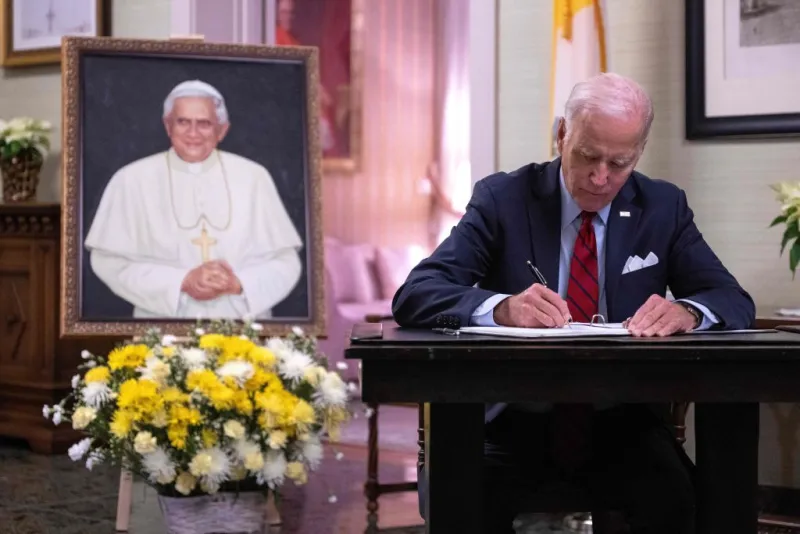
U.S. President Joe Biden signs the condolence book for Pope Emeritus Benedict XVI at the Apostolic Nunciature of the Holy See in Washington, D.C., on Jan. 5, 2023. / Photo by JIM WATSON/AFP via Getty Images
Boston, Mass., Jan 6, 2023 / 10:40 am (CNA).
President Joe Biden visited the Vatican embassy in Washington, D.C., known as the apostolic nunciature, on Thursday to sign a book of condolences for Pope Benedict XVI, who died Dec. 31.
After being greeted by Archbishop Christophe Pierre, the Vatican’s nuncio to the United States, the president wrote:
“Together with Catholics across the United States, I join in mourning the passing of Pope Emeritus Benedict,” according to the AP.
“He was a brilliant scholar and truly Holy Man. I will always cherish our time together at the Vatican when he was Pope discussing Catholic theology. He was a great theologian and I learned much in a few hours. May his soul rest eternally with the Lord,” he wrote.
“It’s a great honor,” Biden can be heard saying on a C-SPAN video after writing his message.
Biden did not attend Benedict’s funeral, which took place on Jan. 5 in St. Peter’s Square at the Vatican.
Only two countries, Italy and Germany, sent official state delegations to attend the funeral, because they were the only two countries that were asked to attend in an official capacity. Other heads of state were welcome to attend in a personal capacity.
Some heads of state who attended in an unofficial capacity included Poland’s President Andrzej Duda, Hungary’s Prime Minister Viktor Orban, Czech Prime Minister Petr Fiala, Slovenian President Nataša Pirc Musar, Queen Sofia of Spain, and King Philip and Queen Mathilde of Belgium.
Joe Donnelly, the U.S. ambassador to the Holy See, attended the funeral and represented the United States.
“I had an opportunity to spend some time with Pope Benedict, a couple of hours, and he was a great. … And reminded me of going back to theology class,” Biden said.
“We spoke about Aquinas and about [the] Summa Theologica,” Biden said, referring to St. Thomas Aquinas’s influential theological writings.
“I found him to be relaxing, very rational, and he had a more conservative view within the Catholic realm than I have. I’m closer to the present pope in terms of his philosophy, his view,” Biden said.
“But I admired him, I thought he was a fine man,” he added.
If you value the news and views Catholic World Report provides, please consider donating to support our efforts. Your contribution will help us continue to make CWR available to all readers worldwide for free, without a subscription. Thank you for your generosity!
Click here for more information on donating to CWR. Click here to sign up for our newsletter.
Washington D.C., Jan 17, 2018 / 03:01 pm (CNA/EWTN News).- The US Conference of Catholic Bishops have beefed up their social media presence for the 9 Days for Life novena, calling Catholics not only to prayer but to action within communities, both virt… […]
A Vatican flag, with the incorrect design likely drawn from Wikipedia, and the dome of St. Peter’s Basilica. / Bohumil Petrik/ACI
St. Louis, Mo., Apr 8, 2023 / 13:00 pm (CNA).
The flag of Vatican City, with its distinctive yellow and white, is instantly recognizable to many Catholics. Likely far fewer people, though, have scrutinized the papal coat of arms on the right-hand side, instead taking the intricate design — which includes famous crossed keys — for granted.
As it turns out, there’s a good chance that the coats of arms on many of the Vatican flags you’ve seen out in the world are rendered incorrectly. And it took until 2023 for the internet to start taking notice.
Imagine you wanted to print your own version of the Vatican flag. Where would you go to find a high-quality picture of one? If you’re like most internet users, your first stop would probably not be the Vatican’s official (but admittedly outdated) vatican.va website. You’re probably going to pull up Wikipedia, one of the world’s most visited websites and an endless storehouse of free image content. Flagmakers the world over appear to have done so over the years.
Imagine many people’s surprise, then, to discover that the image of the “Flag of Vatican City” displayed on Wikipedia has been wrong several times over the years, most recently from 2017 to 2022. (It was also wrong from 2006–2007.)
What is “wrong” about these flags, you might ask? It’s a small detail in the grand scheme of things but easy to spot once you know about it. The erroneous Wikipedia file includes a red disk at the bottom of the papal tiara as well as a different shade of yellow on portions of the coat of arms.
The anonymous Wikipedia editor who changed the look of the flag in 2017 wrote that he or she did so for “color correction” purposes, noting that the Vatican’s coat of arms includes the red at the bottom of the tiara. The only problem? The Vatican’s official flag design renders the coat of arms differently, with the circular bottom of the tiara in white.
The image was reverted to the correct one in 2022, but the damage was done. A casual internet search will turn up dozens of Vatican flags for sale that clearly used the incorrect image downloaded from Wikipedia. The incorrect flag has even made its way into emojis. (This whole situation gained attention last month after a Reddit user made a post about it.)
An inexpensive Vatican flag available for sale on Amazon that makes use of the incorrect Wikipedia flag design. Amazon/Screenshot
Father William Becker, pastor at St. Columbanus Parish in Blooming Prairie, Minnesota, read the Reddit post with interest and amusement. Becker, a self-described “flag guy,” has studied the Vatican flag for years and even wrote an entire book about it. He has fond memories of raising the yellow and white colors over his alma mater, the North American College in Rome.
Becker told CNA that the saga of the Vatican flag on Wikipedia demonstrates a need for the Vatican to step in and clarify exactly what its flag should look like, especially considering the fact that Catholic churches all over the world display the Vatican flag.
It was precisely this lack of clarity on the official design of the Vatican flag that led Becker to create a website detailing, as best as he could, the correct design for the flag.
“Cultural communities in general have turned to flags in a stunning way,” Becker commented, citing in part a proliferation of cheaply made, mass-produced flags. And, anecdotally, there seems to be an ever-increasing interest in the Vatican flag as a way for Catholics to claim an identity, whether by flying a flag at home, waving it at a papal event, or by putting one in their social media profile picture.
The Vatican flag. Bohumil Petrik/CNA
Perhaps surprisingly, the Vatican flag is less than 100 years old, as is Vatican City itself. For more than a millennium before 1870, the pope ruled over the Papal States, large regions mainly within present-day Italy. After the Vatican lost control of the Papal States, it found itself a tiny island surrounded by an acrimonious Italy. It took nearly 60 years until the ratification of the Lateran Accords of 1929 ushered in harmony between the Vatican and Italy, and the creation of the world’s smallest sovereign country.
In the days of the Papal States, many different flags were used, but the yellow and white color scheme was a common feature. Becker said the modern design was first used by the merchant fleet in the Papal States from 1825 to 1870. In 1929, that design was chosen as the new flag of Vatican City, the sovereign country.
“It took a while in 1929 to get some flags made. The techniques of mass production weren’t available yet, and so it would have been a matter of sewing up some flags and fitting out buildings with flag staffs,” Becker noted, saying that during this time and for years afterward there was quite a bit of variation between the Vatican flags people flew, perhaps even more so than today.
“That’s kind of common with other countries too, especially those that don’t really take pains to standardize their design. [Nowadays] a flagmaker is likely to go to a source like Wikipedia, and it may vary in its accuracy,” Becker told CNA.
The same flag chosen in 1929 was reconfirmed in a revised Vatican constitution, issued by Pope John Paul II in 2000. The original Vatican flag was actually square, as indeed the official version is today. Since roughly the 1960s, though, buildings began to fly oblong state flags that followed Italy’s flag proportions, probably because most Vatican flags at the time were mass-produced there.
The flag has special significance beyond the walls of Vatican City as a marker for the Vatican’s extraterritorial properties, of which there are more than a dozen. These properties, which include major basilicas such as St. Paul Outside the Walls and St. Mary Major, are marked as the Vatican’s through their flying of the papal flag.
Becker said he hopes his website will serve as a helpful resource for anyone looking for the exact Vatican flag design, at least until the Vatican issues some kind of clarification on what exactly the flag should look like.
“The papal flag is interesting because on the one hand, the Vatican is such a small state, but the papal flag is seen all over the world. Anywhere there’s a Catholic church, you might be likely to run into a papal flag,” he said.
“It would be nice if somebody at the Holy See could, through their website or wherever, make some design specifications more available … design specifications that manufacturers could rely on a bit more.”
Sacramento, Calif., Sep 2, 2017 / 05:29 am (CNA/EWTN News).- A new bill in California would punish the ‘misgendering’ of nursing home and long-term care patients with hefty fines and even jail time.
In February, state senator Scott Wiener introduced SB 219, the “Long-term care facilities: rights of residents” bill, which has already been passed by California’s state senate. After being recommended by the state assembly’s judiciary committee, the bill will now be considered by the California House of Representatives.
If passed into law, the policy would punish nursing home and long-term care workers who refuse to call patients by their preferred pronouns with fines of up to $1,000, or jail time for up to a year, or both.
Besides compelling workers to refer to residents by their preferred pronouns, the bill would also mandate that facilities allow residents room assignments and bathroom preferences based on gender identity rather than biological sex.
Ned Dolejsi, executive director of the California Catholic Conference, told CNA that the bill could unjustly target religious facilities and place excessive burden on an already-heavily regulated industry.
“It would potentially compromise some of the institutions that are religiously sponsored and would not want to be supportive” of gender identity room or bathroom assignments, he said.
He added that it seemed to be solving a problem that wasn’t there, since there haven’t been widespread reports of discrimination based on gender in the state’s nursing home and long-term care facilities.
“In many ways it seems to be a solution looking for a major problem,” he said.
“That’s certainly one of our concerns – is this just part of a larger ideological drill? Do we have examples of people being mistreated around the state because of their gender experience? It seems that this is more like – let’s fix something that we don’t even know needs fixing.”
Greg Burt, with the California Family Council, testified against SB 219 in July, noting that it would infringe on the First Amendment rights of workers by compelling them to use speech with which they might not agree.
“How can you believe in free speech, but think the government can compel people to use certain pronouns when talking to others?” Burt asked members of the Assembly Judiciary Committee during his testimony.
“Compelled speech is not free speech. Can the government compel a newspaper to use certain pronouns that aren’t even in the dictionary? Of course not, or is that coming next?”
Burt also denounced the bill for lacking any religious exemptions for religiously-affiliated institutions.
“Those proposing this bill are saying, ‘If you disagree with me about my view of gender, you are discriminating against me’,” Burt testified. “This is not tolerance. This is not love. This is not mutual respect… True tolerance, tolerates people with different views. We need to treat each other with respect, but respect is a two-way street. It is not respectful to threaten people with punishment for having sincerely held beliefs that differ from your own.”
Dolejsi said he anticipated that the bill would pass in the legislature sometime in the next week, and would head to the desk of the governor. At that point, the California Catholic Conference would advocate for a veto, based on the burden the bill would place on religious institutions and the industry of nursing and long-term care facilities.
“Our advocacy with the governor will be inviting his veto based on…(the fact that) it doesn’t seem to be sensitive to the many religious organizations that sponsor these particular homes and facilities, and there’s no (religious exemption). And, absent a strong experience out in society for rights being violated in this regard, it seems like this is burdening the state in an industry that’s already challenged.”
Understaffing and under-qualified personnel is a growing problem in nursing home and long-term care facilities throughout the nation, as baby boomers age and the industry struggles to keep up.
While this bill could pave the way for legislation that would apply more broadly, such legislation is already in the works, Dolejsi noted, including a bill that would mandate gender identity training for all state employees.
“That’s the nature of how we’re experiencing this in California,” he said. “It’s like every aspect of public life needs to salute and address concerns of the LGBT folks.”
Dolejsi encouraged concerned Catholics to keep up with the legislation that was being approved, and to contact their elected officials by email or phone to express their concerns. He also encouraged participation in town hall meetings, and persistency in raising their concerns.
“We need practical laws,” he added. “And if there is truly a case of discrimination, then let’s sit down and figure out how to…bring people together and solve it in a way that’s respectful of people’s religious values and expressions and experiences.”
Leave a Reply
