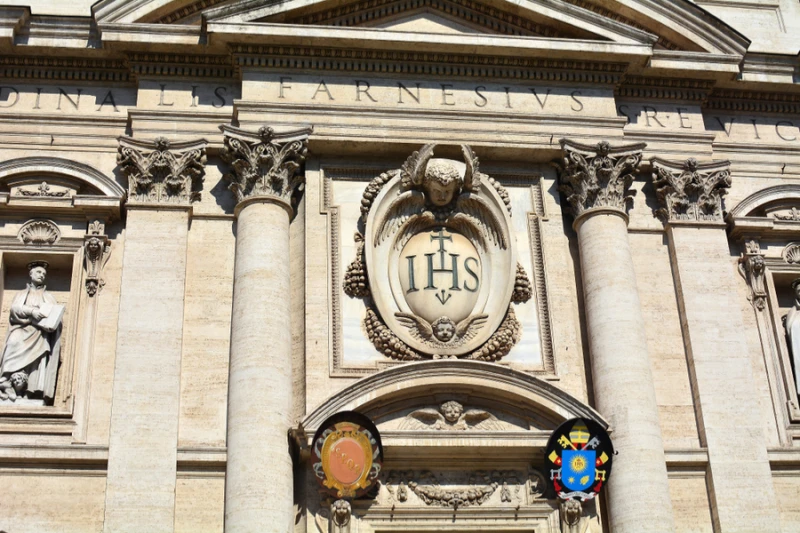
The Church of the Gesu, the mother church of the Society of Jesus, Rome. / liberowolf/Shutterstock
Rome Newsroom, Dec 5, 2022 / 05:45 am (CNA).
A prominent Jesuit priest and artist had his ministry restricted, reportedly after an investigation by his religious order into allegations of abuse against religious sisters in Slovenia.
The Jesuits said in a statement dated Dec. 2 that the order has barred 68-year-old Father Marko Ivan Rupnik, SJ, from hearing confessions or conducting spiritual direction since the Vatican received a complaint against him in 2021.
The Vatican declined in October to carry out a canonical process due to the statute of limitations, the order said. The complaint did not include minors.
The Jesuit order said the restrictions on Rupnik’s ministry were still in effect and included a ban on leading the Ignatian Spiritual Exercises. The priest is also prohibited from engaging in public activities without the permission of his superior.
The Jesuit is best known for overseeing the renovation of the Redemptoris Mater Chapel in the Vatican’s Apostolic Palace, which reopened in 1999 after three years of work.
Rupnik also designed the Redemptor Hominis Church at the St. John Paul II National Shrine in Washington, D.C., as well as other projects in the U.S.
Despite the restrictions on his public ministry, on Nov. 30, Rupnik received an honorary doctorate from the Pontifical Catholic University of Paraná in Brazil.
The Centro Aletti has also continued to publish a video on YouTube every Sunday of Rupnik commenting on the Sunday Gospel. The Diocese of Rome posted a video of Rupnik speaking about eucharistic adoration in February.
According to the Jesuits, the Vatican’s Dicastery for the Doctrine of the Faith (DDF) asked the order to conduct a preliminary investigation into the Slovenian priest, who has been incardinated in the Diocese of Rome since the early 1990s.
A final report was submitted to the DDF, and in early October, the Vatican “found that the facts in question” fell outside the statute of limitations, the Jesuits said.
A source in the Diocese of Rome confirmed Dec. 5 to ACI Prensa, CNA’s Spanish partner agency, that the provincial of the Jesuits had informed the diocese of the precautionary measures against Rupnik and suggested that his pastoral activities in the diocese be limited.
The Diocese of Rome did not perform its own investigation into the allegations against Rupnik, the source said, since the accusations concerned alleged abuse in Slovenia, not in Rome.
The source also confirmed that Rome auxiliary Bishop Daniele Libanori had conducted a separate inquiry, unrelated to Rupnik, into the Loyola Community, which was founded in Slovenia.
During the canonical visitation, which is still ongoing, Libanori received accusations from at least nine women against Rupnik, the source said. Rupnik was reportedly the community’s confessor and spiritual director for a number of years.
Run by law and religion scholars, the Italian website “Silere non possum,” Latin for “I cannot keep quiet,” published a story with reports that Rupnik had abused consecrated women in the Loyola Community.
If you value the news and views Catholic World Report provides, please consider donating to support our efforts. Your contribution will help us continue to make CWR available to all readers worldwide for free, without a subscription. Thank you for your generosity!
Click here for more information on donating to CWR. Click here to sign up for our newsletter.
Vatican City, May 18, 2017 / 10:26 am (CNA/EWTN News).- Pope Francis said that there is no outcome that can justify the use or destruction of embryos for scientific purposes – even for the commendable cause of trying to help those suffering from incurable diseases.
“Some branches of research, in fact, utilize human embryos, inevitably causing their destruction. But we know that no ends, even noble in themselves, such as a predicted utility for science, for other human beings or for society, can justify the destruction of human embryos,” he said May 18.
Pope Francis spoke during a meeting at the Vatican Thursday with people affected by a rare and incurable genetic brain disorder called Huntington’s disease, along with their families and caretakers.
His comments were significant given the massive slate of members from the medical and scientific communities who treat the patients with Huntington’s and perform research on how to prevent the disease or slow its progression. Present were some 1,700 people from 16 different countries. Sponsors for the event included major corporations such as Virgin Airlines.
There are several ethical problems surrounding the research on Huntington’s disease, including the use of embryonic stem cells taken from embryos made through in vitro fertilization.
The Pope noted this fact during the audience, encouraging scientists to pursue scientific advancement only through means that do not contribute to the “throw-away culture” which treats human beings as objects for use.
The is not the first time Francis has spoken out against embryonic stem cell research. In his 2015 environment encyclical Laudato Si, he decried “a tendency” within the field of science “to justify transgressing all boundaries when experimentation is carried out on living human embryos.”
“We forget that the inalienable worth of a human being transcends his or her degree of development,” he said, adding that once technology disregards ethical principles, “it ends up considering any practice whatsoever as licit.”
“When we fail to acknowledge as part of reality the worth of a poor person, a human embryo, a person with disabilities – to offer just a few examples – it becomes difficult to hear the cry of nature itself; everything is connected.”
Once the human being seeks absolute dominion, the foundations of our life “begin to crumble,” the Pope said in Laudato Si, so that instead of cooperating with God, man puts himself in God’s place “and thus ends up provoking a rebellion on the part of nature.”
Thousands of pro-life advocates gathered outside the U.S. Supreme Court in Washington, D.C., on Dec. 1, 2021, in conjunction with oral arguments in the Dobbs v. Jackson Women’s Health Organization abortion case. / Katie Yoder/CNA
Washington D.C., Dec 2, 2021 / 08:04 am (CNA).
Anna Del Duca and daughter, Frances, woke up at 5 a.m. Wednesday morning to brave the 30-degree weather outside the U.S. Supreme Court in Washington, D.C. They arrived hours before oral arguments began in the highly-anticipated abortion case, Dobbs v. Jackson Women’s Health Organization.
The case, which involves a Mississippi law restricting most abortions after 15 weeks, challenges two landmark decisions: Roe v. Wade, the 1973 ruling that legalized abortion nationwide, and Planned Parenthood v. Casey, which upheld Roe in 1992.
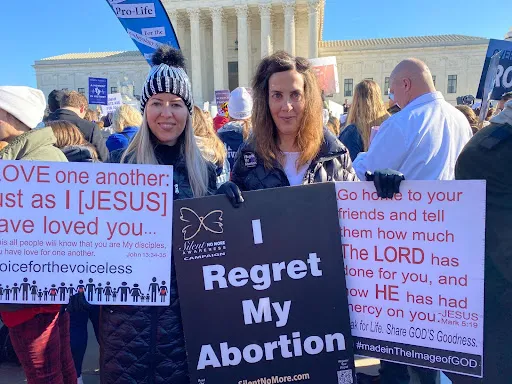
“We’re looking forward to the end of Roe versus Wade in our country,” Anna, who drove from Pittsburgh Tuesday night, told CNA. In her hands, she held a sign reading, “I regret my abortion.”
Anna Del Duca (right) and her daughter, Frances, traveled from Pittsburgh to attend a pro-life rally outside the U.S. Supreme Court on Dec. 1, 2021, in conjunction with oral arguments for the Dobbs v. Jackson Women’s Health Organization abortion case. Katie Yoder/CNA
“I would like to use my testimony to be a blessing to others,” she said, so that “others will choose life or those who have regretted abortion or had an abortion would turn to Jesus.”
Anna remembered having an abortion when she was just 19. Today, she and her daughter run a group called Restorers of Streets to Dwell In Pittsburgh that offers help to women seeking healing after abortion.
Anna and Frances were among thousands of Americans who rallied outside the Supreme Court before, during, and after the oral arguments. To accommodate them, law enforcement closed the street in front of the court. Capitol police also placed fencing in the space in front of the building in an attempt to physically separate rallies held by abortion supporters and pro-lifers.
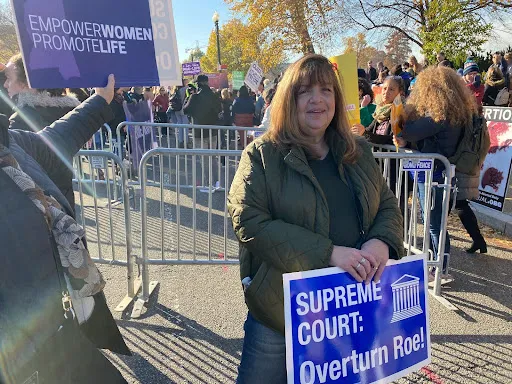
At 21-weeks pregnant, pro-life speaker Alison Centofante emceed the pro-life rally, called, “Empower Women Promote Life.” The event featured a slew of pro-life women of diverse backgrounds and numerous politicians.
“It’s funny, there were so many diverse speakers today that the only unifying thread was that we want to protect preborn children,” Centofante told CNA. They included Democrats, Republicans, Christians, Catholics, agnostics, atheists, women who chose life, and women who regretted their abortions, she said.
She recognized women there, including Aimee Murphy, as people who are not the typical “cookie cutter pro-lifer.”
Aimee Murphy, 32, founder of pro-life group Rehumanize International, arrived at the Supreme Court around 6:30 a.m. She drove from Pittsburgh the night before. Her sign read, “Queer Latina feminist rape survivor against abortion.”“At Rehumanize International, we oppose all forms of aggressive violence,” she told CNA. “Even as a secular and non-partisan organization, we understand that abortion is the most urgent cause that we must stand against in our modern day and age because it takes on average over 800,000 lives a year.”
She also had a personal reason for attending.
“When I was 16 years old, I was raped and my rapist then threatened to kill me if I didn’t have an abortion,” she revealed.
“It was when he threatened me that I felt finally a solidarity with unborn children and I understood then that, yeah, the science told me that a life begins at conception, but that I couldn’t be like my abusive ex and pass on the violence and oppression of abortion to another human being — that all that I would be doing in having an abortion would be telling my child, ‘You are an inconvenience to me and to my future, therefore I’m going to kill you,’ which is exactly the same thing that my rapist was telling me when he threatened to kill me.”
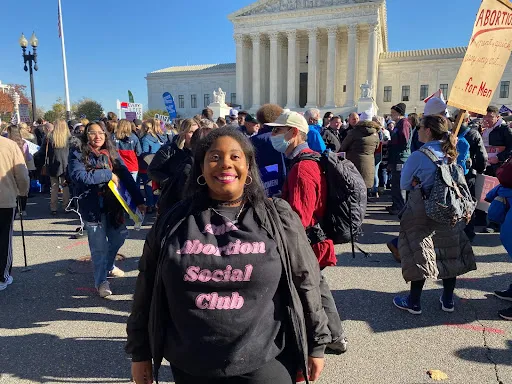
On the other side of the police fence, the Center for Reproductive Rights and the National Abortion Access Coalition and NARAL Pro-Choice America participated in another rally. Yellow balloons printed with the words “BANS OFF OUR BODIES” escaped into the sky. Several pro-choice demonstrators declined to speak with CNA.
Voices clashed in the air as people, the majority of whom were women, spoke into their respective microphones at both rallies. Abortion supporters stressed bodily autonomy, while pro-lifers recognized the humanity of the unborn child. Chants arose from both sides at different points, from “Whose choice? My choice!” to “Hey hey, ho ho, Roe v. Wade has got to go!”
At 10 a.m., the pro-life crowd sudddenly went silent as the oral arguments began and the rally paused temporarily as live audio played through speakers.
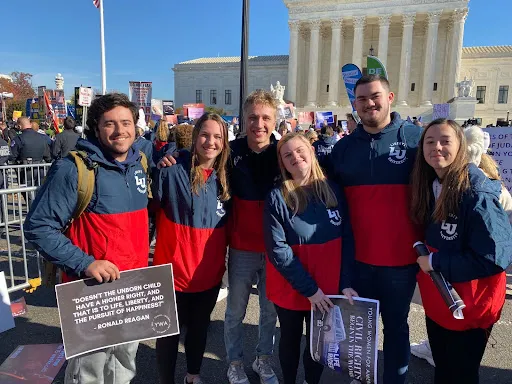
Hundreds of students from Liberty University in Lynchburg, Virginia, traveled to Washington, D.C. for a pro-life rally outside the U.S. Supreme Court on Dec. 1, 2021, in conjunction with oral arguments in the Dobbs v. Jackson Women’s Health Organization abortion case. Katie Yoder/CNA
During the oral arguments, students from Liberty University knelt in prayer. One student estimated that more than a thousand students from the school made the more than 3-hour trip from Lynchburg, Virginia.
“Talking about our faith is one thing, but actually acting upon it is another,” he said. “We have to be the hands and feet of Jesus Christ. So to me this is part of doing that.”
Sister Mary Karen, who has been with the Sisters of Life for 21 years, also stressed the importance of prayer. She drove from New York earlier that morning because, she said, she felt drawn to attend. She came, she said, to pray for the country and promote the dignity of a human person.
“Our culture is post-abortive,” she explained. “So many people have suffered and the loss of human life is so detrimental, just not knowing that we have value and are precious and sacred.”
Theresa Bonopartis, of Harrison, New York, was among the pro-life demonstrators outside the U.S. Supreme Court on Dec. 1, 2021. She runs a nonprofit group called Entering Canaan that ministers to women and others wounded by abortion. Katie Yoder/CNA
She stood next to Theresa Bonopartis, who traveled from Harrison, New York, and ministers to women and others wounded by abortion.
“I’ve been fighting abortion for 30 years at least,” she told CNA.
Her ministry, called Entering Canaan, began with the Sisters of Life and is observing its 25th anniversary this year. It provides retreats for women, men, and even siblings of aborted babies.
Abortion is personal for Bonopartis, who said she had a coerced abortion when she was just 17.
“I was kicked out of the house by my father and then coerced into getting an abortion,” she said. “Pretty much cut me off from everything, and that’s something people don’t really talk about … they make it try to seem like it’s a woman’s right, it’s a free choice. It’s all this other stuff, but many women are coerced in one way or another.”
She guessed that she was 14 or 15 weeks pregnant at the time.
“I saw my son. I had a saline abortion, so I saw him, which I always considered a blessing because it never allowed me to deny what abortion was,” she said. Afterward, she said she struggled with self-esteem issues, hating herself, guilt, shame, and more. Then, she found healing.
“I know what that pain is like, I know what that experience is like, and you know that you can get past it,” she said. “You just want to be able to give that message to other people, that they’re able to heal.”
Residents of Mississippi, where the Dobbs v. Jackson case originated, also attended.
Marion, who declined to provide her last name, drove from Mississippi to stand outside the Supreme Court. She said she was in her early 20s when Roe v. Wade was decided in 1973.
“At the time, of course, I could care less,” she said. Since then, she had a change of heart.
“We were the generation that allowed it,” she said, “and so we are the generation who will help close that door and reverse it.”
Marion, who declined to provide her last name, was among those who attended a pro-life rally outside the U.S. Supreme Court on Dec. 1, 2021, from Mississippi, where the Dobbs v. Jackson Women’s Health Organization abortion case originated. Katie Yoder/CNA
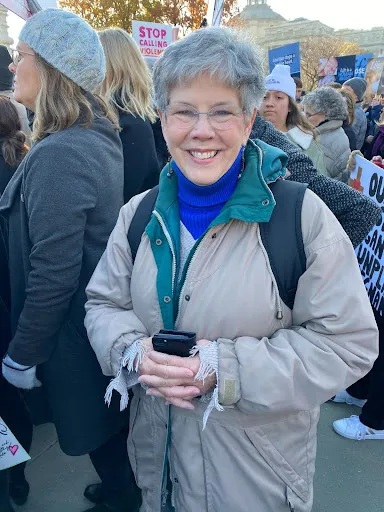
The crowd at the pro-life rally included all ages, from those who had witnessed Roe to bundled-up babies, children running around, and college students holding up homemade signs.
One group of young friends traveled across the country to stand outside the Supreme Court. They cited their faith and family as reasons for attending.
Mathilde Steenepoorte, 19, from Green Bay, Wisconsin, identified herself as “very pro-life” in large part because of her younger brother with Down syndrome. She said she was saddened by the abortion rates of unborn babies dianosed with Down syndrome.
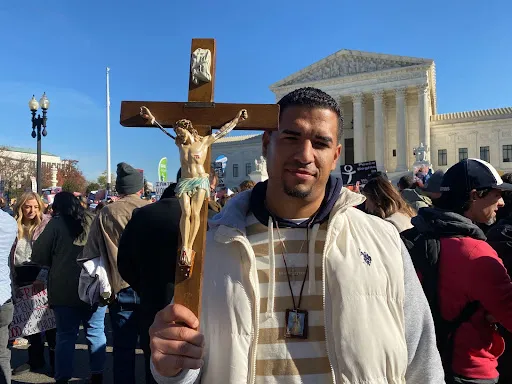
Juanito Estevez, from Freeport, a village on Long Island, New York, at a pro-life rally outside the U.S. Supreme Court on Dec. 1, 2021. Katie Yoder/CNA
Juanito Estevez, from Freeport, a village on Long Island, New York, arrived Tuesday. He woke up at 6 a.m. to arrive at the Supreme Court with a crucifix in hand.
“I believe that God is the giver of life and we don’t have the right [to decide] whether a baby should live or die,” he said.
He also said that he believed women have been lied to about abortion.
“We say it’s their right, and there’s a choice,” he said. When girls tell him “I have the right,” his response, he said, is to ask back, “You have the right for what?”
Mallory Finch, from Charlotte, North Carolina, was among the pro-life demonstrators outside the U.S. Supreme Court on Dec. 1, 2021.
Mallory Finch, from Charlotte, North Carolina, also woke up early but emphasized “it was worth it.” A pro-life podcast host, she called abortion a “human-rights issue.”
“I hope that it overturns Roe,” she said of the case, “but that doesn’t mean that our job as pro-lifers is done. It makes this, really, just the beginning.”
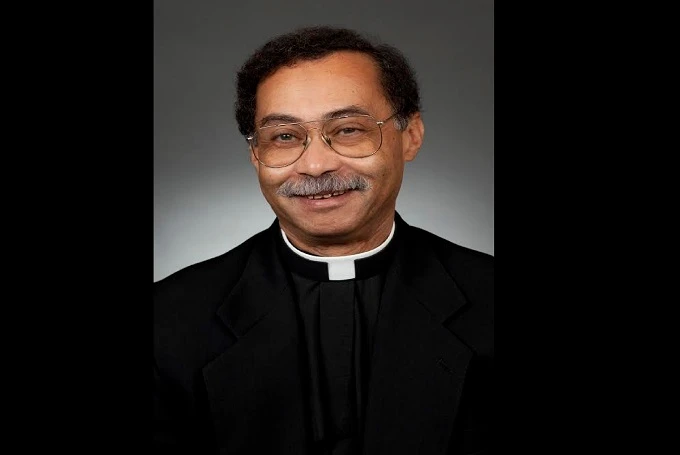
Vatican City, Mar 8, 2017 / 06:13 am (CNA/EWTN News).- On Wednesday the Vatican announced Pope Francis’ appointment of Fr. Roy Edward Campbell, Jr., a former vice-president for Bank of America, as an auxiliary bishop for the Archdiocese of Washington.
“All of us in the Archdiocese are deeply grateful that our Holy Father, Pope Francis, has named Father Roy Campbell to be an auxiliary bishop in our Church of Washington,” Cardinal Donald Wuerl, Archbishop of Washington, said in a statement March 8.
Father Campbell, who was born, raised and who has worked and served in the archdiocese, “brings to his new ministry recognized talent and demonstrated ability. He also bears witness to the great cultural and ethnic richness of the Church of Washington reflected in all of the faithful, lay, religious and clergy.”
“Personally I look forward to continuing to work closely with our new auxiliary bishop, who over the years has made significant contributions to the pastoral life of this archdiocese,” he said.
Fr. Campbell, 69, had a 33-year long career with Bank of America, beginning as a teller and working his way up to vice president and “Project Manager” before taking an early retirement in 2002 to follow a priestly vocation.
Born on Nov. 19, 1947, in southern Maryland, the Campbell was raised in D.C. and was interested in the priesthood as a child, but never committed to entering the seminary.
After high school he attended and graduated from Howard University in 1969 and later received a master’s degree in banking from the University of Virginia, working in the retail banking industry in the Washington-Baltimore area until taking an early retirement in 2002.
He was an active Catholic both in parishes and the broader Washington-area community, serving as a lector and usher and as a member on the Pastoral and Finance Councils at the Shrine of the Sacred Heart.
An encounter with a homeless man in December 1995, prompted him to reflect on his relationship with Jesus, and as a result he entered the archdiocese’s permanent diaconate program in 1999. He entered the seminary in January 2002, and was ordained a priest May 26, 2007.
Since his ordination, bishop-elect Campbell has been parochial vicar and pastor at several parishes. He said in a video interview for the Archdiocese of Washington that “the Lord himself has bestowed upon me through the Holy Father,” a great honor by the appointment.
“The only thing I was looking forward to doing in answering our Lord’s call is to be a priest for his people. To love and serve those who he’s called me to,” he continued.
“And if he’s calling me to serve on a larger scale than a parish, as a bishop, then I know I will have his grace, his direction, and his love to help me do so. So, outside of that, what it will entail, I will find out.”





Rupert Pupnick and Marko Rupnik! Doing what they shouldn’t!