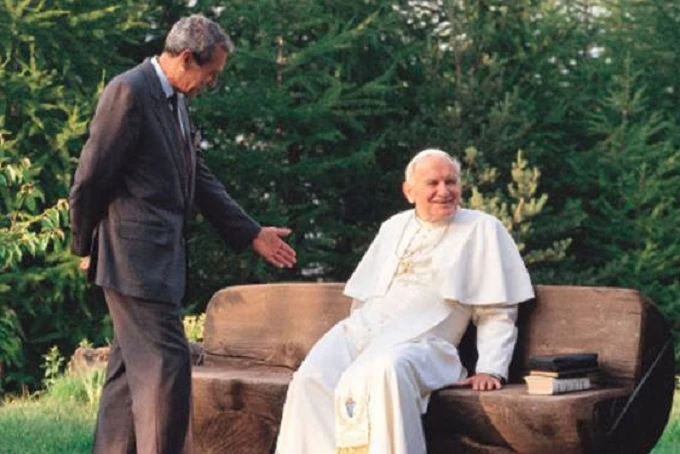
Vatican City, Jul 9, 2017 / 09:16 am (CNA/EWTN News).- During his 22 years as spokesman for St. John Paul II, Dr. Joaquin Navarro-Valls became somewhat of a legend in the Vatican – not only for his keen professional abilities and insight into the Pope’s mind, but also for his genuine kindness and deep spiritual life.
In a word, most who knew the late Spanish layman, who died earlier this week, have referred to him as a “gentleman” who was elegant, professional, kind and incredibly savvy.
Fr. John Wauck, a longtime friend of Navarro-Valls, described him as “an old-school gentleman and a consummate professional – capable, discreet, committed, loyal.”
Likewise, Greg Burke, current Director of the Holy See Press Office, said after announcing news of Navarro’s passing on Twitter that “Joaquin Navarro embodied what Ernest Hemingway defined as courage: grace under pressure.”
Burke said that he had met Navarro-Valls while working as a correspondent for Time Magazine the same year that the publication had named St. John Paul II “Man of the Year.”
In dealing with the Pope’s spokesman, Burke said “I expected to find a man of faith, but I found a man of faith who was also a first class professional” that was already well known and respected by his peers in the communications world.
“I didn’t always agree with Navarro, but he always behaved like a Christian gentlemen – and those can be hard to find these days,” Burke said.
Navarro-Valls was born in Cartagena, Spain in 1936. He studied medicine at the Universities in Granada and Barcelona, and worked as a professional psychiatrist and teaching medicine before obtaining degrees in journalism and communications.
He joined Opus Dei after meeting its founder St. Josemaria Escriva, continuing to collaborate with the founder in Rome, where he moved in 1970.
In Rome he was a correspondent for the Spanish newspaper ABC and was twice elected president of the Rome-based Foreign Press Association in Italy.
He was the first lay journalist to hold the position of Director of the Vatican Press Office, which he was appointed to by Pope St. John Paul II in 1984. He served through the Pope’s death and two years into the pontificate of Benedict XVI before retiring in 2006.
After, he served as president of the advisory board of the Opus Dei-affiliated Campus Biomedical University in Rome until his death.
In his tenure at the Vatican Press Office spanning more than two decades, Navarro-Valls helped to modernize Vatican communications, especially as technology advanced. As Burke said, “he lived through the fax to the age of the internet.”
In 1992, he used $2 million to equip the press office with up-to-date technology and to modernize the facilities. He also streamlined the distribution of materials by making archives, documents and the Pope’s activities accessible online.
He died in Rome July 5 surrounded by fellow members of Opus Dei after battling terminal cancer. His funeral was held Thursday, July 6 at 11a.m. at the basilica of Sant’Eugenio, and was celebrated by the Vicar General of Opus Dei, Bishop Mariano Fazio.
Mario Biasetti, a journalist under the last five popes and a friend and colleague of Navarro-Valls, said he was a professional journalist, and it showed in everything he did.
Even when a colleague or a journalist would ask him a tough question, “it didn’t faze him,” Biasetti said. “He would tell you exactly what happened, but he would do it with a smile.”
“Joachin Navarro was a very well thought of man all-around. He had no difficulty to speak with anybody, whether officially or not officially.”
Biasetti traveled on many papal trips with John Paul II, and Navarro was always there and always by his side, he said. He was also always willing to pitch in and “always came through” for journalists with whatever they needed.
For Burke, one of the key things that stood out about Navarro-Valls is that he was someone who would work “shoulder-to-shoulder with the rest of us,” who “knew the world” and was good with languages.
Burke noted that before coming to the Vatican, Navarro worked as a correspondent, “and his colleagues from around the globe clearly recognized his merits, electing him President of the Stampa Estera in Rome.”
“I remember watching Navarro closely during the U.N. Population Conference in Cairo – one of the best examples of what Pope Francis calls ideological colonization. It was fascinating to see someone who was defending the faith, but he wasn’t on the defensive. He was leading the fight.”
Asked about what, if any, advice he had given Burke on doing the job, the spokesman said the advice he got “was more personal than professional, such as ‘don’t neglect your interior life, and make sure you pray – you’ll need it in this job.’”
This attention to the spiritual life is something that was also obvious to others who worked with Navarro. In Biasetti’s words, the Spaniard “was a journalist, yes, but he was also a churchman.”
Fr. Wauck, a professor of the Institutional Church Communications faculty at the Pontifical University of the Holy Cross in Rome and a fellow member of Opus Dei, recalled that this spiritual dynamic was evident even in Navarro’s work.
The priest said that when he thinks of Navarro, the first thing that comes to mind is “the conversion of the Time magazine reporter Wilton Wynn,” a well-known old-time reporter in the Middle East and Rome during John Paul II’s pontificate.
“Naturally, it was the vibrant Christian example of the Pope that attracted Wilton to the faith, but his long friendship with Navarro-Valls played a key part as well,” Wauck said, adding that Navarro-Valls “maintained an affectionate concern for Wilton’s spiritual well-being for the rest of his life.”
Another memory the priest recalled is “a small act of kindness” that took place over the summer some 15 years ago.
Fr. Wauck said that he had mentioned, in passing, in front of Navarro, that he had broken his swimming goggles. “The next day, I found a new pair on my desk, and they were much better than the ones I’d broken.”
Fr. Federico Lombardi, Navarro-Valls’ immediate successor as Director of the Holy See Press Office, also reflected on his relationship with his late predecessor, calling to mind Navarro’s character and impact on Vatican communications.
Lombardi recalled meeting Navarro after coming to Rome in 1991 to take on the role as Director of Programming for Vatican Radio.
After meeting and working alongside the Spaniard, particularly when the Pope traveled abroad, it immediately became clear that he was “a stable and important component” of the papal entourage, “but also likeable, friendly and cordial,” Lombardi said.
“Naturally I already knew him for his fame as a brilliant and competent ‘spokesman’ for the Pope,” he said, noting that the official title for someone in Navarro’s position is “Director of the Holy See Press Office.”
However, in the case of Navarro-Valls, spokesman “was an entirely appropriate name.”
Even if this wasn’t the official description of his duty – which was rather “Director of the Press Office” – it must be said that in his case it was an entirely appropriate name given the close relationship he had with John Paul II.
According to Lombardi, it was Navarro himself who often stressed that it was “absolutely necessary to have – and to indeed have – a direct relationship with the Pope, in order to know his thinking and line of thought with surety and clarity, and to be able to present himself to the world, to the Press Office and to public opinion as an authoritative interpreter of that thought, and not just hearsay.”
Throughout Navarro’s lengthy tenure working in the Vatican, there was absolutely “no doubt” that “he was very close to the Pope, so close that he must be considered one of the most important figures of that extraordinary pontificate.”
This, Lombardi said, is “not only because of his evident public visibility, but also for his role as intervention and advice. Certainly John Paul II had great confidence in him and held his service in high esteem.”
Burke, who is Lombardi’s successor as Director of the Holy See Press Office, referred to this relationship when he announced Navarro’s passing, posting a photo of him standing next to John Paul II with a big smile.
<blockquote class=”twitter-tweet” data-lang=”en”><p lang=”tl” dir=”ltr”>Joaquin Navarro, 1936-2017.<br>Keep Smiling. <a href=”https://t.co/VCqL4GH5sS”>pic.twitter.com/VCqL4GH5sS</a></p>— Greg Burke (@GregBurkeRome) <a href=”https://twitter.com/GregBurkeRome/status/882672100091322370″>July 5, 2017</a></blockquote>
<script async src=”//platform.twitter.com/widgets.js” charset=”utf-8″></script>
“I tweeted out a photo of Navarro-Valls and John Paul II smiling together, saying ‘Navarro, keep smiling.’ But I actually took that quote from John Paul II,” he said.
It was after a meeting between the Pope and the editors of Time Magazine, Burke explained. Navarro was standing off to the side a little, but smiling, happy with how things had gone and Pope St. John Paul II, noticing, said to him in English: “keep smiling.”
“You could tell that they had a very, very good relationship,” he said.
When it came to Navarro’s professional abilities, Lombardi said that at U.N. conferences the Spaniard would end up playing a primary and even diplomatic role, thanks to his “experience and communicative ability.”
“His intelligence, elegance and relational abilities were prominent. To that is added a great knowledge of languages and a true genius in presenting news and information content in a brilliant, attractive and concise way,” Lombardi said.
These are all gifts that made Navarro “an ideal person as a point of reference in the Vatican for the international information providers, but also for relations” with people in the public, communications and political spheres.
As both a layman and a consecrated member of Opus Dei, Navarro could be counted on as a competent and respected professional, but also as someone “whose dedication and faithful love of the Church could really be counted on, for the effective availability of both time and heart.”
For Lombardi, the lengthy duration of Navarro’s service as Director of the Press Office, his authoritativeness, efficiency and the quality of his work make his tenure “an age that will likely remain unique in the history of the Press Office and of Vatican communications.”
“Certainly, the dimension of communications and public relations in the immense pontificate of John Paul II cannot in any way be independent of Dr. Navarro’s work and personality,” he said. “It was an invaluable service to the Church.”
Lombardi voiced his gratitude to Navarro, specifically for the “courtesy and attention” he showed during the time they worked together.
“I always considered him a teacher in the way of carrying out his service and I never would have imagined to be called to succeed him,” Lombardi said, adding that his predecessor was “totally inimitable.”
“In the context of a different pontificate I tried to interpret and carry out the task assigned to me as best as I knew how, but preserving, for what was possible, his precious legacy,” he said.
Lombardi and Navarro remained friends even after the latter stepped down. For Lombardi, his predecessor was always “an example of a discreet, true and deep spiritual life, fully integrated with his work, a model of dedication to the service of the Pope and the Church, a teacher in communications.”
“Even for me – as I already said, but I willingly repeat – he was inimitable.”
 […]
[…]






For Bishop Georg Bätzing not an easy task. German CNA reporter AC Wimmer international journalist knows how to set up a an undeclared portrait of reality. Card Kasper warns the Synodaler Weg, You’ll break your necks! Francis, Too much centralization does not lead to good ends [spoken by a cognoscenti].
Despite the fiery warnings, Herr Bätzing, “The current situation of the Church is very challenging. It hits me personally very hard that so many people are leaving the Church. In doing so, they are casting a vote and showing me that they no longer agree with the way the Church presents itself”. What a man for so unenviable a task. No being there for him whatsoever. Ah, the pathos of it all.
The solution: remove all Germans from the episcopacy in Germany and replace them with bishops from Poland, Hungary, and countries in Africa. And, please, include NO Jesuits, Americans, Irish, French, Italians or Spaniards, and none from Central and South America. It does seem that the world of the Orthodox Catholic Church is indeed shrinking.
Deacon you’re likely aware there’s a list of traditional German bishops who oppose Herr Bätzing and the Synodaler Weg among them, Card Joachim Meisner, Card Rainer Woelki, Card Gerhard Müller, Bishop Rudolf Voderholzer, Bishop Stefan Oster. Difficulty is they’re outnumbered by the progressives both among the clergy and within the population. A strong orthodox pope might have saved the German Church from what appears complete dissolution, except for pockets of traditional bishoprics. We hope for a turnaround.
We can only pray. Yes, there are some good German bishops but too few are ordinaries.
In the interests of not-easy unity within cultural diversity, Batzing reminds me of the double-speaking cannibal as he “walked together” with his guest: “I’d like to have you for dinner.”
I wonder if the Pope excommunicated them and installed new bishops, would these guys have to give up their luxury church tax funded lifestyle?
I have a feeling that the German Synodal process has a lot to do with maintaining the status quo in regard to tax money and the hordes of “professional Catholics” who make very nice livings off of the Church. Without the government church tax, the Church in Germany would be dead. It’s nothing but an empty shirt.
BINGO!
The task is straightforward, however for the unrepentant enemies of Jesus impossible!
Revelation 21:8 But as for the cowardly, the faithless, the detestable, as for murderers, the sexually immoral, sorcerers, idolaters, and all liars, their portion will be in the lake that burns with fire and sulphur, which is the second death.”
1 John 1:9 If we confess our sins, he is faithful and just to forgive us our sins and to cleanse us from all unrighteousness.
1 Corinthians 5:11 But now I am writing to you not to associate with anyone who bears the name of brother if he is guilty of sexual immorality or greed, or is an idolater, reviler, drunkard, or swindler—not even to eat with such a one.
Jude 1:7 Just as Sodom and Gomorrah and the surrounding cities, which likewise indulged in sexual immorality and pursued unnatural desire, serve as an example by undergoing a punishment of eternal fire.
1 Peter 3:12 For the eyes of the Lord are on the righteous, and his ears are open to their prayer. But the face of the Lord is against those who do evil.”
1 Corinthians 6:9-11 Or do you not know that the unrighteous will not inherit the kingdom of God? Do not be deceived: neither the sexually immoral, nor idolaters, nor adulterers, nor men who practice homosexuality, nor thieves, nor the greedy, nor drunkards, nor revilers, nor swindlers will inherit the kingdom of God. And such were some of you. But you were washed, you were sanctified, you were justified in the name of the Lord Jesus Christ and by the Spirit of our God.
The defiant take no heed for they are far from Jesus. They like all the benefits of the church, yet will not take the obligations, duties and responsibilities to heart. Let us pray for them that the Holy Spirit turns their heart.
“Bishop Batzing has repeatedly dismissed any and all concerns. . .”
But he does notice that people are voting with their feet. He can’t seem to connect the dots. I’d point him to today’s article (Nov. 15) in The Catholic Thing”.
The anti-christ-church-of-viceroy-bishops-and-cardinals exists for the sake of its self-shepherding bureaucracy, and the synod-promoting-idolatry-and-sinfulness is the mass grave they dig for themselves. Herr Batzing is right to note how hard their destination is for them…digging is just hard, hard work.
I pray that the faithful Catholic people suffering in Germany escape these frauds.
i love god
If a man is his own god, he will not bend the knee to the creative God of the universe. What have you created out of nothing, recently?
Isaiah 45:5 I am the Lord, and there is no other, besides me there is no God; I equip you, though you do not know me,
Exodus 20:3 “You shall have no other gods before me.
Though you may not know Him, Christians would be delighted to introduce Him! Who knows, you just might like the ides!
Genesis 1:1-In the beginning, God created the heavens and the earth. The earth was without form and void, and darkness was over the face of the deep. And the Spirit of God was hovering over the face of the waters. And God said, “Let there be light,” and there was light. And God saw that the light was good. And God separated the light from the darkness. God called the light Day, and the darkness he called Night. And there was evening and there was morning, the first day. …
Prayers and blessings for you.
Deacon Peitler above – I like your solution but I’m sure you are aware there are a few worthy American bishops, as well as some hailing from countries you have blacklisted. There might even be a few worthy Jesuits, but, I agree, that gang needs to go through an extended period of penance before making it back on the up-for-consideration list.
Batzig gives away the game in this article. When a bishop says the reasons why people are leaving the One, True Church are “for the most part, justified,” it is immediately clear that he has lost his faith and should resign. No successor to the Apostles worthy of the title would say this.