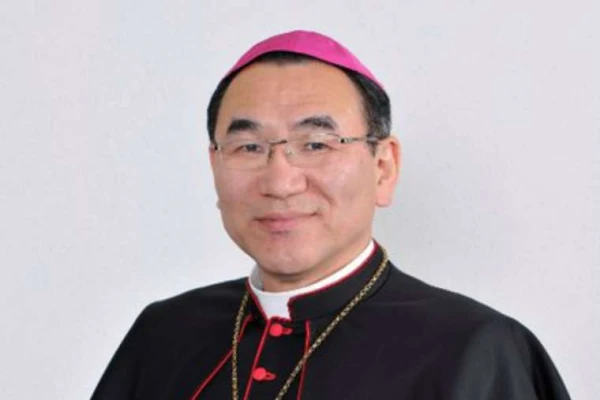
Tokyo, Japan, Nov 20, 2019 / 04:00 am (CNA).- The Archbishop of Tokyo, Isao Kikuchi, spoke with CNA about the challenge for Japanese Catholic churches to keep Catholics engaged, in the face of ongoing population decline and growing religious apathy from Japanese youth.
“Population decline due to the low birth rate and the aging population is not just a problem for the church but a problem for the entire Japanese society.”
The archbishop’s remarks came shortly before Pope Francis is due to visit Japan Nov. 23-26.
The “birthrate crisis,” as the Japanese call it, is indeed considered one of the most dangerous threats facing Japan’s short-term future.
Each successive generation since the economic bubble has dropped in population, with many Japanese going unmarried or remaining childless. Even among young parents who do conceive, the average amount of children is between one and two.
Families with three children are not very common, and families with more than three are extremely rare.
This ongoing collapse in the national population has negatively affected all sects of Japanese society. Young men and women now face a future in a country with an economy expected to drastically worsen. Elderly generations are finding it difficult to survive on the government’s retirement budget as the gap between the number of elderly retirees and the number of working citizens gradually shrinks.
“For example, when we look at the situation in convenience stores, many of those who work there are either elderly Japanese people or young foreigners,” Archbishop Kikuchi told CNA.
Until recently, foreign convenience store clerks had been a rarity in Japan. Now, close to 60,000 foreigners are employed at convenience stores throughout the country. Many are students seeking part-time work while living abroad.
“The same scenario is reflected in the church today, and since it is no different from the situation of the Japanese society, I do not feel that it is in a dangerous level as it is,” Kikuchi said.
“Rather, since the church is a small community accounting only to less than 1% of the population, I see it as an opportunity for the Good News to be preached everywhere, a potential to yet expand evangelization activities.”
According to the most recent available data, approximately 35% of Japanese claim Buddhism as their religion, while around 3-4% claim strict adherence to Shinto or associated folk religions. Only 1-2% of Japanese claim Christianity as their religion, and only around half of Japanese Christians are Catholic.
“I acknowledge however that the Catholic faith not being passed on by the parents to their children is a big problem. This is due primarily to the collapse of the traditional Japanese family system in the context of our present society.”
The Japanese sense of the “traditional family system” to which the archbishop refer is straightforward: a hard-working father who puts bread on the table; a mother dedicated to keeping the wallet, house, and kids in check; the children, who spend time between the home, school, and community groups such as sports teams; and the grandparents, typically parents of the mother, who help raise the children and maintain the house as best they can.
This style of family has also been called a “multi-generational household,” and is becoming increasingly rare in Japan, especially in major metropolitan areas such as Tokyo.
“The collapse is caused by the situation in the workplace that goes along with the changing Japanese economic situation (non-regular employment, overtime, working parents),” said Archbishop Kikuchi.
“And the excessive activities in the education of children,” the archbishop added, noting that extracurricular activities are held on Saturdays, Sundays and holidays, and students are often tied up for extra hours in “cram schools” due to the deterioration of the quality of education.
Japan’s ruthless work culture is hardly unknown. The image of the exhausted salaryman working unpaid overtime deep into the night is a symbol that is recognizably Japanese in countries around the world, and one of the most enduring stereotypes of the Japanese people.
In recent generations, women have also more frequently entered the workforce – willingly or sometimes without a choice due to the economic pressures of raising children.
Less well known, however, are the strict expectations put on middle school and high school students to join and participate in after-school groups with their peers. More than just the competitive sports teams – clubs for music, art, and dance prove to be highly demanding of children’s time.
Just as their parents are burdened with work expectations, children often spend more time out of the house than in it.
“From abroad, we even hear voices pointing out that school and community events held on Saturdays and Sundays are silently persecuting religion,” laments the archbishop.
Many athletic groups demand members to practice on Saturday and Sunday – the time when most families should be going to mass.
“In addition, such a collapse in the traditional Japanese family system has caused marriages to break down, with single mothers raising their children in poverty,” said the archbishop.
“Under such circumstances, it has become difficult to find time to bring children to church on Sundays, and likewise difficult to find time to share the faith at home.”
While club participation isn’t mandatory, it is expected. Failing to join a sports team or interest-based group can severely handicap a student socially.
And while couples are financially rewarded for creating larger families, the government has been unable to give young Japanese a sufficient push to make them comfortable with the traditional idea of family-making.
Free kindergarten and child-care have recently been established after a recent bill passed – the legislation was offered as a way to encourage more children, taking the burden of early care off of the mother and father.
But monthly stipends and free nursery school are not enough to pull the tide of Japanese population decline in the other direction.
“Merely admonishing people to bring back the traditional home is not a solution. The problem concerns not only the church, but must be tackled by the entire society. Should this situation continue on, I am afraid not only the home but also the local community will collapse and disappear from the whole Japanese society.”
 […]
[…]




Families are the backbone of Planet Earth, our common home. May each family be blessed with strength, courage, a happy present, and a bright future.
A beautiful prayer. God bless you.
Re title of this article – I guess this is what Phil Lawler was on about the other day in Catholic Culture. (Sorry, I can’t re-find the article). I see Bishop (Arch?) Schneider, usually no slouch, also has reservations.
Religious pluralism.
Then why bother with the Catholic Church and its specific claims to Revelation and the truth?
Ramjet above – exactly.
At the World’s Congress of Religions (August 25 through October 15, 1893), which was concurrent with the World’s Columbian Exposition in Chicago, some 120 or more major papers were delivered. Of the over 100 presenters, seven were Catholic. Of these, Cardinal Gibbons (in his seven pages of small print) delivered a fraternal, and also forthright, and even modern address, including this:
“The religion of Christ imparts to us not only a sublime conception of God, but also a rational idea of man and of his relations to his Creator [….] The Gospel of Christ, as propounded by the Catholic church, has brought not only light to the intellect, but comfort also to the heart. It has given us ‘that peace of God which surpasseth all understanding”–the peace which springs from the conscious possession of the truth [….]
“The Catholic Church has taught man the knowledge of God and of himself [see Gaudium et spes, n. 22]; she has brought comfort to his heart by instructing him to bear the ills of this life with Christian philosophy [e.g., the later corpus of St. John Paul II]; she has sanctified the marriage bond [yes?]; she has proclaimed the sanctity and inviolability of human life from the moment that the body is animated by the spark of life till it is extinguished [timely!]; she has founded asylums for the training of children of both sexes and for the support of the aged poor; she has established hospitals for the sick and homes for the redemption of fallen women [or now, pro-life centers]; she has exerted her influence toward the mitigation and abolition of human slavery [and today’s sex trafficking]; she has been unwavering friend of the sons of toil [Rerum Novarum, 1891]. These are some of the blessings which the Catholic church has conferred on society.”
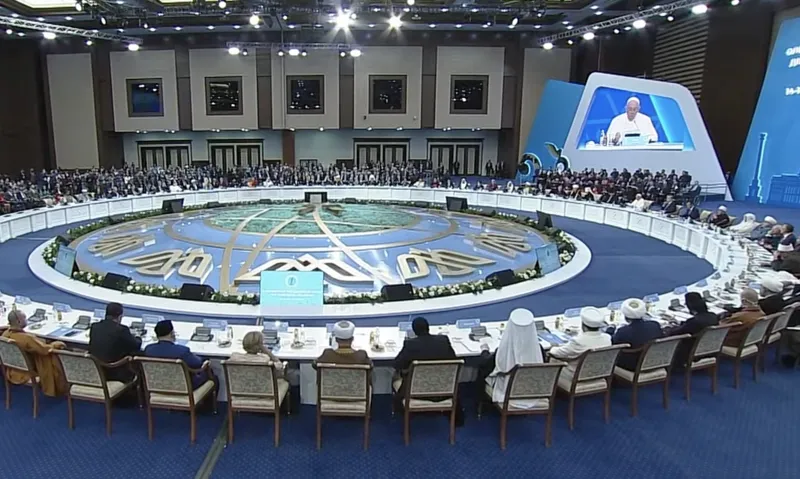
If possibly not a fitting focus from a guest to the interreligious congress in Kazakhstan, then surely some clear and non-generic reference points of the Faith, for fledgling superdicastery of Evangelization instituted as part of the current curial reform.
1) 1893. Why can’t we hear this today? Oh, sorry. Too triumphalist.
2) I think I was mistaken in thinking I had read an article by Phil Lawler on this notion of religious pluralism as God’s (active) will. I’ll have to go with just Bishop Schneider.
Jesus is the only way to Heaven!
Repent of your sins and turn to him as your Lord and Savior! We live in the end times.