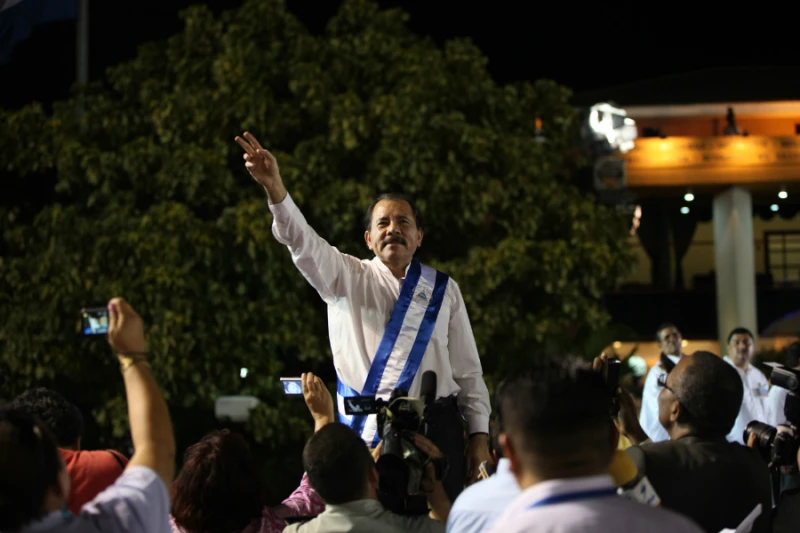
Daniel Ortega celebrates his re-inauguration as president of Nicaragua, Jan. 10, 2012. / Cancilleria del Ecuador via Flickr (CC BY-SA 2.0).
Washington, D.C. Newsroom, Aug 16, 2022 / 14:00 pm (CNA).
Human rights activist Bianca Jagger is raising awareness of the Nicaraguan regime’s oppression of the Catholic Church, calling on Pope Francis to condemn the government’s targeted attacks on the faithful.
In a statement earlier this week, Jagger said she was “deeply saddened and concerned … by the silence of the Holy Father.”
In an interview with Crux, Jagger – who is Nicaraguan herself – stated that the Catholic Church is one of the last targets standing in the breach against Nicaraguan president Daniel Ortega and his wife and vice president, Rosario Murillo.
Ortega has been president of Nicaragua since 2007, and oversaw the abolition of presidential term limits in 2014.
He was a leader in the Sandinista National Liberation Front, which had ousted the Somoza dictatorship in 1979 and fought US-backed right-wing counterrevolutionaries during the 1980s. Ortega was also leader of Nicaragua from 1979 to 1990.
Nicaraguan attacks against Catholics intensify
According to Jagger, the Ortega regime – which has long oppressed Nicaraguan citizens, civil organizations and media – is now turning its focus to attacking the Church.
Now that the regime has silenced independent journalists, political opposition, and human rights activists, they “understand that the great leaders of the country are members of the Catholic Church: the bishops, the priests, the religious sisters and the laity,” Jagger said.
In a recent attack, the government arrested Bishop Rolando Álvarez of Matagalpa Aug. 4, along with several priests, seminarians, and laypeople following the banning of an Our Lady of Fatima procession by Nicaraguan police. Álvarez remains under house arrest, an effort to “declare war against the Catholic Church,” according to Jagger.
Ortega also expelled the Missionaries of Charity from the country in July.
Pope Francis has not spoken out
When asked by Crux about Pope Francis’ silence, Jagger stated, “I am deeply saddened and concerned, surprised, by the silence of the Holy Father.”
Jagger has publicly appealed to Pope Francis to address the unfolding situation in Nicaragua.
“I am appealing to him not to order Bishop Rolando Alvarez to leave the country,” she said, urging that “Getting rid of all the bishops and priests who stand up, who have the courage to stand up, is not the answer. The answer is to intercede, and speak up against the man who has declared a war against the Catholic Church.”
Bishop Silvio José Báez Ortega, an auxiliary bishop of Managua, has been living in exile since 2019 at the pope’s request.
The Vatican did not immediately respond to CNA’s request for comment.
The far-left Ortega regime has been accused of corruption, voter fraud, imprisoning critical dissenters and journalists, and committing violent human rights abuses against the people of Nicaragua.
Both the current and former U.S. presidents have condemned Ortega for these acts. The Trump administration first imposed sanctions against the regime in 2018. President Biden signed the bi-partisan RENANCER Act, which extended sanctions, and called the 2021 re-election of Ortega a “sham.”
Jagger’s activism and faith
Bianca Jagger is a human rights activist, former actress, and ex-wife of Mick Jagger, the lead singer of The Rolling Stones, whom she married in a Catholic ceremony in 1971. The couple divorced in 1978, but Jagger continues to practice the faith.
“Once a Catholic, always a Catholic…Religion is a very important aspect of my life,” she said in a 2008 interview with High Profiles.
Her past activism has included lobbying for wider celebration of the Latin Mass (TLM) in England.
The Bianca Jagger Foundation did not immediately respond to CNA’s request for comment.
If you value the news and views Catholic World Report provides, please consider donating to support our efforts. Your contribution will help us continue to make CWR available to all readers worldwide for free, without a subscription. Thank you for your generosity!
Click here for more information on donating to CWR. Click here to sign up for our newsletter.
Bishops process into St. Peter’s Basilica for the closing Mass of the first assembly of the Synod on Synodality on Oct. 29, 2023. / Vatican Media
Rome Newsroom, Jul 9, 2024 / 06:00 am (CNA).
The guiding document for the final part of the Synod on Synodality, published Tuesday, focuses on how to implement certain of the synod’s aims, while laying aside some of the more controversial topics from last year’s gathering, like women’s admission to the diaconate.
“Without tangible changes, the vision of a synodal Church will not be credible,” the Instrumentum Laboris, or “working tool,” says.
The six sections of the roughly 30-page document will be the subject of prayer, conversation, and discernment by participants in the second session of the 16th Ordinary General Assembly of the Synod of Bishops, to be held throughout the month of October in Rome.
Instead of focusing on questions and “convergences,” as in last year’s Instrumentum Laboris, “it is now necessary that … a consensus can be reached,” said a FAQ page from synod organizers, also released July 9, answering a question about why the structure was different from last year’s Instrumentum Laboris.
The guiding document for the first session of the Synod on Synodality in 2023 covered such hot-button topics as women deacons, priestly celibacy, and LGBTQ outreach.
By contrast, this year’s text mostly avoids these subjects, while offering concrete proposals for instituting a listening and accompaniment ministry, greater lay involvement in parish economics and finances, and more powerful parish councils.
“It is difficult to imagine a more effective way to promote a synodal Church than the participation of all in decision-making and taking processes,” it states.
The working tool also refers to the 10 study groups formed late last year to tackle different themes deemed “matters of great relevance” by the Synod’s first session in October 2023. These groups will continue to meet through June 2025 but will provide an update on their progress at the second session in October.
The possibility of the admission of women to the diaconate will not be a topic during the upcoming assembly, the Instrumentum Laboris said.
The new document was presented at a July 9 press conference by Cardinals Mario Grech and Jean-Claude Hollerich, together with the special secretaries of the synodal assembly: Jesuit Father Giacomo Costa and Father Riccardo Battocchio.
“The Synod is already changing our way of being and living the Church regardless of the October assembly,” Hollerich said, pointing to testimonies shared in the most recent reports sent by bishops’ conferences.
The Oct. 2-27 gathering of the Synod on Synodality will mark the end of the discernment phase of the Church’s synodal process, which Pope Francis opened in 2021.
Participants in the fall meeting, including Catholic bishops, priests, religious, and laypeople from around the world, will use the Instrumentum Laboris as a guide for their “conversations in the Spirit,” the method of discussion introduced at the 2023 assembly. They will also prepare and vote on the Synod on Synodality’s advisory final document, which will then be given to the pope, who decides the Church’s next steps and if he wishes to adopt the text as a papal document or to write his own.
The third phase of the synod — after “the consultation of the people of God” and “the discernment of the pastors” — will be “implementation,” according to organizers.
Prominent topics
The 2024 Instrumentum Laboris also addresses the need for transparency to restore the Church’s credibility in the face of sexual abuse of adults and minors and financial scandals.
“If the synodal Church wants to be welcoming,” the document reads, “then accountability and transparency must be at the core of its action at all levels, not only at the level of authority.”
It recommends effective lay involvement in pastoral and economic planning, the publication of annual financial statements certified by external auditors, annual summaries of safeguarding initiatives, the promotion of women to positions of authority, and periodic performance evaluations on those exercising a ministry or holding a position in the Church.
“These are points of great importance and urgency for the credibility of the synodal process and its implementation,” the document says.
The greater participation of women in all levels of the Church, a reform of the education of priests, and greater formation for all Catholics are also included in the text.
Bishops’ conferences, it says, noticed an untapped potential for women’s participation in many areas of Church life. “They also call for further exploration of ministerial and pastoral modalities that better express the charisms and gifts the Spirit pours out on women in response to the pastoral needs of our time,” the document states.
Formation in listening is identified as “an essential initial requirement” for Catholics, as well as how to engage in the practice of “conversation in the Spirit,” which was employed in the first session of the Synod on Synodality.
Pope Francis and delegates at the Synod on Synodality at the conclusion of the assembly on Oct. 28, 2023. Credit: Vatican Media
The document says the need for formation has been one of the most universal and strong themes throughout the synodal process. Interreligious dialogue also is identified as an important aspect of the synodal journey.
On the topic of the liturgy, the Instrumentum Laboris says there was “a call for adequately trained lay men and women to contribute to preaching the Word of God, including during the celebration of the Eucharist.”
“It is necessary that the pastoral proposals and liturgical practices preserve and make ever more evident the link between the journey of Christian initiation and the synodal and missionary life of the Church,” the document says. “The appropriate pastoral and liturgical arrangements must be developed in the plurality of situations and cultures in which the local Churches are immersed …”
How it was drafted
Dubbed the “Instrumentum Laboris 2,” the document released Tuesday has been in preparation since early June when approximately 20 experts in theology, ecclesiology, and canon law held a closed-door meeting to analyze around 200 synod reports from bishops’ conferences and religious communities responding to what the Instrumentum Laboris called “the guiding question” of the next stage of the Synod on Synodality: “How to be a synodal Church in mission?”
After the 10-day gathering, “an initial version” of the text was drafted based on those reports and sent to around 70 people — priests, religious, and laypeople — “from all over the world, of various ecclesial sensitivities and from different theological ‘schools,’” for consultation, according to the synod website.
The XVI Ordinary Council of the General Secretariat of the Synod, together with consultants of the synod secretariat, finalized the document.
According to the working tool, soliciting new reports and feedback after the consultation phase ended is “consistent with the circularity characterizing the whole synodal process.”
“In preparation for the Second Session, and during its work, we continue to address this question: how can the identity of the synodal People of God in mission take concrete form in the relationships, paths and places where the everyday life of the Church takes place?” it says.
The document says “other questions that emerged during the journey are the subject of work that continues in other ways, at the level of the local Churches as well as in the ten Study Groups.”
Expectations for final session
According to the guiding document, the second session of the Synod on Synodality can “expect a further deepening of the shared understanding of synodality, a better focus on the practices of a synodal Church, and the proposal of some changes in canon law (there may be yet more significant and profound developments as the basic proposal is further assimilated and lived.)”
“Nonetheless,” it continues, “we cannot expect the answer to every question. In addition, other proposals will emerge along the way, on the path of conversion and reform that the Second Session will invite the whole Church to undertake.”
The Instrumentum Laboris says, “Synodality is not an end in itself … If the Second Session is to focus on certain aspects of synodal life, it does so with a view to greater effectiveness in mission.”
In its brief conclusion, the text states: “The questions that the Instrumentum Laboris asks are: how to be a synodal Church in mission; how to engage in deep listening and dialogue; how to be co-responsible in the light of the dynamism of our personal and communal baptismal vocation; how to transform structures and processes so that all may participate and share the charisms that the Spirit pours out on each for the common good; how to exercise power and authority as service. Each of these questions is a service to the Church and, through its action, to the possibility of healing the deepest wounds of our time.”
The European Court of Human Rights in Strasbourg, Germany / CherryX|Wikipedia|CC BY-SA 3.0
Washington D.C., Feb 6, 2023 / 09:55 am (CNA).
The European Court of Human Rights ruled Jan. 17 that Russia violated the human rights of three homosexual… […]
Pope Francis delivers his Sunday Angelus message to about 20,000 faithful in St. Peter’s Square at the Vatican on Oct. 22, 2023. / Credit: Vatican Media
Vatican City, Oct 31, 2023 / 08:50 am (CNA).
In the Catholic Church, the first days of November are an important time for remembering those who have come and gone before us — both the holy men and women who are canonized saints in heaven and our departed loved ones we hope and pray are also partaking in the beatific vision.
At the Vatican, Pope Francis will mark this holy and significant season with prayer and two liturgies.
On the solemnity of All Saints on Nov. 1, Pope Francis will give a short address and lead the Angelus, a traditional Marian prayer, from a window overlooking St. Peter’s Square at noon Rome time.
It is the pope’s custom to lead an Angelus on holy days of obligation.
Since All Saints’ Day falls on a Wednesday this year, Francis will not hold his usual weekly general audience.
For All Souls’ Day on Nov. 2, he will continue his recent custom of holding a Mass at a cemetery to pray for the dead.
Since 2016, Pope Francis has celebrated a Mass at five different cemeteries in or near Rome. For All Souls’ Day in 2019, he celebrated Mass at the Catacombs of Priscilla, while in 2022 he did not visit a cemetery but offered Mass for deceased bishops and cardinals in St. Peter’s Basilica — another papal custom during the week of All Saints’ and All Souls’ Days.
For 2023, Francis will again return to a cemetery to mark All Souls’ Day. He will preside over a Mass at 10 a.m. at the Rome War Cemetery, which contains 426 Commonwealth burials from the Second World War.
The small cemetery is near the Pyramid of Cestius, a Roman-era pyramid in the Ostiense neighborhood south of the historic center of Rome.
The following morning, on Nov. 3, Pope Francis will preside over a Mass in St. Peter’s Basilica for the repose of the soul of Pope Benedict XVI and the bishops and cardinals who have died in the previous year. It is the pope’s practice to offer this Mass sometime during the first week of November.
What a time to be alive – even Bianca Jagger is exasperated by Rome. Seriously, perhaps the most underappreciated scandal of this Papacy is the obvious sympathy that Francis has for hard leftist regimes (Communist or not) that, among their other crimes, openly persecute the Church. The situation in China has deservedly gotten attention, but it is just as bad in Latin America and elsewhere.
Well, I never thought I’d see the day when Bianca Jagger defends the Church against the dictatorial regime in her country while the (Latin American) Pope is nowhere in sight.
Expecting someone who accepts as a gift Christ crucified on the Communist hammer and sickle, which is still kept at Rome, should not be expected to lift a finger regarding Nicaragua.
CCP / Noriega / El Che’ / Fidel all are friends of Francis. Bet on it.
The tyrant ortega has been president there for more year than I care to count, which means that he is getting older and older which means in turn that the day is approaching when he will have to answer for his deeds.







What a time to be alive – even Bianca Jagger is exasperated by Rome. Seriously, perhaps the most underappreciated scandal of this Papacy is the obvious sympathy that Francis has for hard leftist regimes (Communist or not) that, among their other crimes, openly persecute the Church. The situation in China has deservedly gotten attention, but it is just as bad in Latin America and elsewhere.
Well, I never thought I’d see the day when Bianca Jagger defends the Church against the dictatorial regime in her country while the (Latin American) Pope is nowhere in sight.
Expecting someone who accepts as a gift Christ crucified on the Communist hammer and sickle, which is still kept at Rome, should not be expected to lift a finger regarding Nicaragua.
CCP / Noriega / El Che’ / Fidel all are friends of Francis. Bet on it.
The tyrant ortega has been president there for more year than I care to count, which means that he is getting older and older which means in turn that the day is approaching when he will have to answer for his deeds.