


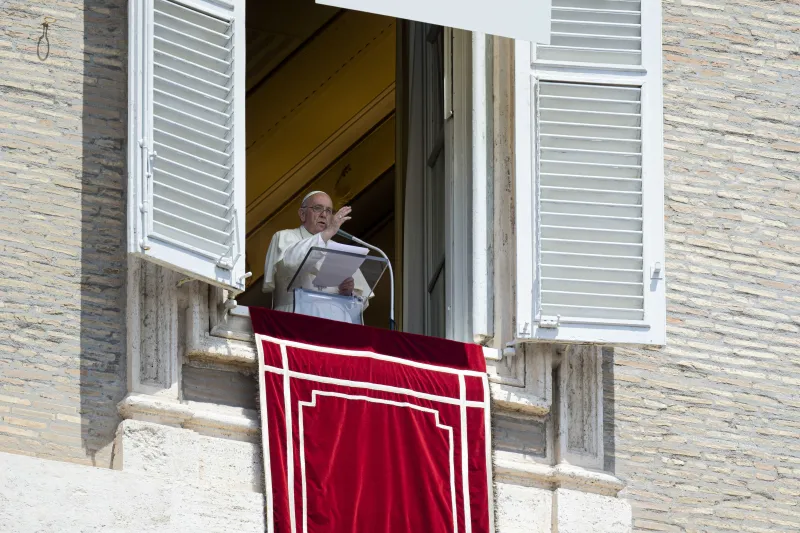
Vatican City, Jul 10, 2022 / 08:00 am (CNA).
Pray for the grace to see and treat others with the compassion of God, Pope Francis said on Sunday.
In his message before the Angelus July 10, the pope spoke about the Parable of the Good Samaritan and the responsibility to help those in need.
Rather than “pointing fingers at others” who do not help the poor, or blaming ourselves for our mistakes, “I would like to suggest another type of exercise to you all,” he said from a window overlooking St. Peter’s Square.
“This is the prayer that I suggest to you today,” he said: “‘Lord, that I might see and have compassion just like you see me and have compassion on me’ — that we might have compassion on those whom we encounter along the way, above all on those who suffer and are in need, to draw near to them and do what we can do to give them a hand.”
He explained that we must acknowledge when we have been indifferent towards the needs of others. “Let us ask the Lord,” he said, “to help us overcome our selfish indifference and put ourselves on the Way.”
The pope said the first Christians were called “disciples of the Way,” because they followed Jesus Christ, who is “the way, and the truth, and the life.”
As Christian believers, Francis said, we strongly resemble the Good Samaritan in the parable because we are also on a journey.
“Walking in the footsteps of Christ, the disciple becomes a wayfarer and — like the Samaritan — learns to see and to have compassion,” he said.
To really see, the pope said, means to have eyes open to reality, “not egoistically closed in on the circle of their own thoughts.”
“The Gospel teaches us to see — it leads each of us to correctly understand reality, overcoming preconceptions and dogmatism each day,” he continued, adding that “so many believers take refuge behind dogmatisms to defend themselves from reality.”
Having eyes open to reality “teaches us to follow Jesus, because following Jesus teaches us to have compassion — to see and to have compassion — to become aware of others, especially those who suffer, those who are in need, and to intervene like the Samaritan, not to pass by but to stop,” he said.
Pope Francis also encouraged everyone to not avoid human contact with the people they help.
“If you give alms without touching the reality, without looking into the eyes of the person in need, those alms are for you, not for that person,” he said. “Think about this. Do I touch misery, even the misery that I am helping? Do I look into the eyes of the people who suffer, of the people that I help?”
If you value the news and views Catholic World Report provides, please consider donating to support our efforts. Your contribution will help us continue to make CWR available to all readers worldwide for free, without a subscription. Thank you for your generosity!
Click here for more information on donating to CWR. Click here to sign up for our newsletter.



Bending low to uplift the downtrodden is a win-win situation. Compassion, mercy, empathy, sympathy – empowers the receiver and enriches the giver.
“That we might have compassion on those whom we encounter along the way, above all on those who suffer and are in need, to draw near to them and do what we can do to give them a hand”. Francis when at his best addresses reality as we experience, leaving us with the pointed question, Do we see and touch the ones in need or is almsgiving purely incidental to satisfy our own need? We may assent to the truth in this, although truth may have a wider spectrum. Interior disposition a demarcation between caritas and convention, the latter the wealthy who contribute large sums for sake of appearance, perhaps prospect of appeasing God. inspired by the Holy Spirit seeks no reward other than the good. All acts of charity have teleological coherence with the Rule, who is God. The measure is the deliberative good intended evident in the act. If, like Francis, we undermine those principles that determine a good end, that end is manifestly obscure interiorly incoherent with the Rule, the beginning and end of all good acts. As Christ alludes, even criminals love those who love them. Even criminals are known to give to the poor for sake of show, a sense of self affirmation. Conscience is only valid when it is formed with knowledge of the good, that which is prescient within the soul, the natural law within, and revealed by God through and in his Son. A poorly formed conscience does not in this context find validity because of its selectivity, since all, that is, universally share the same human nature created in God’s image with the same inherent principles of determining good from evil. Added is a response [TCT] by Fr Gerald Murray to Pope Francis’ allusion to Archbishop Cordileone on Pastors not being pastoral: “Cordileone did nothing more than simply and courageously enforce canon law in view of the ‘salvation of souls, which in the Church must always be the supreme law.’ [canon 1752]. When he promulgated the Code of Canon Law in 1983, Pope St. John Paul II stated: We therefore, exhort all our beloved children to observe, with sincere mind and ready will, the precepts laid down, buoyed by the hope that a zealous Church discipline will flourish anew, and that from it the salvation of souls will be ever more fervently promoted, with the assistance of the Blessed Virgin Mary, Mother of the Church’” (Apostolic Constitution Sacrae disciplinae leges). In summary this is what remains the paramount issue with this pontificate, which has undermined for stated purpose of merciful love the inviolability of principles of justice that shape our right reason and form conscience. Charity then is not a throw blanket that warmly covers our sins. That idea is completely dispelled with Christ’s passion and death on the Cross.
Unable to comment on Sandra Miesel’s as usual informative historical account, this one The blessings and example of St Benedict, I’ll post here perhaps too not out of place.
What struck me were Ms Miesel’s references to miracles, which having been duly corrected [with a nuance of admonition] by her on the miracle of the Holy Eucharist at Bolsena, as having contributed to the celebration of the solemnity – that the alleged miracle had no influence on the institution of the solemnity. I’ve been careful since. Surprised [happily] today to find her listing in detail several miracles [not one] attributed to St Benedict. From a blessing that shattered a poisoned cup of wine, to bread poisoned by a local jealous pastor, apprehended as such by Benedict, who then orders a raven to carry it away into the wilderness, to seven dancing naked girls [around the hermitage] to tempt Benedict.
Seven! It would take only one to sorely test me. But then Benedict was a great saint. What marvels of proof of Benedict’s sanctity. I’m edified by Ms Miesel’s seeming change of heart on miracles. Perhaps she might reconsider the influence of the alleged one at Bolsena.