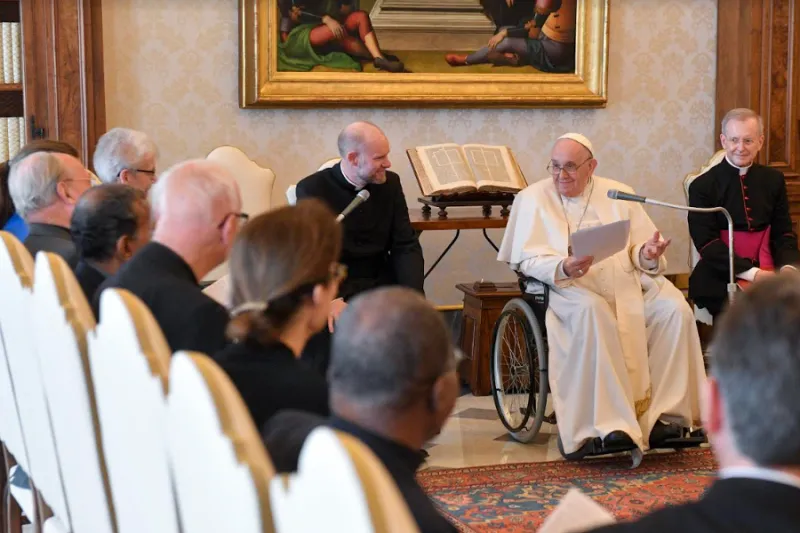
Pope Francis meets with members of the Anglican-Roman Catholic International Dialogue Commission (ARCIC) at the Vatican, May 13, 2022. / Vatican Media.
Vatican City, May 13, 2022 / 12:20 pm (CNA).
Pope Francis said on Friday that members of the Anglican Communion are “valued traveling companions” as Catholics take part in a worldwide synodal process.
Speaking to the Anglican-Roman Catholic International Dialogue Commission (ARCIC) on May 13, the pope said he hoped that Anglicans would contribute to the two-year initiative leading to the Synod on Synodality in Rome in 2023.
He said: “As you know, the Catholic Church has inaugurated a synodal process: for this common journey to be truly such, the contribution of the Anglican Communion cannot be lacking. We look upon you as valued traveling companions.”
The 85-year-old pope noted that in July he is due to travel to South Sudan with Justin Welby, the Archbishop of Canterbury and leader of the Anglican Communion.
The pope, who has been making his public appearances in a wheelchair since May 5 due to a torn ligament in his right knee, said: “As part of this concrete journey, I wish to recommend to your prayers an important step. Archbishop Justin Welby and the Moderator of the Church of Scotland, two dear brothers, will be my traveling companions when, in a few weeks’ time, we will at last be able to travel to South Sudan.”
“The visit was postponed on account of the troubles in that country. My brother Justin is sending his wife ahead of us for the works of preparation and charity. This is the fine work he is doing with his wife, as a couple, and I thank her very much.”
He added: “Ours will be an ecumenical pilgrimage of peace. Let us pray that it may inspire Christians in South Sudan and everywhere to be promotors of reconciliation, patient weavers of concord, capable of saying no to the perverse and useless spiral of violence and of arms.”
The Anglican Communion is the world’s third-largest Christian communion after the Catholic Church and Eastern Orthodox Church. It has an estimated 85 million members in more than 165 countries.
ARCIC was founded in 1967 by the then Archbishop of Canterbury Michael Ramsey and Pope Paul VI. Currently in its third phase, the commission’s most recent document is entitled “Walking Together on the Way.”
If you value the news and views Catholic World Report provides, please consider donating to support our efforts. Your contribution will help us continue to make CWR available to all readers worldwide for free, without a subscription. Thank you for your generosity!
Click here for more information on donating to CWR. Click here to sign up for our newsletter.
Vatican City, Jan 31, 2020 / 03:15 pm (CNA).- A text presented Friday by Roberto de Mattei of Corrispondenza Romana as a portion of Pope Francis’ apostolic exhortation following the Amazon synod is a draft, and not necessarily the final version, according to a Vatican source.
“What is now circulating is one draft, which was distributed for review and comment as the final text is developed,” a source in the Dicastery for Communication told CNA Jan. 31.
The text provided by de Mattei is substantially identical to article 111 of the final document of the Amazon synod, which calls for the ordination of married men as priests.
That article of the final document proposes “that criteria and dispositions be established by the competent authority, within the framework of Lumen Gentium 26, to ordain as priests suitable and respected men of the community … who have had a fruitful permanent diaconate and receive an adequate formation for the priesthood, in order to sustain the life of the Christian community through the preaching of the Word and the celebration of the Sacraments in the most remote areas of the Amazon region.”
According to de Mattei, the text he published came to him “from several bishops” who had received a portion of the forthcoming apostolic exhortation.
Earlier this month Cardinal Claudio Hummes, the relator general of the Amazon synod, sent a letter to some ordinaries indicating that the apostolic exhortation should be promulgated in January or February.
“The draft is currently being reviewed and corrected and then needs to be translated. Pope Francis hopes to promulgate it by the end of this month or in early February,” Cardinal Hummes, who is also president of the Pan Amazonic Church Network, wrote in a Jan. 13 letter.
Among the works of REPAM is “protection for the 137 ‘contactless tribes’ of the Amazon and affirmation of their right to live undisturbed.”
Cardinal Hummes said in his letter that Francis is preparing the exhortation “to present the New Paths for the Church and for an Integral Ecology as developed with the guidance of the Holy Spirit” during the Amazon synod.
According to Cardinal Hummes, the exhortation “is keenly awaited and will attract great interest and many different responses.”
The cardinal added that the pope wants ordinaries to receive the text “before it is published and before the world press starts to comment on it, and join him in presenting the Exhortation and making it accessible to the faithful, to fellow believers and all people of good will, and to the media, the academic world, and others in positions of authority and influence.”
Cardinal Hummes offered “some suggestions” to bishops on how to prepare well for the exhortation’s release. “The purpose is not to generate publicity or attract attention. Rather, it is quietly to support you the Ordinary, in communion with Pope Francis, as you prepare to receive the Exhortation and pass it on to the People of God in your jurisdiction.”
In addition to advocating the priestly ordination of married men, the synod’s final document called for women to be considered for diaconal ordination. It presented the synod assembly’s reflections and conclusions on topics ranging from environmentalism, inculturation in the Church, and the human rights of indigenous communities in the face of economic, environmental, and cultural exploitation.
Four days before the final document was approved, Cardinal Christoph Schönborn of Vienna indicated that it was to be written principally by a team chaired by Cardinal Hummes.
Father Patrick Hughes shows how to make a traditional St. Brigid’s Cross in County Cavan, Ireland. / Credit; Courtney Mares/CNA
Rome Newsroom, Feb 1, 2024 / 06:00 am (CNA).
Ireland on Thursday is celebrating the 1,500th anniversary of the death of St. Brigid of Kildare, the Emerald Isle’s female patron saint.
St. Brigid (c. 453–524 A.D.) is credited with pioneering female monastic life in Ireland. Her feast is celebrated on Feb. 1, which became an annual public bank holiday across Ireland last year in her honor.
“St. Brigid was a huge figure of authority in the early Church, baptized by St. Patrick, professed by St. Mel, spiritual adviser to St. Conleth,” Bishop Denis Nulty of Kildare and Leighlin said at a Mass ahead of her feast.
Ireland’s Kildare County has organized lectures, pilgrimages, and many activities in its Brigid 1500 Program to mark the anniversary, including a workshop on how to weave a St. Brigid’s Cross — St. Brigid’s most enduring symbol.
A St. Brigid’s cross is traditionally made out of rushes or reeds freshly pulled from the ground.
Father Patrick Joseph Hughes, a country priest in County Cavan, can make a St. Brigid’s cross from rushes in a matter of minutes.
Hughes told CNA that the story that has been handed down over the years is that St. Brigid was trying to explain to the local chieftain, who did not believe in God, that Jesus was his savior and died on a cross for him. The chieftain did not understand, so she made a cross out of rushes from the ground and presented it to him: “‘Look,’ she said, ‘that’s a cross, and Jesus was stretched out on that for the world.’”
On the eve of the Feast of Saint Brigid, it is tradition in Ireland to make a St. Brigid’s Cross out of rushes.
Last year while we were filming in Ireland, Father Patrick Hughes gave us a quick demonstration of how to make one.
St. Brigid’s Catholic Church in Kildare will kick off the feast day on Feb. 1 with a Mass at 9:15 a.m. offered by Bishop Nulty.
The bishop recently installed St. Brigid’s relics in St. Brigid’s Catholic Church on Jan. 29 as part of the 1,500th anniversary celebrations.
The relics were taken from the bone fragment of St. Brigid’s head, which has been kept in St. John the Baptist Church in Lumiar, Portugal, since three Irish knights brought it there in 1273. The Portuguese church gave the relic to the Brigidine Sisters in Tullow, Ireland, in the 1930s, and they recently gifted it to St. Brigid’s in Kildare.
“Today we have brought her home,” Nulty said. “Obtaining the relic of a saint like Brigid is no easy feat. I visited Lumiar in October 2021 with the singular intention of securing a relic for St. Brigid’s Church. I was privileged then to hold the relic of her head, which is contained in a splendid brass casket. Sadly, I couldn’t squeeze it into my Ryan Air flight bag!”
Notably, the Catholic bishop and female Anglican leaders will also come together for an ecumenical service at 11 a.m. on the feast day at the historic St. Brigid’s Cathedral, built on the site of the ancient hilltop where St. Brigid founded her monastery in the year 480 A.D. The previously Catholic cathedral, consecrated in 1230, is now an Anglican cathedral.
The service will be followed by a “pause for peace,” a minute of silent prayer for peace. St. Brigid was known as a peacemaker. Among the many stories told about St. Brigid, local tradition holds that Brigid gave away her father’s sword in exchange for food for a family suffering from hunger.
The fifth-century abbess St. Brigid is one of Ireland’s three patron saints, along with St. Patrick and St. Columba. Most historians place her birth around the year 450, near the end of St. Patrick’s evangelistic mission.
St. Brigid. Credit: Octave 444, CC BY-SA 4.0, via Wikimedia Commons
It is notoriously hard to establish the historical details of Brigid’s life, but according to one of the more credible biographies of Brigid — Hugh de Blacam’s essay in “The Saints of Ireland” — Brigid was born out of wedlock to a pagan chieftain named Dubthach and a Christian slave woman named Broicsech. The chieftain sold the child’s pregnant mother to a new master but contracted for Brigid to be returned to him eventually.
Brigid was likely baptized as an infant and raised as a Catholic by her mother. Thus, she was well formed in the faith before leaving Broicsech’s slave quarters at around age 10 to live with Dubthach and his wife.
After this, Brigid’s faith grew immensely. She gave generously to the poor and tended to the sick. One story says Brigid once gave away her mother’s entire store of butter, which was later replenished after Brigid prayed.
Once she was released from servitude, she was expected to marry. However, Brigid had no interest in marrying. She went so far as to disfigure her own face and prayed that her beauty be taken from her so no one would want to marry her. Because she refused to change her mind about marriage, she received permission to enter religious life.
Brigid, along with seven friends, is credited with organizing communal consecrated religious life for women in Ireland.
In 480, Brigid founded her monastery in Kildare, which was called “Church of the Oak.” The monastery sat on top of a shrine to a Celtic goddess. Throughout the rest of her life, she established several monasteries across Ireland.
Brigid rooted her life as a nun in prayer, but she also performed substantial manual labor: cloth making, dairy farming, and raising sheep. She also spent time traveling across Ireland founding new houses and building up a uniquely Irish form of monasticism. When she was not traveling, pilgrims made their way to Kildare, seeking the advice of the abbess.
“What were the character traits that defined St. Brigid of Kildare? To mention just a few, she was hospitable, she was a peacemaker, she was a strong woman of faith,” Nulty said.
This reader recalls a letter to-the-editor to, I think The New Oxford Review, where an Anglican was disconcerted even then, in the early 1980s, over the dialogue between the Catholic Church and the Anglican communion. The Anglican writer asked how could the Catholic Church dialogue with Anglicans when the Anglicans, themselves, had no idea what they themselves believed.
A significant milestone since then, of course, is Pope St. John Paul II’s “Ordinatio Sacerdotalis” regarding the nature of the sacrament of Holy Orders. Probably this more recent clarification (1994), and others, will be useful to help reorient the Anglican-style “synodal wayward” in Germany.
Low Church, broad Church, Anglo Catholic….I wonder which branch of this ecclesial community will be listened too…talk about ideology…we have nothing to learn from heresy and schism only how not to fall into error…the sincerity of individuals who adhere or find themselves in their history as part of this communion..yes we may learn much from individuals..in fact they may achieve a deeper relationship with Christ than countless Catholics..only because those Catholics neglected the means of holiness..Word of God, Sacraments, prayer and the spiritual and corporal works of mercy. This is mind-blowing confusion.
“[Some] Anglicans are ‘valued traveling companions'”.
I’ll buy that. Like those two on Anglican Unscripted.
This reader recalls a letter to-the-editor to, I think The New Oxford Review, where an Anglican was disconcerted even then, in the early 1980s, over the dialogue between the Catholic Church and the Anglican communion. The Anglican writer asked how could the Catholic Church dialogue with Anglicans when the Anglicans, themselves, had no idea what they themselves believed.
A significant milestone since then, of course, is Pope St. John Paul II’s “Ordinatio Sacerdotalis” regarding the nature of the sacrament of Holy Orders. Probably this more recent clarification (1994), and others, will be useful to help reorient the Anglican-style “synodal wayward” in Germany.
Low Church, broad Church, Anglo Catholic….I wonder which branch of this ecclesial community will be listened too…talk about ideology…we have nothing to learn from heresy and schism only how not to fall into error…the sincerity of individuals who adhere or find themselves in their history as part of this communion..yes we may learn much from individuals..in fact they may achieve a deeper relationship with Christ than countless Catholics..only because those Catholics neglected the means of holiness..Word of God, Sacraments, prayer and the spiritual and corporal works of mercy. This is mind-blowing confusion.
