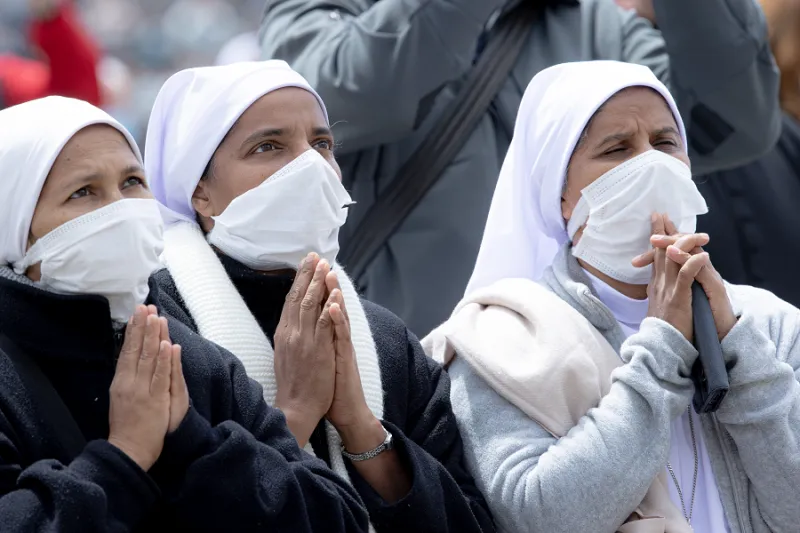
Religious sisters pray during the Regina caeli with Pope Francis in St. Peter’s Square May 2, 2021. / Daniel Ibanez/CNA.
Madrid, Spain, Apr 20, 2022 / 14:07 pm (CNA).
Given the improvement in the situation with the COVID-19 pandemic in Spain, a Royal Decree published Wednesday states that the use of masks indoors is no longer mandatory, but keeps in place the requirement for hospitals and public transportation.
The Archdiocese of Madrid issued a statement April 20 announcing the decree going into effect and called for the faithful to be prudent and for those at greater risk to the virus to take precautions.
The archdiocese pointed out that the Royal Decree recommends that “people with greater vulnerability” continue to wear a mask in “any situation in which there is prolonged contact with people at a distance of less than 1.5 meters,” or about five feet.
The decree also calls for “responsible use” of masks in “closed spaces for public use in which people pass through or stay for a long time.”
Previously, the vicar general of the Archdiocese of Madrid, Father Avelino Revilla, announced that “due to the favorable development of the health situation,” beginning March 11, liturgical celebrations “will be carried out only in accordance with what is contained in the liturgical books.”
If you value the news and views Catholic World Report provides, please consider donating to support our efforts. Your contribution will help us continue to make CWR available to all readers worldwide for free, without a subscription. Thank you for your generosity!
Click here for more information on donating to CWR. Click here to sign up for our newsletter.
The Diocese of Pittsburgh’s Gismondi Job Training Program helps those in need. / Credit: Photo courtesy of Catholic Charities of the Diocese of Pittsburgh
Washington, D.C. Newsroom, May 6, 2024 / 17:40 pm (CNA).
Catholic Charities of the Diocese of Pittsburgh is expanding its social services offered to people who are homeless and those in poverty with a newly created “Compassion Corner” opening in August.
The nonprofit charity group is renovating a former office building located in downtown Pittsburgh to provide health care services, mental health services, job training programs, a place for the homeless population to eat, and a variety of other resources. The nearly 45,000-square-foot building is located at 111 Boulevard of the Allies, next to The Red Door (run by the Catholic Divine Mercy Parish), which provides services such as food for people who are homeless.
“I believe this is all divinely led,” Christopher Scoletti, a board member of Catholic Charities of the Diocese of Pittsburgh and previous president of the board, said during an official launch last week.
“I believe God is working and channeling the love that we all have for our communities, for our neighbors, for one another,” Scoletti added. “I believe God is channeling the pride that we have for the City of Pittsburgh to enforce a powerful change for a better future.”
Susan Rauscher, who serves as the charity’s executive director, told CNA that the new building will allow Catholic Charities to provide more medical and dental care, which it offers to those in poverty for free. She said this expansion will allow for more dental chairs and more medical services, among other things.
“[We’re] really excited about the increase in the number of people who can get health care services,” Rauscher said.
Catholic Charities of the Diocese of Pittsburgh provides eye exams to its clients. Credit: Photo courtesy of Catholic Charities of the Diocese of Pittsburgh
According to Rauscher, the added space will allow the nonprofit to provide mental wellness services, which will include anger management and therapy. The group will also provide job training services, which will include a free 12-week telecommunications course, and connect them with employers with whom the charity has existing relationships. The job programs will include training for five certifications.
“Moving into the new building gives us some additional space to move into new areas that help us bring holistic solutions to our clients,” Rauscher added.
Because of the Compassion Corner’s proximity to The Red Door, Catholic Charities will create a spot for people who are homeless to eat inside. Rauscher noted that those people will also receive access to these services.
“[Catholic Charities of the Diocese of Pittsburgh is] pushing toward not only providing that emergency assistance and those basic needs but also incorporating case management and that long-term stability,” Rauscher said.
More than 100 elected officials, community leaders, and business leaders attended the official launch of the Compassion Corner, according to the diocesan Catholic Charities. This included Pittsburgh Mayor Ed Gainey, who praised the work of the nonprofit and said Christians “can’t just read the Bible and teach the Bible” but need to show their faith in Christ through the “works and deeds that we do.”
“That falls on all of us to do,” Gainey said during a speech at the launch. “It doesn’t just fall on government [and] nonprofit [organizations]. It falls on us.”
Catholic Charities of the Diocese of Pittsburgh has raised about $12 million in donations for its Campaign for Compassion Corner to provide these services, which is more than 70% of its goal of $17 million. The group is trying to raise $13 million for Catholic Charities and $4 million for its partner, Gift of Mary, an emergency women’s shelter.
Rauscher told CNA that 100% of the staff at the Catholic Charities of the Diocese of Pittsburgh has personally contributed to the fundraising effort. She praised the work of the staff, saying: “They can squeeze every penny out of every dollar that’s entrusted to us and turn it into solutions for the people they serve.”
Catholic Charities of the Diocese of Pittsburgh serves about 20,000 people annually, according to Rauscher. She said the nonprofit served about 23,000 people last year.
Cardinals Christoph Schönborn and Gerhard Ludwig Müller. / Credit: Daniel Ibáñez/CNA
CNA Newsroom, Jun 10, 2024 / 13:45 pm (CNA).
Shortly after Pope Francis opposed the possibility of an ordained female diaconate, two German-speaking cardinals … […]






Leave a Reply