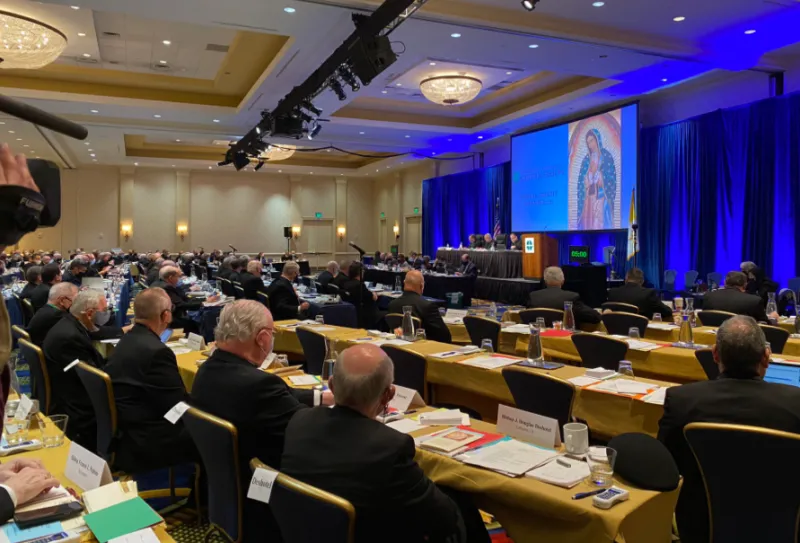
The bishops of the United States Conference of Catholic Bishops elected Father Michael J.K. Fuller as their new general secretary on Tuesday, Nov. 16.
The election was held on the second day of the Fall General Assembly of the USCCB.
Fuller defeated Father Daniel Hanley. The two men were selected by Archbishop Jose Gomez of Los Angeles as candidates for general secretary following an open nomination process. He will serve for a five-year term.
Gomez did not disclose a vote total. The election was conducted according to USCCB bylaws, meaning it was conducted on a paper ballot that was sealed in an envelope.
Fuller is filling the vacancy created by the resignation of Msgr. Jeffrey Burrill on July 20, 2021, about five weeks after he was elected to the post at the Spring 2021 General Assembly.
Burrill resigned ahead of media reports detailing inappropriate behavior and the frequent use of the gay hookup app Grindr.
Fuller, a priest of the Diocese of Rockford, Ill., served as the interim general secretary after Burrill’s resignation.
If you value the news and views Catholic World Report provides, please consider donating to support our efforts. Your contribution will help us continue to make CWR available to all readers worldwide for free, without a subscription. Thank you for your generosity!
Click here for more information on donating to CWR. Click here to sign up for our newsletter.
Carissa Carroll, pictured with her son Jack, founded the nonprofit organization Jack’s Basket to celebrate babies with Down syndrome / Credit: Screenshot/EWTN Pro-Life Weekly
Washington, D.C. Newsroom, Mar 21, 2024 / 09:00 am (CNA).
As many countries celebrate World Down Syndrome Day on March 21, a panel of pro-life leaders and scholars is calling attention to the threat that prenatal testing poses to preborn children who are diagnosed with Down syndrome in the womb.
“[The mother] often faces tremendous internal and external pressure to undergo an abortion,” said J.D. Flynn, who moderated the panel at the Catholic University of America’s Institute for Human Ecology and is himself the father of two children with Down syndrome.
Prenatal screening within the first 11 through 14 weeks of pregnancy can determine whether a preborn child has a higher likelihood of having Down syndrome, but a follow-up diagnostic test can confirm whether the child has the condition. Although efforts to destigmatize the condition have had some success, the likelihood that a mother will abort her child increases dramatically after such a diagnosis.
A 2012 study that compiled data from 24 studies between 1995 and 2011 found that more than two-thirds of preborn children who were diagnosed with Down syndrome in the womb were killed via abortion. Rates throughout Europe are even higher — more than 90%. In Iceland, nearly all preborn children diagnosed with Down syndrome are aborted and only about two or three children with Down syndrome are born every year.
Mary O’Callaghan, a visiting fellow at Notre Dame University’s McGrath Institute for Church Life, noted a disconnect between the “more positive” attitude the public expresses about people with Down syndrome and the “more aggressive targeting” of abortion for preborn children with Down syndrome.
“Those with Down syndrome are increasingly showing us their ability to flourish,” said O’Callaghan, who also has a child with Down syndrome. In spite of this, she said, “we’re in a much worse place in respect to abortion and Down syndrome.”
Bridget Brown, a 36-year-old woman with Down syndrome who serves on the National Catholic Partnership on Disability Council on Intellectual and Developmental Disabilities, expressed the same concern.
Noting the trends in countries such as Iceland, Brown said she may be from the last generation of people with Down syndrome: “The world may never again benefit from our gifts.”
“This is genocide — the systematic killing of a whole people,” Brown added, citing a letter she wrote to Pope Francis about the situation in Iceland before meeting the pontiff in 2017.
Bridget Brown meets with Pope Francis in Vatican City on Oct. 21, 2017. Credit: L’Osservatore Romano.
According to Tracy Winsor, who co-founded an organization to support couples who carry their children to term after a prenatal diagnosis called Be Not Afraid, many women consider abortion after a diagnosis because receiving the news is a “traumatic event” for most couples and is presented as a “worst-case scenario.”
Winsor noted that doctors will present a lot of information, which “can be overwhelming” at the moment. She advises parents to immediately connect with parents who have children living with Down syndrome and to advocates for individuals with Down syndrome.
O’Callaghan agreed: “Meeting with other parents around this time is very helpful [in reducing abortion].” Prenatal testing, she noted, should be oriented toward preparing for their child.
“They need to think about prenatal testing oriented toward the health of their child,” O’Callaghan said.
Brown similarly noted that like everyone else, her “life is filled with hopes and possibilities” and encouraged couples who receive a prenatal Down syndrome diagnosis for their preborn child to approach the situation positively.
“Make plans based on dreams and not on fears,” Brown said. “Believe in yourself and your child.”
Father Fidelis Moscinski (lower left, standing behind the cross), a well-known pro-life activist and priest of the Franciscan Friars of the Renewal (CFR) is seen during a tense standoff between pro-life and pro-abortion demonstrators in Lower Ma… […]
The flag of Germany. / Trine Juel via Flickr (CC BY 2.0).
CNA Staff, May 10, 2021 / 11:00 am (CNA).
A Catholic theologian has said it is “foolish” to deny that the German “Synodal Way” is seeking changes that would be schismatic. Fr. Thomas Wein… […]
Leave a Reply