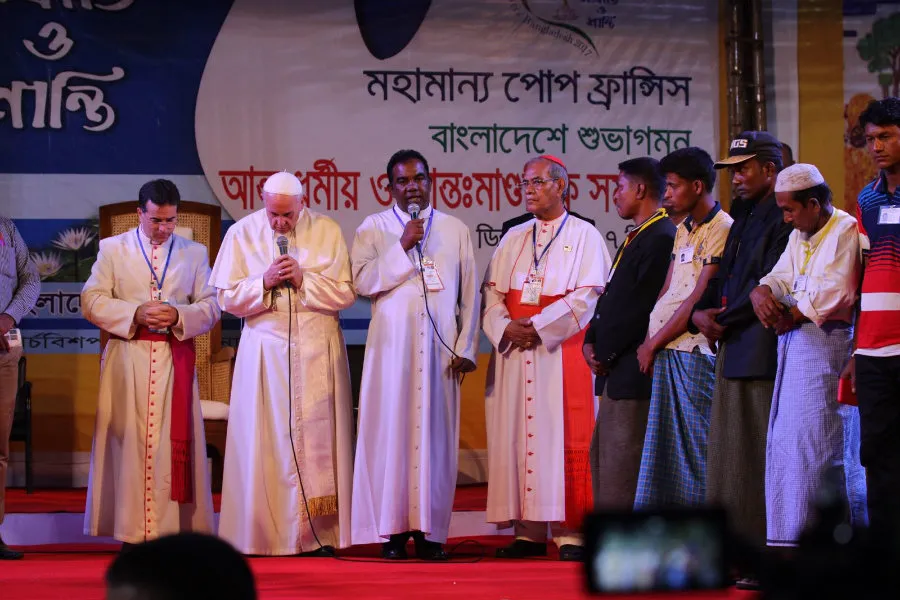
Vatican City, Dec 1, 2017 / 05:34 am (CNA/EWTN News).- In an encounter with interfaith leaders in Bangladesh, Pope Francis stressed the need to join together in promoting mutual respect and combating religiously-justified violence, saying this can’t achieved through mere tolerance, but requires real knowledge and trust of the other.
In a Dec. 1 meeting with interreligious leaders in Bangladesh, Pope Francis praised them for their commitment to live together in “mutual respect and goodwill” in the country, “where the right to religious freedom is a founding principle.”
The fact that they are all meeting together, he said, “stands as a subtle yet firm rebuke to those who would seek to foment division, hatred and violence in the name of religion.”
Pointing to the commitment of interfaith leaders in Bangladesh to building a culture of encounter, Francis said this goal “entails more than mere tolerance.”
“It challenges us to reach out to others in mutual trust and understanding, and so to build a unity that sees diversity not as a threat, but as a potential source of enrichment and growth,” he said, adding that it also serves as a challenge to “cultivate an openness of heart that views others as an avenue, not a barrier.”
Pope Francis with the interreligious leaders on his second day in Dhaka, Bangladesh, which is the second phase of his Nov. 27-Dec. 2 tour of Asia. He was in Burma Nov. 27-30, and will stay in Bangladesh until Dec. 2.
So far, the Pope has been outspoken on the need for peace and healing, specifically in Burma, and has stressed the importance of interfaith dialogue, praising the strides Bangladesh has made in this area.
The theme of interreligious unity has been a major talking point of the Pope’s visit to both countries, as Burma is a majority Buddhist nation and Bangladesh is majority Muslim. In Bangladesh, 86 percent of the population practices Islam. The 375,000 Catholics there represent less than 0.2 percent of the total population.
Pope Francis arrived to the interreligious encounter in a rickshaw, where he listened to testimonies from five leaders representing different religious communities in Bangladesh, including Muslims, Hindus, Buddhists, Anglicans and Catholics. Among the Catholics who spoke were a layman and Cardinal Patrick D’Rozario CSC, Archbishop of Dhaka, who is the first Bangladeshi cardinal, appointed by Francis in 2016.
Around 18 members of the Rohingya Muslim community were also present, including 5-year-old child. The Pope greeted them individually at the end of the event, listening as they each briefly explained their stories through an interpreter.
A largely Muslim ethnic group who reside in Burma’s Rakhine State, the Rohingya have recently faced a sharp increase in state-sponsored violence in their homeland, leading the United Nations to declare the crisis “a textbook example of ethnic cleansing.”
With an increase in persecution in their home country of Burma more than 600,000 Rohingya have fled across the border to Bangladesh, where millions are in refugee camps. The crisis, which boiled over ahead of the Pope’s trip, has been a focal point of the visit.
In his speech to the interfaith leaders, Francis said there are three essential elements of the “openness of heart” that allow us to really encounter others: a door, a ladder and a path.
The door, he said, “is not an abstract theory but a lived experience” which enables one to have real dialogue, “not a mere exchange of ideas.” And going through this door requires “good will and acceptance,” he said, but stressed that this attitude is “not to be confused with indifference or reticence in expressing our most deeply held convictions.”
Pope Francis then turned to the image of the ladder, saying it is one “that reaches up to the Absolute.” By looking to this transcendent aspect of interreligious activity, he said, “we realize the need for our hearts to be purified, so that we can see all things in their truest perspective.”
Finally, he said the path they must take is one that leads “to the pursuit of goodness, justice and solidarity.”
“It leads to seeking the good of our neighbors,” he said, explaining that when religious concern for the good of others comes from an open heart, it “flows outward like a vast river, to quench the dry and parched wastelands of hatred, corruption, poverty and violence that so damage human lives, tear families apart, and disfigure the gift of creation.”
This spirit of openness, acceptance and cooperation among believers doesn’t just contribute to a culture of harmony and peace, but is “its beating heart.”
The world desperately needs this heart to beat strongly, he said, in order “to counter the virus of political corruption, destructive religious ideologies, and the temptation to turn a blind eye to the needs of the poor, refugees, persecuted minorities, and those who are most vulnerable.”
“How much, too, is such openness needed in order to reach out to the many people in our world, especially the young, who at times feel alone and bewildered as they search for meaning in life!”
Pope Francis closed his speech thanking the leaders for their efforts to promote a culture of encounter among the different religions in Bangladesh, and prayed that they would help all believers “to grow in wisdom and holiness, and to cooperate in building an ever more humane, united and peaceful world.”
In his greeting to the Pope, Cardinal D’Rozario said the religious harmony that exists in Bangladesh “is rooted in our cultural identity.” The fact that they live peacefully in a multi-religious and multi-ethnic context, he said, is a heritage “we proudly enshrine in our hearts and we feel so much pain when this sacrosanct heritage is attacked and harmony is disturbed.”
He said Bangladesh continues to “march forward” with the hope of building up humanity through integral development and care of the planet, and voiced the Church’s commitment to “cherish harmony and love peace” in the nation.
Francis was also greeted by five leaders of the different religious communities in Bangladesh, including Grand Imam and Mufti of Bangladesh, Farid Uddin Masud, on behalf of the country’s Muslim community; Swami Dhruveshananda Adhyaksha on behalf of the Hindu community, and Sanghanayaka Suddhananda Mahathero on behalf of the Buddhist community, among others.
In his greeting, Imam Masud said the world today needs compassion and love more than anything else.
“The only remedy and solution to the problem of malice, envy and fighting among nations, races and creeds lies in the compassionate love preached and practiced by the great men and women of the world,” he said, and praised Pope Francis for his “tireless efforts” on behalf of the oppressed, regardless of religion, cast or nationality.
“This is a great inspiration for all of us,” he said, and pointed specifically to the Pope’s support of the Rohingya Muslims from Burma, saying the Pope’s concern for them “will bring a positive result in regard to the attempts to ensure their human rights.”
The Muslim community in Bangladesh, he said, “pay our tribute and show respect” to Pope Francis for his attention not only to the Rohingya, but to people of all faiths, adding that the Pope’s role in promoting world peace “deserves our wholehearted respect.”
On his part, Swami Dhruveshananda Adhyaksha, representing the Hindu community, said that while the religions of those gathered may be different, “the objective is the same.”
“Just as all the rivers which originate from different sources blend into the same ocean, so all religions, though different, lead to the same beatitude,” he said, adding that “we have the duty to remain firm in the ideals we believe in, showing due respect for others.”
Likewise, Sanghanayaka Suddhananda Mahathero, Chief Patriarch of the Buddhists of Bangladesh and President of Bangladesh Bouddha Kristi Prachar Sangha, said the Pope’s visit has “ushered a new horizon of interreligious harmony among all faiths” in Bangladesh.
He said he has been moved by Francis’ “deep sense of kindness and compassion” toward the marginalized, and that the image of Pope Francis washing the feet of young African refugees is something that constantly stays in his mind.
“The Holy Father has achieved greatness,” he said, explaining that Bangladesh is committed to religious cooperation.
Affirming the sentiments of Bangladeshi resident Abdul Harmid, who in yesterday’s speech to the Pope said the country has a “zero tolerance” policy on violent interreligious conflict, the Buddhist leader said “we gather here to invoke with one voice the blessings of peace and fraternity in our country.”
After the testimonies, the encounter closed with a prayer recited by Anglican Bishop Philip Sarkar, who asked for strength to fight together against the evils of discrimination, division and corruption in Bangladesh.
“There are many people today in our world who are the victims of terrorism, conflicts, oppression and exploitation,” he said, noting that religious and ethnic minorities all over the world are suffering hatred and discrimination, and pointing to the Rohingya crisis in neighboring Burma as an example.
He prayed that world leaders and those who have authority would be guided by “wisdom and kindness” so as to wield their power in service to their people with love and attentive care.
Sarkar then pointed to the “hypocrisy and pride” each of the religions present at times display, saying “we misunderstand and hate people of other faiths and create suspicion with each other. We don’t know how to respect other religions and people of other faiths.”
He asked forgiveness for this, and prayed that God would help them to realize the depth of his love in order to “love others and live in service for others, but not judge others because of their faith or creed.”
The bishop closes his prayer asking that the interfaith leaders would be led by a spirit “of love and wisdom” in order to “show the path of true light and true life in this confused and dark world.”
 […]
[…]


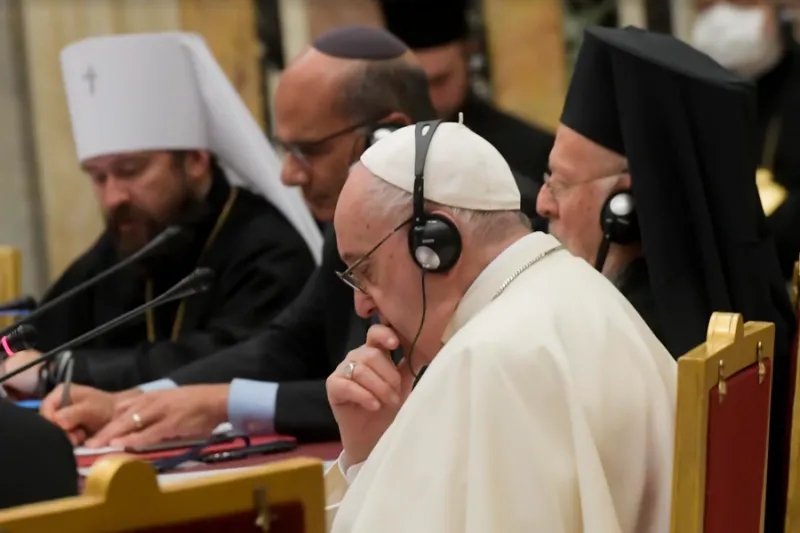
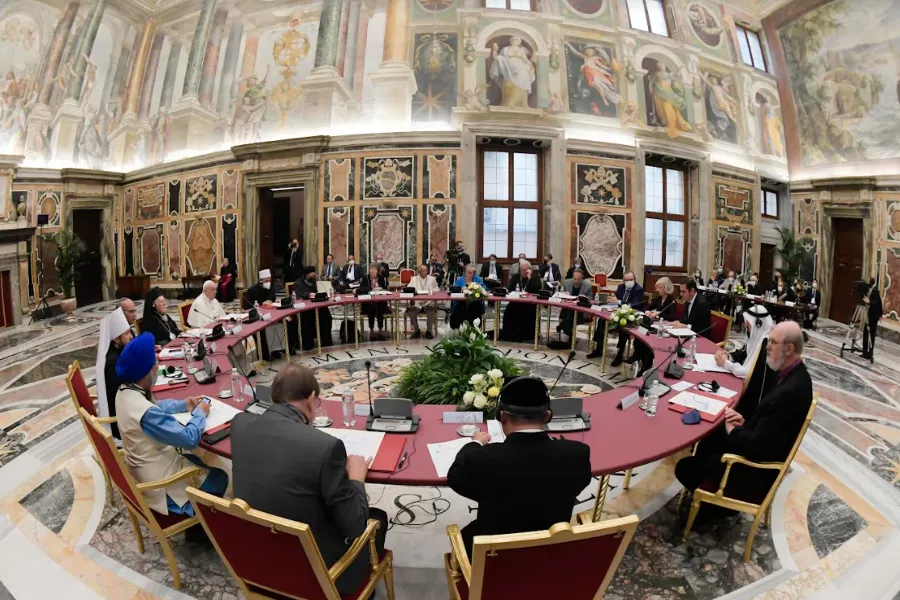
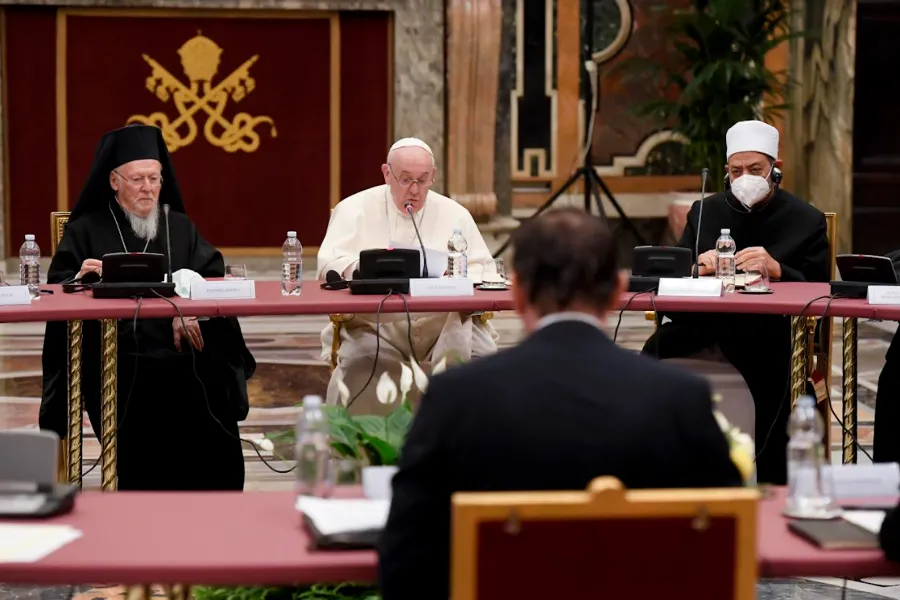


With much the same message, and more lucidly than some, Pope John Paul II linked the ecological challenge with human life:
“As I have already stated, the seriousness of the ecological issue lays bare the depth of man’s MORAL CRISIS. If an appreciation of the value of the human person and of human life is lacking, we will also lose interest in others and in the earth itself [….] the human person, endowed with the capability of choosing freely, has a grave responsibility to preserve this order for the well-being of future generations. I wish to repeat that the ecological crisis is a moral issue” (“Message for the 1990 World Day of Peace,” December 8, 1990; last sentence in italics).
The ADDED CHALLENGE for the perennial Catholic Church is to proclaim the moral issue without submerging it back into a range of closely related, preemptive political options and agendas sometimes embedded in “educational” institutions—and capable of debate!
The Catholic Social Teaching on solidarity, especially, is the “negation of ideology,” belonging instead “to the field…of theology and particularly moral theology” (Centesimus Annus, 19993, n. 55, citing Pope Paul VI’s Homily at the final public session of the Second Vatican Council, AAS 58, 1966).
Concluding his Message of 1990, Pope John Paul II introduces an interesting word:
“It is my hope that the inspiration of St. Francis will help us to keep ever alive a sense of ‘FRATERNITY’ with all those good and beautiful things which almighty God has created. And [he adds] may he remind us of our serious obligation to respect and watch over them with care, in light of that greater and higher fraternity that exists within the human family” (all caps added).
A setting in which traditionalist perspectives on interfaith unity and cooperation has appeal. From my previous comment, “Wynand De Beers’ holistic philosophy is attractive as an appeal to unity and the spiritual. It certainly is a first things first approach identifying what we all have in common, the inherent grasp of universal truths”. Should we add to this discussion what was missing then and is missing now in an historical parallel? “The Catholic Herald Heretic of the week. Charbonneau-Lassay [and Jacques Maritain] saw traces in other world religions of the original Revelation from whence Judaism and then Catholicism had sprung; but for him these were to be used to draw people to the One True Faith. For Guénon [with Frithjof Schuon a traditionalist founder], however, Catholicism fell short of being a genuine conduit – which led not only to a break with his Catholic friends (Maritain tried to have his work put on the Index of Forbidden Books), but to his own conversion to Islam”. At this decisive moment in our history when the trend is toward a globalist vision in which the salt of Catholicism now becoming one among many loses its savor, must we witness to Christ beyond what John Paul II deemed adequate? What Saint Francis envisioned during Christendom differs radically in context to what John Paul envisioned 1990 during the collapse of the Soviet Union. As it does presently with the inexorable advent of Globalism replacing the Advent of Christ. Fratelli Tutti is more in line with a paved over Christianity suitable to its incorporation into a world body. An ode to Mother Earth offered by Pope Francis at the interreligious meeting on education speaks to this dilemma of misplaced priorities, “God always forgives, we occasionally forgive. Nature never forgives”. Prayerful, however so nevertheless to the wrong god. Christ proclaimed in season and out is not just the better, now the only approach. Proclamation of the Cross he bore as did Saint Francis bearing the wounds of Christ reconfigures ecology incontext of what most matters. Man’s salvation.
All so very true–the Ode to Mother Earth (e.g., Pachamama). Instead, and regarding the task of real inculturation we have this:
“The process of inculturation may be defined as the Church’s efforts to make the message of Christ penetrate a given sociocultural milieu, calling on the latter to grow according to all its particular values, as long as these are compatible with the Gospel. The term inculturation includes the notion of growth, of the mutual enrichment of persons and groups, rendered possible by the encounter of the Gospel with a social milieu. ‘Inculturation is the incarnation of the Gospel in native culture and also the introduction of these cultures into the life of the Church'” (International Theological Commission, “Faith and Inculturation,” The Holy See, 1988).
Too often Pope Francis and his handlers replace the “message” with what he calls “making a ‘mess’ of things.”
A very credible Chinese convert to Catholicism (John C. W. Wu, who translated the Bible into Chinese in the 1920s) remarks that while the Eastern (natural) religions are not the same as the Logos, they do at least, and significantly, “point to the Logos” (University of Notre Dame doctoral dissertation by John A. Lindblom, 2021). Somewhat as did Classical thought in the West. The Incarnation is a fulfillment of the search which is built into human nature, East and West.
For particular reasons, and as an non-credentialed non-specialist, I would have trouble including the religion of Islam in this category, although “witnesses” to Christ (faith in the person of Christ) can still have ennobling discussions with the “followers” of Islam (distinguished from the overlaid belief system or natural/encysted religion called Islam). Scratching the surface on this fascinating topic, I humbly propose an author interview conducted with me by CWR in 2017: https://www.catholicworldreport.com/2017/04/29/the-mosque-the-manger-and-modernity/