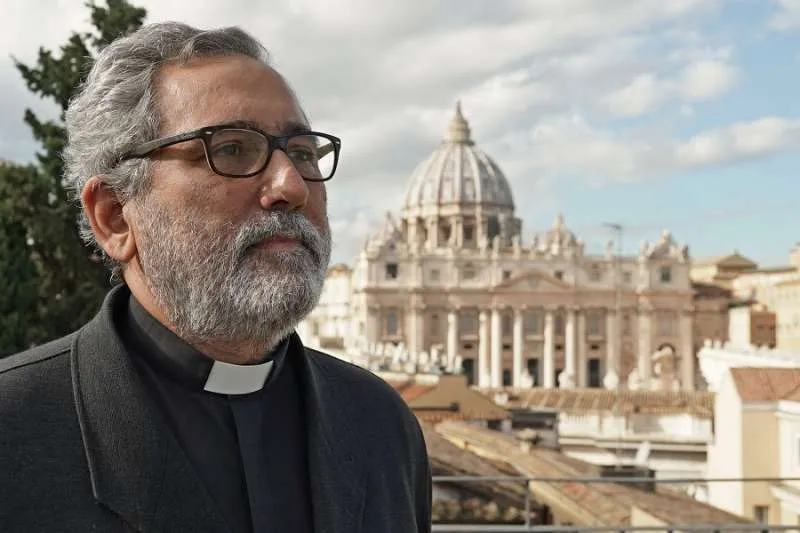
Fr. Juan Antonio Guerrero Alves. / Office of Communication Society of Jesus.
Vatican City, Jun 22, 2021 / 15:00 pm (CNA).
The Vatican’s Secretariat for the Economy issued on Tuesday a set of regulations related to new norms for awarding public contracts unveiled by Pope Francis last year.
The regulations are contained in a decree signed by Fr. Juan Antonio Guerrero Alves, S.J., the Pontifical Delegate and prefect of the Secretariat for the Economy.
The decree, consisting of 49 articles, concerns the pope’s apostolic letter, “Norms on transparency, control and competition in the procedures for awarding public contracts of the Holy See and Vatican City State,” dated May 19, 2020.
The apostolic letter, issued motu proprio (“on his own impulse”), outlined new procedures for awarding public contracts that aim to increase oversight and accountability, and ensure the Vatican and Holy See work only with vetted financial partners.
The decree says that the new regulations “apply to all purchases of services, supplies, and works.”
It states that “economic operators” under investigation for crimes are excluded “from participation in procedures for direct awarding of contracts and being registered in the list of authorized vendors.”
It rules that “subcontracting may be permitted to the maximum extent of 30% of the contract value.”
It also covers the procedures to be followed in cases of urgency.
Alongside the decree, the Secretariat for the Economy also released a 91-page document containing seven annexes to the new regulations, published on the website of the Vatican newspaper L’Osservatore Romano.
A note introducing the decree and the annexes on the website said: “The choices made combine the need for operational efficiency with the highest standards of transparency and the principles of legality and fair competition.”
“This is, therefore, a further concrete step on the path of the Holy See’s economic reforms.”
ACI Stampa, CNA’s Italian-language news partner, noted that the decree does not extend to real estate transactions, which it said would be the subject of further regulations issued before the end of 2021.
Last October, Pope Francis named Cardinal Kevin Farrell president of a committee monitoring internal Vatican financial decisions which fall outside of the new accountability norms.
The five-member group is called the “Commission for Reserved Matters.”
If you value the news and views Catholic World Report provides, please consider donating to support our efforts. Your contribution will help us continue to make CWR available to all readers worldwide for free, without a subscription. Thank you for your generosity!
Click here for more information on donating to CWR. Click here to sign up for our newsletter.
Wichita, Kan., Feb 22, 2020 / 05:00 am (CNA).- A Kansas priest recalls the holy deeds of Servant of God Emil Kapaun, a POW and chaplain during the Korean War, whose path to sainthood will meet a major milestone next month.
Bishops and cardinals from the Vatican’s Congregation for the Causes of Saints will vote March 10 to on whether the process to declare Kapaun a saint should progress to the next stage of advancement.
Kapaun was named in 1993 a “Servant of God,” the first designation on the way to being declared a saint. To be declared “venerable” is the second step in the canonization process; which Kapaun could reach next month.
Father John Hotze, the postulator for Kapaun’s cause, said the priest, whom he described as an average man from Kansas, is an example of stewardship and selflessness.
If Kapaun does become a saint, “then there’s hope for each and every one of us to be a saint, also,” Hotze said.
“He was just an average guy. He was just a poor Kansas farm boy. He had nothing, and he was able to use what little he had in service to others,” he said.
“He used all of his time and talent and treasure in service to God and in service to others.”
Kapaun, who was born during the Great Depression in Pilsen, Kansas; he was ordained a priest in 1940 and began ministry as a parish priest in his hometown.
During World War II, Kapaun would offer the sacraments at the nearby Harrington Army Air Field, until he became a full-time army chaplain in 1944. He was stationed in India and Burma for the duration of the war. There, he offered soldiers the sacraments, and, Hotz said, served his unit with a selfless attitude.
“I was speaking to his brother Eugene once, and his brother said that he thought [Emil] always had that missionary spirit in his heart.”
“He said that he thought one of the reasons why [Emil] asked to become a chaplain was because he knew that that would be part of this missionary life,” he said.
Hotze described Kapaun as a “soldier’s chaplain” who would do anything for his men.
Because the priest’s jeep had been damaged, Kapaun would often ride his bicycle, meeting men even at battlefield front lines, and following the sound of gunshots to find out if he was
“[The soldiers] would all look up to see where Father Kapaun was at because, they said, as soon as they heard the gunfire, … they knew that he would be on his bicycle … [Kapaun] knew that’s where he would be needed,” he said.
After World War II ended, Kapaun used his GI bill study history and education at the Catholic University of America. He returned home as pastor of his boyhood parish briefly, and served at a few other parishes, until the army had need of him.
In 1948, the United States issued a call for military chaplains to return to service. Kapaun jumped at the chance. He was then sent to Texas, Washington, and Japan, before being deployed to Korea.
Hotze said that many of the men serving in the same unit viewed him as a saint. He said Tibor Rubun, a Jewish soldier, was once worried during an attack when Kapaun comforted him and began praying with him using the Hebrew Scriptures.
During the Battle of Unsan in November of 1950, Kapaun worked tirelessly to comfort the suffering and retrieve the wounded from the battlefield. One of the soldiers he retrieved was a wounded Chinese soldier, who helped him negotiate a surrender after he was surrounded by enemy troops. Kapaun was taken as a prisoner of war.
Hotze said Kapaun also saved Herbert Miller’s life, a man who had been shot and then wounded by a grenade, which broke his ankle and shredded his legs with shrapnel. Korean soldiers would kill any U.S. prisoners who could not walk to the camp, so Kapaun carried Miller 30 miles on a prisoners’ march.
Kapaun was then taken to prison camp number five in Pyoktong, a bombed out village used as a detainment center. The soldiers at the camp were severely mistreated, facing malnourishment, dysentery, and a lack of warm clothing to counter an extremely cold winter. Kapaun would do all he could for the soldiers, washing their soiled clothes, retrieving fresh water, and attending to their wounds
When he developed pneumonia and a blood clot in his leg, the chaplain was denied medical treatment. He died in 1951.
“[He was] taken away to the hospital. The men called it the death house because you didn’t come out of it alive. When they took you there, they didn’t give you any water or they didn’t give you any food or anything,” Hotze said.
“He wound up dying there and…the men talked about how there was not a dry eye in the camp.”
For his bravery at Unsan, Kapaun was posthumously awarded the Medal of Honor by President Obama in 2013. The medal is the United States’ highest military award for bravery.
Hotze said Catholics today are still influenced and inspired by Kapaun. He said every June pilgrims march from Wichita to Kapaun’s hometown of Pilsen. He said the 60 mile walk is in commemoration of the priest and his march to the prison camps. The pilgrimage last summer gathered about 200 people.
Hotze emphasized two points of Kapaun’s spirituality. He said Kapaun dedicated himself to the service of others and he did so joyfully.
“I think his willingness to serve is probably one of the most appealing things, and, another thing was that this willingness to serve, that he did it with joy.”
“He had every right … to resent the situation that he was in, in his life or the difficulties that he was facing but he never did. He never was angry. He was never resentful or hateful.”
Pope Francis waves to crowds gathered in St. Peter’s Square on June 19, 2022, on Corpus Christi Sunday. / Vatican Media
Denver Newsroom, Jun 19, 2022 / 09:56 am (CNA).
The Feast of Corpus Christi is a time for Christians to remember that God will meet their basic needs to eat and to be filled with the joy and amazement of receiving loving nourishment from Jesus Christ, Pope Francis said Sunday.
At the same time, the pope emphasized, the Eucharist must also move Christians to action.
“We can evaluate our Eucharistic Adoration when we take care of our neighbor like Jesus does,” the pope said Sunday before the recitation of the Angelus at St. Peter’s Square in Rome.
“There is hunger for food around us, but also for companionship; there is hunger for consolation, friendship, good humor; there is hunger for attention, there is hunger to be evangelized. We find this in the Eucharistic Bread — the attention of Christ to our needs and the invitation to do the same toward those who are beside us. We need to eat and feed others.”
The pope’s remarks reflected on Sunday’s Gospel reading, the miracle of the multiplication of the loaves and fishes from the Gospel of Luke.
The pope linked the reading to the institution of the Eucharist at the Last Supper. The Eucharist was like “the destination of a journey along which Jesus had prefigured through several signs, above all the multiplication of the loaves narrated in the Gospel of today’s liturgy.”
The pontiff reflected on the manner of the miracle when Jesus fed so many who lacked food.
“The miracle of the loaves and fishes does not happen in a spectacular way, but almost secretly, like the wedding at Cana — the bread increases as it passes from hand to hand. And as the crowd eats, they realize that Jesus is taking care of everything,” said Pope Francis.
“This is the Lord present in the Eucharist. He calls us to be citizens of Heaven, but at the same time he takes into account the journey we have to face here on earth,” he said. “If I have hardly any bread in my sack, he knows and takes care of it himself.”
Thousands gather in St. Peter’s Square in Rome on June 19, 2022, to hear Pope Francis’ Angelus reflections. Vatican Media
The pope connected the tangible needs of food with the intangible needs of humankind.
“Sometimes there is the risk of confining the Eucharist to a vague, distant dimension, perhaps bright and perfumed with incense, but rather distant from the straits of everyday life. In reality, the Lord takes all our needs to heart, beginning with the most basic,” he said.
“In the Eucharist, everyone can experience this loving and concrete attention of the Lord. Those who receive the Body and Blood of Christ with faith not only eat, but are satisfied. To eat and to be satisfied: These are two basic necessities that are satisfied in the Eucharist,” he added. “The crowd is satisfied because of the abundance of food and also because of the joy and amazement of having received it from Jesus!”
Jesus Christ’s self-giving presence is key to understanding the Eucharist, the pope said.
“We certainly need to nourish ourselves, but we also need to be satisfied, to know that the nourishment is given to us out of love. In the Body and Blood of Christ, we find his presence, his life given for each of us. He not only gives us help to go forward, but he gives us himself — he makes himself our traveling companion, he enters into our affairs, he visits us when we are lonely, giving us back a sense of enthusiasm.”
“This satisfies us, when the Lord gives meaning to our life, our obscurities, our doubts; he sees the meaning, and this meaning that the Lord gives satisfies us,” the pope explained. Everyone is looking for the presence of the Lord, because “in the warmth of his presence, our lives change,” the pope added.
“Without him, everything would truly be gray,” he said. “Adoring the Body and Blood of Christ, let us ask him with our heart: ‘Lord, give me that daily bread to go forward, Lord, satisfy me with your presence!’”
The pope also prayed that the Virgin Mary may teach us “how to adore Jesus, living in the Eucharist and to share him with our brothers and sisters.”
Statements on Spanish martyrs, Ukraine war
After the Angelus, the pope discussed the Saturday beatification of Dominican religious who were killed in the Spanish Civil War.
“They were all killed in hatred of the faith in the religious persecution that took place in Spain in the context of the civil war of the last century,” the pope said, calling for applause for them. “Their witness of adherence to Christ and forgiveness for their killers show us the way to holiness and encourage us to make their lives an offering of love to God and their brothers and sisters.”
The conflict of Ukraine after the Russian invasion also was a point for prayer, the pope said: “Let us not forget the suffering of the Ukrainian people in this moment, a people who are suffering.”
“I would like you all to keep in mind a question: What am I doing today for the Ukrainian people? Do I pray? Am I doing something? Am I trying to understand? What am I doing today for the Ukrainian people? Each one of you, answer in your own heart,” he asked.
Prayers for Myanmar, World Meeting of Families
Pope Francis also lamented the violence in Myanmar, which has forced many to flee their homes and blocked them from meeting basic needs.
“I join the appeal of the bishops of that beloved land, that the international community does not forget the Burmese people, that human dignity and the right to life be respected, as well as places of worship, hospitals, and schools. And I bless the Burmese community in Italy, represented here today,” he said.
In early 2021 the Myanmar military seized power in the country. Its crackdown on opponents provoked a violent backlash. The U.N. High Commissioner for Refugees has said the conflict has displaced more than 800,000 people from their homes. Of these, 250,000 are children.
Pope Francis also noted that the 10th World Meeting of Families will begin June 22 in Rome and throughout the world. Around 2,000 Catholic families will gather in Rome this week to meet Pope Francis and hear talks on marriage and the faith.
“I thank the bishops, parish priests, and family pastoral workers who have called families to moments of reflection, celebration and festivity,” he said. “Above all, I thank the married couples and families who will bear witness to family love as a vocation and way to holiness. Have a good meeting!”
Leave a Reply