

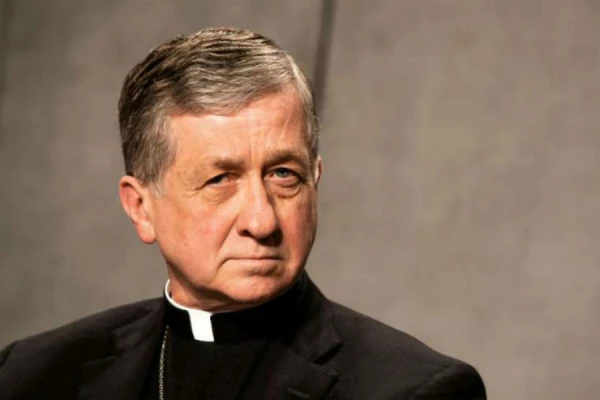
CNA Staff, Jan 20, 2021 / 05:04 pm (CNA).- Cardinal Blase Cupich, archbishop of Chicago, used Twitter to issue a scathing criticism of the USCCB’s official statement on the inauguration of President Joe Biden.
In his four-part Twitter thread on Wednesday, Cardinal Cupich said that “the U.S. Conference of Catholic Bishops issued an ill-considered statement on the day of President Biden’s inauguration. Aside from the fact that there is seemingly no precedent for doing so, the statement, critical of President Biden, came as a surprise to many bishops, who received it just hours before it was released.”
“The statement was crafted without the involvement of the Administrative Committee, a collegial consultation that is a normal course for statements that represent and enjoy the considered endorsement of the American bishops,” he said.
“The internal institutional failures involved must be addressed, and I look forward to contributing to all efforts to that end, so that, inspired by the Gospel, we can build up the unity of the Church, and together take up the work of healing our nation in this moment of crisis,” the cardinal said.
The overt criticism of the USCCB came after Cardinal Cupich published a separate statement on his website that did not include these critiques. It follows a flurry of public reactions from his fellow U.S. bishops, who have supported the USCCB statement.
Three different bishops speaking on background to CNA said they were aware that Cardinal Cupich wanted a more supportive, clearly pro-Biden statement, and that he spent most of Wednesday trying to get the support of other bishops to come up with an alternative statement.
The USCCB statement to which Cupich was responding was originally expected to be released at 9 a.m. Eastern time. However, it was delayed and published only after Biden was sworn in to office and around the time Pope Francis published a message to the new president.
The statement was from Archbishop Jose Gomez of Los Angeles, president of the bishops’ conference.
Gomez stressed that the bishops’ job is not to be political, but to preach the truth. He said that while there are numerous issues of concern to the bishops’ conference, abortion is the preeminent issue that cannot be ignored.
Gomez said that “abortion is a direct attack on life that also wounds the woman and undermines the family. It is not only a private matter, it raises troubling and fundamental questions of fraternity, solidarity, and inclusion in the human community. It is also a matter of social justice. We cannot ignore the reality that abortion rates are much higher among the poor and minorities, and that the procedure is regularly used to eliminate children who would be born with disabilities.”
“Rather than impose further expansions of abortion and contraception, as he has promised, I am hopeful that the new President and his administration will work with the Church and others of good will. My hope is that we can begin a dialogue to address the complicated cultural and economic factors that are driving abortion and discouraging families,” he continued.
“My hope, too, is that we can work together to finally put in place a coherent family policy in this country, one that acknowledges the crucial importance of strong marriages and parenting to the well-being of children and the stability of communities,” Gomez said. “If the President, with full respect for the Church’s religious freedom, were to engage in this conversation, it would go a long way toward restoring the civil balance and healing our country’s needs.”
If you value the news and views Catholic World Report provides, please consider donating to support our efforts. Your contribution will help us continue to make CWR available to all readers worldwide for free, without a subscription. Thank you for your generosity!
Click here for more information on donating to CWR. Click here to sign up for our newsletter.


I always thought I understood that to support or encourage the sin of another was also a sin. And I thought that having a prominent Catholic speak out in public attacking church teaching was a serious offense called “giving scandal”?? If this is so, what is the problem that Cardinal Cupich sees with the USCCB not being sufficiently pro-Biden? Why does a Catholic Cardinal want to support a pro-abortion candidate by cloaking him with apparent church approval anyway?
Gomez’ statement was pure fluff, and Cupich’s throwing in his (unasked for) 2 cents just makes it that much more absurd.
If one were to ask for a clear reason why many Catholics are leaving, I would cite this silliness – and that’s exactly what it is – as a contributing factor.
“Cardinal Cupich wanted a more supportive, clearly pro-Biden statement”
Yeah, I’ll just bet he did.
If Cupich couldn’t support the USCCB’s well-crafted, balanced, responsible statement, then the red he wears is more symbolic of the devil than of being a Cardinal. Thank God I’m not in Cupich’s archdiocese.
Biden on his first day already signed an EO to fund abortion s with taxpayers money overseas. He starts his presidency killing the more unborn.
Cardinal Cupcake is a disgrace to the Catholic Church. He should resign from office and turn in his red hat.
Despite the prayers and anthems of the inauguration yesterday, isn’t the elephant in the living room the generational genocide that has continued on with public support since 1973? The practice of procured abortion is an unjust and violent assault on innocent human life in which young minority women are most affected.
Cupich. Of course.
Archbishop Gomez, President of the USCCB, proposes a Coherent Family Policy as a point of engagement between natural law and Catholic Social Teaching (CST) and a national public policy incoherence gone off the rails. But adolescent Cardinal Cupich whines that he has a problem (probably still smarting from his success in sidelining Cardinal DiNardo, then President of the USCCB, on a strategy to correct a pattern of sex abuses, and then not being elected to any USCCB offices?).
The balanced and coherent CST centers on the transcendent Dignity of the Human Person (without 60 million exceptions) within the Family, plus Solidarity with Subsidiarity, plus Rights with Responsibilities, plus Faithful Citizenship with Informed Conscience (the Biden challenge), plus an Option for the “poor” with the Dignity of work, and all of this with long-term care for God’s Creation (and pre-born creations?).
But why propose the comprehensive coherence and depth of the CST when we can settle for a more politically-driven nexus of incoherence?
Why settle for Gomez’s CST—the negation of all ideology—when we can bundle all of our ersatz ideologies onto one letterhead? The Cupich faction has got it all worked out (!), from a national and historical perspective–the railroad (pun intended) nexus of cattle stockyard slaughterhouses in 19th-century Chicago. Hamburger moral theology, anyone?
If bishops decide to defend the faith on essential moral teaching they have every right, and the obligation as defenders of the faith to teach and correct. I’m not aware of any liceity canonical or otherwise of a superior [Cardinal Cupich apparently has a Scots Guard status to keep the troops in line conferred by the Vatican] including the Vat Sec of State Parolin to embargo and demand removal of an earlier statement by Archbishop Gomez and the USCCB that clearly and correctly identified Pres Biden’s anti Catholic positions, “Archbishop Gomez pointed out that the incoming president’s agenda does not square with Catholic teaching. ‘So, I must point out that our new President has pledged to pursue certain policies that would advance moral evils and threaten human life and dignity, most seriously in the areas of abortion, contraception, marriage, and gender. Of deep concern is the liberty of the Church and the freedom of believers to live according to their consciences'” (Pete Baklinski in LifeSite). Bishops pleas be courageous and pleasing to God, not man. Do your work as defenders of the faith!
If bishops decide to defend the faith on essential moral teaching they have every right, and the obligation as defenders of the faith to teach and correct. I’m not aware of any liceity canonical or otherwise of a superior [Cardinal Cupich apparently has a Scots Guard status to keep the troops in line conferred by the Vatican] including the Vat Sec of State Parolin to embargo and demand removal of an earlier statement by Archbishop Gomez and the USCCB that clearly and correctly identified Pres Biden’s anti Catholic positions, “Archbishop Gomez pointed out that the incoming president’s agenda does not square with Catholic teaching. ‘So, I must point out that our new President has pledged to pursue certain policies that would advance moral evils and threaten human life and dignity, most seriously in the areas of abortion, contraception, marriage, and gender. Of deep concern is the liberty of the Church and the freedom of believers to live according to their consciences'” (Pete Blazinski in LifeSite). Bishops be pleasing to God, not man. Be courageous and do your obligatory and necessary work as defenders of the faith!
Read a good Catholic author refer to the Vichy Bishops. Perfect definition for Cardinal Cupich. HE is perfectly Modernist. Sad thing is he and his side could whine to the Vatican and get heard.
“Gomez stressed that the bishops’ job is not to be political, but to preach the truth.”
That is NEWS. Let’s check back to see if a walk follows such amazingly new, different, and curious talk.