CNA Staff, Sep 24, 2020 / 06:30 pm (CNA).-
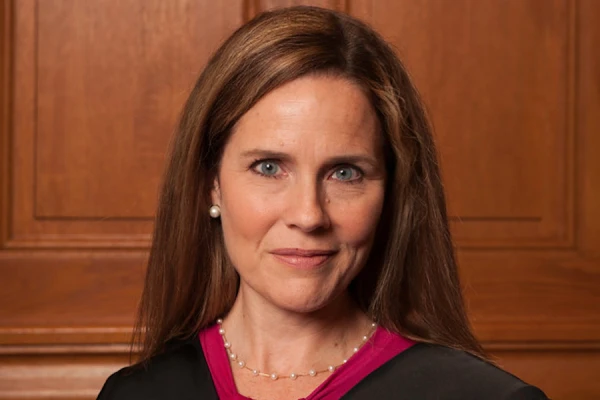
Legal experts have pushed back after a Catholic commentator said it is reasonable for the Senate to question potential Supreme Court nominee Amy Coney Barrett’s membership in the People of Praise, a charismatic covenant community based in South Bend, Indiana.
Barrett, a federal judge and professor at Notre Dame Law School, is widely reported to be a member of the People of Praise, and has faced media criticism for that, even while covenant communities have been fixtures in American Catholic and Protestant churches since the 1970s.
Massimo Faggioli, a historian and Catholic commentator, wrote a Sept. 24 op-ed for Politico Magazine expressing suspicion about the vows or promises Barrett may have made to an entity that, in his view, appears to lack the accountability of the official Church hierarchy.
Faggioli noted that “the dogmatic dimension of the Catholic intellectual tradition is, literally, an open book—the Catechism of the Catholic Church.”
However, Faggioli claimed, “[Barrett] has made solemn promises that go far beyond the baptismal promises every Catholic makes.”
“To whom has Barrett made a vow of obedience? What is its nature and scope? What are the consequences of violating it?” Faggioli asked.
The professor did not note that since 2018, the People of Praise have made their covenant publicly available on their website. The covenant requires members to promise mutual support, common Christian discipleship, and common Christian witness. Members often move into the same low-income neighborhoods, in order to promote community development and develop charitable programs.
The People of Praise have said that their covenant agreement differs from a vow— which is a promise made to God— and that members are free to leave at any time.
Nevertheless, the Senate’s vetting process for Supreme Court nominees ought, Faggioli said, to examine “oaths and commitments they may have made that could affect or supersede an oath to protect and defend the Constitution of the United States.”
Faggioli did not mention that numerous Supreme Court justices have been Freemasons, making vows of loyalty that are generally understood to supersede other loyalties and obligations.
In a Catholic context, “vows” are specifically defined by the Code of Canon Law as promises made to God, while the group’s covenant speaks of “a unique relationship one to another and between the individual and the community.”
The group’s covenant, according to the People of Praise’s website, is “made freely and only after a period of discernment lasting several years.”
“Our covenant is neither an oath nor a vow, but it is an important personal commitment. We say that People of Praise members should always follow their consciences, as formed by the light of reason, and by the experience and the teachings of their churches,” the group’s website reads.
The group’s website also states that “we have always understood that God can call a person to another way of life, in which case he or she would be released from the covenant.”
A former member of the People of Praise told CNA that the covenant was taken seriously, and as a result his family was encouraged to reconsider when they decided to leave several decades ago, but the group did release them from the covenant..
Even vows of obedience, in and of themselves, are not new or uncommon amongst Catholics. As Faggioli himself notes, Jesuits, Franciscans, Dominicans and lay Catholic members of “secular institutes” all take them.
“But at least in these communities, the vow of obedience that such a person has made would be visible, formal and accountable. That is not the case with new Catholic charismatic communities, whose vows are not public and whose leadership is not accountable under Church law,” Faggioli writes.
People of Praise’ covenant, which is publicly available, speaks mostly about the members’ commitments to each other and to the community, and does not explicitly include any provisions related to obedience to the group’s leadership, though it does provide that the member “accept the order of this community.”
Part of the covenant includes a promise to “obey the direction of the Holy Spirit” “in full harmony with the Church.”
Covenant communities- Protestant and Catholic- emerged across the country in the 1970s, as a part of the Charismatic Renewal movement in American Christianity.
While most People of Praise members are Catholic, the group is officially ecumenical; people from a variety of Christian denominations can join. Members of the group are free to attend the church of their choosing, including different Catholic parishes.
The group began with 29 members who formed an agreement to follow common principles, to give five percent of annual income to the group, and to meet regularly for spiritual, social, and service projects.
Rick Garnett, a professor at Notre Dame Law School, argued in a response to Faggioli’s op-ed that while there may be legitimate reasons for a nominee’s faith to come up in their hearings, a willful misunderstanding or misrepresentation of a nominee’s beliefs is not acceptable, nor is the application of greater skepticism to a nominee’s sworn testimony because of disagreements with that nominee’s religious beliefs or affiliations.
“Several Democratic senators did these things during Barrett’s hearings on her Court of Appeals nomination, and too many commentators and activists are doing these things now,” Garnett contended.
Barrett offered sworn testimony in 2017 to the Senate that she sees “no conflict between having a sincerely held faith and duties as a judge,” and that she will “never impose my own personal convictions upon the law.”
In a 2018 interview with the South Bend Tribune, People of Praise leader Craig Lent said the group never tries to influence how their members live their professional lives.
Faggioli in his op-ed cited a 2014 warning from Pope Francis for church communities in which he advised them not to “usurp the individual freedom” of members.
But Garnett noted that Pope Francis has praised charismatic renewal movements as a “current of grace” in the Catholic Church, and rejected the idea that Pope Francis’ comments could be used to single out People of Praise specifically.
Bishop Peter Smith, auxiliary of Portland in Oregon and a member of the People of Praise, rejected the idea that there is anything out of the ordinary or inappropriate about the group. If affiliation with the group were something to be concerned about, he said, Pope Francis would not have appointed him a bishop.
Some former members of the People of Praise have alleged that leaders have exerted undue influence over family decision-making, or pressured the children of members to commit to the group before being able to make that decision with maturity.
One critic, philosopher Adrian Reimers, has written that the group has made “serious errors” in its theological approach.
One former member of the group acknowledged the criticisms the group has faced, and said groups like People of Praise can develop unhealthy dynamics without careful attention. But he told CNA that “the rank and file People of Praise members are very, very good people, wholeheartedly dedicated to the Lord,” he said.

[…]