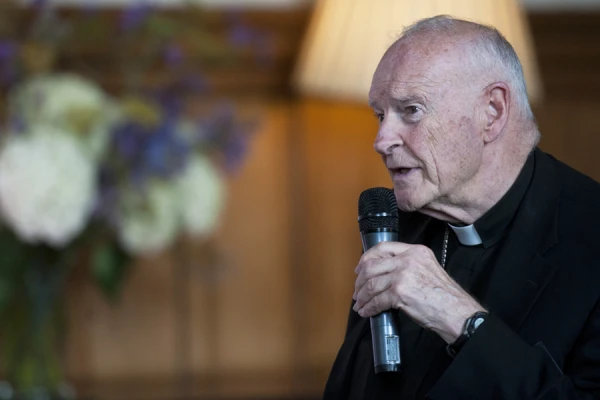
Vatican City, Nov 6, 2020 / 08:31 am (CNA).- The Vatican announced Friday that the long-awaited report on the disgraced former cardinal Theodore McCarrick will be released next week.
A Nov. 6 statement from Matteo Bruni, director of the Holy See press office, said: “On Tuesday, 10th November 2020, at 2:00 p.m. (Rome time), the Holy See will publish the ‘Report on the Holy See’s institutional knowledge and decision-making process related to former Cardinal Theodore Edgar McCarrick (from 1930 to 2017),’ prepared by the Secretariat of State by mandate of the Pope.”
The statement confirmed CNA’s Thursday report that the McCarrick Report would be published on Nov. 10.
The report, which was initially expected to be released in December 2019, comes after a Vatican review of documents and witness accounts spanning McCarrick’s 40-year episcopal career, after he was accused of serial sexual crimes related to minors and seminarians in 2018.
Cardinal Timothy Dolan of New York said Thursday that the report could be a “black eye” for the Church.
The U.S. Church is “still waiting for the release of the so-called ‘McCarrick Report’ by the Holy See, detailing the damning story of former-cardinal Theodore McCarrick. That could be another black-eye for the Church,” Dolan wrote in a Nov. 5 post on his website.
If you value the news and views Catholic World Report provides, please consider donating to support our efforts. Your contribution will help us continue to make CWR available to all readers worldwide for free, without a subscription. Thank you for your generosity!
Click here for more information on donating to CWR. Click here to sign up for our newsletter.

Pope Francis’ brief remarks during the Angelus July 21, 2024, focused on the day’s Gospel passage from Mark, which demonstrates how rest and compassion for others go together. / Credit: Vatican Media
Vatican City, Jul 21, 2024 / 07:30 am (CNA).
Do not be consumed by “the anxiety of doing,” but spend time in rest and silent prayer to receive God’s grace, Pope Francis said on Sunday.
The pontiff told Catholics, especially those in ministry, to beware “the dictatorship of doing” during his weekly reflection and Angelus on July 21.
The Angelus is a Marian prayer traditionally recited at three different hours throughout the day: at 6 a.m., 12 p.m., and 6 p.m.
“It is only possible to have a compassionate gaze, which knows how to respond to the needs of others, if our heart is not consumed by the anxiety of doing, if we know how to stop and how to receive the grace of God, in the silence of adoration,” Pope Francis said on a hot and humid day during the peak of summer in Rome.
Addressing the large crowd gathered in St. Peter’s Square, Francis said we are often “held prisoner by haste.” He called it an important warning, especially for those in engaged in ministry and pastoral service in the Church.
“Am I able to stop during my days? Am I capable of taking a moment to be with myself and with the Lord, or am I always in a hurry for things to do?” he said from a window of the Apostolic Palace.
He added that sometimes families are forced to live a frenetic pace; for example, when a father has to work from dawn until dusk to put food on the table. But this is a social injustice, he said, and we should help families in this situation.
Religious sisters wave Spanish flags at Pope Francis during his weekly Angelus in St. Peter’s Square on Sunday, July 21, 2024. Credit: Vatican Media
The pope’s brief remarks focused on the day’s Gospel passage, which demonstrates how Jesus is able to combine both rest and compassion for others.
In the Gospel, Jesus invites his apostles to “Come away by yourselves to a deserted place and rest a while,” but when they get out of the boat, they find the crowd already waiting for them.
Jesus’ “heart was moved with pity for them, for they were like sheep without a shepherd; and he began to teach them many things,” the Gospel of Mark, chapter six says.
“These may seem like two incompatible things — resting and being compassionate — but they actually go together,” Pope Francis underlined.
Jesus is concerned for his disciples’ tiredness, the pontiff said, because he is aware of the danger of our ministries and lives falling victim to an over concern with “things to do and with results.”
“We become agitated and lose sight of what is essential,” he emphasized.
Francis also explained that the rest proposed by Jesus is not “an escape from the world, a retreat into a merely personal well-being,” but a rest that helps us to have more compassion for others.
“Only if we learn how to rest can we have compassion,” he said.
After leading the Angelus, the pope spoke about the Summer Olympic Games, set to start in Paris on July 26, and the Paralympics, which will follow in August.
Sports, he said, have “a great social force, capable of peacefully uniting people of different cultures.”
“I hope that this event can be a sign of the inclusive world we want to build and that the athletes, with their sporting testimony, will be messengers of peace and good role models for young people,” he added.
Francis also recalled the tradition from Ancient Greece of the “Olympic Truce,” noting that such an initiative would be an opportunity to “demonstrate a sincere desire for peace.”
Vatican City, Apr 30, 2018 / 07:16 am (CNA/EWTN News).- The Vatican confirmed Monday that a delegation of six German bishops and one priest will meet with Vatican officials, including the head of the CDF, later this week to discuss the issue of the reception of the Eucharist by non-Catholic spouses of Catholics.
The meeting will take place May 3 with Archbishop Luis Ladaria Ferrer, prefect of the Congregation for the Doctrine of the Faith and Fr. Hermann Geissler, head of the department’s doctrinal section.
The German delegation, which includes Cardinal Reinhard Marx of Munich and Freising and Cardinal Rainer Maria Woelki of Cologne, will also meet with Cardinal Kurt Koch, president of the Pontifical Council for Promoting Christian Unity and Fr. Markus Graulich, under-secretary of the Pontifical Council for Legislative Texts.
The meeting takes place following reports, later denied by the German bishops’ conference, that the Congregation for the Doctrine of the Faith had rejected a planned proposal by the conference to publish guidelines permitting non-Catholic spouses of Catholics to receive the Eucharist in some limited circumstances.
In February, Cardinal Marx, announced that the conference would publish a pastoral handout for married couples that allows Protestant spouses of Catholics “in individual cases” and “under certain conditions” to receive Holy Communion, provided they “affirm the Catholic faith in the Eucharist.”
The announcement concerned a draft version of the guidelines, which were adopted “after intensive debate” during a Feb. 19-22 general assembly of the German bishops’ conference under the leadership of Cardinal Marx, who is the conference chairman.
The German delegation will also include Bishop Felix Genn of Munster, as well as both the president and vice-president of the conference’s doctrinal commission, Bishop Karl-Heinz Wiesemann of Speyer and Bishop Rudolf Voderholzer of Regensburg.
Bishop Gerhard Feige of Magdeburg, president of the commission for ecumenism of the German bishops’ conference and Fr. Hans Langendorfer, general secretary of the conference will also take part.
It was reported April 18 by CNA and other media that the CDF had raised objections about the German bishops’ proposal; sources close to the congregation had confirmed this to CNA.
It is unclear whether the Vatican has asked the bishops’ conference to modify the contents of the draft guidelines, whether they have suspended the development of a draft while the matter is considered further, or whether it has been entirely rejected.
Last month, seven German bishops, led by Cardinal Woelki, sent a letter to the CDF and to the Pontifical Council for Promoting Christian Unity asking for clarification on the matter, appending a copy of the drafted guidelines. The signatories did not consult beforehand with Cardinal Marx.
The seven bishops reportedly asked whether the question of Holy Communion for Protestant spouses in interdenominational marriages can be decided on the level of a national bishops’ conference, or if rather, “a decision of the Universal Church” is required in the matter.
The letter was also signed by Archbishop Ludwig Schick of Bamberg, Bishop Gregor Hanke of Eichstätt, Bishop Konrad Zdarsa of Augsburg, Bishop Stefan Oster of Passau, Bishop Rudolf Voderholzer of Regensburg, and Bishop Wolfgang Ipolt of Görlitz.
The Code of Canon Law already provides that in the danger of death or if “some other grave necessity urges it,” Catholic ministers licitly administer penance, Eucharist, and anointing of the sick to Protestants “who cannot approach a minister of their own community and who seek such on their own accord, provided that they manifest Catholic faith in respect to these sacraments and are properly disposed.”
Vatican City, Nov 18, 2018 / 05:19 am (CNA/EWTN News).- During a difficult time, it can be easy to see only the immediate problem; but asking Jesus to be the guide is the key to weathering the storm, Pope Francis said Sunday at a Mass with 6,000 poor a… […]
Leave a Reply