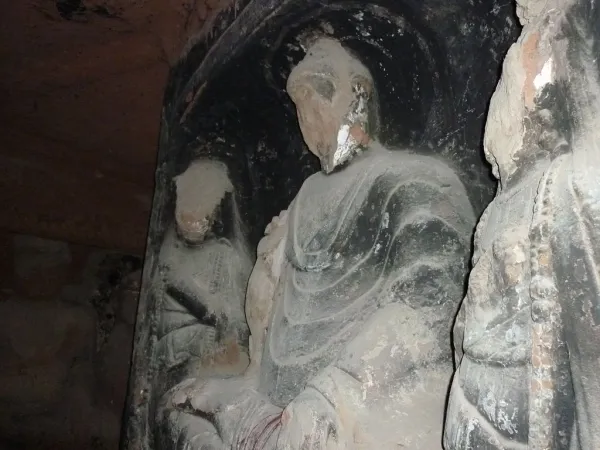
CNA Staff, Jul 1, 2020 / 11:22 am (CNA).- Cardinal Timothy Dolan of New York wrote Sunday that the destruction of monuments is detrimental to the knowledge of history, and warned against a ‘cultural revolution’ like that of China under Mao Zedong.
“God forbid we’d go through a cultural revolution as China did five decades ago. Beware those who want to purify memories and present a tidy – and inaccurate – history,” the cardinal wrote in a June 28 opinion piece at the Wall Street Journal.
China’s Cultural Revolution of 1966-76 sought to eradicate traditional elements from Chinese society, particularly old customs, old culture, old habits, and old ideas.
“And who’s to say which statues, portraits, books and dedications are spared,” the cardinal asked. “Remember when some objected to raising the status of the Martin Luther King Jr.’s birthday to a national holiday, citing his self-admitted flaws?”
Many public monuments have been the focus of vandalism or have been thrown down in recent weeks.
Long-controversial statues of Confederate leaders were toppled in some localities, as were statues of George Washington, Christopher Columbus, and Ulysses S. Grant. At least two statues of St. Junipero Serra were knocked down by rioters in California, and a statue of St. Louis has been protested against.
The cardinal recalled the story of a parishioner who opposed his dedication of a new parish to Saint Peter, citing the first pope’s three-fold denial of Christ.
“Knowing her and what parish she was from, I wrote back, ‘But you’re a proud parishioner at St. Mary Magdalene Church. She was sure not a paragon of virtue for a chunk of her life. Yet, by God’s grace, she became a radiant, inspirational saint. If we can’t name churches after sinners, the only titles we’d have left would be Jesus and His Mother!’”
He noted that the same is true “of America’s historical personalities,” adding that “all of them had flaws, yet all of them still contributed a lot of good to our nation’s progress.”
He said toppling statues and vandalizing monuments is comparable to book burning.
“Our children need to know their country’s past, its normative figures and their virtues and vices. That’s how we learn and pass on our story,” he said.
He suggested that there is no “more effective way to comprehend America’s history of racism” than by reading Huckleberry Finn or the short stories of Flannery O’Connor.
“My own mom kept a photo of her parents hanging on the wall of our house. Her dad, my grandfather, was an abusive drunk who abandoned his family. I’m glad we got to know of him, the good and the bad,” Cardinal Dolan wrote.
He reflected that “if we only honor perfect, saintly people of the past, I guess I’m left with only the cross. And some people would ban that.”
Having studied American Church history, he said that “as a historian … I want to remember the good and the bad, and recall with gratitude how even people who have an undeniable dark side can let light prevail and leave the world better.”
“I want to keep bringing classes of schoolchildren to view such monuments, and to explain to them how even such giants in our history had crimes, unjust acts and plain poor judgment mixed in with the good we honor.”
If you value the news and views Catholic World Report provides, please consider donating to support our efforts. Your contribution will help us continue to make CWR available to all readers worldwide for free, without a subscription. Thank you for your generosity!
Click here for more information on donating to CWR. Click here to sign up for our newsletter.

St. Louis, Mo., Aug 1, 2023 / 08:45 am (CNA).
The Biden administration is expected to pay $65,000 after attempting in 2021 to exclude fertility awareness-based family planning methods, a form of natural family p… […]
Fr. Richard Cassidy, professor of Sacred Scripture at Sacred Heart Major Seminary, dresses in Roman prisoner garb as he holds a copy of his newest book, “A Roman Commentary on St. Paul’s Letter to the Philippians.” Fr. Cassidy’s eighth scholarly work, the book explores the subversive nature of St. Paul’s Letter to the Philippians, which the apostle wrote from behind bars in a Roman prison cell. / Valaurian Waller | Detroit Catholic
Detroit, Mich., Apr 30, 2022 / 08:00 am (CNA).
It was a tough decision for Rick Cassidy as he began graduate studies at the University of Michigan in mid-1960s. Would he take the course on Imperial Rome, because of his love of history, or the course History of Slavery, because of his deep concern for social justice?
The Dearborn native chose the course on slavery. The insights he acquired have helped to guide Fr. Richard Cassidy’s scholarly work for three decades, including his latest work, “A Roman Commentary on St. Paul’s Letter to the Philippians“ (Herder & Herder, 2020).
Paul’s letter, composed in chains and secreted out of his Roman jail cell, is intentionally “counter-slavery” argues Father Cassidy, professor of Sacred Scripture at Sacred Heart Major Seminary since 2004, as well as “counter-emperor.” At its core, Philippians is an underground epistle that subverts the Roman power structure and the “lordship pretensions of Nero.” Reviewers praise the “distinctive thesis” of Father’s groundbreaking work as “fresh and illuminating,” making for “fascinating reading.”
This is Father Cassidy’s seventh book that examines the influence of Roman rule on the writers of the New Testament, and his eighth book overall. He returned to Ann Arbor on a rainy afternoon in late June to discuss his newest work.
Dan Gallio: St. Paul’s Letter to the Philippians is most known for its soaring declaration of the divinity Christ, before whom one day “every knee must bend,” and “every tongue proclaim” his universal lordship (2:6-11).
Your new book presents a unique argument: Paul’s letter is primarily a “subversive” document of resistance against the Roman Empire—particularly against emperor worship and slavery. How did you arrive at this against-the-grain interpretation?
“A Roman Commentary on St. Paul’s Letter to the Philippians” (Herder & Herder, 2020) is Fr. Cassidy’s eighth book and a follow-up on his 2001 work, “Paul in Chains: Roman Imprisonment and the Letters of St. Paul”. Valaurian Waller | Detroit Catholic
Father Cassidy: These insights were the result of long hours with the text, spending a lot of prayer time for guidance, as to Paul’s situation.
The issue of slavery came into play strongly. I now saw that Jesus was executed as a violator of Roman sovereignty, condemned by Pilate, executed under Emperor Tiberius—and that this was the slave’s form of death. This is a crucial point.
In regards to the two topics you mention, I had the intuition that the Letter to the Philippians was “counter-emperor cult” and “counter-slavery.” First, the self emptying of Christ from on high—descending downward into human form, downward, downward to the point of the slave’s death on a Roman cross—and then you have St. Paul’s wonderful words in chapter 2, verses 9-11.
My insight was that there is going to be a redressing of what has happened. Because of the great faithfulness of Jesus Christ, the Father intervenes and begins the lifting up, the ascending of Christ, where the Father exalts Jesus and bestows upon him “the name above every other name.”
So I can now speak about this famous passage in terms of a kind of “drama”: four scenes that represent the descent of Jesus, and four scenes that represent his ascent, akin to a medieval passion play. The Father intervenes on Christ’s behalf, conferring upon him the name of “Lord.” Now all of creation, including the emperor, the governor, the imperial personnel, are all subject to Jesus. They have to prostrate themselves before the name of Jesus.
DG: So, essentially, Philippians is subversive because it makes a political statement as much as a theological one.
FC: Yes, but for some, it is a great privilege to genuflect at the name of Jesus. This includes slaves! Paul had integrated slaves into his community in Philippi. They were empowered now to proclaim the name of Jesus, standing alongside free men and women. They are standing alongside the Roman imperial power structure, all involved in the same process of bowing before Christ and proclaiming his name.
A security guard at Sacred Heart Major Seminary helps Fr. Cassidy don his “prisoner’s clothing” for a photo shoot promoting Fr. Cassidy’s latest book, “A Roman Commentary on St. Paul’s Letter to the Philippians,” which details Paul’s experience behind bars and the conditions under which he wrote his Letter to the Philippians. Valaurian Waller | Detroit Catholic
And that name is “Lord.” Jesus is being acclaimed as Lord, and not the emperor, to the glory of God the Father. This is the decisive element of Philippians 2:6-11, blended together in this one passage.
DG: You provide a forty-four-page introduction to the social situation of the Roman colony of Philippi. Why did you feel such an informative but lengthy introduction was necessary to support your thesis?
FC: I had to establish that conditions at Philippi mirror conditions at Rome. This is important. Philippi was like “Little Rome.” When Paul is speaking of conditions at Philippi, his is also experiencing the same oppressive conditions at Rome as a chained prisoner. I had to establish that emperor worship was everywhere, in Philippi’s renowned amphitheater, in the streets, in public artifacts. That is why I had to go into an extensive introduction to set the stage of what Paul is doing in his letter.
DG: Your appendices are extensive, too, like bookends to the introduction, driving the thesis home again using illustrations.
FC: There is one illustration of a monument where slaves are chained, and a slave trader is proclaiming his prowess as a slave trader. This monument to the degradation of slavery was at a city adjacent to Philippi. Paul almost certainly passed by it on his way to and from Philippi. It was discovered back in the 1930s and almost destroyed in the war by Nazi bombings.
DG: Paul is sometimes criticized by revisionist commentators for not rejecting the institution of slavery in his letters. Is your book an answer to these critics?
FC: Paul’s approach to slavery is complicated. There are some letters where he seems to envision the imminent return of Christ. Possibly he minimized the importance of slaves being freed in these letters. However, in Philippians, his final letter before his death, he addresses the issue definitively. It is very undermining of slavery.
I intended to de-establish the idea that Paul acquiesced to slavery. He did not acquiesce. The laudatory prepublication comments by scholars make me think the book will have a decisive role in re-imaging Paul.
Against a prevailing notion that St. Paul “acquiesced” to the idea of slavery in his writings, Fr. Cassidy’s book aims to counter the idea by showing how St. Paul’s Letter to the Philippians actually served a subversive purpose in a Roman empire dominated by emperor worship and tight controls. Valaurian Waller | Detroit Catholic
DG: Back to Philippians 2:6-11. Why do you maintain this passage is not a hymn or baptismal catechesis, as is customarily believed, but is an original composition of Paul? Is this position another example of your counter exegesis?
FC: This is not some other preexisting hymn. No! This is fresh imaging. Visceral imaging. This is intensity from identifying with Christ as the “slave crucified.” No one else could have composed this passage. And Paul could not have composed this passage until he was in Roman chains and could see the threat posed against Jesus by the counterfeit claims that Emperor Nero is Lord.
DG: It’s almost like the passage is “supra-inspired,” that he would get such an original insight while in such dreadful circumstances.
FC: Correct. And there is a real question as to how this letter could be transmitted from prison, with the security and censorship. In garments? In pottery? It is possible the original written letter was confiscated. So how is Paul is getting his subversive thoughts past the Roman guards?
I suggest in my book that Paul was drilling his associates, Timothy and Epaphroditus, to memorize his letter, given the role of memory in early Christian life.
DG: With your busy teaching and pastoral duties, where to you find the motivation and energy to produce such a thoroughly researched, and beautifully written, work of scholarship?
FC: It’s Spirit driven!
DG: Is the Spirit driving you to another book?
FC: I would say so. After a book comes to publication, there is always a kind of mellowing period. So right now I have not identified the next project. I am appreciating the graces I have received from this book, and trusting that the same Spirit who has shepherded me through this sequence will still stand by me, guiding me forward.
A person holds a foil while smoking following the decriminalization of all drugs, including fentanyl and meth, in downtown Portland, Oregon, on Jan. 25, 2024. Since hard drugs were decriminalized in Oregon three years ago, there are no arrests, … […]
2 Comments
Catholics are blessed to have our statues and our saints. While almost all were sinners during their life, we recognize them in memorial for their virtuous examples of how to live. But I do believe the Edmond Pettus bridge in Selma needs to be renamed. While Edmond Pettus did both good and bad in his life, he’s remembered primarily for being the head of the KKK. This bridge has become an icon for evil, not virtue.
But why is our society focused on the dead statues, rather than the living? Recently in Harlem, some evildoers attacked a sleeping 66-year-old homeless man with a huge illegal firework. The explosion burned him, but fortunately, he lived. Instead of wasting all this energy on tearing down the dead, let us invest our collective energy on building up the living…helping the homeless, educating the young, changing hearts and minds on the horrors of abortion, walking with mothers in need, etc. So little time, so much to do. I can’t imagine an evildoer waking up the next day and feeling good about their actions. I also can’t imagine anyone not waking up the next day and not feeling good after committing a virtuous act of kindness. People, do God’s work and be happy!
what is bishop dolan doing to protect statues, stain glass windows, and other Church property? has he called on parish priests to organize a quick reaction force of men to form a human barricade or respond to a church under attack or threatened?
Catholics are blessed to have our statues and our saints. While almost all were sinners during their life, we recognize them in memorial for their virtuous examples of how to live. But I do believe the Edmond Pettus bridge in Selma needs to be renamed. While Edmond Pettus did both good and bad in his life, he’s remembered primarily for being the head of the KKK. This bridge has become an icon for evil, not virtue.
But why is our society focused on the dead statues, rather than the living? Recently in Harlem, some evildoers attacked a sleeping 66-year-old homeless man with a huge illegal firework. The explosion burned him, but fortunately, he lived. Instead of wasting all this energy on tearing down the dead, let us invest our collective energy on building up the living…helping the homeless, educating the young, changing hearts and minds on the horrors of abortion, walking with mothers in need, etc. So little time, so much to do. I can’t imagine an evildoer waking up the next day and feeling good about their actions. I also can’t imagine anyone not waking up the next day and not feeling good after committing a virtuous act of kindness. People, do God’s work and be happy!
what is bishop dolan doing to protect statues, stain glass windows, and other Church property? has he called on parish priests to organize a quick reaction force of men to form a human barricade or respond to a church under attack or threatened?