CNA Staff, Jun 22, 2020 / 07:30 pm (CNA).- As New York City’s eviction moratorium expires for some people affected by the coronavirus pandemic, Catholic Charities has warned that many low-income residents may face risk of eviction.
New York City’s original moratorium on landlords evicting tenants for non-payment of rent concluded on June 20. It will be extended until August 20, but only for some people.
Antonio Garcia, director of the Preserving Housing program at Catholic Charities of New York, warned that many people in the city could be at risk of eviction. He said the evicted moratorium will be extended for those who have received unemployment benefits from the government, but not others who have been affected by the pandemic, without collecting unemployment benefits.
“Nobody knows the magnitude of the problem yet, what we could see is a spike in people facing eviction in New York City,” said Garcia, according to Net TV.
Every year, more 200,000 cases of non-payment are taken up in the New York Housing Court, and 9% of these cases result in evictions, according to Catholic Charities. Garcia thinks the number of evictions could double with the moratorium lifting.
Tatiana, a professional working with adults who have developmental disabilities, told Net TV that many of her clients will not qualify for the moratorium because they did not make enough money to apply for unemployment, even though the pandemic has left them jobless.
She called the system unfair, saying her clients “have to feed their families and they have bills that they can’t catch up on.”
Catholic Charities of New York said it will continue to be a resource for at-risk tenants and help seek long-term solutions to rent-payment concerns.
“We help clients find the resources to pay the rental arrears, we also mediate with landlords to find a solution, sometimes landlords are willing to abate some of those rental arrears,” said Garcia, according to Net TV.
“We have employment specialists who can help them, we also have a tenant education program that helps people with budget management.”
If you value the news and views Catholic World Report provides, please consider donating to support our efforts. Your contribution will help us continue to make CWR available to all readers worldwide for free, without a subscription. Thank you for your generosity!
Click here for more information on donating to CWR. Click here to sign up for our newsletter.
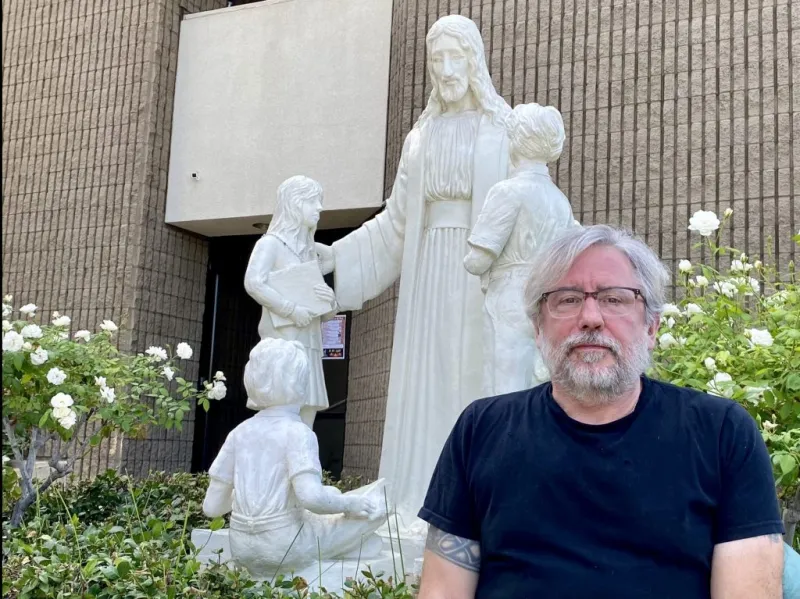
Michael Stucchi poses in front of the restored statue of Jesus with children at St. Mel’s Church in Woodland Hills, California. / Photo credit: Tom Hoffarth
Woodland Hills, California, Nov 5, 2022 / 08:00 am (CNA).
In the darkness of an early Saturday morning last March 19, Father Steve Davoren and his golden lab, Blue, came out the back exit of the rectory at St. Mel’s Church in Woodland Hills, California, for a pre-dawn run.
But before he could start, the priest’s heart sank when he saw what the floodlights pointing at the church’s iconic statue cluster of Jesus and three children revealed.
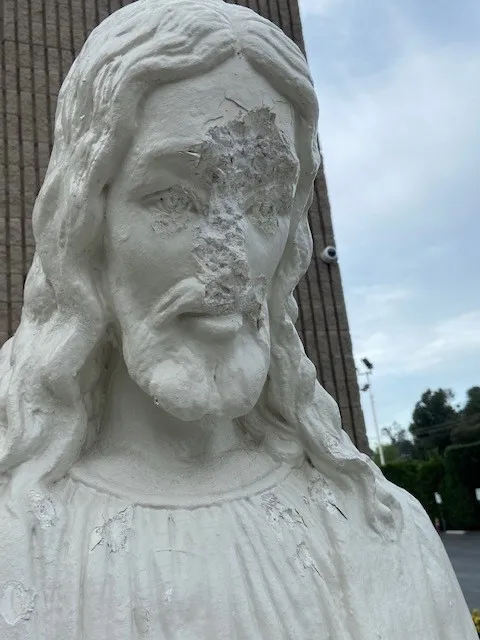
Grainy security footage only captured the arm of a person repeatedly swinging an unidentified weapon at the statues. Pieces fell from what has been a longtime centerpiece of the parish, in a highly visible spot off of busy Ventura Boulevard.
Chunks of the marbled concrete that came off the twisted, exposed rebar were everywhere: in the raised flower bed flanked by white rose bushes, in the parking lot, on the sidewalk next to the parish office.
Davoren immediately called the church’s business manager, Lisa Feliciano, who threw on a hoodie and came right over.
“It was horrific,” Feliciano said. “But now we were putting pieces in a box, crying. I couldn’t believe anyone could have this much hate to do this.”
Feliciano filed a police report along with the surveillance video, which she described as “two minutes of torture.”
“I see it and it still makes me cry,” she said.
Details of the damaged statues of Jesus at St. Mel’s Church in Woodland Hills, California. Photo credit: Michael Stucchi
It fell to Davoren to explain the attack to parishioners the next day at Sunday Masses, preaching understanding and forgiveness in the place of anger and frustration.
“To me, the irony of this was the person who did this had to be a broken person himself,” said Davoren, pastor at St. Mel’s since 2018. “Through Scripture we know we need to pray for people who feel they have to destroy.”
Michael Stucchi heard Davoren’s message loud and clear that weekend. A systems software engineer by trade, Stucchi has found satisfaction working for the parish to restore four in-church statues in the past as well as Nativity scene statues.
He has been their humble go-to, fix-it man. But this was something bigger.
“When I spoke to Father Steve about it a few days after it happened, I admit, I was angry, mad, indignant because the statues were special to me and my family,” said Stucchi, whose son works in the parish office. “But then I heard his sadness and concern for the mental state of the person who damaged the statues. That’s so much like him. This really altered my paradigm from reactive to proactive — to ask if I could look into ways of repairing them.
“Father Steve’s compassion is what Jesus would want us to have. All the people who work here are in the same mindset of love and forgiveness. We have no idea what terrible things are in that person’s life.”
Stucchi and Feliciano started the reconstruction by collecting and studying photographs of the statues to examine all their features. The depiction of Jesus is about 6 feet tall and weighs about 1,000 pounds; each child on its own concrete base weighs about 300 pounds.
The collection dates to the 1950s, when the parish was first built. It had once been part of a fountain display in front of the school office and later relocated near the church’s west doors in the 1990s when the new parish center was built.
Feliciano had contacted the Los Angeles Archdiocese about filing an insurance claim and was told it might cost as much as $30,000 to repair.
Stucchi said he could take care of it, with no charge to the parish.
That didn’t surprise Feliciano, who calls Stucchi “a true angel.”
“Look at the difference between someone filled with hate and destruction … and then someone like Michael who spends his time showing pure love and joy putting it back together,” Feliciano said. “Both are our neighbors, they live among us. How can there be such a vast difference in someone’s heart and soul?”
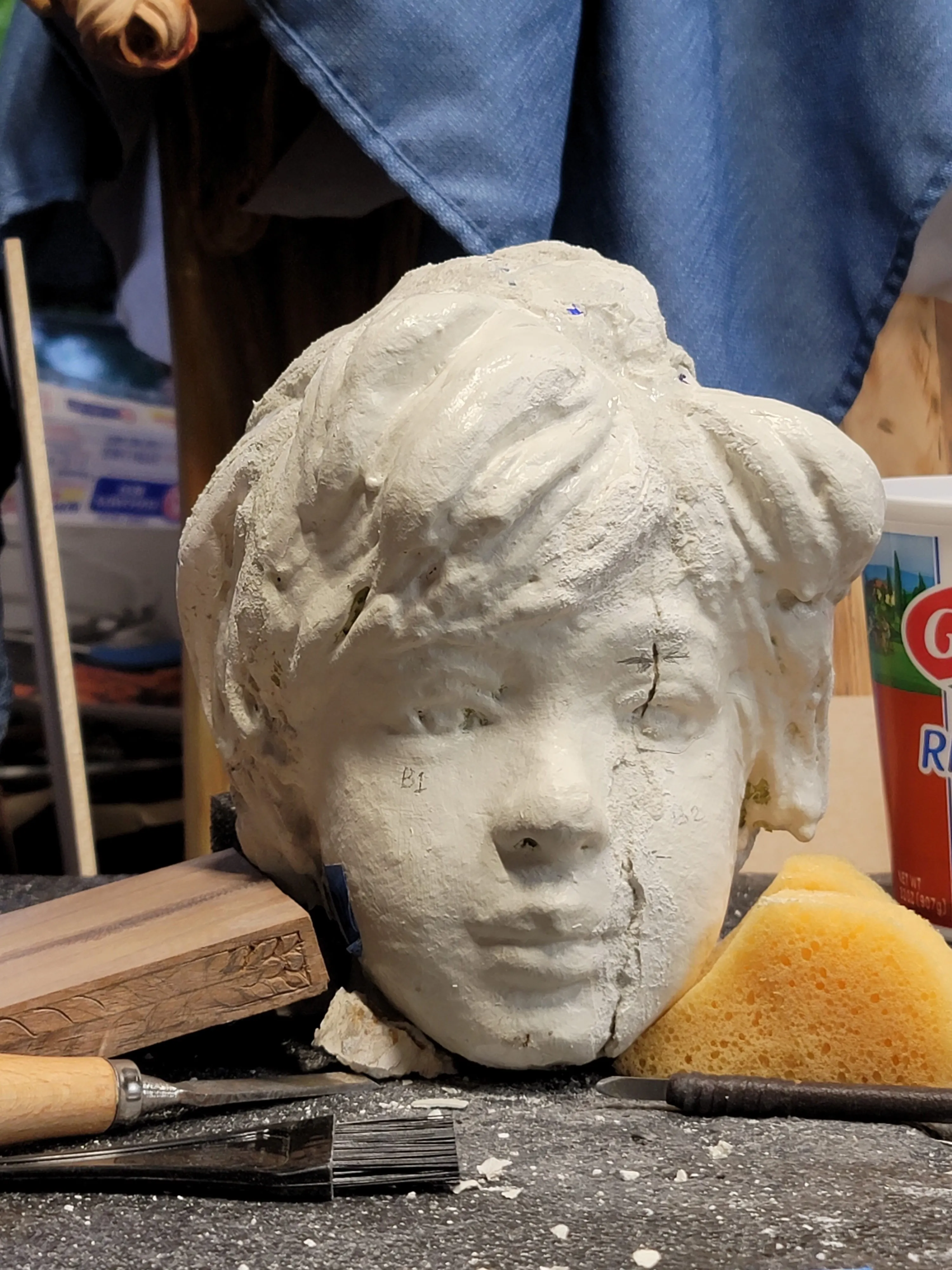
Michael Stucchi has pieced together the statues at St. Mel’s Church in Woodland Hills, California, to where they may even be in better condition when finished. Photo credit: Michael Stucchi
Stucchi experimented with different combinations of compounds — crushed marble, white Portland cement, and waterproof exterior grout. Most of the work had to be done on site, with some pieces taken to his home garage.
“I was super cautious about not making anything worse,” said Stucchi, noting the materials often dried too quickly in the summer heat, causing more delays. “The saddest part to me was the damage to Jesus. We know enough about the pain and suffering Jesus went through in his life, but to see an image of him obliterated, that’s too much.”
Slowly and meticulously, Stucchi has pieced together the statues to where they may even be in better condition now because of the ways weather and age already caused cracks and decay before the vandalism.
Seven months later, Stucchi has a few finishing touches — and plenty of gratitude — still left.
“As a priest’s sacrifice and commitment are beyond my comprehension or capabilities, having seen their dedication and that of the other volunteers and staff, I felt it’s the least I can do,” Stucchi said. “Notwithstanding, the Catholic Church was always there for me when I was a child and young adult.”
From a business perspective, Feliciano said the experience has taught her about the need for better security. The statues also were previously vandalized in 2021 when someone painted the faces a green color, but they were easy enough to repaint white.
“As a parishioner, the kindness of Michael reminds me that there is goodness in the world,” said Feliciano, who noted the 100-degree days Stucchi spent with the statue last summer. “I am reminded to pray for the person who was filled with enough hate to do the damage and thank God for blessing us with Michael.”
Father Davoren believes that “to some degree, we’re all broken and damaged, but our faith in the love of God allows people like Michael the tenderness to painstakingly put those pieces of the statue back together.
“It’s about giving people the right amount of grace to rebound in their lives.”
Detroit, Mich., Nov 2, 2018 / 04:00 am (CNA).- A year after Detroit’s archbishop released a letter outlining a plan for his diocese’ revitalization, the diocese is working to put his words into action with a campaign called “Unleash the Gospel.”
The archdiocese held a year of prayer in 2014, asking the Holy Spirit to revitalize their diocese, which is facing a steady decline in practicing Catholics. In 2016 the diocese held a synod, a meeting of lay Catholics, priests, deacons, and religious, to discuss evangelization, the challenges facing the diocese, and potential solutions.
Communication director Edmundo Reyes told CNA that he hopes the archdiocese’ new initiative, which is primarily based around short videos, will encourage parishes, individuals and families to cultivate a missionary attitude.
Reyes said more than 550 volunteers plan to encourage parishioners at all 218 parishes Nov. 3-4 to sign up for the Archdiocese’ daily “Unleash the Gospel” emails. There will also be reflection booklets available for those without a smartphone or computer.
The initial goal, Reyes said, is to encourage parishioners to spend five minutes in reflection and prayer per day for six days, guided by short videos emailed to them the day after they sign up. Reyes hopes the videos will encourage parishioners to reflect on what it means to be a Church “on mission.”
He said the initiative is not primarily about “social justice,” although helping people, especially the poor, is a key part of the Archdiocese’ revitalization. Rather he hopes the videos and the initiative in general will refocus people on the “original issue” of Christianity, which is proclaiming the Gospel.
“It’s about us understanding that the main mission of the Church is to share the Gospel with others. That’s the wrong that need to be righted,” Reyes said. “The videos are trying to explain how to do that.”
Archbishop Allen Vigneron laid out some of the particular obstacles to evangelization in the Archdiocese of Detroit his 2017 letter. He wrote that these challenges have contributed to “a widespread pessimism of the possibility for authentic renewal.”
“For several decades the number of practicing Catholics has been in steady decline, a significant factor leading to many painful closings and mergings of parishes and schools, which has in turn caused more people to drift away in discouragement or frustration,” the Archbishop wrote.
“The number of active priests has also dropped considerably. In the last half century our metro area has suffered from urban blight, economic decline, racial tensions, family breakdown, substance abuse, and crime.”
Some solutions the archbishop offered in his letter had been discussed at the diocesan synod. They included an emphasis on repentance, personal testimonies, utilizing new media, and witnessing to faith within families.
In light of these challenges and using the archbishop’s letter as a guide, Reyes said the goal of the “Unleash the Gospel” initiative is to move from a focus maintenance of problems to an emphasis on outward-focused, mission oriented Church. He said a lot of archdiocesan parishes have already embraced the call to action, including Our Lady of Good Counsel parish in Plymouth, which he described as a very vibrant parish that is already cultivating a missionary atmosphere.
“[Jesus is] asking us to step up and share the Gospel with others,” Reyes said.
“It’s about evangelization, it’s about sharing the Gospel, it’s about being joyful missionary disciples, and to do things in a different way.”
Reyes said the diocese’ initiative was in the works before the current sexual abuse crisis began during summer 2018. He said his team made changes to at least one of the videos to emphasize the need for missionary renewal in the face of crisis in the Church.
“It is clear to us that we are called to “unleash the Gospel” not in spite of the crisis, but because of the crisis,” Reyes said.
“Sin is real, and it’s present in our society. We can see that very clearly…there’s sin in our Church as well. This is why the time to “unleash the Gospel” is now. This is why we should bring the Good News of Jesus Christ to people, to ourselves and to our Churches.”
Michigan’s Attorney General announced an investigation in September into all of Michigan’s eight diocese to look into any potential coverup of sexual abuse, which Vigneron said he welcomed.
The archdiocese will launch a new diocesan website in the coming days, and Reyes said other initiatives are in the works, including podcasts and training for all parishes to be “radically hospitable” to Catholics returning to the Church at Christmas. The archdiocese plans to launch a separate magazine and website for Unleash the Gospel in 2019.
Allentown, Pa., Sep 16, 2019 / 12:30 pm (CNA).- A Pennsylvania man who sent online threats to the Little Sisters of the Poor is asking a federal court to allow him out of jail. Jaan Kruus, Jr., 55, will present his bail request in court on Monday at 3pm.
Kruus was was indicted by a federal grand jury in July on two counts of sending threatening messages online, via his computer, to the Little Sisters of the Poor, LehighValleyLive.com reported.
According to the indictment, Kruus sent “a threat to injure another, specifically, persons affiliated with the Little Sisters of the Poor,” on February 1, 2017 and again on May 9, 2017, from Emmaus, Pennsylvania to Washington, D.C.. The Little Sisters of the Poor operate a residence for elderly patients in Northeast Washington, D.C., the Jeanne Jugan Residence.
Kruus was ordered to undergo a health and psychological evaluation by U.S. Magistrate Judge Harry S. Perkin. He requested bail, and at his hearing will take place September 16 in the Eastern District Court of Pennsylvania.
According to his motion for pretrial release, Kruus resides in Emmaus, Pennsylvania and cares for a disabled friend while living with his parents. He was evaluated by psychologist Jeffrey E. Summerton, Ph.D., who decided that he could benefit from mental health counseling and may have anger management issues.
The motion says that after being questioned by FBI agents in June of 2017 about the online threats, Kruus was not arrested or deemed a threat despite having allegedly admitted to sending the threats.
“In its argument for detention the government relies heavily on a crumpled note purportedly in Mr. Kruus’ handwriting that was found in a wastebasket in 2011 by his then and still estranged wife,” the motion states. “The note uses the verbs ‘kill’ and ‘bomb’ in the imperative voice with various objects including his parents, two neighbors, and law enforcement officials.”
“He [Kruus] was investigated by the local police regarding that writing and was not charged. Nothing has come of the writing in the following eight years,” the motion states.
It is unclear from the July indictment what specific content was contained in the threats Kruus sent to the Little Sisters of the Poor in 2017, as well as his motive for doing so.
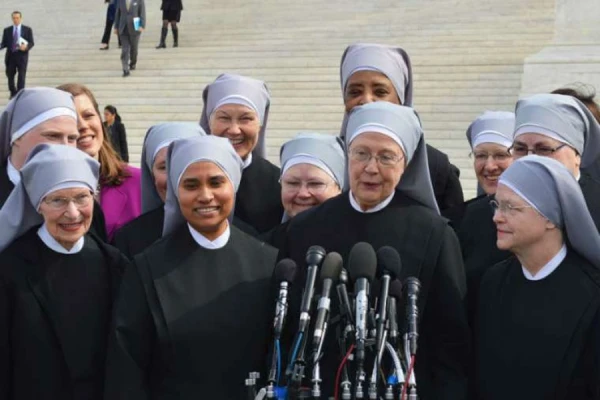
The Little Sisters of the Poor have been in national news in recent years for their lawsuit against the Affordable Care Act’s contraceptive mandate that went all the way to the Supreme Court. The health care law required coverage of certain preventative services in health plans, clarified by the Obama administration to include contraceptives and sterilizations—including emergency contraceptives that prevent implantation of a fertilized embryo, thus causing early abortions.
The religious exemptions to the mandate were narrowly tailored and excluded many religious non-profits that objected to the mandate, including the Little Sisters of the Poor. An “accommodation” offered by the Obama administration did not satisfy the sisters and others, who argued in court that it would still force them to contradict their religious mission in forcing them to provide contraceptive coverage in their health plans.
Although the Trump administration issued a rule in 2017 expanding the religious exemptions to the mandate, Pennsylvania Attorney General Josh Shapiro filed a lawsuit against the religious order, as did the California Attorney General Xavier Becerra, saying the sisters should not receive a religious exemption to the mandate.
The Little Sisters of the Poor congregation was founded in France in 1839 by St. Jeanne Jugan and entered the United States in 1869; the congregation is dedicated to living with and caring for the elderly poor, and serves in more than 30 countries around the world.





Leave a Reply