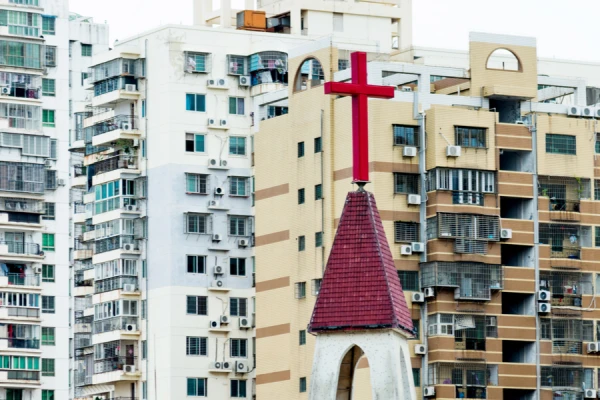
CNA Staff, Apr 30, 2020 / 02:00 pm (CNA).- As the Chinese government makes progress containing the COVID-19 pandemic, authorities have resumed action to remove crosses from buildings and crackdown on religious practice.
The latest round of enforcement actions have included the removal of crosses from buildings belonging to the state-run churches. According to a report from UCA News, priests say they are cooperating in the removal of exterior crosses in hopes that entire church buildings will not be demolished or converted into a building for secular use.
According to a parishioner in the Chinese province of Anhui named John, Chinese officials cut down the cross from the top of Our Lady of the Rosary Church on April 18. Our Lady of the Rosary belongs to the Chinese Patriotic Catholic Association (CPCA, the Catholic Church officially sanctioned by the Chinese Communist Party and operating both in communion with Rome and under state control.
The bishops of the CPCA, who were in many cases illicitly consecrated and under official excommunication, were received into full communion with Rome as part of the Vatican’s 2018 provisional agreement with China. The full terms of the China deal were not released to the public but have been reported to include the right of state authorities to propose and veto candidates for the episcopacy in China.
John, speaking to UCA News, explained that on April 13, the leaders of Our Lady of the Rosary–which does not have a member of the clergy assigned to it, and all religious activities are organized by the laity–asked the city authorities about making repairs to the church building. Three days later, the community director of the city requested keys and access to the church, in order to remove its cross.
Concerned parishioners went to Bishop Joseph Liux Xinhong of the Diocese of Anhui, who told them to request more information from the local CPCA office. The local CPCA office said they did not know of any plan to remove the cross from the building.
Xinhong was one of the bishops who had his excommunication lifted and his position recognized by the Vatican following the 2018 provisional deal.
On April 17, the parish community leader said that he had been given “directions from superiors” regarding removing the cross. The following day, said John, the cross was removed by a “team of young people.”
Elsewhere in the province of Anhui, on April 19 a cross was removed from a church in Suzhou City during pre-dawn hours, presumably to avoid the chance of a crowd protesting its removal. A man from the diocese named Paul told UCA News that the removal had previously been scheduled for the afternoon.
Paul said that police officers blocked people from entering the church or taking pictures of the removal, and that a cell phone had been confiscated after it captured a picture of the cross coming down.
In Hefei City, which is also located in the Anhui province, authorities on April 27 took a cross off a building for a Protestant church.
A priest from the Diocese of Anhui, identified only as “Father Chen,” told UCA News that these sorts of activities are “happening all over the mainland” and are not limited to one diocese or province.
“If the churches don’t unite to resist, many more crosses will be removed,” he said.
In September 2017, China enacted strict new regulations concerning religion. Since then, authorities have been vigilant in enforcing permitting requirements. Churches that are not found to be in compliance are destroyed.
If you value the news and views Catholic World Report provides, please consider donating to support our efforts. Your contribution will help us continue to make CWR available to all readers worldwide for free, without a subscription. Thank you for your generosity!
Click here for more information on donating to CWR. Click here to sign up for our newsletter.

India’s supreme court building is pictured in New Delhi on July 9, 2018. / Credit: SAJJAD HUSSAIN/AFP via Getty Images
New Delhi, India, Aug 22, 2024 / 16:00 pm (CNA).
Catholic leaders in India have lauded the country’s high court for rejecting a plea for “passive euthanasia” from the parents of a 30-year-old man who has been in a vegetative state for 11 years.
Commenting on the August 20 verdict issued by a three-judge bench led by Chief Justice Dhananjaya Chandrachud, Archbishop Raphy Manjaly of the Archdiocese of Agra, the chairman of the doctrinal commission of the Catholic Bishops’ Conference of India, said: “We would like to congratulate the Court for its unambiguous verdict while calling for support for the family facing a serious crisis.”
“We are extremely happy that the sacredness of life has been upheld by the court,” the prelate told CNA on Aug 22.
When the lawyer for the distressed parents of the 30-year old man — who fell from a hostel balcony in 2013 while studying for engineering and had been comatose since then — told the Supreme Court that the family had sold their house to pay for their son’s treatment, the chief justice admitted the court was “moved by the plight of the parents.”
“Can some alternative be introduced?” Chandrachud asked. “Both parents are aging. Is there any facility where [the patient] can be lodged, and the expenses covered? He is suffering from bed sores.”
Yet the court “cannot permit passive euthanasia as he is not on a life support system,” the justice said. The patient is fed through a nasal tube.
In 2018 the Supreme Court said Indian law “prohibits anyone, including a physician, from causing the death of another person by administering any lethal drug, even if the objective is to relieve the patient from pain and suffering.”
“Passive” euthanasia, meanwhile, is allowed in cases where doctors remove patients from mechanical life support. The removal of nasal feeding tubes is not allowed under that rule.
Archbishop Manjaly noted that “while taking a clear pro-life stance, the judgment acknowledges that there is definitely a crisis.”
“The suffering family cannot be pushed into a corner. We are happy that the court insists on community support for the distraught family,” he pointed out.
The prelate of the Taj Mahal city of Agra also recounted how Aruna Shanbaug, a nurse brutalized by a janitor while on hospital duty in 1973, remained in vegetative condition for 41 years with the nursing community in the Mumbai hospital taking care of her until her death in 2015.
“Society needs such compassion to care for the needy. The Church stands for that,” Manjaly said.
A reconstruction of an ancient church recently discovered in Armenia. The newly discovered church measures about 100 feet across and is shaped like an octagon with “cruciform annexes oriented east-west and north-south,” according to Achim Lictenberger, who noted the discovery of a similar structure from a slightly later period found in Abchazia (Sebastopol). / Credit: AGAP
Washington, D.C. Newsroom, Oct 24, 2024 / 08:00 am (CNA).
A team of German and Armenian researchers made a groundbreaking discovery last week of an ancient church in Armenia dating back to the fourth century, making it the oldest documented church in Armenia, which is considered the first Christian nation in the world.
In an email correspondence with CNA, co-directors of the project Achim Lichtenberger and Torben Schreiber of the University of Münster and Hayk Gyulamiryan of the Armenian Academy of Sciences explained the significance of the discovery made by the team at the site of the ancient city of Artaxata. The project’s fourth co-director, Mkrtich H. Zardaryan, could not be reached for comment by the time of publication.
Historic roots of Christianity in Armenia
“Being the first country which adopted Christianity at the state level, and where the apostles Thaddeus and Bartholomew preached Christianity in the early first century, this discovery is a very important fact for Armenians,” Gyulamiryan told CNA, further stating that “the findings are among the most important in Armenia in recent decades.”
Lichtenberger also emphasized the site’s particular importance, as the church was discovered near the monastery of Khor Virap, where Gregory the Illuminator had been kept in prison before he converted the Armenian king Tiradates III to Christianity in the fourth century.
The monastery of Khor Virap and Ararat in Armenia. Credit: AGAP
As Gyulamiryan stated, although the roots of Christianity may be traced back to the time of the apostles in Armenia, it was not until 301 that Christianity was proclaimed the official religion of Armenia.
According to tradition, Armenia’s conversion is attributed to St. Gregory the Illuminator, a Christian evangelist and convert from Zoroastrianism who miraculously cured the nation’s pagan king of a peculiar “illness” after no other pagan priest was able to do so.
The widely-adopted story of how Armenia became Christian draws from a mythical history promulgated by the fifth-century author Agathangelos, the Armenian researcher explained.
As the legend goes, the pagan king of Armenia had become fascinated by the beauty of St. Hripsime, a nun who had fled with her abbess and community from persecution in Rome. The king offered to marry and make her queen, but Hripsime refused and was able to ward off the king’s advances through miraculous strength.
After the king ultimately had Hripsime and her community killed, historians claim he was “turned into a wild boar who tore at his own flesh” and could not be cured by any priests of pagan or Zoroastrian temples who attempted the feat.
Eventually, the king’s sister persuaded him to appeal to St. Gregory, whom the king had imprisoned for the past 15 years. Once St. Gregory was released, he cured the king of his “disease” and converted him and the entire royal family to the Christian faith.
Artaxata, where these events are believed to have taken place, is “a major place related to early Christianity in Armenia,” Lichtenberger told CNA.
St. Gregory is revered both in the Orthodox Armenian Apostolic Church and in the Catholic Church traditions. In 2005, Pope John Paul II erected a 19-foot statue of St. Gregory in the north courtyard of St. Peter’s Basilica in Vatican City.
The excavation area of the archeological site where the remains of an ancient church were found in Armenia. Credit: AGAP
The discovery
The newly-discovered church measures about 100 feet across and is shaped like an octagon with “cruciform annexes oriented east-west and north-south,” according to Lichtenberger, who noted the discovery of a similar structure from a slightly later period found in Abchazia (Sebastopol).
Although the Araxata site was previously discovered, Lichtenberger told CNA that the church had been buried underground and gone undiscovered until the team carried out its magnetic prospections and excavations this past spring.
The researchers confirmed in September the age of the church to be from about 350 A.D. using radiocarbon dating techniques on a series of samples taken from a wooden platform belonging to the original construction of the building.
Ahead of the autumn excavations this year, Gyulamiryan told CNA he remembered thinking that the team “should confidently dig up the next chapter of the history of Armenia.”
The massive mortar wall of the recently discovered ancient church believed to be the oldest in Armenia. Credit: AGAP
According to Lichtenberger, the radiocarbon date from the wooden samples corresponded with pottery shards that were also discovered inside the church and with “the overall construction technique of the building using substantial amounts of mortar.”
“In the center of the church we encountered significant amounts of marble decoration that suggest that this part was prominently adorned,” he said. Interestingly, the German researcher noted that the state of the building upon discovery indicated that it had perhaps met a hostile end.
“The building was heavily destroyed (maybe intentionally),” he wrote, “the marble construction smashed, parts of the floor tiles removed, the roof set on fire, and all was buried in a huge collapse of roof tiles and burnt roof beams.”
However, according to Lichtenberger, there are no primary literary sources that correspond to the church, as “literary sources only relate to a seventh-century A.D. church in Artaxata.”
By contrast, while the Armenian literary tradition attests that the oldest church in the country is the Etchmiadzin Cathedral, Lichtenberger noted, “archeological evidence from this place does not date back to the mid-fourth century A.D.”
“This does not mean that Etchmiadzin is younger than the Artaxata church, it only means that the Artaxata church provides earlier archaeological evidence,” he added. “Therefore we assume that the Artaxata church is the oldest archaeologicallyattested church in Armenia.”
The Etchmiadzin Cathedral, which Armenian literary tradition attests is the oldest church in the country. But Achim Lichtenberger says this “does not mean that Etchmiadzin is younger than the Artaxata church, it only means that the Artaxata church provides earlier archaeological evidence. Therefore we assume that the Artaxata church is the oldest archaeologically attested church in Armenia.” Credit: Madalaine Elhabbal
Future of the project
Schreiber shared with CNA in another email chain that analysis of data collected from the site will play a significant role in future archeological measures.
“The interaction of the excavation results, the geophysical survey, and the scientific investigations (natural sciences) will keep us busy in the coming year,” Schreiber said. “However, we are certain that these measures will provide us with a very comprehensive picture of this extraordinary and important find.”
Excavations in the ancient ruins of a church recently discovered in Armenia, the oldest Christian nation in the world. Credit: AGAP
The research team from the University of Münster and the Armenian Academy of Sciences have been at the Artaxata site since 2018 and have also made other noteworthy discoveries, including an unfinished Roman aqueduct, a Hellenistic sanctuary, and the remains of an Urartian settlement, according to Lichhtenberger.
The team of researchers also includes 10 students from the German university along with various internal and external specialists who consulted with the team on different groups of materials at the site, including animal and human bones, plants, or “archaeobotanical” matter, marble, plaster, pottery, and roof tiles — “of which we found a lot,” Lichtenberger said.
“We will continue the work of the Armenian-German Artaxata Project in the future,” he told CNA.
Leave a Reply