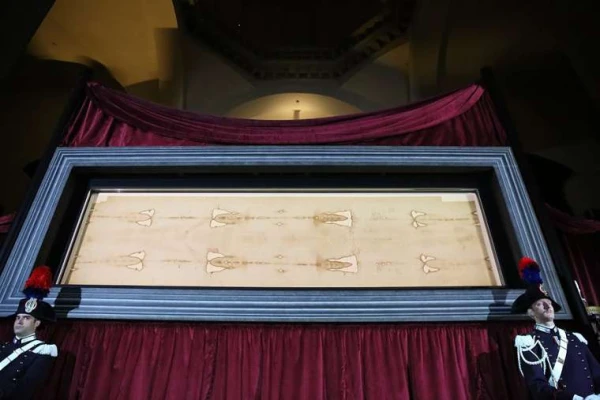
Turin, Italy, Apr 6, 2020 / 04:00 am (CNA).- Catholics around the world will be invited to pray virtually before the Turin Shroud on Holy Saturday as the world struggles to contain the coronavirus pandemic, Church officials have said.
The Shroud, which bears the image of a crucified man and has been venerated for centuries as Christ’s burial cloth, will be displayed via livestream at 5pm local time April 11.
Archbishop Cesare Nosiglia will preside over a liturgy from the chapel of Turin cathedral where the Shroud is kept in a climate-controlled vault. It will be broadcast live on television and social media.
The archbishop said he was responding to thousands of requests from people asking to venerate the Shroud amid a global crisis that has so far claimed nearly 70,000 lives.
"Thanks to television and social networks," he said, "this time of contemplation will make available to everyone throughout the world the image of the sacred cloth, which reminds us of the Lord's passion and death, but also opens our hearts to faith in His resurrection.”
He said he hoped that the ceremony would give strength to those suffering amid the pandemic.
"Yes, the love with which Jesus gave us his life and which we celebrate during Holy Week is stronger than any suffering, every illness, every contagion, every trial and discouragement,” he said. “Nothing and no one can ever separate us from this love, because it is faithful forever and unites us to him with an indissoluble bond."
Turin is located in northwest Italy, not far from the epicenter of the coronavirus outbreak in the country, which has led to nearly 16,000 deaths and a nationwide lockdown since March 10.
Archbishop Nosiglia announced last year that the Shroud would be displayed in December 2020 when Turin hosts an annual meeting organized by the Taizé Community. This would be the fifth time that the Shroud has gone on public display since the year 2000.
The last time the Shroud was presented to the public was in 2015. Pope Francis prayed before the relic during a visit to Turin on June 21 that year. Afterwards, he described it as an icon of Christ’s love.
“The Shroud,” the pope said, “attracts people to the face and tortured body of Jesus and, at the same time, urges us on toward every person who is suffering and unjustly persecuted.”
If you value the news and views Catholic World Report provides, please consider donating to support our efforts. Your contribution will help us continue to make CWR available to all readers worldwide for free, without a subscription. Thank you for your generosity!
Click here for more information on donating to CWR. Click here to sign up for our newsletter.

Father Patrick Hughes shows how to make a traditional St. Brigid’s Cross in County Cavan, Ireland. / Credit; Courtney Mares/CNA
Rome Newsroom, Feb 1, 2024 / 06:00 am (CNA).
Ireland on Thursday is celebrating the 1,500th anniversary of the death of St. Brigid of Kildare, the Emerald Isle’s female patron saint.
St. Brigid (c. 453–524 A.D.) is credited with pioneering female monastic life in Ireland. Her feast is celebrated on Feb. 1, which became an annual public bank holiday across Ireland last year in her honor.
“St. Brigid was a huge figure of authority in the early Church, baptized by St. Patrick, professed by St. Mel, spiritual adviser to St. Conleth,” Bishop Denis Nulty of Kildare and Leighlin said at a Mass ahead of her feast.
Ireland’s Kildare County has organized lectures, pilgrimages, and many activities in its Brigid 1500 Program to mark the anniversary, including a workshop on how to weave a St. Brigid’s Cross — St. Brigid’s most enduring symbol.
A St. Brigid’s cross is traditionally made out of rushes or reeds freshly pulled from the ground.
Father Patrick Joseph Hughes, a country priest in County Cavan, can make a St. Brigid’s cross from rushes in a matter of minutes.
Hughes told CNA that the story that has been handed down over the years is that St. Brigid was trying to explain to the local chieftain, who did not believe in God, that Jesus was his savior and died on a cross for him. The chieftain did not understand, so she made a cross out of rushes from the ground and presented it to him: “‘Look,’ she said, ‘that’s a cross, and Jesus was stretched out on that for the world.’”
On the eve of the Feast of Saint Brigid, it is tradition in Ireland to make a St. Brigid’s Cross out of rushes.
Last year while we were filming in Ireland, Father Patrick Hughes gave us a quick demonstration of how to make one.
St. Brigid’s Catholic Church in Kildare will kick off the feast day on Feb. 1 with a Mass at 9:15 a.m. offered by Bishop Nulty.
The bishop recently installed St. Brigid’s relics in St. Brigid’s Catholic Church on Jan. 29 as part of the 1,500th anniversary celebrations.
The relics were taken from the bone fragment of St. Brigid’s head, which has been kept in St. John the Baptist Church in Lumiar, Portugal, since three Irish knights brought it there in 1273. The Portuguese church gave the relic to the Brigidine Sisters in Tullow, Ireland, in the 1930s, and they recently gifted it to St. Brigid’s in Kildare.
“Today we have brought her home,” Nulty said. “Obtaining the relic of a saint like Brigid is no easy feat. I visited Lumiar in October 2021 with the singular intention of securing a relic for St. Brigid’s Church. I was privileged then to hold the relic of her head, which is contained in a splendid brass casket. Sadly, I couldn’t squeeze it into my Ryan Air flight bag!”
Notably, the Catholic bishop and female Anglican leaders will also come together for an ecumenical service at 11 a.m. on the feast day at the historic St. Brigid’s Cathedral, built on the site of the ancient hilltop where St. Brigid founded her monastery in the year 480 A.D. The previously Catholic cathedral, consecrated in 1230, is now an Anglican cathedral.
The service will be followed by a “pause for peace,” a minute of silent prayer for peace. St. Brigid was known as a peacemaker. Among the many stories told about St. Brigid, local tradition holds that Brigid gave away her father’s sword in exchange for food for a family suffering from hunger.
The fifth-century abbess St. Brigid is one of Ireland’s three patron saints, along with St. Patrick and St. Columba. Most historians place her birth around the year 450, near the end of St. Patrick’s evangelistic mission.
St. Brigid. Credit: Octave 444, CC BY-SA 4.0, via Wikimedia Commons
It is notoriously hard to establish the historical details of Brigid’s life, but according to one of the more credible biographies of Brigid — Hugh de Blacam’s essay in “The Saints of Ireland” — Brigid was born out of wedlock to a pagan chieftain named Dubthach and a Christian slave woman named Broicsech. The chieftain sold the child’s pregnant mother to a new master but contracted for Brigid to be returned to him eventually.
Brigid was likely baptized as an infant and raised as a Catholic by her mother. Thus, she was well formed in the faith before leaving Broicsech’s slave quarters at around age 10 to live with Dubthach and his wife.
After this, Brigid’s faith grew immensely. She gave generously to the poor and tended to the sick. One story says Brigid once gave away her mother’s entire store of butter, which was later replenished after Brigid prayed.
Once she was released from servitude, she was expected to marry. However, Brigid had no interest in marrying. She went so far as to disfigure her own face and prayed that her beauty be taken from her so no one would want to marry her. Because she refused to change her mind about marriage, she received permission to enter religious life.
Brigid, along with seven friends, is credited with organizing communal consecrated religious life for women in Ireland.
In 480, Brigid founded her monastery in Kildare, which was called “Church of the Oak.” The monastery sat on top of a shrine to a Celtic goddess. Throughout the rest of her life, she established several monasteries across Ireland.
Brigid rooted her life as a nun in prayer, but she also performed substantial manual labor: cloth making, dairy farming, and raising sheep. She also spent time traveling across Ireland founding new houses and building up a uniquely Irish form of monasticism. When she was not traveling, pilgrims made their way to Kildare, seeking the advice of the abbess.
“What were the character traits that defined St. Brigid of Kildare? To mention just a few, she was hospitable, she was a peacemaker, she was a strong woman of faith,” Nulty said.
Fr. Árpád Kanyó in the first Romani, or Gypsy, Greek Catholic church. / EWTN News In Depth
Nyiregyhaza, Hungary, Jul 24, 2021 / 15:00 pm (CNA).
When Fr. Árpád Kanyó first arrived at his current parish, he didn’t know the language or culture of t… […]
The Lecceto hermitage near Siena, Italy. / Credit: LigaDue, CC BY-SA 4.0, via Wikimedia Commons
ACI Stampa, May 27, 2025 / 12:18 pm (CNA).
The Augustinian nuns of Lecceto are a small community living in a hermitage 10 kilometers (a little more … […]
1 Comment
What is the link to use on Saturday to view the Holy Shroud?