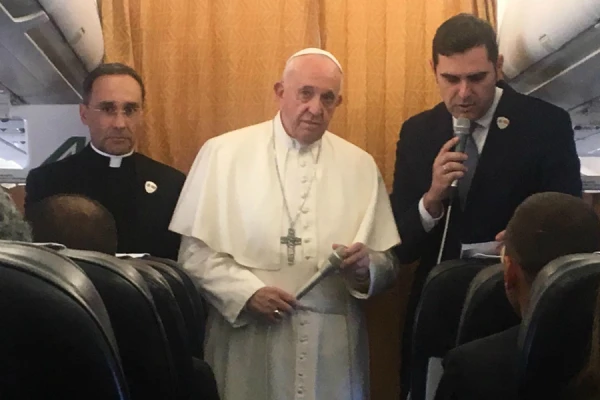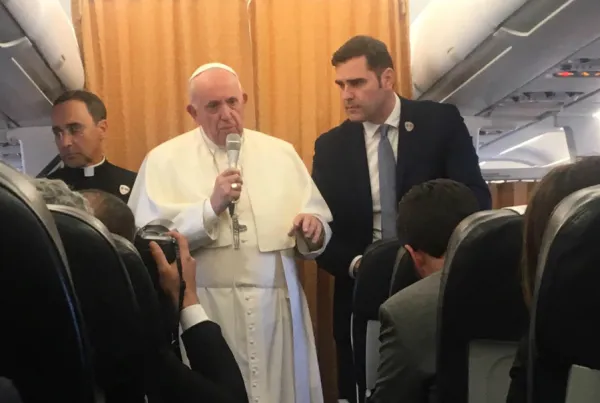
Aboard the papal plane, May 7, 2019 / 04:30 pm (CNA).- Please read below for CNA’s full transcript of the pope’s May 7 in-flight press conference from Skopje, North Macedonia to Rome:
Alessandro Gisotti:
Good evening Holy Father, thank you after such intense days for being here to share a thought about this journey that was so intense and so beautiful. A short trip, inevitably a short press conference, I will not add words other than these: Holy Father you have already walked in the footsteps of Mother Teresa, a great witness of Christian love, and we have all been struck today, as you know it, by the death of Jean Vanier, another friend, brother of the least of these, another great witness. Here, before the questions I wanted to ask if you wanted to share a thought about Jean Vanier.
Pope Francis:
Yes, I knew of the illness of Jean Vanier. His sister, Geneviève Jeanningros, informed me on a regular basis. One week ago, I called him on the phone, he listened to me, but could hardly speak. I would like to express my gratitude for this testimony. He was a man who knew how to read the Christian existence from the mystery of death on the cross of illness, from the mystery of those who are despised and rejected in the world. He worked, not only for the least of these, but also for those who before birth face the possibility of being sentenced to death. He spent his life like this. I am simply thankful to him and thankful to God for giving us this man with a great witness.
Gisotti:
Thank you, Holy Father, the first question will be from Biljana Zherevska of TV Macedonia.
Biljana Zherevska, MRT: [In English] Your Holiness, it is a great pleasure to have you in our country. We feel honored by your visit. What is interesting for us is to hear from you what is your greatest impression from the two countries, what touched you the most? The persons, objects, atmosphere. What will you remember of these two countries when you go [back] to the Holy See?
Pope Francis: They are two totally diverse nations. Bulgaria is a nation of a tradition from centuries ago. Macedonia, on the other hand, has a tradition from centuries, but not as a country: as a people, that ultimately rose to form as a nation… It is a beautiful fight! For us Christians Macedonia is a symbol of the entrance of Christianity in the East. Christianity entered in the East through you all.. those Macedonians that appeared to Paul in a dream: “come to us, come to us.” He was leaving for Asia, it is a mystery that call… And the Macedonian people are proud of this, they do not lose the opportunity to say that Christianity entered Europe through us, through our door, because Paul was called by a Macedonian.
Bulgaria has had to fight so much for its identity as a nation. The mere fact that in the 1800s, I believe 1823, more or less, 200,000 Russian soldiers died to regain independence from the hands of the Turks … we think of what 200,000 means. So much struggle for independence, so much blood, so much mystique to find consolidation of identity.
Macedonia had the identity and now it has come to consolidate it as a people, with small, big problems, like its name, and this we all know. Both have Christian, Orthodox, Catholic and Muslim communities. The percentage of Orthodox is very strong in both with a small amount of Muslims and even fewer Catholics, in Macedonia more so than Bulgaria. A thing I saw in both nations is the good relationship between the different faiths. In Bulgaria we saw it in the prayer for peace. This is a normal and beautiful thing for Bulgarians, because they have a good relationship, each person has the right to express his own religion and has the right to be respected. This touched me. Then the dialogue with Patriarch Neophyte was a beauty… he is a man of God, a great man of God. In Macedonia I was struck by a phrase the president told me: “Here there is not religious tolerance, there is respect.” They have respect. In a world like this respect is missed very much. Respect for human rights, we miss respect for so many things, respect for children, for the elderly, that the mystique of a country would be respect is striking. I do not know if I answered more or less briefly.
Gisotti:
Holy Father, the next question will be asked by Peter Nanev from Bulgarian television.
Peter Nanev, BTV: Good evening. Peter Nanev, BTV Bulgaria. [In English] It is more of a personal question, as Your Holiness, you’re like a human being, from where do you find strength in your body, in your spirit in cases when you have to give even more strength for a heavily sick child?
Pope Francis: First of all I would like to tell you that I do not go to the witch… [laughs]. I do not know. I do not know, really. It is a gift from the Lord. When I am in a country, I forget everything, but not because I want to forget it, I forget it, and I am only there. And then this gives me perseverance, I don’t know, but [when] I am on the trip I am not tired! Then I am tired! After! But where do I take the strength from? I believe that the Lord gives it to me, there is no explanation. I ask the Lord to be faithful, to serve him in this work of travels, that the trip will not be tourism. I ask. All is his grace. Nothing else comes to me to say. But then I do not do so much work, huh? Thank you.
Gisotti:
He will now address a question. We remain in Eastern Europe, Silvije Tomasevic of Croatian press and television, Vecernij List.
Silvije Tomasevic, Vecernij List: The national Orthodox Churches are not always in agreement among them, for example, they have not recognized the Macedonian Church. But when they have to criticise the Catholic Church they are always in unison, for example the Serbian Church does not want Cardinal Stepinac to be canonized. Your comment on this situation?
Pope Francis: In general, the relationships are good, they are good and there is good will. I can tell you sincerely that I have met men of God among the patriarchs. Neophyte is a man of God, and then him that I carry in my heart, a favorite, Ilia II of Georgia is a man of God, that has been good to me, Bartholomew is a man of God, Kirill is a man of God. They are great patriarchs that give witness. You can tell me. But everyone, we have defects. Everyone. But in the patriarchs I have found brothers and some… I do not want to exaggerate, but I would like to say the word ‘saints’ and this is important.
Then there are historic things between our Churches, some old things, for example today the president was saying to me that the Eastern schism began here in Macedonia.
Now the pope comes for the first time, to mend the schism I do not know, but to say we are brothers, because we cannot adore the Holy Trinity without hands united as brothers. This is not only my conviction, also the patriarchs’, everyone.
Then there is a historic world… you are Croatian? It was seeming to me I sensed the aroma of Croatia. The canonization of Stepinac is a historic case. He is a virtuous man for this Church, which has proclaimed him Blessed, you can pray [through his intercession]. But at a certain moment of the canonization process there are unclear points, historic points, and I should sign the canonization, it is my responsibility, I prayed, I reflected, I asked advice, and I saw that I should ask Irenej, a great patriarch, for help. We made a historic commission together and we worked together, and both Irenej and I are interested in the truth. Who is helped by a declaration of sanctity if the truth is not clear? We know that [Stepinac] was a good man, but to make this step I looked for the help of Irenej and they are studying. First of all the commission was set up and gave its opinion. They are studying other sources, deepening some points so that the truth is clear. I am not afraid of the truth, I am not afraid. I am afraid of the judgment of God.
Gisotti: There is time for another question. Joshua McElwee.
Josh McElwee, National Catholic Reporter: Thank you so much, Holy Father. In Bulgaria you visited an Orthodox community that has continued a long tradition of ordaining women deacons. In a few days you will meet with the International Union of Superiors General*, that three years ago requested a commision for women deacons. Can you tell us something you have learned from the report of the commission on the ministry of women in the early years of the Church? Have you made some decision?
Pope Francis: I did not hear the first part of your question.
McElwee: [repeats a part of the question.]
Pope Francis: The commission was made, it worked for almost two years. They were all different, all toads from different wells, all thinking differently, but they worked together and were in agreement until a certain point. But each of them then has her own view that does not agree with that of the others. And there they stopped as a commission and each is studying [how] to go forward.
For the female diaconate, there is a way to imagine it with a different view from the male diaconate. For example, the formulas of female deacon ordination found until now, according to the commission, are not the same for the ordination of a male deacon and are more similar to what today would be the abbatial blessing of an abbess. This is the answer of some of them. I’m speaking a little from the ear, from memory.
Others say that it is a female deacon formula, but they argue that it is not clear. There were female deacons, but was it a sacramental ordination or not? And that is discussed, it is not clear. That they helped in liturgy, in Baptisms by immersion, when the woman was baptized the deaconesses helped, also for [unclear] the woman’s body. Then a document came out where diaconesses were called by the bishop when there was a matrimonial argument for the dissolution of the marriage or divorce or separation. When the woman accused her husband of beating her and the bishop called the deaconesses to look at the woman’s body for the bruises and so they testified in the judgment. These are the things I remember.
But fundamentally, there is no certainty that it was an ordination with the same form, in the same purpose as male ordination. Some say there is doubt, let’s go ahead and study. I am not afraid of studying, but up to this moment it does not proceed.
Then it is curious that where there were deaconesses it was almost always a geographic zone, especially in Syria. And then in another part, it does not touch or nothing. All these things I received from the commission. Each one continues to study, and [they have] done a good job, because up to a certain point [they were] in agreement. And this can be an impetus to go ahead and study and give a definitive answer, yes or no, according to the characteristics of that time.
An interesting thing. Some theologians of a few years ago, 30 years ago for example, said that there were no deaconesses because women were in the background in the Church, not only in the Church. Always women… But it is a curious thing: in that period there were so many pagan priestesses, the female priesthood in pagan cults was ordinary in that day. As it is understood as a female priesthood, a pagan priesthood in women, it was not done in Christianity. This is being studied also. They have arrived at a point, now each of the members is studying according to her theory. This is good. Varietas delectat.
Gisotti: Holy Father, thank you for your availability. The press conference finishes here, at this point, because in a little while they will serve the dinner. And so, thank you to you all. Especially during this trip when we woke up at night to move [from place to place].
Pope Francis: I would like to say one thing about the trip: Something I found much consolation in and which has touched me profoundly during the trip. Two extreme experiences. The experience with the poor today here in Macedonia at the Mother Teresa Memorial. There were so many poor people, but to see the meekness of those sisters: they were caring for the poor without paternalism, but as children. But a meekness, the ability to caress the poor, the tenderness of these sisters. Today, we are used to insulting each other. One politician insults the other, one neighbor insults the other, even in families they insult each other. I cannot say that it is a culture of insult, but the insult is a weapon in the hand, even to speak ill of others, slander, defamation, and to see these sisters that care for every person as Jesus. It hit me, a good young man approached and the superior told me, ‘this is a good boy’ and caressed him and she said it with the tenderness of a mom and made me feel the Church a mother. It is one of the most beautiful things to feel the maternity of the Church. Today I felt it there.
I thank Macedonia for having this [inaudible]. Another extreme experience was the First Communion in Bulgaria. I was moved because my memory went back to October 8, 1944, to my First Communion, when they sang [the hymn] ‘O santo altare custodito dagli angeli’ (who here remembers it?), I saw those children that open themselves to life with a sacramental decision. The Church guards the children, they are limited, they have to grow, I am promised, and I lived it very strongly, I felt in that moment those 249 children were the future of the Church, they were the future of Bulgaria. These are two things that I lived with much intensity I wanted to communicate. Thank you very much, pray for me. I do not want to leave without speaking about these days, the centenary of trips. They are roses from Bulgaria, a small thought to mark the 100th trip.
They tell us that now there will be whiskey.
 […]
[…]