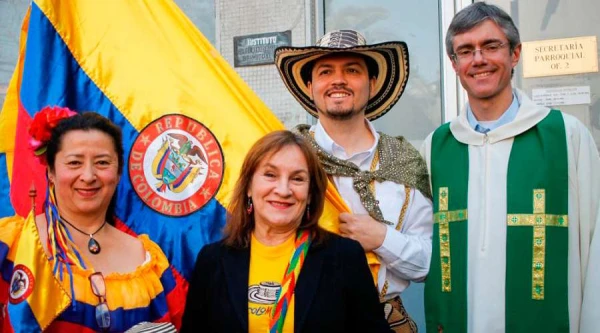
Santiago, Chile, Mar 21, 2019 / 12:31 am (CNA).- For six years, Fr. Marcio Toniazzo has worked as the director of immigration services for the Archdiocese of Santiago in Chile.
In that time, he says he has witnessed “a good marriage…between migration and Chile,” in which “both [have] had to reinvent themselves.”
Toniazzo, a priest with the Congregation of the Missionaries of Saint Charles Scalabrinians, spoke with ACI Prensa, CNA’s Spanish language sister agency, as he concludes his work in the Latin American country.
He said that in his work to help foreigners integrate and assimilate in Chilean culture, he has found that “God was providential with the Church in Chile, because migration is what is revitalizing the Church in the midst of its crisis.”
“The migrant is the one who is working to help incorporate, integrate, improve, heal and go forward,” he said. “The migrant has given a new dynamism to the faith and a clear example is the choirs they have joined in the communities. It’s with that participation that they find a way of showing their love for God and to live the faith through music.”
The energy in the workplace, the cuisine available, and culture that Chile is experiencing “show that migrants came to contribute and have a life experience,” he reflected.
Chile’s economic and political stability has made it a major destination for Latin American immigrants. Politicians in the last year have proposed cracking down on immigration through tighter border control and increased restrictions on access to social services for immigrants.
Toniazzo himself is an immigrant, originally from Brazil. During his time in Chile, he has directed the Chilean Catholic Institute for Migration and served as pastor at a parish.
He has also witnessed the development of the Integrated Center to Serve Migrants, which includes two shelters for men and women, an employment exchange for migrants, and activities to support the assimilation of foreigners and enhance parish work with diverse communities.
This growth has been joyful for the priest. But he has also witnessed moments of sadness, particularly in seeing the limited resources and capacity for immediate housing assistance and food available to migrants who have come to Chile with high hopes.
“As a country, we don’t have enough places to receive and care for the children who come with their mothers, or pregnant women. Many of them have nowhere to live,” he said.
“The big challenge now for immigration is inculturation, an encounter between those who arrive and those who receive them. How to help each other so there is cohesion and a family is formed, a Pentecost and not a Tower of Babel,” he reflected.
Concluding his assignment in Chile, Toniazzo is now headed to Miami, where he will begin a new pastoral ministry with the Brazilian community there.
He said he is both fearful and anxious about migrating the U.S. and starting over with a new country and culture and he works to spread the Gospel.
At the same time, he is grateful for his experiences in Chile and all the volunteers there who “are working in a committed and dedicated manner to advance God’s work” in the two shelters and in the parish.
Toniazzo said he hopes their work will continue to bear fruit, guided by “the words of Jesus: ‘I was a stranger and you welcomed me’.”
“To welcome the migrant is to welcome Christ,” he said. “There can be a lot of difficulties, problems, dissatisfaction and challenges – but Christ is in the migrant and all the good that is done. God doesn’t forget it.”
This article was originally published by our sister agency, ACI Prensa. It has been translated and adapted by CNA.
If you value the news and views Catholic World Report provides, please consider donating to support our efforts. Your contribution will help us continue to make CWR available to all readers worldwide for free, without a subscription. Thank you for your generosity!
Click here for more information on donating to CWR. Click here to sign up for our newsletter.

Washington D.C., Nov 5, 2017 / 02:12 pm (CNA).- It’s been a month since the New York Times first published an investigative report on Harvey Weinstein, a Hollywood film producer and studio executive who has been accused of sexually assaulting numerous women in the entertainment industry since the 1990s.
Already, the reports have been followed by a movement among women – both those who have made additional accusations against Weinstein and other celebrities, and women throughout the world who are sharing their own stories of sexual assault on social media, accompanied by the hashtag #MeToo.
The Catholic Church in the United States faced its own sex abuse crisis in the early 2000s, beginning with the Boston Globe’s report on extensive sexual abuse by clergy, particularly against minors. Since then, the Church has taken care to provide numerous resources to such victims, and develop robust child protection policies.
But what can the Church provide for adult victims of general sexual assault, whether committed by Church personnel or other people?
Catholic psychologist Dr. Greg Bottaro said one of the most important things the Church can do to help victims of sexual assault is to anticipate and initiate the conversation about it.
“I think that’s the good thing about the Harvey Weinstein case – obviously this has become a more common conversation, but there needs to be more of that,” he said.
“Let people know that it’s ok to talk about this, it’s ok to report this, if something has happened to you it’s ok to come forward.”
Victims also need validation “that the assault is wrong, because sexual assault is traumatic. It’s trauma in the deepest sense of the word, and the definition of trauma is the perceived harm to life or integrity of body. Having your bodily integrity violated is a traumatic event, there’s a loss of power that happens, it’s a real victimization.”
If a Catholic experiences sexual assault, there are several websites that can help connect them to Catholic counselors and therapists, including catholicpsych.com, catholictherapists.com, and wellcatholic.com. Most dioceses also have Catholic counselors and therapists with whom they work closely and to whom victims can be referred, Dr. Bottaro noted.
Seeking a healing and help that incorporates one’s Catholic faith is important, Dr. Bottaro said, because the trauma caused by sexual violence can wound the deepest parts of the human person.
“Our bodies are meant to be gifts to be given with full freedom in a full fruition of our choice, and when that choice is taken away, that’s a strike against our sense of (self),” he said.
“So the healing we seek has to take that into account and help us rebuild the sense of self that is founded on a deeper principle.”
People who have experienced sexual assault also often are in need of spiritual healing, because such traumatic events can cause them to question their belief in God as a loving father, Dr. Bottaro noted.
“One effect (of trauma) is that our sense of being safe in the world is violated, and that digs down into our sense of having a father who loves us and takes care of us,” he said. “Victims of trauma have to make sense of that – how can you say that there’s a father in heaven who loves me when this happened to me? So having a psychologist who can walk through that with somebody, and help wrestle with that reality, and learn how to accept suffering as part of God’s will is an essential element to healing.”
Sue Stubbs is the director of the Victim Assistance Office for the Archdiocese of Atlanta, Georgia. While her office was originally created to respond to the clergy sex abuse crisis, as were many diocesan child and youth protection departments, Stubbs said that her office has become a catch-all, and now provides resources to a wide variety of victims, whether they were assaulted by church personnel or not.
Besides helping connect victims with counselors, Stubbs said the office also puts on retreats every year, two for women and one for men, that help address both psychological and spiritual components of healing after sexual assault.
Stubbs said it was important for victims to seek spiritual as well as psychological healing, because the two areas often overlap, and because recognizing God as an all-good and all-loving creator helps victims make sense of their experiences.
“You have to believe that someone bigger than you cares about you, and created you a certain way, to really understand that nothing…that happens to you and nothing that you do can change the way God made you. (Your worth) stays the same no matter what.”
Her office also facilitates trauma recovery groups for victims that are usually put on once or twice a year, for nine sessions each. The groups welcome people who have suffered all kinds of trauma and sexual assault, whether in childhood or later in life.
The benefit of a group, Stubbs said, is that people can get a sense that they’re not alone.
“You don’t feel alone, you don’t feel different. (Victims sometimes) feel like a freak and they realize they’re not. Someone in the group is saying the same thing that they’ve thought a million times,” she said. “And it provides a safe connection, because these people get it, they’re not afraid to reach out because they know that this person has had something similar.”
Stubbs said that she often tells other people in Church leadership that the Church has to start seeing victims of sexual assault as people who are on the peripheries, to whom Pope Francis has called the Church to minister.
“The people that come to church oftentimes are the periphery, you just can’t see it,” Stubbs said. “People who’ve been sexually assaulted are the periphery and they could be sitting right next to you and have no idea, because they don’t talk about it, they hide it, it’s an invisible secret that they’re afraid to show anybody.”
“There’s a part of them that feels broken, they perceive themselves as something sinful, but it isn’t their sin, it’s someone else’s sin that has affected their life, and it’s confusing,” Stubbs said.
“And I think that’s where the Church can help to untie those knots – I think we could add the spiritual piece” that is missing from other community resources, she said.
College campuses are unfortunately a place of increased risk for sexual violence – especially for women. RAINN – the Rape, Abuse and Incest National Network, reports that women ages 18-24 are at a heightened risk to experience sexual assault, both on and off college campuses.
In order to prevent and educate students about sexual assault and other harmful situations, The Catholic University of America (CUA) has created PEERS – Peer Educators Empowering Respectful Students – a group that seeks to educate other students and help foster a more respectful environment on campus.
Stephanie Davey is the Assistant Dean in the Office of the Dean of Students at CUA and oversees much of the work that PEERS does. She said that PEERS helps students understand what sexual assault is, and how to either intervene to prevent it from happening or what to do if sexual assault has occurred.
Davey said they especially want victims to “understand that we are a supportive place and they don’t have to be fearful or ashamed about seeking support,” whether the incident occurred with another CUA student or not.
The university just concluded observing October as Sexual Violence Prevention Month, during which the school has participated in several national campaigns that raise awareness of sexual violence and encourage increased conversation about the issue.
For example, Davey said, the students participated in the national “Walk a Mile in Her Shoes” campaign, which usually involves men walking in high heels, but CUA decided to do it with a Catholic twist.
“Instead of having men walk in high heeled shoes we had a candlelit solidarity walk through campus and stopped at different places through campus and read testimonies of survivors…and culminated with a prayer service outside our chapel with our chaplain and then had some fellowship,” she said.
Much of their training, such as bystander intervention training, is rooted in the Catholic faith, she said – being a good Samaritan, being a good neighbor, and upholding the dignity of everyone.
“I think that that’s what we do well in terms of addressing these issues but also not ignoring our Catholic identity,” she said.
“Every person has worth and dignity, it’s our responsibility to look out for each other and uphold that dignity.”
Pope Francis meets with the United States bishops at St. Matthew’s Cathedral in Washington, D.C., on Sept. 23, 2015. / Credit: L’Osservatore Romano
CNA Staff, Apr 22, 2025 / 07:00 am (CNA).
Pope Francis, who died on April 21 at the age of 88, visited the United States just once, nearly 10 years ago, in September 2015.
Despite the brevity of the visit, he accomplished a lot: Attracting hundreds of thousands of participants, he canonized a new saint (St. Junípero Serra), became the first pope to ever address a joint session of Congress, and galvanized the U.S. Catholic community with his presence and his speeches on the East Coast.
Washington, D.C.
Pope Francis began his tour of North America with several days in Cuba. Landing in Washington, D.C., on Sept. 22, 2015, Pope Francis met with President Barack Obama first thing the next morning. The meeting came amid a time of concerns for many American Catholics regarding politics, including the Obama administration’s contraceptive mandate and the recent legalization of same-sex marriage nationwide, via the June 2015 Supreme Court decision in Obergefell v. Hodges.
Pope Francis is greeted by President Barack Obama on Sept. 22, 2015. Credit: Somodevilla/Getty Images
During the presidential meeting, Francis praised Obama’s commitment to inclusivity and noted that American Catholics have contributed greatly to building a tolerant and inclusive society while also stressing that religious liberty “remains one of America’s most precious possessions.” He also encouraged commitment to addressing the “urgent” issue of climate change, building on his expansive 2015 encyclical on the environment, Laudato Si’.
Pope Francis says Mass for clergy and religious in Philadelphia’s Cathedral Basilica of Sts. Peter and Paul, Sept. 26, 2015. Credit: L’Osservatore Romano.
While in D.C., that same day, the pope addressed bishops and priests at the Cathedral of St. Matthew the Apostle and later celebrated Mass at the Basilica of the National Shrine of the Immaculate Conception. At the latter Mass, he celebrated the first canonization on American soil by declaring Junípero Serra, who founded missions along present-day California, a saint.
“He was the embodiment of ‘a Church which goes forth,’ a Church which sets out to bring everywhere the reconciling tenderness of God,” the pope said.
Crowds gather for the Mass canonizing St. Junipero Serra at the Basilica of the National Shrine of the Immaculate Conception in Washington, D.C., on Sept. 23, 2015. Credit: Alan Holdren/CNA
On the same day, Francis made an unscheduled stop to visit with the Little Sisters of the Poor in Washington, D.C., to support the sisters as they awaited word on whether or not the Supreme Court will hear their case against the federal contraception mandate. (The sisters are still fighting aspects of the mandate, even after more than 14 years in court.)
Pope Francis greets Sister Marie Mathilde, 102 years old, at the Jeanne Jugan Residence in Washington, D.C., Sept. 23, 2015. Credit: Photo courtesy of the Little Sisters of the Poor
Francis addressed a joint session of Congress the next day, Sept. 24, making him the first pope to ever to do so. During his lengthy speech, he condemned the arms trade and the death penalty — statements that reportedly made some lawmakers in the room squirm.
Francis went on to assert that the family was being threatened like never before and praised American figures, including Abraham Lincoln and Martin Luther King Jr., for their tireless efforts to defend freedom and moral values. He also touched on respect for human life and the environment in the well-received speech.
Pope Francis speaks to the U.S. Congress in Washington, D.C., on Sept. 24, 2015. Credit: L’Osservatore Romano
The pope also visited St. Patrick Parish and met with people experiencing homelessness at Catholic Charities, addressing people who minister to the poor. He offered St. Joseph as their patron and model, because, he said, St. Joseph grappled with injustice and suffering in his care for Mary and Jesus.
“The Son of God came into this world as a homeless person,” the pope said. “The Son of God knew what it was to start life without a roof over his head.”
“We can find no social or moral justification, no justification whatsoever, for lack of housing. There are many unjust situations, but we know that God is suffering with us, experiencing them at our side. He does not abandon us.”
Controversially, while in D.C. Pope Francis met with Kim Davis, a Kentucky county clerk who had become a cultural lightning rod for refusing to issue same-sex marriage licenses. The pope reportedly told her to “stay strong,” offering rosaries to Davis and her husband. The Vatican later clarified that Francis met with Davis and her husband as part of a large group invited by the nunciature, with the Vatican spokesperson adding that the pope “did not enter into the details” of her situation.
New York City
After flying to New York City the evening of Sept. 24 and praying vespers at St. Patrick’s Cathedral in Manhattan, Francis addressed the United Nations General Assembly the next day, Sept. 25, the fifth time a pope had addressed the body.
The pontiff issued a call to the countries of the world to reject what he called “ideological colonization” — the “imposition of anomalous models and lifestyles which are alien to people’s identity and, in the end, irresponsible.”
Pope Francis’ historic address to the U.N. in New York City on Sept. 25, 2015. Credit: Alan Holdren/CNA
Like his predecessor, Benedict XVI, Pope Francis made a solemn visit with other religious leaders to Ground Zero, the site of the 9/11 attacks, later on Sept. 25. He met with families of first responders, saying at the site museum that acts of destruction always have “a face, a concrete story, names.” He offered a “prayer of remembrance” for all those killed that day, along with a prayer for the survivors and those who are mourning the loss of their loved ones.
Pope Francis speaks during an interreligious prayer service at Ground Zero, Sept. 25, 2015. Credit: Addie Mena/CNA
Later that day, after visiting Our Lady, Queen of the Angels School in the Harlem neighborhood of New York City, Francis celebrated Mass at Madison Square Garden. He encouraged people to remember those in the city who are often forgotten, including “foreigners, the children who go without schooling, those deprived of medical insurance, the homeless, the forgotten elderly.”
Madison Square Garden prepares for the papal Mass, Sept. 25, 2015. Credit: Alan Holdren/CNA
“Knowing that Jesus still walks our streets, that he is part of the lives of his people, that he is involved with us in one vast history of salvation, fills us with hope. A hope which liberates us from the forces pushing us to isolation and lack of concern for the lives of others, for the life of our city,” the pope said.
“A hope which frees us from empty ‘connections,’ from abstract analyses, or sensationalist routines. A hope which is unafraid of involvement, which acts as a leaven wherever we happen to live and work. A hope which makes us see, even in the midst of smog, the presence of God as he continues to walk the streets of our city.”
Philadelphia
Pope Francis’ visit included an appearance at the 2015 World Meeting of Families (WMF) in Philadelphia, an event that focuses on celebrating the gift of the family.
Pope Francis at the World Meeting of Families in Philadelphia on Sept. 26, 2015. Credit: L’Osservatore Romano
After flying to the “City of Brotherly Love” the morning of Sept. 26, Pope Francis took part in a Mass for clergy and religious at Philadelphia’s Cathedral Basilica of Sts. Peter and Paul. In his homily address, the pope challenged the clergy and religious to inspire new vocations.
He called for women to take on a greater role in the Church, highlighting the example of St. Katharine Drexel — a Philadelphia native — and he reminded the priests and religious present of their role in ministering to families, couples preparing for marriage, and young people.
He later addressed a crowd of some 50,000 people at Independence Mall, the site of Independence Hall and the Liberty Bell, for a religious freedom rally with Hispanic and other immigrants.
Speaking to thousands of families gathered on the Benjamin Franklin Parkway in Philadelphia that night, a visibly moved Pope Francis ditched his prepared remarks and instead gave an impromptu reflection on the beauty and dire importance of family life. He voiced his thanks at “the presence of all of you — who are a real witness that it’s worth being a family!” A society “is strong, solid, and edified on beauty, goodness, and truth,” he added.
Pope Francis addresses the Festival of Families in Philadelphia on Sept. 26, 2015. Credit: EWTN
On Sept. 27, the next day, Francis had an unscripted meeting with five abuse survivors — three women and two men — all of whom had been abused in childhood either by members of the clergy, family members, or educators. He promised accountability for perpetrators and expressed sorrow for the victims’ suffering.
In the face of such heinous acts as sexual abuse, “God cries,” he said, adding that “the criminal sins of the abuse of minors can’t be kept in silence any longer … I promise, with the vigilance of the Church, to protect minors and I promise [that] all of those responsible will be held accountable.”
He told a gathering of international bishops afterward that the survivors’ stories of suffering “have aggravated my heart” and said that crimes of abuse must never be kept in silence.
Later that morning, Francis visited a Philadelphia correctional facility, saying at the meeting with a group of 100 inmates and their families that every person is marked and bruised by life, but Jesus washes away our sins and invites us to live a full life.
Pope Francis embraces a man at Curran-Fromhold Correction Facility in Philadelphia on Sept. 27, 2015. Credit: EWTN
Reflecting on the trip, the Holy Father said it was “particularly moving for me to canonize St. Junípero Serra, who reminds us all of our call to be missionary disciples.”
He added that he was touched “to stand with my brothers and sisters of other religions at Ground Zero, that place which speaks so powerfully of the mystery of evil. Yet we know with certainty that evil never has the last word, and that, in God’s merciful plan, love and peace triumph over all.”
Furthermore, he promised his prayers for the U.S. people, saying: “This land has been blessed with tremendous gifts and opportunities. I pray that you may all be good and generous stewards of the human and material resources entrusted to you.”
“I thank the Lord that I was able to witness the faith of God’s people in this country, as manifested in our moments of prayer together and evidenced in so many works of charity.”
Concluding, he asked those present: “Do not let your enthusiasm for Jesus, his Church, our families, and the broader family of society run dry.”
“May our days together bear fruit that will last, generosity and care for others that will endure!” he said. “Just as we have received so much from God — gifts freely given us, and not of our own making — so let us freely give to others in return.”
St. Louis, Mo., Feb 10, 2023 / 11:55 am (CNA).
Following two straight years of notable growth, Catholic school enrollment rose again slightly nationwide in 2022-3023, according to new data made public Monday by the N… […]
2 Comments
Migrants – they are blessed with patience, courage, zeal and joy to practice and proclaim the Good News through their daily lives.
Not going to happen in the US.