Nashville, Tenn., Jan 3, 2019 / 10:00 am (CNA).- An Episcopalian priest set out to write a book on finding and understanding the Gospel’s truth. Now, after he and his family have converted to Catholicism, he says they have found it.
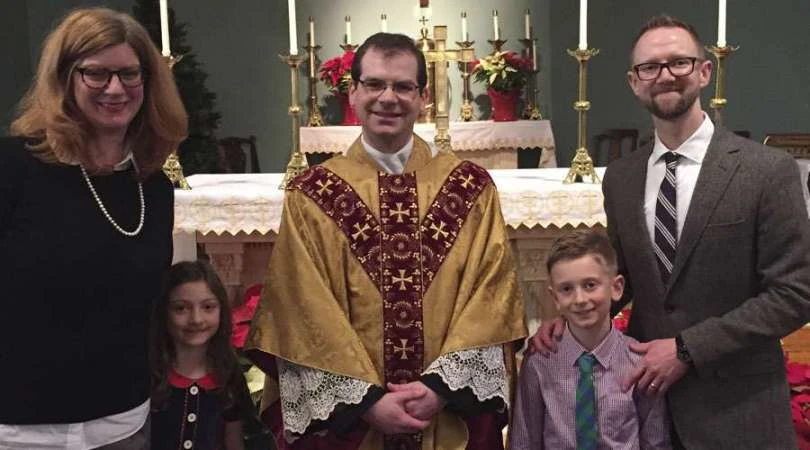
Andrew Petiprin, his wife Amber, and their two children Alex and Aimee were confirmed into the Catholic Church on Jan. 1, at St. Patrick’s Parish in Nashville, the city where they have lived for the last 18 months.
“I am grateful for 16 formative years as an Anglican, and 8 as an Episcopal priest, most recently as Canon to the Ordinary in the Diocese of Tennessee. But I am thrilled that the Lord has called me, my wife, and our children into full communion with Rome,” said Petiprin on Twitter.
Petiprin told CNA that his conversion was heavily influenced by questions raised in the process of writing his book “Truth Matters: Knowing God and Yourself,” which was released last April.
“Even though I was writing about doctrines that applied to different Christians in different traditions, finishing the book was a real emphasis to examine the questions again about whether I should be Catholic.”
The book discussed foundational elements of Christian doctrine: the Trinity, Christology, the Holy Spirit, atonement and salvation. Petiprin said that after the book’s completion, a major question arose – where does the authority come from to verify the truth of these subjects?
“It really forced me back into questions I had been asking myself for a long time, namely, where is truth ultimately to be found?” he said.
“For me, it came back to the papacy, it came back to the Church…The Roman Catholic Church is [the] primitive Church that the doctrine has developed faithfully within over these centuries.”
Petripin had set out to write the book as a project for his parishioners, but his goal for the book have since changed. He said he now hopes that it will lead people to seek out more catholic resources.
“Now, I really hope that people read the book and then they get a copy of the Catechism of the Catholic Church, that they begin exploring the Catholic faith.”
“I intend to write a follow up to it called Catholic Truth Matters and explore some particularities of why it’s not enough to be just okay with Christian doctrine but also to see how the practices of the Catholic Church are the place where Gospel is lived out at its fullest.”
Petiprin told ACI Prensa that he was heavily influenced by the death of Saint John Paul II, and more recently, by devotion to the Blessed Virgin Mary.
“In 2005 when Pope Saint John Paul II died, I had a very strong feeling that I was connected to him and to the Church and that I would one day be Catholic. It turned out to take more than 13 years,” he said.
“Over the past several months I have begun praying the Rosary and asking for Mary’s prayers. Loving Mary is all about loving Jesus. Her maternal love for me inspires a deeper love for her son, my savior.”
Petiprin said he is “overwhelmed with the welcome I am receiving from Catholics. Their faith is real, and they can’t help but pour out enthusiasm for people like me who have been called to share it with them. I hope in time that I can share that same level of welcome with others coming into the faith.”
While married Anglican ministers who convert to Catholicism are permitted to pursue the priesthood, Petiprin says he has not yet decided if he will seek ordination.
“I am open to discernment about eventual formation for the Catholic priesthood, but I am eager now to find good employment and live the Catholic faith with my family as a layman.”
If you value the news and views Catholic World Report provides, please consider donating to support our efforts. Your contribution will help us continue to make CWR available to all readers worldwide for free, without a subscription. Thank you for your generosity!
Click here for more information on donating to CWR. Click here to sign up for our newsletter.
CNA Staff, Feb 5, 2024 / 07:00 am (CNA).
After a year of major efforts to prohibit irreversible and untested transgender operations on young children, lawmakers across the U.S. are continuing the push to protect chil… […]
An Easter Vigil procession at St. Dominic Parish in San Francisco. / Credit: St. Dominic Parish/Lorelei Low
CNA Staff, Mar 15, 2025 / 06:00 am (CNA).
Five years ago this week, public health orders issued amid the uncertainty of the novel coronavirus turned Mass schedules across the country and the world upside down.
In those early days following the WHO’s March 11, 2020, declaration of COVID-19 as a pandemic, the bishops of every U.S. diocese issued some form of dispensation, suspending the obligation that Catholics must attend Sunday Mass in person.
Thousands of parishes and ministries scrambled to develop plans to offer livestreamed Masses, deliver the sacraments in a “socially distanced” manner, and live out the Church’s life as best they could under extraordinary circumstances. Public Masses at most parishes were suspended entirely for a time, and those that were able to reopen were subject, in many areas, to distancing requirements and numerical or percentage-based attendance caps.
As Catholics nationwide adapted to the changes — not knowing how long this new reality might last — observers feared that many Catholics, barred from their parishes for so long and now accustomed to attending from the comfort of home, might not return after the parish doors reopened.
A study from the Pew Research Center found that most Catholics continued participating in Mass throughout the pandemic — but many were only able to do so virtually. In November 2022, when the survey was done, only about 4 in 10 U.S. Catholics said they attended Mass in person as often as they did before the pandemic.
Indeed, from the start of the COVID pandemic lockdowns in the U.S. to the declared end of the pandemic in May 2023, in-person Mass attendance averaged just 15% — a dismal figure, but not markedly lower than the 24% it was before. (The Catholic Church teaches that Catholics are obligated to attend Mass in person every Sunday, except for a serious reason such as illness or if they’ve been dispensed from their obligation by their pastor or bishop.)
Some bishops lifted the dispensations they had issued as early as late 2020, while a few held out until 2022. In lifting the dispensations they issued amid the lockdowns, many U.S. bishops implored Catholics to return to Mass in person.
While Mass attendance today among Catholics in the U.S. remains much lower than among Catholics in other countries, recent data has suggested that U.S. in-person Mass attendance levels have quietly returned to where they were in 2019 after years of uncertainty over whether they would ever rebound.
For some thriving parishes in the U.S., the lockdowns — while challenging — presented an opportunity to continue sharing the faith in a creative manner and come out even stronger than they were before.
Father John Mosimann, pastor at St. Mary of the Immaculate Conception Parish in Fredericksburg, Virginia, told CNA that the parish has seen its numbers grow since the pandemic.
On a typical weekend, Mosimann and his four parochial vicars celebrate 11 total Masses in English, plus another in Spanish at a different parish where they are kick-starting a Spanish Mass ministry.
All told, roughly 3,800 people attended St. Mary’s weekend Masses on a typical week in 2019. According to headcounts, the parish had already exceeded its pre-pandemic levels by 2023, with around 4,300 attendees on average. The parish, which is about 55 miles south of Washington, D.C., has 6,700 registered families and nearly 100 active ministries.
Father John Mosimann poses with altar servers and Bishop Michael Burbidge of Arlington, Virginia. Credit: Photo courtesy of Father John Mosimann
During the pandemic, St. Mary’s added extra Masses — since for a time, Masses were limited to a smaller-than-usual number of attendees — and continued hosting adoration. Like so many other parishes, the parish had to quickly adapt to a livestreaming paradigm in order to stay connected with the community.
“I was in the office and I was looking at Facebook and I said, ‘What if I hit this button and go live, what would happen?’” Mosimann remembers thinking as the lockdowns began.
“And so I started streaming on Facebook Live and everybody started jumping in … ’What’s going on, Father? What’s going to happen?’ And I didn’t have answers, because I wasn’t that great a prophet. But we did immediately start streaming.”
He said parishioners were grateful for the effort the priests made to stay in touch, despite the occasional technical challenge — a problem far from unique to St. Mary’s.
“If you want perfect sound and you want a studio, go to EWTN. They’ve got professional equipment. If you want to see your priests, come talk to us,” Mosimann said he told his parishioners.
“We’re not going to be anxious over having studio quality, because what’s important is for us to be connected to you. People responded to that. People were very grateful for that. It was very frequently cited by parishioners, how grateful they were for our staying in touch with them during that difficult moment.”
Father John Mosimann baptizes a child at his parish, St. Mary of the Immaculate Conception in Fredericksburg, Virginia. Credit: Ginny Foreman
The last of Virginia’s capacity-restricting public health orders on venues was lifted in late May 2021, and Bishop Michael Burbidge of the local Diocese of Arlington in the following month lifted the dispensation he had issued, inviting Catholics to return to Mass throughout the diocese. So far, as in most U.S. dioceses, Mass attendance overall in Arlington has risen significantly but has not quite returned to pre-pandemic levels.
Since the pandemic’s end, Mosimann said his focus has been on encouraging parishioners to use their time and talents generously to help rebuild and grow the parish community.
For Mosimann, the pandemic experience was proof that by remaining faithful even through troubling and difficult times, God can and does bring good out of bad situations through his grace.
“[We] did everything we could to provide the sacraments to God’s people and to make it available as much as possible with all the restrictions. That should be the goal of every parish, every day, whether there’s a pandemic or not,” Mosimann said.
‘We are proud to be who we are’
Father Michael Hurley, OP, pastor of St. Dominic Parish in San Francisco, said his parish, which offers what he believes is the largest young adult presence in the entire archdiocese, regularly sees attendance numbers today that are similar to pre-pandemic levels.
The parish was able to safely provide the sacraments to those in need during the pandemic and had, providentially, already set up livestreaming for Masses shortly before the start of the pandemic. To this day the parish maintains a healthy online base of Dominican laypeople who tune in for Masses and prayer.
Father Michael Hurley, OP, (left) and his fellow priests from St. Dominic Parish in San Francisco cross the street in a homage to “Abbey Road.” Credit: St. Dominic Parish/Ivi Fandino
Hurley said he personally never worried during lockdown about people not returning to Mass, instead trusting that Catholics would return when they could. He said his main concern was keeping the church building open safely during the pandemic — in a state with some of the strictest lockdown measures in the country — to maintain sacramental support.
California finally lifted all capacity restrictions on religious gatherings in April 2021 after previously implementing a near-total ban on indoor services that was contested all the way to the U.S. Supreme Court.
The sanctuary of St. Dominic Parish in San Francisco. Credit: St. Dominic Parish/Alex Mizuno
Though the demographics of St. Dominic Parish has changed somewhat, in-person worshippers, many of whom work in the Bay Area’s high-tech sector, have returned in large numbers.
“The Lord is always searching for the strays, right? … All you have to do is open the doors and do what you’re doing, and people will come,” Hurley told CNA.
That said, Hurley said he believes St. Dominic’s beautiful church building, welcoming atmosphere, and a strong sense of identity — as a Dominican-led parish that aims to “radiate the joy of the Gospel in the heart of the city” — helps to make it an attractive place for Catholics, especially young adults. They also keep the church building open for personal prayer throughout the day, a rarity in a city that occasionally struggles with crime.
“We are proud to be who we are as Catholics, and for us as clergy, as Dominicans. And that makes a huge difference,” Hurley said.
CNA Staff, Oct 30, 2020 / 04:21 pm (CNA).- A strong majority of New Zealand voters approved the legalization of assisted suicide and euthanasia for the terminally ill Oct. 30. Foes of legalization said many voters appeared confused about the measure’s far-reaching effects and warned that the move will have consequences for the vulnerable.
The nationwide referendum passed with support from 65% of voters on Friday. It allows terminally ill persons who are believed to have six months or fewer to live to be euthanized or to take a lethal dose of prescribed drugs themselves, on the condition that two doctors agree the person is well-informed. Patients are eligible if they show significant, ongoing decline in physical ability and experience “unbearable suffering that cannot be eased.” The law will take effect Nov. 6, 2021.
Legalization opponent Euthanasia-Free NZ said some 80% of adult New Zealanders appeared to misunderstand the referendum. Only 20% knew the act would not make it legal to turn off life support machines. Such a practice is not illegal under current law.
“It seems that most New Zealanders voted for an end-of-life choice that is in fact already legal,” Renée Joubert, executive officer of Euthanasia-Free NZ, said Oct. 30.
Surveys indicated similar confusion about eligibility criteria. Only 29% knew that terminally ill people who have depression or another mental illness would be allowed to seek euthanasia. Only 13% of adults knew that the act does not require an independent witness.
The New Zealand law does not require a waiting period before a lethal dose is prescribed, nor does it require a competency test.
In November 2019 the New Zealand Parliament approved the bill, officially called “The End of Life Choice Bill,” by a vote of 69-51. The bill had the backing of Prime Minister Jacinda Ardern of the ruling New Zealand Labour Party and her main rival, Judith Collins of the center-right National Party, the New York Times reports. Voters had to approve the act in referendum in order for it to become law.
An earlier version of the bill would have allowed those with severe or incurable conditions who were not terminally ill to seek euthanasia or assisted suicide as well.
Joubert objected that parliament voted down more than 100 amendments that “could have made this law safer” and said the law lacks safeguards that have been standard in U.S. law.
“It’s disappointing that the New Zealand public were generally uninformed about the details of the End of Life Choice Act,” she said.
When New Zealand’s National Party was governing the country, a parliamentary study on assisted suicide and euthanasia proposals concluded that “the public would be endangered” by legalization of the practices.
In 2017, the National Party-controlled Parliament’s health committee said submissions on the proposal “cited concern for vulnerable people, such as the elderly and the disabled, those with mental illnesses, and those susceptible to coercion.”
“Others argued that life has an innate value and that introducing assisted dying and euthanasia would explicitly undermine that idea. To do so would suggest that some lives are worth more than others. There were also concerns that, once introduced, eligibility for assisted dying would rapidly expand well beyond what was first intended,” the committee said.
In 2018 the Catholic bishops of New Zealand published resources against assisted suicide legislation and encouraged Catholics to oppose legalization. The Nathaniel Centre, the New Zealand bishops-founded Catholic bioethics center, posted resources on Church teaching on euthanasia and assisted suicide to their website and social media pages ahead of the referendum.
Ahead of the election, the Nathaniel Centre said the act is “badly drafted and seriously flawed.”
“It will expose many New Zealanders to the risk of a premature death at a time when they are most vulnerable. Whatever one’s views about the idea of euthanasia, it is not compassion to vote for a dangerous law,” the center said. “The group most at risk if we legalize euthanasia and assisted suicide are those vulnerable to the suggestion they would be ‘better off dead’ – our elders, disabled people, and people with depression and mental illness who find themselves fitting the eligibility criteria.”
The center cited the Lawyers for Vulnerable New Zealanders, a group of over 200 lawyers, including some supporters of euthanasia, opposed the act on the grounds it is too broadly drafted, “dangerous,” and “broader in its scope and riskier than comparable laws overseas.”
Other opponents of the act included the New Zealand Medical Association, Hospice New Zealand, Palliative Care Nurses and Palliative Medicine Doctors.
David Seymour, the lawmaker who sponsored the act, praised its passage as “a great day,” the New York Times reports. In his view, the vote made New Zealand “a kinder, more compassionate, more humane society.”
Pope Francis has on multiple occasions spoken out against assisted suicide and euthanasia, both of which are “morally unacceptable” according to Church teaching. In 2016, Pope Francis told medical professionals that assisted suicide and euthanasia are part of the “throwaway culture” that offers people “false compassion” and treats human persons like a problem.
Euthanasia is legal in the Netherlands, Belgium, Luxembourg, Canada and Colombia. Doctor-assisted suicide is legal in Switzerland. Some U.S. states have legalized assisted suicide.
Also on New Zealand’s ballot was a proposal to legalize recreational marijuana use, allow adults age 20 and over to buy cannabis from licensed outlets, and allow adults to grow the plant at home. Advertising and smoking the drug in public would be banned. That proposal failed by a vote of 53% to 46%, according to preliminary results.
The country already has legalized medical marijuana.
Critics of the recreational use legalization warned that it would make the drug more accessible to children, Bloomberg News reports. They said cannabis is a serious drug harmful to mental health, especially among adolescents.
For their part, advocates said legalization would weaken the power of drug trafficking gangs, regulate quality and raise awareness of health risk through the use of warning labels. They said indigenous Maori people are disproportionately arrested and convicted for the drug.
Some figures suggest that New Zealanders are among the biggest users of marijuana in the world, with 80% having tried the drug by age 20 and 12% reporting use of the drug in the past year.
Pope Francis criticized drug use and legalization in a 2014 address to the International Drug Enforcement Conference in Rome.
“Let me state this in the clearest terms possible: the problem of drug use is not solved with drugs! Drug addiction is an evil, and with evil there can be no yielding or compromise,” the pope said. “To think that harm can be reduced by permitting drug addicts to use narcotics in no way resolves the problem. Attempts, however limited, to legalize so-called ‘recreational drugs’, are not only highly questionable from a legislative standpoint, but they fail to produce the desired effects.”
Welcome Home Andrew and Amber Petiprin and their two children Alex and Aimee