No Picture
News Briefs

This ‘pilgrim grandmother’ walked 570 miles to pray for families

May 14, 2018 CNA Daily News 0

Mexico City, Mexico, May 14, 2018 / 07:00 pm (CNA/EWTN News).- Emma Morosini has been called the “pilgrim grandmother.”  Earlier this month, at the age of 94, she earned that nickname by concluding a 570-mile walking pilgrimage in honor of Our Lady of Guadalupe.

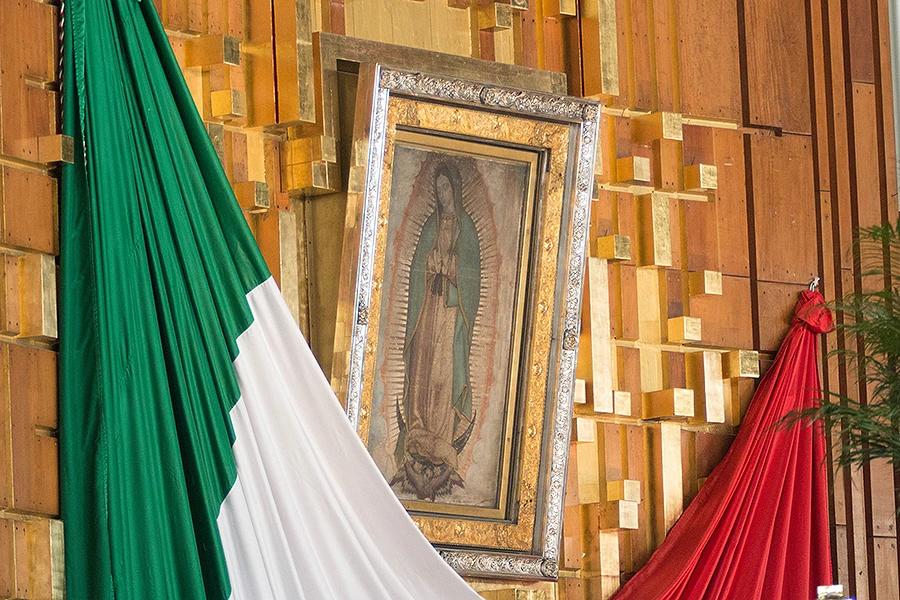
Her 40 day pilgrimage took Morosini from Monterrey, in northeastern Mexico, to Mexico City, where she prayed at the Basilica of Our Lady of Guadalupe, before the tilma of Saint Juan Diego.


Emma Moronsini. 91 años. Camina hace 1 mes. Salió de Tucumán. Quiere llegar a la Basílica (Luján). Ya está en Córdoba pic.twitter.com/zwXJFnIRFw

— Sebastián Volterri (@SebaVolte) February 13, 2015


Morosini, a native of Italy who for more than 25 years has made pilgrimages to shrines around the world, arrived the afternoon of May 12 at the Basilica of Our Lady of Guadalupe in Mexico City, to pray for families, young people, and “world peace.”

The “pilgrim grandmother” has visited shrines in Portugal, Spain, Poland, Israel, Brazil and Argentina.

During this pilgrimage, Morosini began walking each day at 6:30 am, carrying a small suitcase and an umbrella, and wearing a reflective vest as a safety precaution.

For food, Morosini carried milk, juice, bread, and water, receiving along the way some donations of fruits and vegetables.

At various points on her way she was accompanied by medical and civil defense personnel or by Mexico’s Federal Police. She was often housed by municipal authorities along her route.

During a 2015 pilgrimage in Argentina, when she was 91, Morosini told reporters that she was praying for “peace in the world, for young people, for all these families that are divided. Many are separated, some live together but aren’t spouses, or they don’t have children. It’s very sad.”

The “pilgrim grandmother” was applauded by fellow pilgrims when she arrived at the the Basilica of Our Lady of Guadalupe. Before entering the church, she woman knelt down, kissed the ground, made the sign of the cross and prayed silently for a few moments.

This article was originally published by our sister agency, ACI Prensa. It has been translated and adapted by CNA.


[…]

No Picture
News Briefs

Argentine bishops call for prayer as congress considers expanded abortion access

May 14, 2018 CNA Daily News 0

Buenos Aires, Argentina, May 14, 2018 / 05:01 pm (ACI Prensa).- As the Argentine congress debates legalizing abortion up to 14 weeks of pregnancy, the country’s bishops called for a special time of prayer for life, especially for the unborn child.

“Prayer has a transformational power which will aid the discernment of those who have the responsibility to make a decision of such magnitude,” the Argentine bishop’s conference stated.

The nation’s legislature is considering a bill that would give women legal access to abortion during the first 14 weeks of pregnancy. The current law in Argentina prohibits abortion, except when the mother’s life or health is determined to be in danger, or in cases of rape.

President Mauricio Macri has encouraged “responsible” debate over the topic, while remaining personally opposed to the legislation, according to the Associated Press. He has said he would not veto the bill if it is passed by congress.

The congress’ lower house, the Chamber of Deputies, is expected to vote on the bill in June.

The time of prayer began May 13 and will conclude June 3.

The bishops asked Catholics to “pray unceasingly” as individuals and in community in parishes, at Mass, as families, among friends, or at work.

The bishops’ call for prayer is part of the #ValeTodaVida (every life matters) campaign.

To support this effort, they sent each parish suggestions to encourage prayer, including the prayer for life composed by Saint John Paul II, which will be prayed at all church services during this time.

“Prayer inspired and animated by the Spirit will allow us to confess with our understanding and our hearts that Every Life Matters,” the bishop’s conference stated.

Finally, regarding the various pro-life marches, the bishops renewed their desire to accompany  those who participate and encouraged them to exercise “the right to freedom of speech proper to a democracy.”

They also expressed their strong desire that “every public demonstration be an opportunity to bear witness respectfully to love for life.”

Annually, between 370,000 and 522,000 Argentine women receive illegal abortions, the country’s health ministry has estimated. Both procuring and performing abortions are criminal offenses in the country.

On March 25, around 150,000 people across Argentina marched for the “Day of the Unborn Child,” which honors the sanctity of all human life.


This article was originally published by our sister agency, ACI Prensa. It has been translated and adapted by CNA.

[…]

No Picture
News Briefs

Court to consider request for media gag order in Cardinal Pell trial

May 14, 2018 CNA Daily News 0

Melbourne, Australia, May 14, 2018 / 04:09 pm (CNA/EWTN News).- An Australian court will determine Wednesday whether to accept a request by prosecutors for a “super injunction” against all media reporting of upcoming trials against Cardinal George Pell, prefect of the Secretariat for the Economy, on charges of historic sexual offenses.

If accepted, the proposed injunction request would do more than block the details of the trials from being made public; it would also prevent “any report of the whole or any part of these proceedings and any court documents associated with this proceeding.”

The injunction would apply to “all states and territories of Australia and on any website or other electronic or broadcast format accessible within Australia.”

Similar restrictions kept private the number and details of the charges against Pell during a month-long preliminary hearing, during which the majority of the charges against the cardinal were dismissed.

The 10 remaining charges are likely to be run as two separate trials, Pell’s defense lawyer Robert Richter has said. The cardinal returns to the County Court in Melbourne May 16 for a further hearing, which is expected to determine if there will be two trials, and their dates.

The typical motive for use of a gag order on media is to keep members of a jury from learning prejudicial information about a case, leading to bias; though it can also prevent judges and lawyers from being held accountable during a trial.

“The proposed order is a blanket ban and is the most extreme form of order that can be made,” said Jason Bosland, deputy director of the Centre for Media and Communications Law at Melbourne Law School, the New York Times reports.

“It prevents publication of all details to do with the case, including the fact that proceedings are on foot and, indeed, that a suppression order has been issued,” Bosland said. “You can’t even publish the judge’s name.”

Cardinal Pell will remain on a leave of absence from his Vatican position as he faces charges of “historic sexual offenses” in his home country of Australia, the Vatican announced May 1.

The Archdiocese of Sydney posted last week an article and advertisement to its diocesan news website, the Catholic Weekly, explaining how supporters of Pell may contribute to a legal fund set up on his behalf.

The article, published May 4, stressed that though the archdiocese assists with living expenses, it is not responsible for the cardinal’s legal costs, and that the fund was established separately and is not being run by the Archdiocese of Sydney.

The Catholic Weekly reported that since Pell took leave from his role as prefect of the Secretariat for the Economy almost 12 months ago, “many supporters wanted to contribute to his legal costs.”

The fund is being managed by a Melbourne legal firm.

Pell is accused of misconduct dating back decades, during his first years as a priest until he became the Archbishop of Melbourne. He has been accused of groping two boys at a swimming pool in the city of Ballarat during the 1970s, as well as assaulting two members of a choir at St. Patrick’s Cathedral in Melbourne during the 1990s. More precise details about the charges were not made public.

The cardinal pleaded not guilty to the charges of historical sexual offense and surrendered his passport. The charge of “historical sexual offense” indicates that the alleged crimes happened decades ago. Australian law prohibits details of the charges from being publicly disclosed.

Pell was appointed Prefect of the Secretariat for the Economy in 2014. He has been on leave of absence from this position since 2017, when he returned to Australia to face the accusations against him. Pell was the Archbishop of Sydney from 2001-2014, and Archbishop of Melbourne from 1996-2001. He was ordained a priest of the Diocese of Ballarat in 1966, and had been appointed an auxiliary bishop of Melbourne in 1987.

Pell was first accused of sexual misconduct in 2002, but no charges were filed at that time. In 2013, police in Australia began an investigation into him, before filing charges last year. Pell is reported to be the first cardinal to face a criminal trial for sexual misconduct.

Lawyers representing Pell insist that the charges against him are “impossible” and that he is innocent. Pell himself has repeatedly proclaimed his innocence, saying that he finds sexual abuse to be abhorrent.

“I’m looking forward, finally, to having my day in court,” said Pell in June 2017. “I’m innocent of these charges. They are false.”

[…]

No Picture
News Briefs

Report promoting abortion in developing nations denounced as ‘grotesque’

May 14, 2018 CNA Daily News 1

Washington D.C., May 14, 2018 / 02:52 pm (CNA/EWTN News).- A report calling for access to contraception and abortion in the developing world is an example of ideological colonization and cultural arrogance, warned a family author and scholar.

“By what moral right do Westerners send the message that the world would be a better place with fewer Africans in it?” said Mary Eberstadt, senior research fellow at the Faith and Reason Institute.

“Such campaigns are going to look as ugly in history’s rearview mirror as the twentieth-century eugenics movement does today,” she told CNA.

Eberstadt was responding to the newly-released Guttmacher-Lancet Commission report, which declared a need for universal access to contraception and birth control within the next 12 years, particularly in the developing world.

The Commission believes that these goals are “consistent with,” yet broader than, the United Nations’ 2030 Agenda for Sustainable Development.

The findings were published last week in the medical journal The Lancet.

They discussed “sexual and reproductive health and rights” (SRHR), a term defined by the report to mean gender-based violence, sexually transmitted diseases, HIV/AIDS, abortion, contraception, infertility, reproductive cancers, and maternal and newborn health.

In addition to the developing world, populations that were identified as having “distinct needs” in this area included adolescents, sex workers, intravenous drug users, immigrants, and refugees.

Failure to embrace the goals outlined by the Guttmacher-Lancet Commission’s agenda have harmed women and put lives at risk, the report claims.

“There is compelling evidence that countries or governments that do not prioritise SRHR have disproportionately poor health indicators. For example, those countries with restrictive abortion laws contributed most to the global burden of 25 million unsafe abortions.”

There is an “urgent need to change the narrative” on these issues, said one of the included commentaries in the report, particularly highlighting the poorer parts of Africa and in southeast Asia.

The Commission found that the cost of promoting abortion and contraception to the developing world would come out to about nine dollars per person, per year, which they claim will “save lives.”

However, Eberstadt objected to the idea that Westerners have the moral standing to promote contraception and abortion in developing nations.

She warned that the rhetoric of the report will not age gracefully and will one day be likened to eugenics campaigns.

“The spectacle of pale elites from increasingly barren societies trying to reduce the fertility of darker people in other societies is intrinsically grotesque,” she said.


[…]