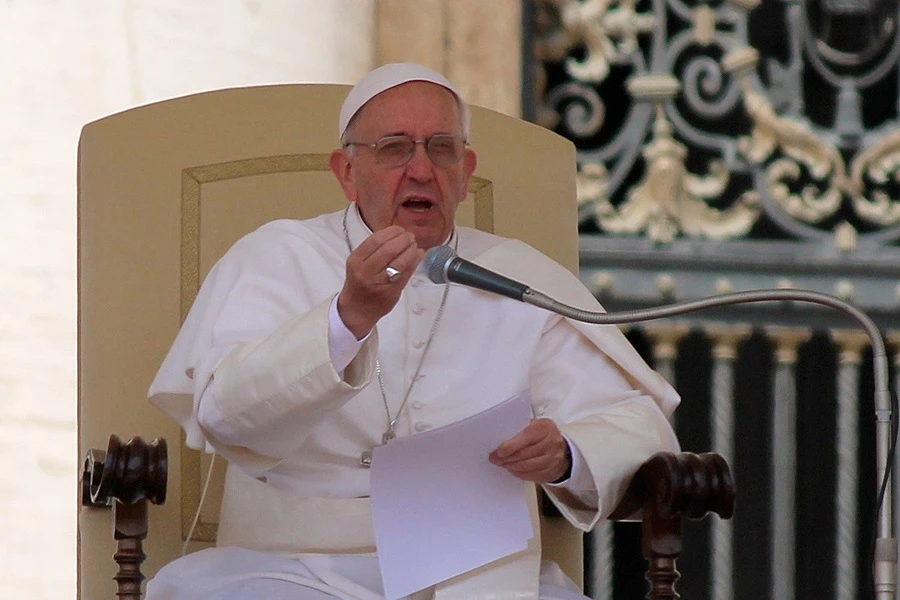
Vatican City, Sep 20, 2018 / 05:21 pm (CNA/EWTN News).- All people have a responsibility to fight new forms of racism in the modern world, Pope Francis told more than 200 participants at a Rome-based conference this week.
“We are living in times in which feelings that many thought had passed are taking new life and spreading,” the pope said Sept. 20.
The international conference on “Xenophobia, Racism and Populist Nationalism in the Context of Global Migration” concluded Thursday. It had been promoted by the Vatican’s Dicastery for Integral Human Development, the World Council of Churches and the Pontifical Council for the Promotion of Christian Unity.
Addressing those present, Pope Francis warned that the modern world appears to be seeing an increase in “feelings of suspicion, fear, contempt and even hatred towards individuals or groups judged for their ethnic, national or religious identity.”
These individuals are “considered not sufficiently worthy of being fully part of society’s life,” and such sentiments “all too often inspire real acts of intolerance, discrimination or exclusion,” he said.
Exclusion of foreigners can also become enshrined in political policy, as some lawmakers exploit fears and misgivings for political gain, he said.
Faced with these social changes, “we are all called, in our respective roles, to cultivate and promote respect for the intrinsic dignity of every human person,” the pope said.
He emphasized the role of religious leaders, educators, and media in this endeavor to promote a culture that respects human life and dignity.
Rev. Olav Fykse Tveit, secretary general of the World Council of Churches, told Vatican News that the conference was intended to show a strong ecumenical commitment to addressing the global issues of racism and xenophobia, to hear from voices across the globe about the issue, and to create common text that can be used as the basis of further efforts.
He stressed the importance of supporting politicians who are standing up for the human rights of migrants, and emphasized the role of religious leaders in upholding human dignity in public discussions surrounding migration.
“There is no easy political answer to all of this: it is a very complex political situation, but we believe that the churches, with our values but also with our networks, our communities, as human beings and as people of faith, can contribute a lot,” he said.
If you value the news and views Catholic World Report provides, please consider donating to support our efforts. Your contribution will help us continue to make CWR available to all readers worldwide for free, without a subscription. Thank you for your generosity!
Click here for more information on donating to CWR. Click here to sign up for our newsletter.
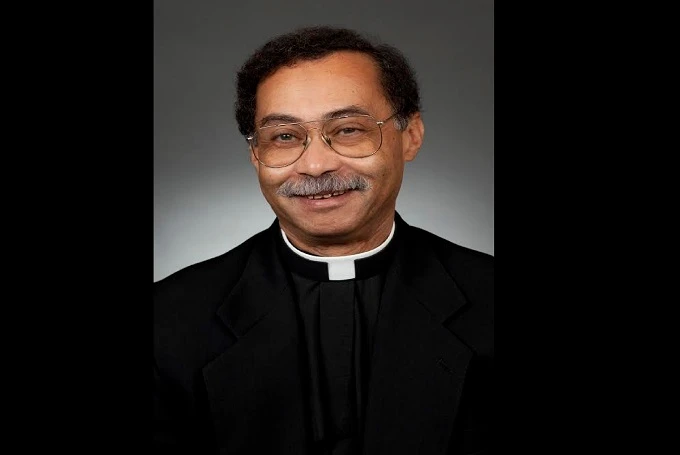
Vatican City, Mar 8, 2017 / 06:13 am (CNA/EWTN News).- On Wednesday the Vatican announced Pope Francis’ appointment of Fr. Roy Edward Campbell, Jr., a former vice-president for Bank of America, as an auxiliary bishop for the Archdiocese of Washington.
“All of us in the Archdiocese are deeply grateful that our Holy Father, Pope Francis, has named Father Roy Campbell to be an auxiliary bishop in our Church of Washington,” Cardinal Donald Wuerl, Archbishop of Washington, said in a statement March 8.
Father Campbell, who was born, raised and who has worked and served in the archdiocese, “brings to his new ministry recognized talent and demonstrated ability. He also bears witness to the great cultural and ethnic richness of the Church of Washington reflected in all of the faithful, lay, religious and clergy.”
“Personally I look forward to continuing to work closely with our new auxiliary bishop, who over the years has made significant contributions to the pastoral life of this archdiocese,” he said.
Fr. Campbell, 69, had a 33-year long career with Bank of America, beginning as a teller and working his way up to vice president and “Project Manager” before taking an early retirement in 2002 to follow a priestly vocation.
Born on Nov. 19, 1947, in southern Maryland, the Campbell was raised in D.C. and was interested in the priesthood as a child, but never committed to entering the seminary.
After high school he attended and graduated from Howard University in 1969 and later received a master’s degree in banking from the University of Virginia, working in the retail banking industry in the Washington-Baltimore area until taking an early retirement in 2002.
He was an active Catholic both in parishes and the broader Washington-area community, serving as a lector and usher and as a member on the Pastoral and Finance Councils at the Shrine of the Sacred Heart.
An encounter with a homeless man in December 1995, prompted him to reflect on his relationship with Jesus, and as a result he entered the archdiocese’s permanent diaconate program in 1999. He entered the seminary in January 2002, and was ordained a priest May 26, 2007.
Since his ordination, bishop-elect Campbell has been parochial vicar and pastor at several parishes. He said in a video interview for the Archdiocese of Washington that “the Lord himself has bestowed upon me through the Holy Father,” a great honor by the appointment.
“The only thing I was looking forward to doing in answering our Lord’s call is to be a priest for his people. To love and serve those who he’s called me to,” he continued.
“And if he’s calling me to serve on a larger scale than a parish, as a bishop, then I know I will have his grace, his direction, and his love to help me do so. So, outside of that, what it will entail, I will find out.”
Vatican City, Apr 26, 2022 / 09:35 am (CNA).
Pope Francis issued an apostolic letter on Tuesday bringing Church law up to date on the rules for dismissal from religious institutes, in light of t… […]
Pope Francis greets pilgrims at his general audience in St. Peter’s Square on Wednesday, Sept. 18, 2024. / Credit: Daniel Ibáñez/CNA
Vatican City, Sep 18, 2024 / 08:54 am (CNA).
Pope Francis on Wednesday said the Catholic Church is “more alive” outside of Europe as he reflected back on his recent apostolic journey to Southeast Asia.
“A first reflection that comes spontaneously after this trip is that in thinking about the Church we are still too Eurocentric, or, as they say, ‘Western,’” the pope said in St. Peter’s Square on Sept. 18.
“But in reality, the Church is much bigger, much bigger than Rome and Europe … and may I say much more alive in these countries,” he added.
Pope Francis greets pilgrims at his general audience in St. Peter’s Square on Wednesday, Sept. 18, 2024. Credit: Daniel Ibáñez/CNA
In his first general audience since returning from the longest international trip of his pontificate, the pope expressed gratitude to God for his experiences in Indonesia, Papua New Guinea, East Timor, and Singapore Sept. 2–13.
“I thank the Lord who allowed me to do as an elderly pope what I would have liked to do as a young Jesuit,” Francis said.
The pope, who turns 88 in December, expressed his enthusiasm for the “missionary, outgoing Church” he encountered on his visit to the four island nations in Asia and Oceania.
The pope recalled his visit to the grounds of the Istiqlal Mosque, the largest mosque in Southeast Asia, where he signed a joint declaration with Grand Imam Nasaruddin Umar condemning religious-based violence and promoting religious harmony.
“There, I saw that fraternity is the future, it is the answer to anti-civilization, to the diabolical plots of hatred, war, and also sectarianism,” he said.
Pope Francis arrives at his general audience in St. Peter’s Square on Wednesday, Sept. 18, 2024. Credit: Daniel Ibáñez/CNA
Pope Francis commented that the missionaries and catechists were the “protagonists” of his visit to Papua New Guinea, where the pope was welcomed by the beating drums of some of the country’s Indigenous tribes who have accepted the Catholic faith.
“I rejoiced to be able to stay a while with the missionaries and catechists of today; and I was moved to listen to the young people’s songs and music: In them, I saw a new future, without tribal violence, without dependency, without economic or ideological colonialism; a future of fraternity and care for the wondrous natural environment,” Francis said.
The pope added that he has “a beautiful memory” from traveling to the remote coastal town of Vanimo, a jungle outpost where he said Argentine missionaries “go into the jungle in search of the most hidden tribes.”
Pope Francis said that he experienced the “air of springtime” in East Timor, a small Catholic country that gained its independence from Indonesia in 2002.
He praised the Catholic country for its many large families and many religious vocations.
“I will never forget the smiles of the children,” he said. “In East Timor, I saw the youthfulness of the Church: families, children, young people, many seminarians and aspirants to consecrated life.”
Frequently throughout his trip, Pope Francis commended the high birth rates found not only in East Timor but also in Indonesia, saying that such high fertility rates should be an example for other countries around the world.
On his return flight to Rome, the pope praised East Timor’s “culture of life,” adding that wealthier countries, including Singapore, could learn from the small country that “children are the future.”
Looking back on his final stop in Singapore, the pope remarked that the modern city-state was very different from other countries he visited during his apostolic journey.
“Even in wealthy Singapore there are the ‘little ones,’ who follow the Gospel and become salt and light, witnesses to a hope greater than what economic gains can guarantee,” he added.
Pope Francis reflected on his journey to the four tropical islands on a cloudy fall morning in Rome. The pope was quite animated as he spoke about his travels, frequently making extra comments off the cuff to the crowd.
He underlined to the crowd that an “apostolic journey” is much different than tourism because “it is a journey to bring the Word of God, to make the Lord known, and also to know the soul of the people.”
At the end of the audience, the pope offered a prayer for the victims of the recent severe flooding in Europe and encouraged the local Catholic communities who are working to provide relief to the flooding caused by Storm Boris.
“In these days, heavy torrential rains have hit Central and Eastern Europe causing victims, missing persons, and extensive damage in Austria, Romania, Czech Republic, and Poland, who have to cope with tragic inconveniences caused by the floods. I assure everyone of my closeness, praying for those who have lost their lives and their families,” he said.
Pope Francis commented that there were many newly married couples who came to the general audience to receive his blessing for their marriages, with the Holy Father giving a shoutout to two Vatican employees who will be married in Vatican City this weekend.
The pope asked the Virgin Mary’s intercession for the newlyweds to have the grace “to accept work and daily crosses as opportunities for growth and purification of your love.”
Francis also prayed for the sick, elderly, and disabled present at the general audience.
“May Our Lady of Sorrows, whom we recalled a few days ago in the liturgy, help you, dear sick and elderly people, to grasp in suffering and difficulties the call to make of your existence a mission for the salvation of your brothers and sisters,” he said.





Human beings are made in the image and likeness of the divine – declare Holy Scriptures.