Vatican City, Sep 13, 2018 / 10:10 am (CNA/EWTN News).- Cardinal Daniel DiNardo has called a Sept. 13 meeting between Pope Francis and leaders from the Church in United States “lengthy and fruitful.”
The cardinal, who is Archbishop of Galveston-Houston and president of the U.S. bishops’ conference, travelled to Rome together with Archbishop José Gomez of Los Angeles, the vice-president of the United States Conference of Catholic Bishops, and USCCB General Secretary Msgr. Brian Bransfield.
Also present at the meeting was Cardinal Séan O’Malley of Boston, who serves as president of the Pontifical Commission for the Protection of Minors and is a member of the C9 Council of Cardinals charged with advising the pope on the governance of the universal Church.
DiNardo requested the meeting with Francis to discuss the ongoing sexual abuse scandals which have rocked the Church in America, in particular the case of Archbishop Theodore McCarrick. Cardinal DiNardo had previously pledged to investigate the case of Archbishop McCarrick to “the full extent of the USCCB’s authority.”
Following a private audience with Pope Francis this morning, DiNardo released a brief statement through the U.S. bishops’ conference.
“We are grateful to the Holy Father for receiving us in audience. We shared with Pope Francis our situation in the United States – how the Body of Christ is lacerated by the evil of sexual abuse. He listened very deeply from the heart. It was a lengthy, fruitful, and good exchange.”
The meeting follows a series of calls by commentators for the Pope Francis to release files held on Archbishop McCarrick in Rome and at the apostolic nunciature in Washington, D.C.
While the statement did not specify if McCarrick’s case or Vatican files related to it were discussed during the meeting, DiNardo has previously called for greater transparency by Church authorities on matters of sexual abuse, and especially that case of Archbishop McCarrick.
DiNardo’s statement said he, together with Cardinal O’Malley, Archbishop Gomez, and Msgr. Bransfield, looked forward to continuing to work together with Pope Francis on resolving the crisis facing the Church in the United States.
“As we departed the audience, we prayed the Angelus together for God’s mercy and strength as we work to heal the wounds. We look forward to actively continuing our discernment together identifying the most effective next steps.”
Earlier this week, Pope Francis announced a special meeting with all the presidents of the world’s bishops’ conferences to discuss sexual abuse in the Church. That meeting is expected to be held in February of next year.
If you value the news and views Catholic World Report provides, please consider donating to support our efforts. Your contribution will help us continue to make CWR available to all readers worldwide for free, without a subscription. Thank you for your generosity!
Click here for more information on donating to CWR. Click here to sign up for our newsletter.
Vatican City, Jun 24, 2022 / 12:54 pm (CNA).
The Pontifical Academy of Life said Friday that the U.S. Supreme Court’s decision to overturn Roe v. Wade “challenges the whole world.”“The court’s opinion shows how the issue o… […]
Bishops process into St. Peter’s Basilica for the closing Mass of the first assembly of the Synod on Synodality on Oct. 29, 2023. / Vatican Media
Rome Newsroom, Jul 9, 2024 / 06:00 am (CNA).
The guiding document for the final part of the Synod on Synodality, published Tuesday, focuses on how to implement certain of the synod’s aims, while laying aside some of the more controversial topics from last year’s gathering, like women’s admission to the diaconate.
“Without tangible changes, the vision of a synodal Church will not be credible,” the Instrumentum Laboris, or “working tool,” says.
The six sections of the roughly 30-page document will be the subject of prayer, conversation, and discernment by participants in the second session of the 16th Ordinary General Assembly of the Synod of Bishops, to be held throughout the month of October in Rome.
Instead of focusing on questions and “convergences,” as in last year’s Instrumentum Laboris, “it is now necessary that … a consensus can be reached,” said a FAQ page from synod organizers, also released July 9, answering a question about why the structure was different from last year’s Instrumentum Laboris.
The guiding document for the first session of the Synod on Synodality in 2023 covered such hot-button topics as women deacons, priestly celibacy, and LGBTQ outreach.
By contrast, this year’s text mostly avoids these subjects, while offering concrete proposals for instituting a listening and accompaniment ministry, greater lay involvement in parish economics and finances, and more powerful parish councils.
“It is difficult to imagine a more effective way to promote a synodal Church than the participation of all in decision-making and taking processes,” it states.
The working tool also refers to the 10 study groups formed late last year to tackle different themes deemed “matters of great relevance” by the Synod’s first session in October 2023. These groups will continue to meet through June 2025 but will provide an update on their progress at the second session in October.
The possibility of the admission of women to the diaconate will not be a topic during the upcoming assembly, the Instrumentum Laboris said.
The new document was presented at a July 9 press conference by Cardinals Mario Grech and Jean-Claude Hollerich, together with the special secretaries of the synodal assembly: Jesuit Father Giacomo Costa and Father Riccardo Battocchio.
“The Synod is already changing our way of being and living the Church regardless of the October assembly,” Hollerich said, pointing to testimonies shared in the most recent reports sent by bishops’ conferences.
The Oct. 2-27 gathering of the Synod on Synodality will mark the end of the discernment phase of the Church’s synodal process, which Pope Francis opened in 2021.
Participants in the fall meeting, including Catholic bishops, priests, religious, and laypeople from around the world, will use the Instrumentum Laboris as a guide for their “conversations in the Spirit,” the method of discussion introduced at the 2023 assembly. They will also prepare and vote on the Synod on Synodality’s advisory final document, which will then be given to the pope, who decides the Church’s next steps and if he wishes to adopt the text as a papal document or to write his own.
The third phase of the synod — after “the consultation of the people of God” and “the discernment of the pastors” — will be “implementation,” according to organizers.
Prominent topics
The 2024 Instrumentum Laboris also addresses the need for transparency to restore the Church’s credibility in the face of sexual abuse of adults and minors and financial scandals.
“If the synodal Church wants to be welcoming,” the document reads, “then accountability and transparency must be at the core of its action at all levels, not only at the level of authority.”
It recommends effective lay involvement in pastoral and economic planning, the publication of annual financial statements certified by external auditors, annual summaries of safeguarding initiatives, the promotion of women to positions of authority, and periodic performance evaluations on those exercising a ministry or holding a position in the Church.
“These are points of great importance and urgency for the credibility of the synodal process and its implementation,” the document says.
The greater participation of women in all levels of the Church, a reform of the education of priests, and greater formation for all Catholics are also included in the text.
Bishops’ conferences, it says, noticed an untapped potential for women’s participation in many areas of Church life. “They also call for further exploration of ministerial and pastoral modalities that better express the charisms and gifts the Spirit pours out on women in response to the pastoral needs of our time,” the document states.
Formation in listening is identified as “an essential initial requirement” for Catholics, as well as how to engage in the practice of “conversation in the Spirit,” which was employed in the first session of the Synod on Synodality.
Pope Francis and delegates at the Synod on Synodality at the conclusion of the assembly on Oct. 28, 2023. Credit: Vatican Media
The document says the need for formation has been one of the most universal and strong themes throughout the synodal process. Interreligious dialogue also is identified as an important aspect of the synodal journey.
On the topic of the liturgy, the Instrumentum Laboris says there was “a call for adequately trained lay men and women to contribute to preaching the Word of God, including during the celebration of the Eucharist.”
“It is necessary that the pastoral proposals and liturgical practices preserve and make ever more evident the link between the journey of Christian initiation and the synodal and missionary life of the Church,” the document says. “The appropriate pastoral and liturgical arrangements must be developed in the plurality of situations and cultures in which the local Churches are immersed …”
How it was drafted
Dubbed the “Instrumentum Laboris 2,” the document released Tuesday has been in preparation since early June when approximately 20 experts in theology, ecclesiology, and canon law held a closed-door meeting to analyze around 200 synod reports from bishops’ conferences and religious communities responding to what the Instrumentum Laboris called “the guiding question” of the next stage of the Synod on Synodality: “How to be a synodal Church in mission?”
After the 10-day gathering, “an initial version” of the text was drafted based on those reports and sent to around 70 people — priests, religious, and laypeople — “from all over the world, of various ecclesial sensitivities and from different theological ‘schools,’” for consultation, according to the synod website.
The XVI Ordinary Council of the General Secretariat of the Synod, together with consultants of the synod secretariat, finalized the document.
According to the working tool, soliciting new reports and feedback after the consultation phase ended is “consistent with the circularity characterizing the whole synodal process.”
“In preparation for the Second Session, and during its work, we continue to address this question: how can the identity of the synodal People of God in mission take concrete form in the relationships, paths and places where the everyday life of the Church takes place?” it says.
The document says “other questions that emerged during the journey are the subject of work that continues in other ways, at the level of the local Churches as well as in the ten Study Groups.”
Expectations for final session
According to the guiding document, the second session of the Synod on Synodality can “expect a further deepening of the shared understanding of synodality, a better focus on the practices of a synodal Church, and the proposal of some changes in canon law (there may be yet more significant and profound developments as the basic proposal is further assimilated and lived.)”
“Nonetheless,” it continues, “we cannot expect the answer to every question. In addition, other proposals will emerge along the way, on the path of conversion and reform that the Second Session will invite the whole Church to undertake.”
The Instrumentum Laboris says, “Synodality is not an end in itself … If the Second Session is to focus on certain aspects of synodal life, it does so with a view to greater effectiveness in mission.”
In its brief conclusion, the text states: “The questions that the Instrumentum Laboris asks are: how to be a synodal Church in mission; how to engage in deep listening and dialogue; how to be co-responsible in the light of the dynamism of our personal and communal baptismal vocation; how to transform structures and processes so that all may participate and share the charisms that the Spirit pours out on each for the common good; how to exercise power and authority as service. Each of these questions is a service to the Church and, through its action, to the possibility of healing the deepest wounds of our time.”
Catherine Miles-Flynn, who has served as director of Christian formation for the Apostolic Vicariate of Southern Arabia for twenty years, spoke at an EWTN news conference on Sept. 26, 2025. / Credit: Daniel Ibanez/EWTN
They’re laughing because they know the “faithful Catholics” they hold in such low regard (the “Pharisees” and “the dumb” people) won’t stop attending Mass on Sundays and Holy Days of Obligation or supporting the parishes even if these same “faithful Catholics” in protest have stopped giving to Diocesan appeals (for awhile).
One line really got them guffawing: “The people are upset because McCarrick rose through the ranks despite his behavior… when really he rose through the ranks BECAUSE of his behavior!”


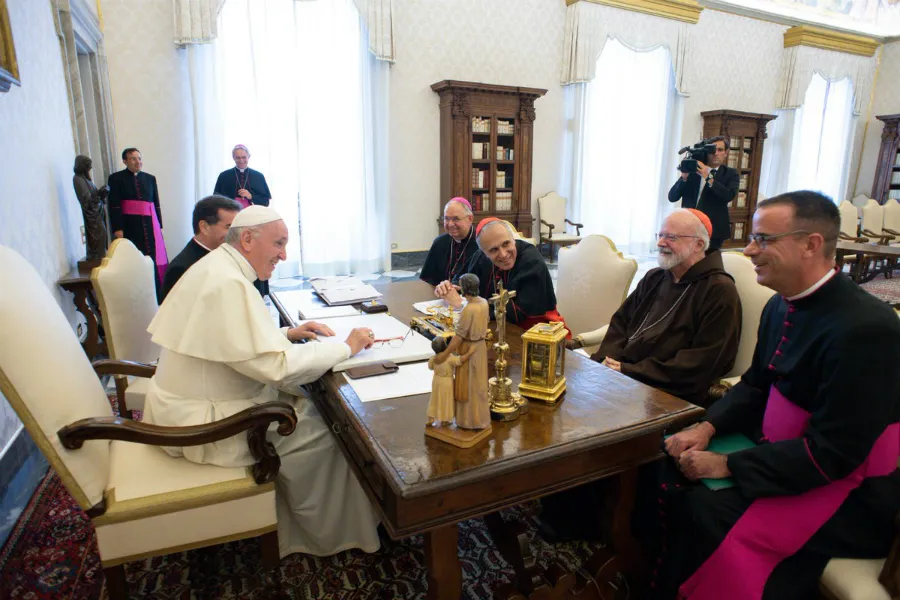



I apologize in advance but having this press picture of these men all smiling and laughing makes them look like a bunch of jack*sses.
These men should be in sackclothe and ashes for the sins of the Church and the sins they have covered and allowed.
God free us from these evil and complicit shepherds.
It appears from the photo that the meeting was a good old boys knee slapping yukfest.
Tone deaf nitwits.
They were talking about Cardinal Burke, Cardinal Sarah and Archbishop Viganò at the time of the photo.
Bet on it.
They’re laughing because they know the “faithful Catholics” they hold in such low regard (the “Pharisees” and “the dumb” people) won’t stop attending Mass on Sundays and Holy Days of Obligation or supporting the parishes even if these same “faithful Catholics” in protest have stopped giving to Diocesan appeals (for awhile).
One line really got them guffawing: “The people are upset because McCarrick rose through the ranks despite his behavior… when really he rose through the ranks BECAUSE of his behavior!”
It works better in Italian.